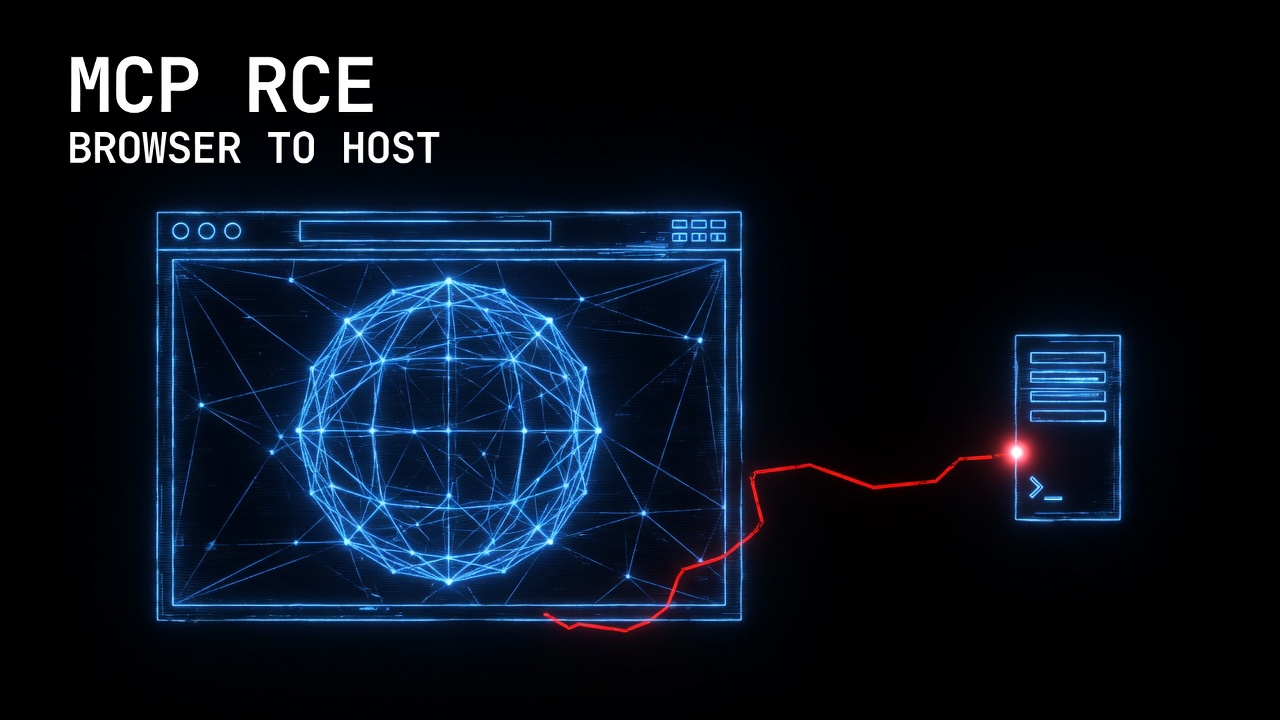
MCP remote code execution stopped being a theoretical risk the moment Microsoft security researchers proved it works through nothing more exotic than a web page.
The research, dubbed AutoJack, demonstrates that a malicious web page rendered by an AI browsing agent can reach local MCP services and execute arbitrary processes on the host machine. Microsoft’s own framing is direct: connecting agents to local tools and system APIs without strict isolation effectively exposes a hidden remote-code-execution surface to attackers — one that doesn’t require a phishing email, a malicious download, or any user action beyond letting an agent visit a page.
This post breaks down exactly why MCP remote code execution became possible, how it maps onto the lethal trifecta framework already covered in this series, and the isolation pattern that closes the gap.
Why MCP Remote Code Execution Is the Lethal Trifecta, Textbook Version
The Lethal Trifecta post in this series defined three capabilities that, combined in one session, enable exploitation: private data access, untrusted content exposure, and external communication. AutoJack reveals a variant worth naming explicitly — local system execution standing in for the third leg.
A browsing agent that renders arbitrary web pages already satisfies untrusted content exposure by design — that’s the entire point of a browsing agent. The moment that same session also has access to local MCP services capable of executing processes, the trifecta completes itself automatically, with no additional misconfiguration required. The attacker doesn’t need to compromise your MCP server. They just need their malicious instructions to ride in on a web page your agent was always going to render anyway.
If you built tools using the patterns in the MCP Server Python post in this series, the question MCP remote code execution forces is specific: does anything reachable by your browsing agent also expose a tool capable of executing local processes, reading the filesystem, or spawning subprocesses? If yes, AutoJack describes your exact exposure.
Closing the MCP Remote Code Execution Gap With Session Isolation
The fix follows directly from the trifecta guardrail pattern, extended with a new capability category specifically for local execution risk.
Step 1 — Add a local-execution capability flag
from enum import Flag, auto


class Capability(Flag):
    NONE = 0
    PRIVATE_DATA_ACCESS = auto()
    UNTRUSTED_CONTENT_EXPOSURE = auto()
    EXTERNAL_COMMUNICATION = auto()
    LOCAL_SYSTEM_EXECUTION = auto()   # new: process spawning, filesystem write,
                                        # or any MCP tool that shells out locally
Step 2 — Hard-isolate browsing sessions from execution tools
class BrowsingSessionIsolationError(Exception):
    """Raised when a browsing-capable session would also gain local execution access."""
    pass


class AgentSession:
    def __init__(self, session_id: str, is_browsing_session: bool = False):
        self.session_id = session_id
        self.is_browsing_session = is_browsing_session
        self.active_capabilities = Capability.NONE

    def register_tool_call(self, tool_capabilities: Capability, tool_name: str) -> None:
        # A session that renders untrusted web content can NEVER also
        # hold local execution capability -- no checkpoint, no exception.
        # AutoJack proved this combination is exploitable by design,
        # not just under misconfiguration.
        if self.is_browsing_session and (tool_capabilities & Capability.LOCAL_SYSTEM_EXECUTION):
            raise BrowsingSessionIsolationError(
                f"[BLOCKED] '{tool_name}' grants local execution to a "
                f"browsing-capable session ({self.session_id}). MCP remote "
                f"code execution risk -- route this tool through a separate, "
                f"non-browsing session instead."
            )

        self.active_capabilities |= tool_capabilities
        print(f"[ALLOWED] {tool_name} -> {self.active_capabilities}")


if __name__ == "__main__":
    browsing_session = AgentSession("browse_001", is_browsing_session=True)

    browsing_session.register_tool_call(
        Capability.UNTRUSTED_CONTENT_EXPOSURE, "render_web_page"
    )

    try:
        browsing_session.register_tool_call(
            Capability.LOCAL_SYSTEM_EXECUTION, "run_local_shell_command"
        )
    except BrowsingSessionIsolationError as e:
        print(f"\n{e}")
Run this and the shell-execution tool call blocks unconditionally — not behind a human checkpoint like the original trifecta guard, but hard-denied. A session that renders untrusted pages has no legitimate reason to also execute local processes in the same context, so there’s no checkpoint to clear here at all.
Architectural Checklist for Browsing Agents With MCP Access
- Run browsing in a separate process or container from any MCP server exposing filesystem or shell execution tools — network-level isolation, not just logical session flags, is the durable fix.
- Audit every MCP tool for implicit local execution — a tool that “just writes a config file” or “just runs a build script” still counts, and AutoJack doesn’t care how routine the tool seemed.
- Never grant a browsing-capable agent direct filesystem write access to anything outside a tightly scoped, disposable sandbox directory.
- Treat this as permanent architecture, not a patch — the underlying weakness is that browsing agents must render untrusted content by definition, so the isolation has to be structural, not a one-time fix for this specific disclosure.
For the original research summary, see this week’s AI agent security roundup covering the AutoJack findings.
The Builder’s Takeaway
MCP remote code execution is exactly the kind of risk the lethal trifecta framework predicted before AutoJack had a name. The pattern doesn’t change: capability combinations that look convenient in a demo become the exact surface an attacker needs in production. The builders separating browsing capability from execution capability at the architecture level — not just hoping no malicious page ever gets rendered — are the ones who’ll read about the next AutoJack-style disclosure instead of appearing in it.
This post is part of The Agentic Protocol’s Work series — the connective infrastructure layer beneath every autonomous pipeline. See also: MCP Server Python.
Continue in This Series
- Langflow CVE CISA Warning — the same IDOR class as AutoJack, now on CISA’s official must-patch list
- Coding Agent Supply Chain Attack — GuardFall: when the scanner itself is the bypassed defense
- Black Hat 2026 AI Agents — Trust Handoff as the unifying architectural pattern
- Lethal Trifecta — why MCP browsing sessions are the highest-exposure trifecta configuration
- AI Agent Gateway — network-layer isolation that contains the RCE surface