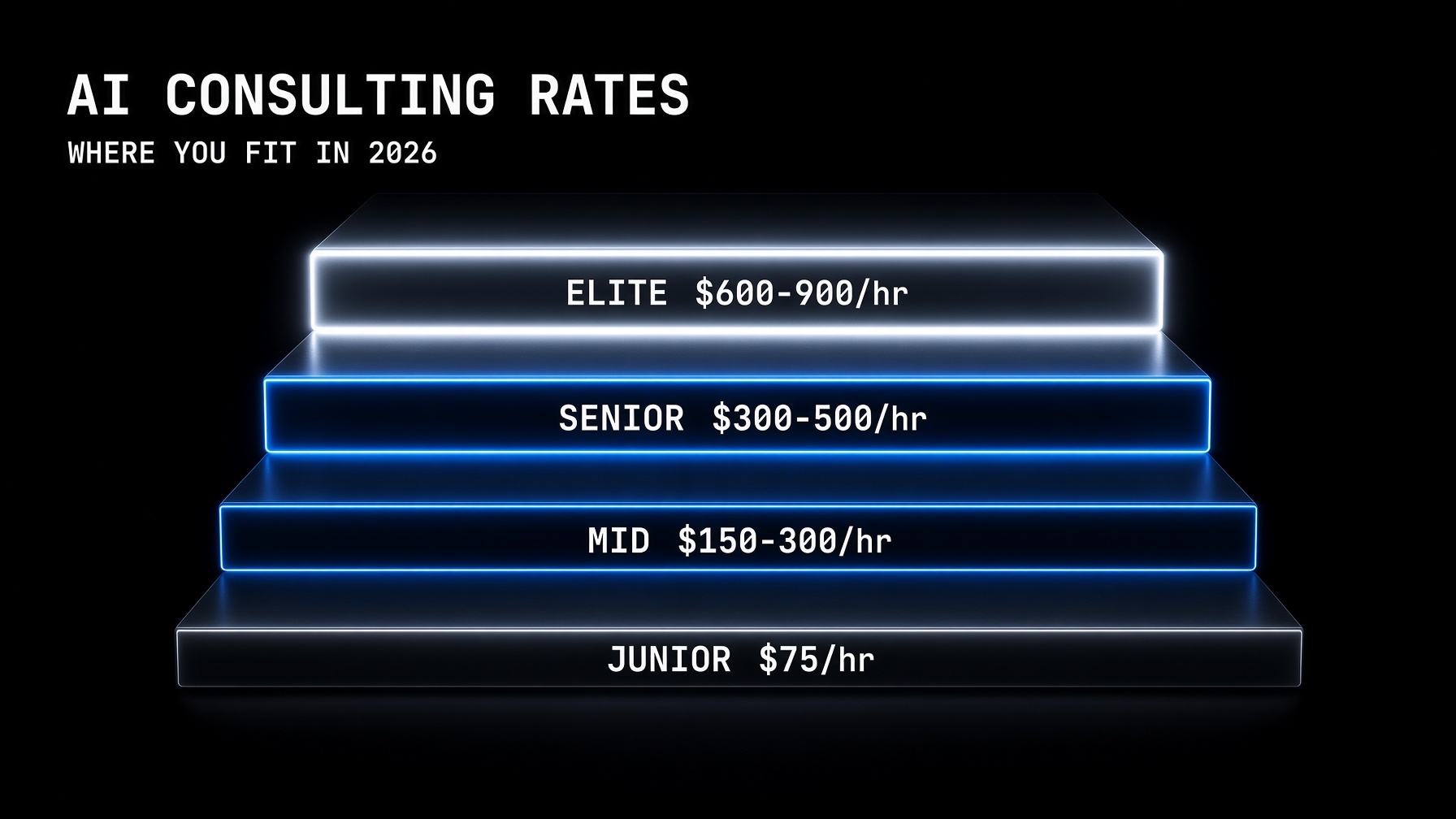
AI consulting rates in 2026 span a 12x range — from $75 per hour for entry-level practitioners to $900 per hour for elite enterprise AI engineers deployed as consultants. Most builders reading this series sit in the $150 to $300 per hour range by capability — and are often charging significantly less because they haven’t positioned their agentic AI expertise as a distinct, premium service category.
This post gives you the rate benchmarks, the positioning framework, and the specific premium factors that separate a $75/hr AI generalist from a $250/hr AI agent specialist — using the same technical foundation this series has built since June.
The 2026 AI Consulting Rate Benchmarks
Four tiers define the 2026 AI consulting market, each separated by experience depth and deliverable type:
| Tier | Experience | Hourly Rate | Monthly Retainer | Typical Deliverable |
|---|---|---|---|---|
| Junior | 0–3 years | $75–$150/hr | $2,000–$5,000 | Single-workflow automation, defined scope, low compliance |
| Mid-Level | 3–7 years | $150–$300/hr | $5,000–$12,000 | Multi-system agent pipelines, production deployment, basic compliance |
| Senior | 7+ years | $300–$500/hr | $12,000–$25,000 | Enterprise architecture, regulated industries, team leadership |
| Elite | Demonstrated results | $600–$900+/hr | $25,000–$40,000+ | On-call incident response, MLOps, AI safety, frontier deployment |
The AI agent developer category specifically sits at $80 to $250 per hour globally, with expert-tier practitioners reaching $180 to $250 per hour for enterprise work and $145 to $210 per hour for startup engagements. The senior LLM engineer rate climbed from $145 in 2023 to $210 in 2026 — a 45 percent jump in three years that reflects genuine scarcity of practitioners who can take agent systems from prototype to production reliability.
The $5,000 vs $20,000 Gap — and Why It’s Yours
The same AI workflow automation project is regularly quoted at $5,000 by a freelance builder and $20,000 by a large consultancy — for the same tools, the same implementation, and often the same quality of output. The 4x gap is firm overhead and brand, not deliverable quality. Boutique AI agencies at $150/hr often outdeliver enterprise firms at $350/hr for SMB projects. The client paying $20,000 is paying for the brand’s insurance against being held responsible for a bad hire, not for superior technical output.
This gap is the builder’s opportunity in 2026. A solo practitioner or small team with production-quality agentic AI experience — real deployments, documented results, compliance-aware architecture — can position at $150 to $250/hr and offer clients a better value proposition than either the $75/hr generalist (limited capability) or the $350/hr enterprise firm (overhead-inflated pricing). The competitive position is specific: demonstrate production experience the $75/hr practitioner doesn’t have, at a price point the enterprise firm can’t match.
The Five Premium Factors That Justify Higher AI Consulting Rates
Five specific expertise factors consistently command rate premiums above the tier baseline in 2026. Each one is buildable from this series’ content:
1. EU AI Act and Regulatory Compliance Expertise (+20–40%)
AI consultants with documented expertise in EU AI Act Article 50 implementation, Colorado AI Act audit trail architecture, and GDPR-AI Act compliance interaction command 20 to 40 percent rate premiums due to scarcity. The EU AI Act enforcement that activated August 2, 2026 created immediate demand for consultants who can implement disclosure mechanisms and audit trails for organizations that haven’t done it yet. This isn’t theoretical expertise — it’s a billable skill with urgency-driven demand and a compressing supply window.
The premium compounds with vertical: an AI consultant who can implement EU AI Act compliance for a financial services firm (where the ESMA and EBA AI Act integration also applies) justifies rates at the top of the 20 to 40 percent premium range. This is the positioning the AI Compliance Services post described — now backed by live enforcement rather than pending regulation.
2. Production Deployment Track Record (+30–50%)
Practitioners with five or more completed agent projects in production charge 30 to 50 percent more than those learning on client projects. The distinction is specific: production means the agent is running on client data, handling real tasks, under real security constraints, with an audit trail and human review path. A portfolio of production deployments — even small ones — is the credential that justifies charging above the junior tier regardless of years of experience.
The production architecture this series documents — 5-layer deployment checklist, AI Agent Gateway, credential isolation, fallback chains — is the evidence base for claiming production experience. Clients paying $150 to $250/hr are buying confidence that their agent won’t fail silently at 2 AM. The architecture documentation is the proof.
3. Vertical Domain Expertise (+20–40%)
AI agent consultants with genuine expertise in healthcare, finance, or legal command 20 to 40 percent premiums because they understand the workflow context, the compliance requirements, and the failure modes specific to that industry. A generalist AI consultant can implement an accounts payable automation workflow. A specialist who understands FINRA 4511, the specific AP process patterns in financial services, and the audit trail requirements for regulated financial records charges at the top of the range.
The agentic finance expertise this series has built — AI treasury automation, the $3.50 ROI per $1 KPMG data, the SEC 17a-4 record-keeping requirements — is exactly the vertical knowledge that commands this premium in finance. The same principle applies in any regulated vertical where AI consultants are scarce.
4. Security Architecture Experience (+15–25%)
AI red teamers charge $54 to $111 per hour on contract, and AI safety/alignment specialists have seen 45 percent salary growth since 2023. The underlying demand is the same that drove the JADEPUFFER ransomware post, the RufRoot CVSS 10.0 disclosure, and the Langflow CISA KEV listing this month: organizations deploying AI agents have realized that insecure agentic systems create catastrophic liability, and practitioners who can both build and secure agent pipelines command measurably higher rates than those who can only build.
The Lethal Trifecta framework, credential isolation patterns, and Five Eyes guidance familiarity this series covers are the specific knowledge base for positioning as a security-aware AI agent consultant — a positioning that’s increasingly rare and increasingly demanded post-August 2026.
5. Multi-Model Architecture and Cost Optimization (+10–20%)
Builders who can design and maintain fallback chains across Claude, GPT-5.6, Gemini, and open-weight models — optimizing for cost, capability, latency, and compliance simultaneously — command premiums over practitioners who build on a single provider. The Token-to-Revenue ratio framework, the per-task model routing logic, and the hybrid local/cloud architecture this series documents are the deliverables clients pay for here. Multi-model optimization at scale is measurably valuable and requires a practitioner who understands the entire provider landscape rather than a single platform’s documentation.
Hourly vs Retainer: Which Pricing Model Wins for AI Agent Work
The pricing model question — hourly versus project versus retainer — has a clear answer for recurring AI agent work: retainer almost always produces higher total income and lower client acquisition cost than hourly or project billing.
The economics are specific. A mid-level AI agent consultant billing $200/hr on hourly engagements and working 80 billable hours per month earns $16,000 gross — but those 80 hours require continuous sales activity to fill the calendar, clients who can plan their demand in one-hour increments, and no recurrence guarantee after each project ends. The same practitioner with four retainer clients at $4,000/month earns $16,000 gross with known monthly income, no hourly time tracking, and clients who self-renew because the agent systems require ongoing monitoring and iteration.
The three retainer structures that work for AI agent practitioners:
- Monitoring retainer ($300–$600/month): You built the system; now you monitor it. Monthly reports, exception handling, quarterly security reviews. Three to five hours of actual work per client per month. Maximum clients per practitioner: 15 to 20. Total capacity revenue: $4,500 to $12,000/month at full load. This is the AI compliance monitoring model — low hours, high scalability.
- Active management retainer ($1,500–$3,000/month): You run the agent system, handle incidents, implement updates, and report monthly outcomes. Eight to fifteen hours per client per month. Maximum clients: six to eight. Total capacity revenue: $9,000 to $24,000/month. This is the Micro-SaaS AI agent retainer model from this series.
- Strategic retainer ($5,000–$10,000/month): You’re an embedded AI advisor — attending strategy meetings, evaluating new use cases, reviewing vendors, and directing implementation. Fifteen to twenty-five hours per month. Maximum clients: two to three. Total capacity revenue: $10,000 to $30,000/month. This tier requires the compliance expertise, vertical domain knowledge, and production track record of the premium factors above to justify the price point.
For the complete 2026 AI consultant rate benchmarking methodology, see AyAutomate’s August 2026 AI automation consultant rate guide.
The Builder’s Takeaway
AI consulting rates in 2026 reward specificity over generality, production experience over theoretical knowledge, and compliance expertise over pure technical capability. A builder who can demonstrate production-grade agentic AI deployments with documented security architecture, EU AI Act compliance implementation, and multi-model cost optimization is not competing with $75/hr prompt engineers — they’re competing with $350/hr enterprise consultants for the same SMB client budget, at a price point ($150 to $250/hr) where the value proposition is unambiguous. The five premium factors above are each independently justified by the work this series documents. Combined, they define a positioning that the 2026 AI consulting market will pay $200 to $300 per hour for — if you can make the case clearly in the first ten minutes of a discovery call.
Continue in This Series
- Micro-SaaS AI Agent — the active management retainer model: $1,500–$3,000/month per client with the full unit economics breakdown
- AI Compliance Services — the monitoring retainer opportunity: EU Act enforcement makes this the lowest-friction client acquisition window in 2026
- AI Agent Passive Income — how consulting retainers fit into the five-stream passive income architecture
- AI Finance Governance — the three-tier governance service with pricing ranges that overlap the strategic retainer model
- How to Deploy AI Agents — the production deployment documentation that justifies the 30–50% production track record premium
This post is part of The Agentic Protocol’s Wealth series — the autonomous capital layer beneath every agent pipeline. See also: Micro-SaaS AI Agent.