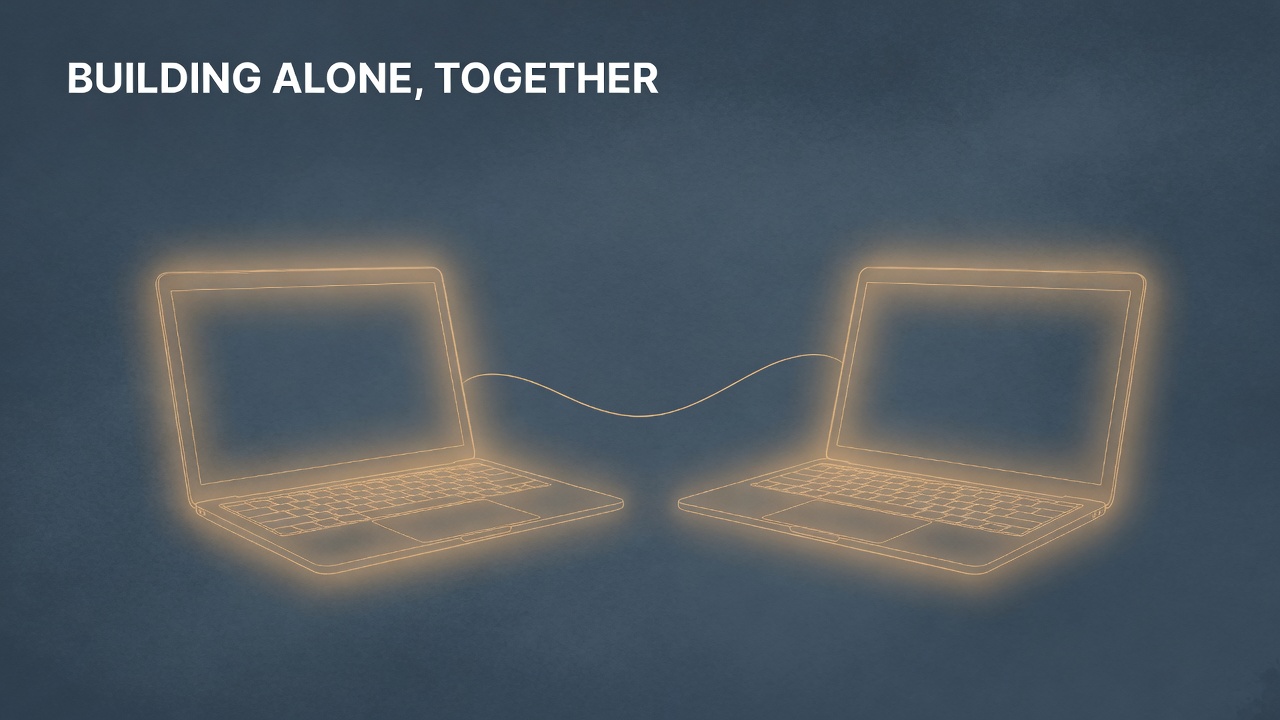
Solo founder isolation isn’t just an occupational complaint — it’s now a documented, measurable pattern in large-scale research, and most builders running a one-person agentic stack are squarely inside the population it describes.
A study published in Science, drawing on five nationally representative surveys covering 588,322 American workers from 2011 to 2024, found that after the pandemic, people in remote-capable jobs spent more time working alone and avoided social activities with friends — a pattern most pronounced among those who lived alone, where reported mental distress and use of mental healthcare increased measurably. A separate nationally representative study of 87,317 employed adults found that working remotely five or more days a week was associated with meaningfully higher odds of loneliness compared to fully in-person work.
This post looks at why solo founder isolation shows up so consistently in the data, and at one specific, well-evidenced practice — body doubling — that directly counters it without requiring you to change how you work.
Why Solo Founder Isolation Is Built Into the Job Itself
Running a single-person agentic operation removes most of the informal social contact that used to be built into a workday by default — a coworker passing your desk, a lunch conversation, a hallway check-in. None of that requires effort when it’s structural. All of it disappears the moment the structure does.
If you’re running the kind of review-heavy workflows covered in the Context Switching Cost post — batched windows reviewing agent output, long stretches of independent architectural work — the daily structure is genuinely solitary by design. That’s not a flaw in how you’ve set things up. It’s the actual shape of solo building, and the research above suggests it carries a real cost worth taking seriously rather than pushing through silently.
Body Doubling: The Practice With the Most Direct Evidence Behind It
Body doubling is simple: you work alongside another person — often a stranger — over video, in silence, each on your own task. No collaboration, no small talk during the session. Just shared presence while you each do your own work.
The mechanism behind why it works isn’t mysterious. Having another person visibly present, even virtually, measurably increases focus and reduces the felt sense of isolation, independent of whether you ever speak to them. Several services have built specifically around this:
- Focusmate — structured 50-minute sessions with a stranger: state your goal, work silently, share progress at the end.
- Flow Club — virtual coworking with ambient music and a hosted, community feel, more structured than a plain video call.
- Discord coworking servers — free, informal voice or video channels where people work together without an agenda.
For solo builders, this slots naturally into the batched review windows already covered in the Attention Residue post — a body-doubling session during a fixed review block adds genuine human presence to time that’s already structured and predictable, without disrupting the workflow you’ve built.
A Few Other Structural Habits Worth Building In
- A standing weekly call with the same one or two people — recurring and low-friction beats sporadic networking. Consistency is what makes it count as real social contact rather than another obligation.
- Leaving the house for at least one task per day that isn’t strictly necessary online — a coffee, a walk, an errand — reintroduces the incidental human contact that solo, fully remote work otherwise removes entirely.
- A non-work Slack or Discord channel with even a small group of peers, used for genuinely casual conversation rather than work coordination.
None of these require restructuring your business. They require treating social contact as infrastructure worth scheduling deliberately — the same discipline already applied to focus blocks and review windows elsewhere in this series, just pointed at a different kind of resource.
A Closing Note
If reading the research above lands heavier than expected, that’s worth paying attention to rather than minimizing. Building something on your own is genuinely demanding, and feeling its weight isn’t a sign you’re doing it wrong. Talking to a friend, a peer, or a professional about it is a reasonable and often underused step — not a last resort.
For the full study, see the Science journal research on remote work and isolation.
This post is part of The Agentic Protocol’s Wellness series — the human layer beneath every system you build alone. See also: AI Brain Fry.