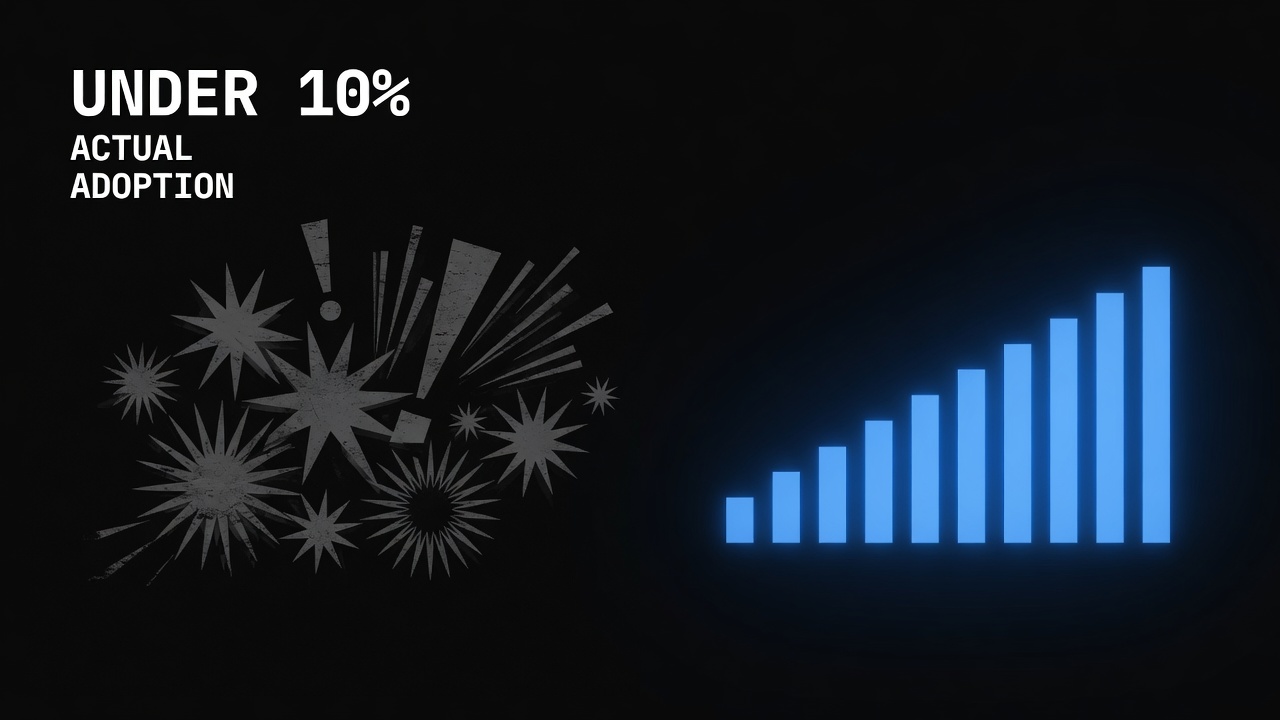
The AI treasury adoption gap is the uncomfortable number sitting underneath every vendor pitch about autonomous finance: a Crisil/Greenwich study published in February 2026 found that under 10% of surveyed companies actually use AI in core treasury operations today.
That’s a striking gap against the volume of agentic treasury content — including several posts in this series — describing forecast accuracy gains, governed autonomy frameworks, and automated cash sweeps. None of that data is wrong. It’s just describing what the leading 10% are doing, not what’s actually happening across the broader market. This post breaks down why the AI treasury adoption gap exists, and why the architecture already covered in this series sits on the right side of it.
Why the AI Treasury Adoption Gap Is So Wide
Treasury leaders aren’t hesitant because the technology doesn’t work. They’re hesitant because many have already lived through transformation projects that dragged on for years, blew through budget, and never delivered the promised return. That history creates a specific, rational fear: another 18-month system overhaul that derails the team without a guaranteed payoff.
There’s a measurement problem compounding the AI treasury adoption gap too. IBM’s ROI framework distinguishes hard ROI — direct cost and profit impact — from soft ROI, covering risk reduction, regulatory cost avoidance, and decision quality. Finance leaders who measure only labor savings systematically underestimate the real return, because fraud prevention and compliance risk reduction rarely show up on a standard cost-saving spreadsheet even though they’re often the largest actual driver of value.
There’s also a sustainability problem most budgets don’t plan for: a deployment that performs well in year one degrades in years two and three without ongoing monitoring and retraining, which quietly erodes confidence in the entire program — even when the original architecture was sound. For the full study context, see Houseblend’s 2026 report on AI agents in treasury.
What the Leading 10% Are Doing Differently
The companies on the right side of the AI treasury adoption gap share a consistent pattern: governance-first architecture with deterministic controls, not a chatbot wrapper bolted onto existing workflows. Agentic 13-week cash forecasts powered by live bank data and deterministic controls reach 88 to 92% accuracy in observed 2026 production environments — versus 65 to 75% for manual forecasts in complex multi-entity environments.
That accuracy gap is exactly the foundation the Automated Cash Sweep post in this series was built on — governed autonomy, hard guardrails, full audit logging. The same companies succeeding here are also the ones treating the human checkpoint as load-bearing infrastructure, not a formality, which is precisely the gap the Deepfake Wire Fraud post addresses directly — out-of-band verification instead of trusting a convincing voice or video alone.
Closing the AI Treasury Adoption Gap Without Becoming a Cancellation Statistic
This is the treasury-specific instance of the broader pattern covered in the AI Agent Project Failure post earlier today: most agentic AI projects don’t fail because the model was incapable. They fail because the architecture around it skipped governance, cost visibility, or a real approval checkpoint.
Applied specifically to treasury, that means:
- Measure both hard and soft ROI from day one — fraud prevention and compliance risk reduction belong in the business case, not just labor savings.
- Budget for years two and three, not just deployment — ongoing monitoring and retraining is what keeps accuracy from drifting back toward manual-forecast territory.
- Build the audit trail and reversal window before scaling — the deterministic controls in the Automated Treasury Code post are what separates a governed pilot from an ungoverned one.
- Treat human verification as infrastructure, not a courtesy step — the same discipline that closes the gap on fraud also closes the trust gap with a hesitant CFO evaluating the program.
The AI treasury adoption gap will close over the next few years regardless — Gartner’s broader enterprise forecasts make that clear. The open question for any individual team is whether they close it by building governed, deterministic infrastructure now, or by becoming one more transformation project that dragged on, went over budget, and got quietly shelved.
This post is part of The Agentic Protocol’s Wealth series — the autonomous capital layer beneath every agent pipeline. See also: Automated Treasury Code.