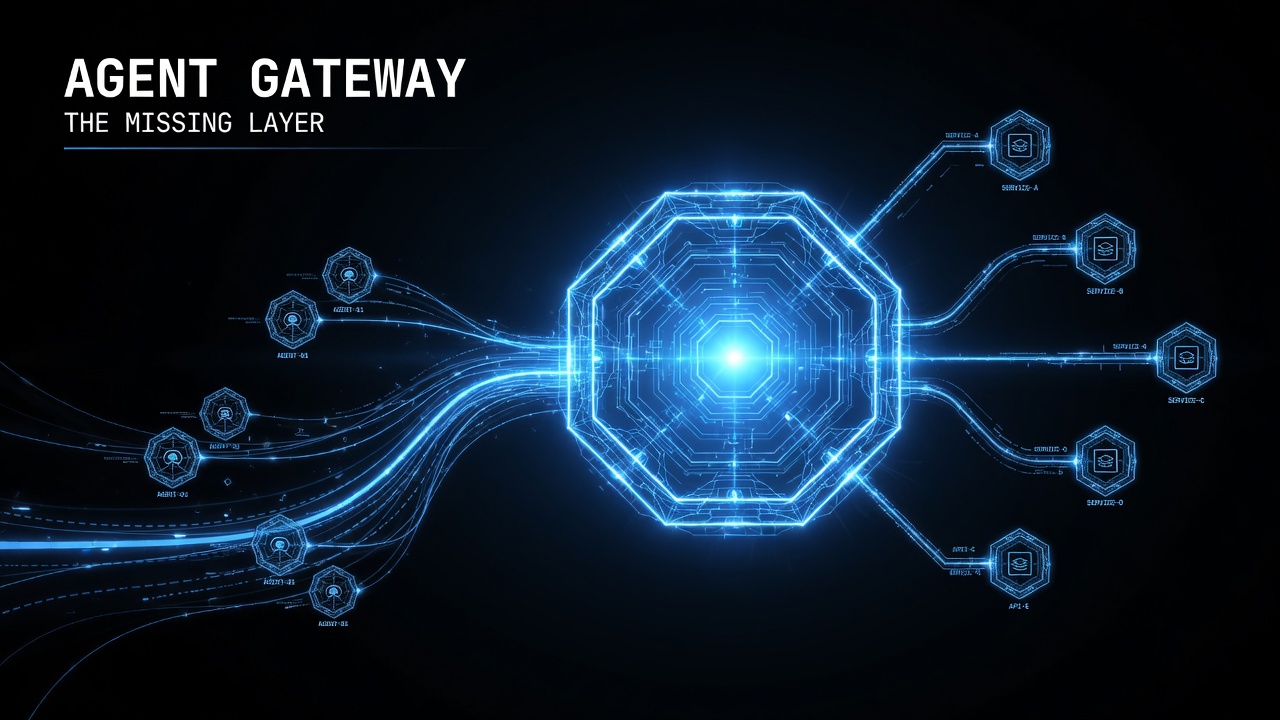
The AI agent gateway just became an official infrastructure category — and if you’ve been following this series since June, you already understand why every problem it solves has been building toward exactly this layer.
On July 5, 2026, Palo Alto Networks acquired Portkey, the AI gateway platform that handles authentication, rate limiting, cost tracking, and fallback routing for agent-to-model calls. The same week, Solo.io donated its agentgateway project to the Linux Foundation, establishing an open-source alternative with enterprise adoption already underway. Nutanix has positioned their own “agent gateway” as the primary new infrastructure category in their 2026 enterprise AI stack. The convergence of three separate organizations naming the same category in the same week is the signal that this layer is graduating from optional component to expected infrastructure.
This post breaks down what an AI agent gateway actually does, why every problem this series has addressed is a problem it solves, and the minimum viable implementation that gives you gateway-level control before the category becomes an enterprise procurement requirement.
What the AI Agent Gateway Category Actually Solves
An AI agent gateway sits between your agents and every downstream service they call — model APIs, tool endpoints, external data sources, payment rails, databases. Think of it as an API gateway, but built around the specific requirements of autonomous agent traffic rather than human-initiated REST calls.
The problems it addresses are exactly the ones documented across this series:
- Authentication and credential scoping. The JADEPUFFER credential isolation post showed that agents with environment-level credential access become harvest targets. An AI agent gateway enforces credential scoping at the network layer — each agent session receives only the API keys its task requires, with the gateway holding the full credential registry and issuing scoped tokens per session.
- Trust level enforcement at the call boundary. The Trust Handoff post showed that pipeline stages need explicit trust levels at every boundary. A gateway inspects every incoming agent call and enforces minimum trust requirements before routing — the same TrustLevel pattern from that post, now enforced at the infrastructure layer rather than the application code layer.
- Cost tracking per agent session. The AI Agent Unit Economics post introduced the Token-to-Revenue ratio. An AI agent gateway tracks token consumption per session, per agent, and per task in real time — the data that makes the T/R ratio calculable without custom instrumentation code on every pipeline.
- Model fallback routing. The Model Fallback Routing post built a Python fallback chain. An AI agent gateway handles this at the infrastructure layer — if the primary model returns a rate limit or error, the gateway retries the next model in the chain without touching application code.
- Audit trail generation for compliance. The Colorado AI Act and EU AI Act compliance posts require immutable audit records before every consequential action. A gateway generates this log automatically for every call that passes through it — no per-pipeline instrumentation required.
- Cloudflare-style access control for inbound agent requests. The Cloudflare AI Agent Block post covered how the web is building access control for agent traffic. The AI agent gateway is the equivalent layer for your own services — controlling which agents are authorized to call which endpoints, under what conditions.
Portkey vs. Agentgateway: What Each Covers
The two leading options in the AI agent gateway category address slightly different layers of the same problem:
Portkey (now Palo Alto Networks) focuses on the model API layer: intelligent routing, fallback chains, load balancing across providers, semantic caching to reduce redundant model calls, and cost visibility dashboards. It’s the layer between your agents and the model endpoints — everything from the Model Fallback Routing and Claude API Outage posts, wrapped in managed infrastructure. Palo Alto’s acquisition adds their existing network security layer, which means Portkey will likely gain prompt injection detection and threat classification on top of the routing capabilities.
Agentgateway (Linux Foundation) focuses on the agent-to-service layer: MCP server routing and discovery, tool call authentication, rate limiting per agent identity, and observability for multi-agent workflows. This is the layer between your agents and the tool servers they call — the governance infrastructure that the MCP Server Python and Claude Code Agent Teams posts described as requiring but didn’t implement in a standalone way.
Production stacks in 2026 are running both: Portkey or equivalent for the model API layer, agentgateway or equivalent for the tool call layer. The two solve adjacent problems and are not redundant.
A Minimum Viable AI Agent Gateway Implementation
Before integrating a full managed gateway, this pattern gives you gateway-level control in pure Python — logging, routing, and trust enforcement in a single class that wraps every outbound agent call.
import os
import time
import anthropic
from datetime import datetime
from decimal import Decimal
from dataclasses import dataclass, field
from typing import Optional

# Import the trust level and credential patterns from earlier posts
# in this series — the gateway is the layer that enforces them all.


@dataclass
class GatewayCallRecord:
    """
    Immutable audit record generated by the gateway for every
    agent-to-model call. Satisfies Colorado AI Act and EU AI Act
    logging requirements without per-pipeline instrumentation.
    """
    call_id: str
    timestamp: str
    agent_session_id: str
    model_requested: str
    model_used: str              # may differ if fallback triggered
    fallback_depth: int
    input_tokens: int
    output_tokens: int
    estimated_cost_usd: float
    latency_ms: float
    task_domain: str             # for compliance classification
    blocked: bool = False
    block_reason: Optional[str] = None


MODEL_CHAIN = [
    "claude-sonnet-5",
    "claude-opus-4-8",
    "claude-haiku-4-5-20251001"
]

MODEL_COSTS = {
    "claude-sonnet-5":               {"input": Decimal("2.00"), "output": Decimal("10.00")},
    "claude-opus-4-8":               {"input": Decimal("5.00"), "output": Decimal("25.00")},
    "claude-haiku-4-5-20251001":     {"input": Decimal("0.80"), "output": Decimal("4.00")},
}


class AgentGateway:
    """
    Minimum viable AI agent gateway.

    Enforces:
    - Credential scoping (JADEPUFFER defense)
    - Model fallback routing (Claude API Outage defense)
    - Per-call cost tracking (Unit Economics)
    - Immutable audit logging (Colorado AI Act / EU AI Act)
    - Domain-based compliance classification (high-risk detection)
    """

    HIGH_RISK_DOMAINS = {
        "financial_services", "credit", "employment",
        "healthcare", "legal", "housing", "insurance"
    }

    def __init__(self, session_id: str, allowed_credentials: list[str]):
        self.session_id = session_id
        self.allowed_credentials = set(allowed_credentials)
        self.audit_log: list[GatewayCallRecord] = []
        self._client = anthropic.Anthropic(
            api_key=os.environ.get("ANTHROPIC_API_KEY")
        )

    def _estimate_cost(self, model: str, input_tokens: int, output_tokens: int) -> float:
        rates = MODEL_COSTS.get(model, {"input": Decimal("5.00"), "output": Decimal("25.00")})
        cost = (Decimal(input_tokens) / 1_000_000 * rates["input"] +
                Decimal(output_tokens) / 1_000_000 * rates["output"])
        return float(cost.quantize(Decimal("0.000001")))

    def _is_high_risk_domain(self, task_domain: str) -> bool:
        return task_domain.lower() in self.HIGH_RISK_DOMAINS

    def call(
        self,
        prompt: str,
        task_domain: str = "general",
        max_tokens: int = 1000,
        system: Optional[str] = None
    ) -> dict:
        """
        Routes the call through the model chain with fallback,
        generates an audit record, and enforces domain-based
        compliance classification.
        """
        call_id = f"gw_{os.urandom(4).hex()}"
        start_time = time.time()
        last_error = None

        for depth, model in enumerate(MODEL_CHAIN):
            try:
                kwargs = {
                    "model": model,
                    "max_tokens": max_tokens,
                    "messages": [{"role": "user", "content": prompt}]
                }
                if system:
                    kwargs["system"] = system

                response = self._client.messages.create(**kwargs)
                latency_ms = (time.time() - start_time) * 1000

                record = GatewayCallRecord(
                    call_id=call_id,
                    timestamp=datetime.utcnow().isoformat(),
                    agent_session_id=self.session_id,
                    model_requested=MODEL_CHAIN[0],
                    model_used=model,
                    fallback_depth=depth,
                    input_tokens=response.usage.input_tokens,
                    output_tokens=response.usage.output_tokens,
                    estimated_cost_usd=self._estimate_cost(
                        model,
                        response.usage.input_tokens,
                        response.usage.output_tokens
                    ),
                    latency_ms=round(latency_ms, 1),
                    task_domain=task_domain,
                    blocked=False
                )
                self.audit_log.append(record)

                if self._is_high_risk_domain(task_domain):
                    print(f"[GATEWAY] [HIGH-RISK] Call {call_id} in domain "
                          f"'{task_domain}' — audit record generated for "
                          f"compliance review.")

                if depth > 0:
                    print(f"[GATEWAY] Fallback triggered: {MODEL_CHAIN[0]} → "
                          f"{model} (depth {depth})")

                return {
                    "call_id": call_id,
                    "model": model,
                    "fallback_depth": depth,
                    "content": response.content[0].text,
                    "cost_usd": record.estimated_cost_usd,
                    "latency_ms": record.latency_ms
                }

            except Exception as e:
                last_error = e
                print(f"[GATEWAY] {model} failed: {type(e).__name__} — "
                      f"trying next model")
                continue

        blocked_record = GatewayCallRecord(
            call_id=call_id,
            timestamp=datetime.utcnow().isoformat(),
            agent_session_id=self.session_id,
            model_requested=MODEL_CHAIN[0],
            model_used="none",
            fallback_depth=len(MODEL_CHAIN),
            input_tokens=0,
            output_tokens=0,
            estimated_cost_usd=0.0,
            latency_ms=(time.time() - start_time) * 1000,
            task_domain=task_domain,
            blocked=True,
            block_reason=f"All models exhausted: {last_error}"
        )
        self.audit_log.append(blocked_record)
        raise RuntimeError(f"[GATEWAY] All models exhausted. Last error: {last_error}")

    def get_session_economics(self) -> dict:
        """Returns per-session cost and call summary for Unit Economics tracking."""
        completed = [r for r in self.audit_log if not r.blocked]
        return {
            "session_id": self.session_id,
            "total_calls": len(completed),
            "total_cost_usd": round(sum(r.estimated_cost_usd for r in completed), 4),
            "fallback_calls": sum(1 for r in completed if r.fallback_depth > 0),
            "high_risk_calls": sum(
                1 for r in completed
                if self._is_high_risk_domain(r.task_domain)
            ),
            "blocked_calls": sum(1 for r in self.audit_log if r.blocked)
        }


if __name__ == "__main__":
    gateway = AgentGateway(
        session_id="session_demo_001",
        allowed_credentials=["anthropic_api"]
    )

    result = gateway.call(
        prompt="Summarize the key compliance obligations under the Colorado AI Act.",
        task_domain="legal",
        max_tokens=500
    )

    print(f"\n[RESULT] {result['call_id']} via {result['model']}")
    print(f"[COST] ${result['cost_usd']} | [LATENCY] {result['latency_ms']}ms")
    print(f"\n[SESSION ECONOMICS]\n{gateway.get_session_economics()}")
This gateway wraps the fallback chain from the Model Fallback Routing post, the cost tracking from the AI Agent Unit Economics post, and the audit record from the Colorado AI Act compliance post — in a single class that any agent in the series’ existing pipelines can use by swapping their direct API client for gateway.call().
When to Integrate a Managed Gateway vs Build Your Own
- Use the implementation above if you’re running a solo or small team stack where self-managed infrastructure is lower friction than vendor onboarding, and where the audit trail requirements are manageable in a local or simple cloud log.
- Integrate Portkey when your primary bottleneck is model API reliability and cost across multiple providers — the managed fallback, caching, and dashboard are worth the overhead when you’re running significant daily volume across three or more model providers.
- Integrate agentgateway when you’re running multiple MCP servers and need a unified discovery, authentication, and rate limiting layer across all of them — the open-source license and Linux Foundation governance make it the right choice for security-sensitive enterprise contexts where vendor lock-in on a new critical infrastructure layer carries procurement risk.
For the full Portkey acquisition and agentgateway Linux Foundation donation details, see Forbes’ coverage of the July 5 AI agent gateway category consolidation.
The Builder’s Takeaway
The AI agent gateway is the missing infrastructure layer that this series has been implicitly assembling piece by piece since June. Credential isolation, trust enforcement, cost tracking, audit logging, fallback routing — every post in the security and compliance thread was solving a sub-problem that a gateway solves at the infrastructure layer. Palo Alto’s acquisition and Solo.io’s Linux Foundation donation are the market’s signal that this layer is graduating from optional architectural pattern to expected enterprise infrastructure. The builders who integrate it now — whether through the implementation above, Portkey, or agentgateway — won’t need to retrofit it under compliance pressure six months from now. The ones who treat it as optional will find it increasingly required, by procurement requirements, regulatory frameworks, and the attack surface that the Coding Agent Supply Chain Attack post made explicit.
This post is part of The Agentic Protocol’s Work series — the connective infrastructure layer beneath every autonomous pipeline. See also: MCP Server Python.