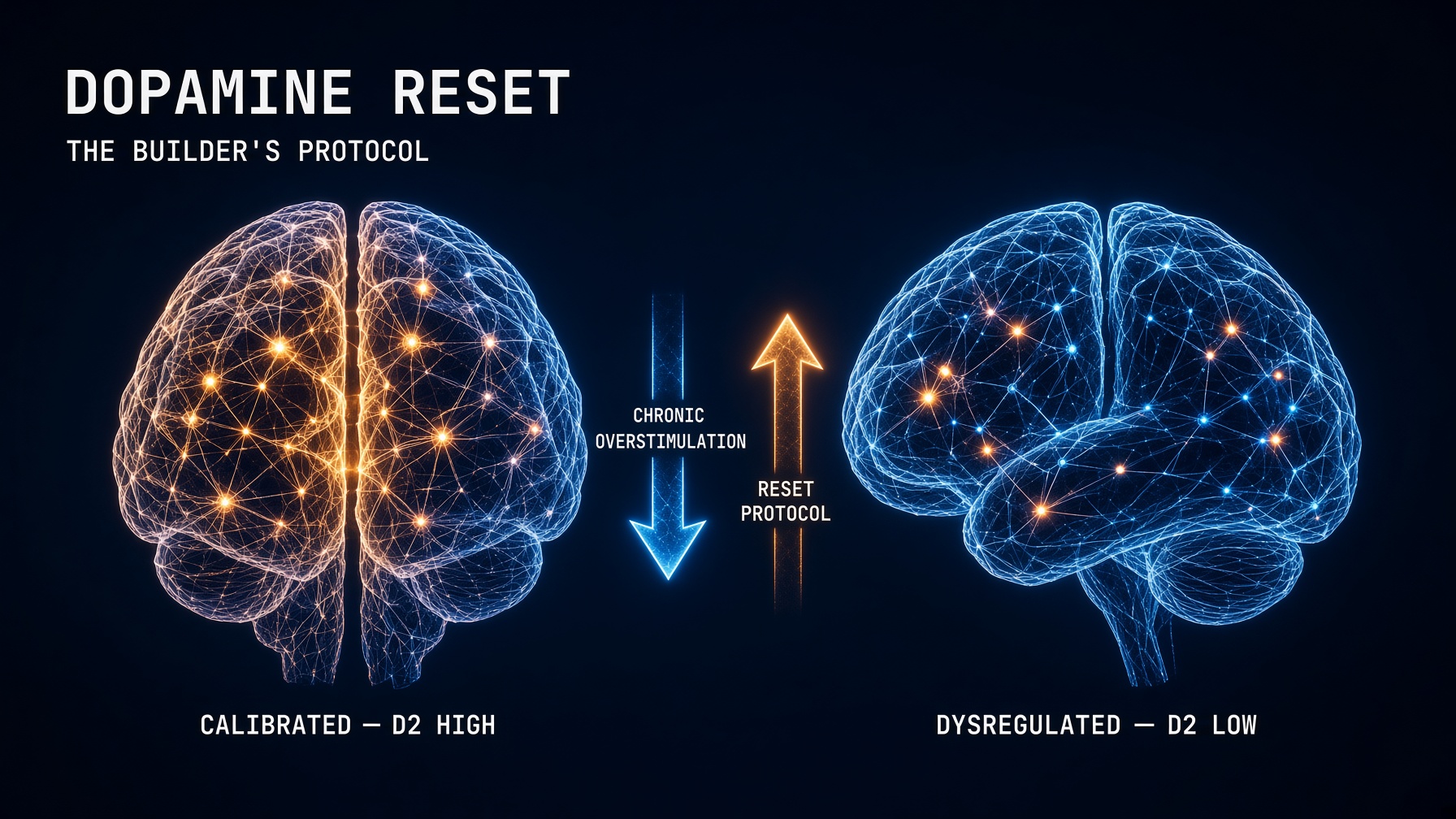
The dopamine detox protocol most builders need in 2026 isn’t about a weekend without your phone. It’s about understanding why deep work feels increasingly unrewarding despite feeling genuinely busy — and what the neuroscience says about fixing it.
The symptom has a name in addiction research: motivational anhedonia. Energy for scrolling, but no drive for meaningful tasks. The ability to spend two hours on Twitter but the inability to start a code review. The experience of feeling constantly stimulated but rarely satisfied. This is not a productivity failure or a character flaw. It’s the predictable result of a reward system that has upregulated its stimulation threshold through repeated exposure to algorithmically optimized, high-dopamine inputs — and downregulated the receptor density required to find lower-stimulation activities rewarding.
Builders in 2026 are in a near-perfect environment for producing this state. AI tools provide instant, high-quality responses — the unpredictable reward schedule that generates the strongest dopamine drive. Slack and Discord maintain constant notification pressure. Multiple screens create parallel stimulation streams. The cognitive tools that make builders productive also happen to match the dopamine-exploitation profile of the inputs that cause D2 receptor dysregulation. This guide explains the mechanism and gives you the protocol that actually addresses it.
What “Dopamine Detox” Actually Means — and What It Doesn’t
The term “dopamine detox” was coined in 2019 by Dr. Cameron Sepah, a clinical psychologist at UCSF Medical School, as a framework rooted in cognitive behavioral therapy principles. His original intent: reduce impulsive behaviors by scheduling deliberate periods of abstinence from specific high-stimulation triggers. Sepah has been explicit that the protocol was never about literally lowering dopamine — the brain requires dopamine to function and cannot fast from it. What the protocol reduces is exposure to engineered, algorithmically optimized stimuli that repeatedly spike the reward system above its natural baseline.
The mechanism behind the real phenomenon the imprecise term describes: dopamine operates at two levels — a steady tonic baseline and rapid phasic bursts. Chronic overstimulation disrupts this balance. When high-dopamine inputs are repeated consistently, neurons respond by physically removing D2 receptors from their surface through internalization — the receptors are pulled inside the cell and sometimes broken down. With fewer D2 receptors available, the same stimulus produces less signal, and activities that previously produced sufficient reward now feel flat. Research on chronic exposure to high-fat foods demonstrates this D2 downregulation clearly. The same mechanism applies to social media and algorithmic content — both of which are engineered to exploit the same dopamine pathway.
The practical consequence for builders: deep work, documentation, code review, and architectural planning are genuinely lower-stimulation activities than scrolling or receiving AI-generated responses. As D2 receptor density falls through chronic high-stimulation exposure, the stimulation gap between these categories widens. Deep work doesn’t feel harder because you’re less capable. It feels harder because your reward threshold has risen above what it can reliably produce.
The Dopamine Detox Protocol: Three Timeframes
Meaningful receptor sensitivity recovery requires a minimum of two to four weeks of sustained withdrawal from specific dysregulating stimuli. Substantial recalibration requires 60 to 90 days. The 24-hour dopamine detox produces a temporary experiential shift — you feel better after a day of reduced stimulation because you’re less immediately activated, not because receptor density has changed. Return to the same inputs the next day and the same dysregulated baseline reasserts within hours.
This doesn’t mean shorter interventions have no value. They have different values at different timeframes:
Tier 1 — The Daily Protocol (ongoing)
The daily dopamine detox protocol is not a single day’s intervention — it’s a set of structural changes to how stimulation is distributed across the workday. Three changes produce the largest sustained impact:
- Protect the first 90 minutes. The Morning Routine Protocol‘s no-phone instruction before the T+90 deep work block isn’t just about attention residue — it’s about entering the highest-cognitive-performance window of the day without having already spiked the dopamine system through notification checking. The first stimulation input of the day sets the baseline comparison for everything that follows. Starting with low-stimulation activity means deep work feels comparatively rewarding. Starting with 20 minutes of Slack feels comparatively flat.
- Batch notifications to two fixed windows. Notifications are a variable-ratio reward schedule — the most powerful driver of compulsive checking behavior known. Batching them to 11 AM and 4 PM removes the variable-ratio element entirely. The stimulation spike still occurs, but on your schedule rather than the app’s, and twice rather than continuously. This single change reduces the average daily dopamine spike frequency enough to measurably protect baseline sensitivity during working hours.
- Hard cutoff on algorithmic content after 8 PM. The Evening Routine Protocol‘s Wind Down phase removes passive screen content specifically because algorithmic video and social media in the hours before sleep suppress melatonin and keep the arousal system elevated. From the dopamine angle, algorithmic content in the evening also means the dopamine system’s last significant stimulus before sleep is high — which research suggests affects baseline calibration during overnight receptor processing.
Tier 2 — The 48-Hour Weekend Reset
A 48-hour reduction in specific high-stimulation inputs produces a measurable experiential shift: deep work on Monday genuinely feels more accessible than it did on Friday. This is not receptor recalibration — it’s temporary nervous system de-escalation. The shift is real but fragile, which is why the Tier 1 daily protocol is what preserves it rather than expecting the weekend reset to carry all the load.
The 48-hour protocol identifies and removes the specific inputs that constitute your personal high-stimulation fast — not all stimulation, but the engineered-for-reward-exploitation category:
- Remove: Social media (algorithmic feed, not messaging), streaming video (algorithmic recommendations, not a specific show you chose intentionally), news apps, gaming that’s compulsive rather than intentional, notifications from non-work apps.
- Keep: Intentional media (a specific film, a book you chose), meaningful social interaction, physical activity, work that’s genuinely creative rather than reactive, food (don’t add unnecessary restriction to the protocol).
- Replace with: The activities in this series that naturally optimize dopamine through the biology rather than exploiting it — Zone 2 outdoor exercise (sustainable dopamine through physical activity), cold exposure (250% dopamine baseline surge documented in 14°C immersion studies), social connection in person, and the boredom that activates the default mode network’s creative and self-reflective function.
Tier 3 — The 30-to-90-Day Recalibration
Meaningful D2 receptor density recovery requires sustained withdrawal from specific dysregulating inputs over weeks, not days. The practical version for builders isn’t a 90-day digital detox — it’s permanently removing the specific high-stimulation inputs that were providing the most dysregulating spikes, while keeping the tools and content that serve genuine work and creative purposes.
The distinction is between engineered exploitation (algorithmic feeds designed to maximize time-on-platform through variable-ratio reward) and genuine value (a specific newsletter you read intentionally, a community where you have real conversations, a tool that makes your work better). Permanently removing the exploitation category while keeping the value category is the structural change that allows D2 receptor density to recover over 30 to 90 days and then remain recovered rather than repeatedly retracing the same dysregulation cycle.
What the Neuroscience Says Actually Resets Dopamine Baseline
Three interventions have documented, mechanism-supported effects on dopamine receptor function — all of which are already in this series’ stack:
- Sleep. A study in the Journal of Neuroscience found that even one night of sleep deprivation downregulates D2 receptors in the brain’s reward center. Sleep deprivation also increases D3 receptors by nearly 20% — D3 receptors are associated with impulsivity and reward-seeking, meaning a sleep-deprived builder is both less able to feel motivated by meaningful work and more likely to reach for high-stimulation inputs. The Sleepmaxxing Protocol is the dopamine reset that runs every night.
- Cold exposure. Cold water immersion at 14°C produces a 250% rise in dopamine above baseline — not a spike-and-crash pattern but a sustained baseline elevation that studies show persists for several hours. The Cold Plunge Protocol in the morning routine produces this elevation at the start of the day, which is precisely why deep work feels qualitatively different on days that include the cold plunge versus days that don’t.
- Exercise. Physical activity — particularly Zone 2 aerobic exercise — produces dopamine through a mechanism that doesn’t exploit or exhaust receptor capacity the way engineered stimuli do. Zone 2 training over weeks produces mitochondrial adaptations that support more stable dopamine baseline function alongside its BDNF effects.
For the complete neuroscience of dopamine reset and receptor recovery, see ScienceInsights’ mechanism-based guide to dopamine reset.
The Builder’s Takeaway
The dopamine detox protocol builders need in 2026 is not a day without screens. It’s the permanent removal of engineered-for-exploitation stimulation from the daily input diet — algorithmic feeds, compulsive notification checking, passive algorithmic video — combined with the biology-based dopamine optimization already built into this series’ stack: seven to nine hours of sleep, cold exposure in the morning, Zone 2 outdoor exercise, and the deliberate boredom that allows the default mode network to activate. The D2 receptor recovery that follows over weeks and months is what makes deep work feel rewarding again, documentation feel manageable, and code review feel like a reasonable use of a Tuesday afternoon. The short version: delete the algorithmic apps, keep the tools. Protect the morning, batch the notifications, cut algorithmic content after 8 PM. Cold plunge, Zone 2, sleep. The dopamine system recalibrates when you stop asking it to operate in an environment it wasn’t designed for.
Continue in This Series
- Cold Plunge Protocol — the 250% sustained dopamine baseline surge from 14°C cold immersion: the fastest biological dopamine reset in the stack
- Sleepmaxxing Protocol — the nightly D2 receptor recovery session: one night of deprivation downregulates reward receptors measurably
- Zone 2 Training Protocol — exercise-based dopamine regulation that doesn’t exploit or exhaust receptor capacity
- Attention Restoration Protocol — boredom and natural environments activate the default mode network: the creative reset that low-stimulation periods produce
- Weekly Reset Protocol — Phase 3’s outdoor walk without audio is the weekly dopamine detox in practice: boredom, nature, no algorithmic input
This post is part of The Agentic Protocol’s Wellness series — the biological hardware layer beneath every autonomous system you build. See also: Cold Plunge Protocol.