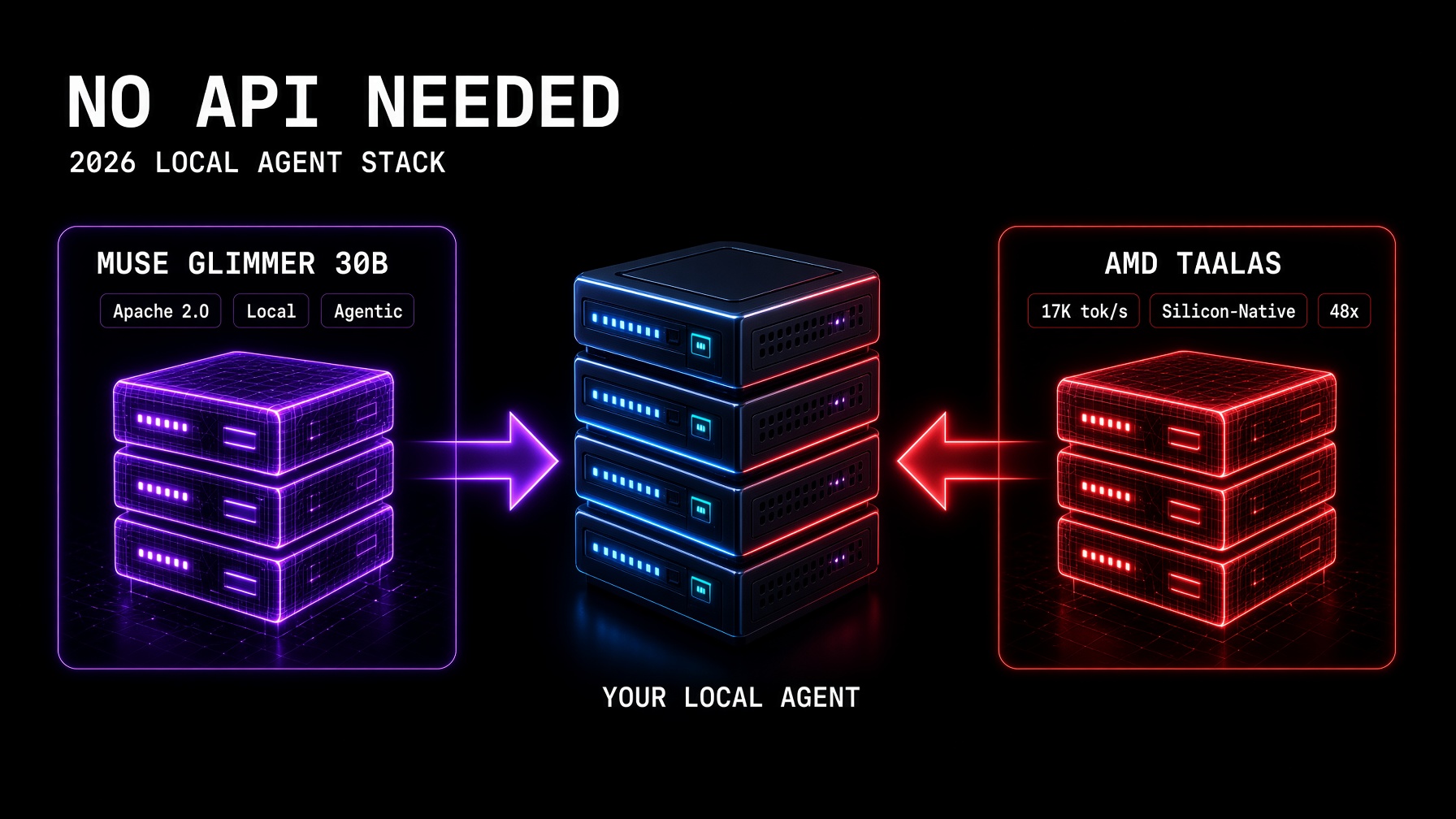
Two announcements in the same week change the economic argument for cloud API-based AI agents more than anything in the past twelve months — and neither one is a new cloud model.
Meta released Muse Glimmer under the Apache 2.0 license: a 30-billion-parameter dense multimodal model tuned specifically for local agentic tool use, with a 131,000-token context window and support for more than 100 languages. The same day, AMD confirmed its acquisition of Taalas, a Toronto startup that bakes model weights directly into custom silicon rather than loading them from high-bandwidth memory — producing approximately 17,000 tokens per second serving Llama 3.1 8B, a figure the company claims is roughly 48 times faster than Nvidia GPUs at time of announcement.
Neither development means builders should stop using the Claude API or GPT-5.6 tomorrow. Together, they mark the point at which the trajectory toward zero-API-cost local agent deployment became credible rather than aspirational — and that trajectory requires a response in how builders design their agent architecture today.
What Muse Glimmer Actually Is
Muse Glimmer occupies a specific position in the open-source model landscape that nothing else has filled cleanly until now: a large, capable, fully open-weight model explicitly designed for local agentic tool-calling workflows rather than optimized primarily for benchmark performance.
The Apache 2.0 license is the key detail. Unlike Meta’s previous Llama releases, which used a custom license that prohibited certain commercial applications above a user threshold, Apache 2.0 means any builder can use, modify, and deploy Muse Glimmer in any commercial product without restriction. No user caps. No revenue thresholds. No usage fees. You download the weights, run the model locally, and pay only for the compute you provision — which on a consumer GPU is measured in cents per hour, not dollars per million tokens.
The “tuned for local agentic tool use” description in Meta’s release notes is the functional differentiator. Most open-weight models are trained primarily on text completion and chat tasks, then fine-tuned for instruction following. Tool calling — the function-calling loop that the How to Build an AI Agent With Python guide covers as the foundation of all agent architectures — requires a model that reliably understands when to call a tool, formats the call correctly, interprets the result, and decides when to call another tool versus returning a final answer. That specific behavior is what Muse Glimmer was trained to do consistently at the 30B parameter scale.
The 131,000-token context window covers the most common production agent use cases: reading a full codebase, processing a lengthy document set, maintaining a long multi-tool conversation without truncation. It doesn’t match Claude Sonnet 5’s 1M token ceiling, but for the majority of builder use cases — those where context requirements fall below 100K tokens — the gap is irrelevant in practice.
What AMD Taalas Changes About Inference Economics
The Taalas architecture addresses a different constraint. Current AI inference hardware — including the Nvidia H100 and H200 that power every major cloud provider’s model serving infrastructure — stores model weights in high-bandwidth memory (HBM) and loads them onto the GPU for each inference call. This creates a memory bandwidth bottleneck: the weights are large, the bandwidth is finite, and most of the time your GPU is waiting for weights to transfer rather than computing.
Taalas eliminates this bottleneck by baking model weights directly into the silicon die during manufacturing. The weights don’t load from external memory — they’re in the chip. The first test chip (HC1, on TSMC’s 6nm process) hit approximately 17,000 tokens per second serving Llama 3.1 8B. A 20-billion-parameter second chip (HC2) is due later this year. AMD’s acquisition brings this architecture into the infrastructure of a company with the supply chain, manufacturing relationships, and distribution reach to put it into data centers and eventually into edge devices.
The implication for agent builders isn’t immediate — the HC1 chip serves Llama 3.1 8B, not a 30B model like Muse Glimmer, and HC2 isn’t shipping yet. But the trajectory is clear: within 18 to 24 months, silicon-native inference hardware capable of serving 30B-class models at speeds that make local agentic use cases responsive — sub-second tool-call latency — is likely to be commercially available through standard cloud and edge compute channels.
The Local AI Agent Stack: What It Looks Like Today
Builders who want to experiment with a local Muse Glimmer agent stack right now can do so with Ollama — the local model serving tool that exposes a Claude API-compatible endpoint, making it straightforward to swap between cloud and local models in any agent architecture.
# Install Ollama: https://ollama.ai
# Then pull Muse Glimmer (once available in Ollama's library):
# ollama pull muse-glimmer:30b

# Ollama exposes an OpenAI-compatible API at localhost:11434
# You can use it with the anthropic SDK via a base_url override,
# or directly with httpx:

import httpx
import json

def local_agent_call(
    prompt: str,
    model: str = "muse-glimmer:30b",
    tools: list[dict] | None = None
) -> dict:
    """
    Call a local Ollama model with tool support.
    Zero API cost after initial hardware setup.
    """
    payload = {
        "model": model,
        "messages": [{"role": "user", "content": prompt}],
        "stream": False
    }
    if tools:
        payload["tools"] = tools

    response = httpx.post(
        "http://localhost:11434/api/chat",
        json=payload,
        timeout=120.0  # local inference can be slower than cloud
    )
    return response.json()


# The hybrid pattern: route by task type
def route_agent_call(
    prompt: str,
    tools: list[dict] | None = None,
    requires_frontier: bool = False
) -> str:
    """
    Route to local or cloud based on task requirements.
    - Simple tool calls → local (zero cost)
    - Complex reasoning, regulated data → cloud API
    """
    if requires_frontier:
        # Use cloud API (claude-sonnet-5 or claude-opus-5)
        import anthropic, os
        client = anthropic.Anthropic(api_key=os.environ.get("ANTHROPIC_API_KEY"))
        response = client.messages.create(
            model="claude-sonnet-5",
            max_tokens=1024,
            tools=tools or [],
            messages=[{"role": "user", "content": prompt}]
        )
        return response.content[0].text
    else:
        # Use local model (Muse Glimmer via Ollama)
        result = local_agent_call(prompt, tools=tools)
        return result.get("message", {}).get("content", "")


# Usage
answer = route_agent_call(
    prompt="Summarize these meeting notes and extract action items.",
    requires_frontier=False  # → goes to local Muse Glimmer
)

sensitive_analysis = route_agent_call(
    prompt="Analyze this financial document for compliance issues.",
    requires_frontier=True   # → goes to Claude API
)
The routing pattern above is the practical implementation of what Muse Glimmer’s Apache 2.0 release makes possible today. Tasks that don’t require frontier-level reasoning, don’t involve regulated data, and don’t need the 1M token context window route to the local model at zero marginal cost. Tasks that do require any of those things route to the cloud API as before.
What This Changes in the Fallback Chain — and What It Doesn’t
The Model Fallback Routing post this series has updated six times this month covers the cloud provider chain: Claude Sonnet 5, GPT-5.6 Terra, Grok 4.5. Muse Glimmer adds a new category to the left of that chain — a pre-cloud tier that runs at zero marginal cost for tasks within its capability range.
What Muse Glimmer doesn’t change: the frontier chain for complex reasoning, the compliance requirements under the EU AI Act (local deployment has its own Article 50 implications if the model interacts with EU users), and the credential isolation and security architecture from the Lethal Trifecta post. A local model running on your hardware with unauthenticated tool access is not safer than a cloud model — it’s exposed to exactly the same prompt injection, credential harvesting, and scope creep vulnerabilities, with the additional risk of no provider-level monitoring to detect anomalous behavior.
The EU AI Act Article 50 disclosure obligation applies to any AI system that interacts with EU persons — local or cloud. Running Muse Glimmer on your own hardware doesn’t exempt the interaction from the disclosure requirement. It does exempt you from the data transfer concerns that make cloud API calls for sensitive data complex under GDPR — local processing that never leaves your infrastructure eliminates the third-party data processor relationship. That’s a meaningful advantage for certain use cases, not a compliance free pass.
For the full Muse Glimmer release details and benchmark data, see AI Weekly’s August 10 coverage.
The Builder’s Takeaway
Muse Glimmer under Apache 2.0 is the most capable open-weight agent-tuned model available today, and AMD’s Taalas acquisition is the hardware trajectory that makes local inference at frontier speeds credible within the next 24 months. Neither replaces the cloud API for complex reasoning, regulated data processing, or tasks that need the full 1M token context ceiling. Together, they establish the routing pattern that forward-looking builders should implement now: local for high-volume routine tool calls, cloud for frontier reasoning and compliance-sensitive workflows. The marginal cost of running Muse Glimmer for appropriate tasks today on a developer workstation is electricity. In 2027, on silicon-native inference hardware, it may be indistinguishable from free. Build the routing layer now — the cost benefit compounds as the hardware matures.
Continue in This Series
- Model Fallback Routing — the cloud chain this post extends with a pre-cloud local tier
- How to Build an AI Agent With Python — the tool-calling loop that routes identically whether the model is local or cloud
- AI Agent Unit Economics — the T/R ratio that determines which tasks are worth routing to local zero-cost versus cloud frontier
- Lethal Trifecta — local models are not exempt: the security architecture applies identically to Muse Glimmer
- EU AI Act Enforcement Day — Article 50 applies to local deployments interacting with EU users — local ≠ unregulated
This post is part of The Agentic Protocol’s Work series — the connective infrastructure layer beneath every autonomous pipeline. See also: Model Fallback Routing.