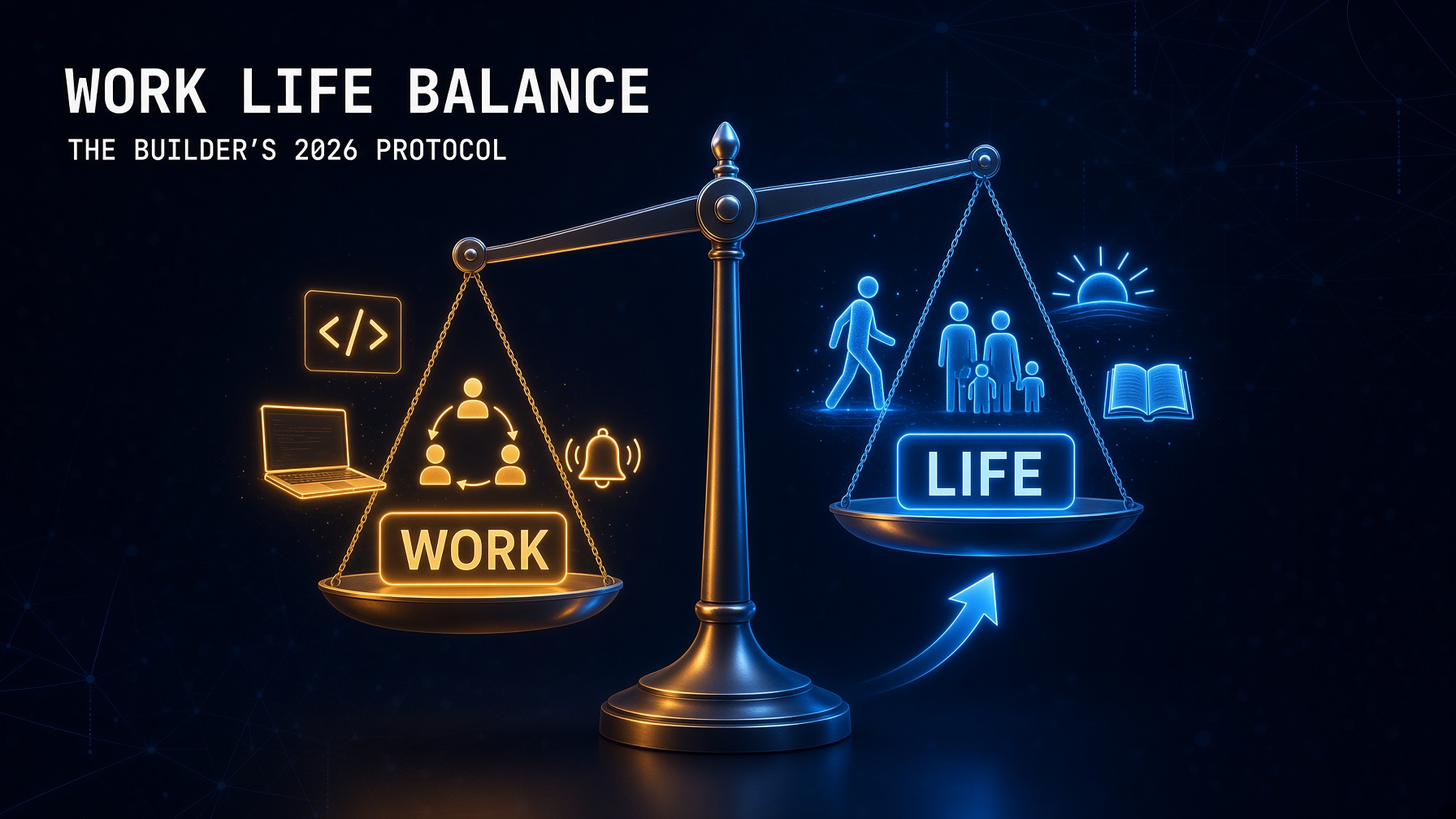
Work life balance in 2026 is simultaneously better and more difficult than at any point in the history of knowledge work. Better: remote and hybrid work eliminated the commute, gave back an average of 72 minutes per day, and 82 percent of workers report better mental health with flexible schedules. More difficult: 86 percent of full-time remote workers now report burnout — the highest rate of any work arrangement — and the number one cause is the inability to disconnect from work when your home is your office and your digital tools are always on.
For AI builders, the “always on” problem has an additional layer that general work-life balance advice doesn’t address. A Claude agent doesn’t clock out at 5 PM. An automation pipeline doesn’t pause for the weekend. Production monitoring sends alerts at 3 AM. Your evening LangChain experiment and your morning work session are indistinguishable at the boundary — both happen in the same environment, on the same device, with the same tools. The blurring is structural, not just habitual. The protocols below address that structural problem directly.
The 2026 Work Life Balance Paradox for Builders
The data shows an apparent contradiction. Remote workers report lower stress levels (79 percent), improved mental health (82 percent), and more personal time (60 percent) compared to office workers. They also report burnout at 86 percent, versus 72 percent for hybrid workers and 63 percent for fully in-office employees. Both sets of numbers are correct. Remote and flexible work removes commute stress, schedule rigidity, and office politics friction. It also removes the structural boundaries — the commute home, the building door, the colleague who signals it’s time to leave — that enforced work-life separation even for people who didn’t consciously maintain it.
The builder-specific version of this paradox: the same digital fluency that makes AI tool adoption effortless makes the off switch harder to find. A developer who can spin up a new CrewAI experiment in 20 minutes has no friction barrier between “thinking about a work problem” and “actively building on it at 9 PM on a Saturday.” The interest is genuine, the tool is available, the cost of starting is zero. What’s missing is the structure that makes not starting the right choice when the hour is 9 PM on Saturday.
The 4 Boundaries That Actually Work for Builders
Boundary 1 — The Hard Stop Time
The single most effective work-life balance intervention for remote workers is a consistent, non-negotiable work stop time — not “I’ll stop when I’m done” or “I’ll stop when it feels like a good breaking point” but a specific clock time after which work tools close. The Evening Routine Protocol‘s 6 PM stop time works because the specificity is what makes it enforceable. “I’ll wrap up soon” has no enforcement mechanism. “At 6 PM the laptop closes” does.
For builders, the hard stop time needs one addition: the Agent Handoff, from the Weekly Reset Protocol. The reason builders check on work in the evening isn’t usually email or Slack — it’s the anxiety that a running agent has done something unexpected. The Agent Handoff closes this: in the 15 minutes before your hard stop time, check every running agent or automation pipeline, confirm it’s behaving as expected, document its status in one line, and close the monitoring dashboard. The documented status is what allows the laptop to close — you’ve transferred the “background task” from your working memory to a written record, which your brain accepts as adequate closure. Without the handoff, the agents running in the background generate the same open-loop anxiety that unfinished tasks generate, and the laptop doesn’t really close even when the lid is down.
Boundary 2 — Work Device Separation
The most effective physical boundary for remote work-life balance is device separation: work happens on a specific machine or in a specific browser profile, personal life happens on a different machine or profile, and the work device physically closes at the hard stop time. The commute that office workers had was fundamentally a device separation mechanism — the “device” (the office) was unavailable at home, so the mental context of work couldn’t travel with you. Device separation recreates this constraint when geography can’t provide it.
For builders who use AI tools for both work and personal projects, this boundary requires a further distinction: the work AI profile (Claude, ChatGPT, etc.) closes with the work device. The personal project AI profile is separate and opens with different intent. This sounds like minor categorization, but the act of switching profiles creates a context shift that reinforces the mental boundary. Your brain uses environmental cues to signal “work mode” or “rest mode.” The same screen with the same Claude interface at 8 PM looks identical to 2 PM, which is part of why the boundary is hard to maintain. A different profile, a different workspace layout, or a different physical device removes the visual ambiguity.
Boundary 3 — Meeting-Free and Notification-Free Blocks
Meeting-free days reduce burnout symptoms by 27 percent among knowledge workers. The mechanism is the same as the Deep Work Protocol‘s core principle: uninterrupted concentration produces significantly better outcomes than equivalent time fragmented by context switching. For work-life balance specifically, meeting-free blocks are the time where builders produce the work that makes the rest of the day feel purposeful rather than reactive.
The notification boundary is the other half of this: 69 percent of remote employees say digital communication tools have made their burnout worse. For builders, this includes AI tool notifications (agent completion alerts, automated pipeline updates, API usage warnings) that don’t belong in the evening or weekend. The Dopamine Detox Protocol‘s notification batching — two windows per day at 11 AM and 4 PM — is the specific implementation. After the hard stop time: all notifications off. Checking them anyway negates the boundary.
Boundary 4 — The “Productive Avoidance” Identification
The most insidious work-life balance problem for builders is what might be called productive avoidance: the late-evening or weekend project that genuinely interests you, produces real output, and feels like rest — but is functionally work that prevents actual recovery. Trying a new LangGraph pattern at 10 PM isn’t procrastination. But if it costs you the recovery sleep that your prefrontal cortex needs for tomorrow’s architectural decisions, the output isn’t worth the cost to the next day’s performance.
The test: can you put the project down in 20 minutes and go to sleep? If the answer is no — if starting the project means the night is gone — it’s not restorative exploration, it’s work with the friction of work removed. Sleep architecture research shows that one night of fewer than seven hours degrades performance measurably the next day. A genuinely interesting side project that costs you sleep costs you tomorrow’s deep work output. The “productive avoidance” boundary is the recognition that not all interesting work is appropriate for the time slot it’s occupying.
The Weekly Rhythm That Protects Recovery
Individual day boundaries prevent acute work intrusion into personal time. The weekly rhythm prevents chronic boundary erosion — the slow drift where hard stops get slightly later, weekends get slightly shorter, and the recovery that the boundaries were protecting never fully arrives because the protected time is incrementally compressed.
Three weekly anchor points that protect the rhythm:
- Friday hard stop, 90 minutes earlier than usual. The week ends on Friday, not when the last task is complete. The Weekly Reset Protocol‘s Phase 1 (weekly review and brain dump) is the Friday close — it takes approximately 30 minutes and produces the written record of open loops that allows the brain to release them over the weekend rather than quietly processing them. Without the Friday close, the weekend begins with the prior week’s unfinished business still running as background tasks.
- One genuinely offline period per week. Not “I didn’t check Slack for a few hours” but a dedicated block — a morning, an afternoon, a full day — where the laptop is closed, the phone is away, and the activity is chosen for its restorative rather than productive value. The Attention Restoration Protocol‘s outdoor nature exposure, the Zone 2 outdoor exercise, or genuine leisure that activates the default mode network rather than directed attention. Research shows that structured flexibility — not total autonomy — reduces burnout risk. The offline period is the scheduled structure that makes the rest of the week’s flexibility sustainable.
- Sunday planning, maximum 20 minutes. The Time Blocking Protocol‘s Sunday planning ritual loaded into the calendar before the week starts. This protects work-life balance by moving planning from reactive (decisions made under deadline pressure) to intentional (decisions made from a rested baseline). A week that starts with a confirmed plan is a week where “just one more thing” has to compete with the existing plan rather than filling an unstructured vacuum.
For the complete 2026 remote work and burnout research base, see WorkTime’s comprehensive remote work statistics report.
The Builder’s Takeaway
Work life balance in 2026 for remote builders requires structural solutions rather than willpower solutions — because the structural problem is that the work environment, the personal environment, the work tools, and the personal curiosity tools are all in the same place at the same time with no ambient separation signal. The four boundaries address the structure: a hard stop time with an Agent Handoff that enables genuine closure, device separation that recreates the environmental context shift the commute used to provide, meeting-free and notification-free blocks that protect the concentration that makes work feel purposeful rather than exhausting, and productive-avoidance identification that distinguishes genuinely restorative exploration from work with the label changed. The weekly rhythm holds the boundaries over time: Friday close, one genuinely offline period, and 20 minutes of Sunday planning. At 86 percent remote burnout rates, the default is to drift into the group that can’t disconnect. The protocol above is what produces the outcome in the other 14 percent.
Continue in This Series
- Evening Routine Protocol — the 60-minute closing sequence that implements Boundary 1’s hard stop time
- Weekly Reset Protocol — the Sunday and Friday structures that maintain the weekly recovery rhythm
- Dopamine Detox Protocol — the notification batching that implements Boundary 3 and protects the dopamine baseline
- Solo Builder Burnout — the deeper burnout prevention architecture for solo developers and independent builders
- Deep Work Protocol — the quality-of-work side of work-life balance: protected deep work time that makes the work hours feel purposeful
This post is part of The Agentic Protocol’s Wellness series — the biological hardware layer beneath every autonomous system you build. See also: Evening Routine Protocol.