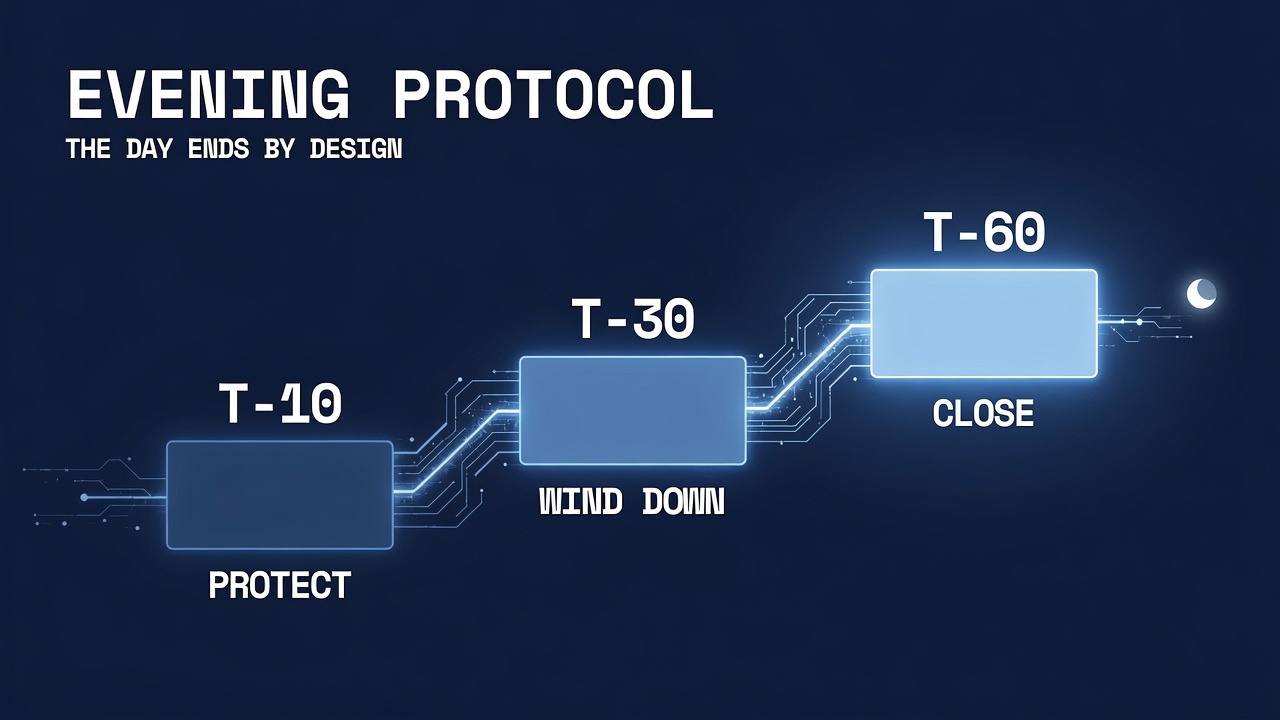
The evening routine protocol for builders is the most misunderstood window in the daily performance stack — because the goal isn’t relaxation. It’s cognitive closure.
A 2026 bedtime screen survey found that 38% of US adults report doomscrolling before bed makes their sleep measurably worse. The problem isn’t the screen — it’s what the screen does to the brain’s default mode network in the hours before sleep. Passive, emotionally reactive content (news, social media, algorithmic video) keeps the arousal system activated at exactly the moment the parasympathetic nervous system needs to begin the temperature-dropping, cortisol-clearing transition into slow-wave sleep. The result: longer sleep onset, shallower slow-wave depth, less consolidated memory, and lower cognitive performance the next morning — the exact cognitive performance the Morning Routine Protocol was built to maximize.
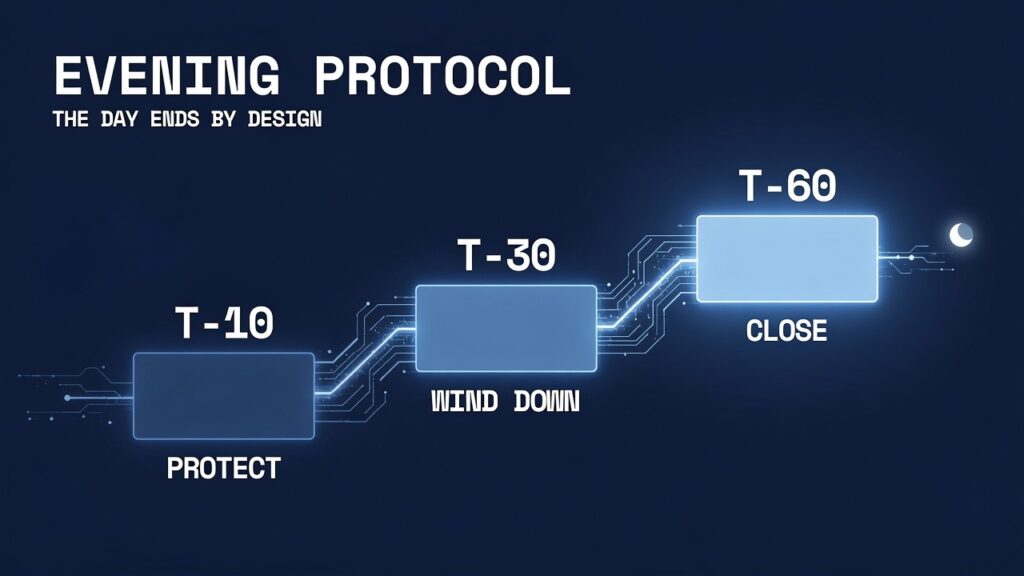
Builders have a specific version of this problem that generic evening routine advice doesn’t address. The cognitive load of agentic AI work — reviewing pipeline outputs, making architectural decisions, processing security alerts, tracking model pricing changes — doesn’t clear automatically at 6 PM. It persists as open cognitive loops that the brain continues processing in the background during sleep onset, competing with the consolidation work that slow-wave sleep is meant to do. The evening routine protocol is the 60-minute sequence that deliberately closes those loops before sleep, rather than leaving them open for the brain to manage at the cost of sleep architecture quality.
Why the Evening Routine Protocol Is a Closing Sequence, Not a Relaxation Sequence
The distinction between closing and relaxing is the insight that makes the evening routine protocol useful for builders specifically. Relaxation advice — take a bath, watch something light, dim the lights — addresses the physiological arousal system. It’s correct advice as far as it goes. But it doesn’t address the cognitive loop problem: the half-finished architecture decision, the unreviewed agent output, the task list item that was deferred, the security patch that was noted but not scheduled. These open loops don’t respond to ambient lighting. They respond to explicit closure.
The Attention Residue post covered how switching between tasks leaves a residue — partial cognitive activation that impairs the next task. The evening version of this is accumulation: every open loop from the workday carries a small attentional cost that accumulates across the sleep onset window. The reason builders often wake at 3 to 5 AM with their brain already processing work is not insomnia — it’s unfinished cognitive business that the brain is attempting to close during the only quiet period it gets.
Matthew Walker’s research, widely referenced in sleep science, establishes that consistent bedtime timing matters more than sleep duration for cognitive function. The evening routine protocol is what makes consistent bedtime timing achievable — it’s the structured transition that prevents the “I’ll just finish this one thing” pattern that delays sleep onset by 45 to 90 minutes indefinitely.
The 60-Minute Evening Routine Protocol: Three Phases
Phase 1 — Close (T-60 to T-40): Commit Before You Quit
The Close phase has one job: convert every open cognitive loop into an explicit written record before the workday ends. Not a mental note. Not a browser tab left open. A physical notebook entry or a task management system update that externalizes the loop completely.
The protocol: open a notebook (not a digital tool — the physical act of writing has stronger loop-closing properties than typing) and complete three captures:
- What got done today. Three to five items, specific enough that tomorrow’s you would know exactly what was completed. This is the cognitive equivalent of a git commit — it creates a checkpoint that the brain can reference rather than holding open.
- What’s unfinished and when it will happen. Every deferred task with a specific future time slot: “The EU AI Act Article 50 disclosure review → Thursday 10 AM.” Specificity closes the loop. “I need to do that sometime” keeps it open.
- One thing that went well. Research on emotional closure before sleep consistently shows that explicitly naming a positive event reduces the overnight processing load on the amygdala — the brain’s overnight threat-monitoring system that activates when the day’s unresolved emotional content remains ambient.
Once the notebook is closed, all work screens close. All work notification channels mute. The Close phase is binary — it ends, and Phase 2 begins. There is no “one more thing” after the notebook closes, because the notebook closing is the signal that every open loop has been captured. One more thing is always available. The Close ritual is what makes stopping possible despite that fact.
Phase 2 — Wind Down (T-40 to T-10): Parasympathetic Activation
The Wind Down phase is where physiological arousal drops. Three inputs matter:
Lighting transition. The Sleepmaxxing Protocol post established that light below 10 lux in the two hours before bed preserves melatonin onset. Overhead lighting off. Amber lamps or candles only. Hardware-level dimming — not software night-shift filters, which reduce warmth but not photon quantity. If you can read comfortably by the light in your evening environment, it’s too bright for melatonin onset to proceed normally.
Temperature drop initiation. Core body temperature must drop 1 to 1.5°C to trigger sleep onset. A warm shower 60 to 90 minutes before bed accelerates this by moving heat from core to skin surface — the mechanism from the Sleepmaxxing Protocol that is the single highest-leverage thermal intervention. The shower belongs in the Wind Down phase, not immediately before sleep.
Low-arousal cognitive engagement. The 2026 research distinguishes passive emotional reactivity (doomscrolling, algorithmic video) from deliberate low-arousal engagement (reading, journaling, light puzzles). Passive reactive content keeps the sympathetic nervous system activated. Deliberate low-arousal engagement gives the brain something to gently occupy it while the physiological wind-down proceeds. Reading physical books is the highest-evidence option — paper, not e-reader, because even e-readers with night mode emit enough light to meaningfully suppress melatonin at close range.
Phase 3 — Protect (T-10 to T-0): Environment and Supplements
The Protect phase is the 10-minute final environment setup before sleep onset:
- Room temperature: 18 to 20°C. Set the thermostat or open the window now, not at sleep onset — the room needs to reach the target temperature before slow-wave sleep begins, not after.
- Magnesium glycinate: 300 to 400mg. The Magnesium Protocol post’s bedtime dose — taken in the Protect phase rather than earlier because the GABA-receptor support works at sleep onset, not during the wind-down. This is the specific timing that makes the supplement effective rather than academic.
- Phone outside the bedroom. Not on silent. Not face-down. Out of the room. The 2026 screen research finding — 38% of adults reporting doomscrolling makes sleep measurably worse — is a function of proximity and accessibility. Removing accessibility removes the temptation that survives willpower failures at T-5.
- Review tomorrow’s three priorities. Already written in the Close phase notebook. Reading them once at Protect phase closes the anticipation loop that would otherwise activate during sleep onset: the brain reviews known plans more quickly than it constructs new ones overnight.
The Caffeine Cutoff That Makes the Evening Routine Protocol Work
The HabitBox architecture for evening routines identifies caffeine cutoff as the most commonly violated single variable that undermines the entire structure. Caffeine’s half-life is 5 to 7 hours depending on individual metabolism. A cup of coffee at 3 PM still has 50% activity in the system at 8 to 10 PM — actively competing with the melatonin onset the Wind Down phase is trying to support. A cup at 5 PM may still have 25% activity at midnight.
The Nootropic Protocol post’s Tier 1 stack specifies L-theanine and caffeine in the morning window, with a caffeine cutoff at noon. That cutoff isn’t a comfort guideline — it’s the constraint that makes the Phase 2 Wind Down physiologically achievable at a consistent bedtime. Builders who move their caffeine cutoff from 5 PM to noon typically report the most significant single improvement in sleep onset time and slow-wave depth of any behavioral change in their stack.
The Morning Routine Protocol and Evening Routine Protocol as a Closed Loop
The Morning Routine Protocol post from this series established the 90-minute opening sequence: light exposure, outdoor Zone 2 exercise, cold shower, L-theanine and caffeine, then deep work block at T+90 with BDNF at peak, adenosine cleared, and cortisol at its natural high.
The Evening Routine Protocol is the closing sequence that makes that morning performance achievable the next day. Without the Close phase, open cognitive loops fragment sleep. Without the Wind Down phase, slow-wave architecture degrades. Without the Protect phase, environmental disruptions interrupt the consolidation window that encodes what the morning’s deep work produced.
The two protocols together are a closed loop: the morning sequence capitalizes on the recovery the evening provided. The evening sequence capitalizes on the cognitive work the morning produced. Neither works independently at full effectiveness. The BDNF Protocol’s neuroplasticity benefit, the Magnesium Protocol’s cognitive age reduction, the Nootropic Protocol’s working memory support — all of them are encoded and consolidated during the slow-wave sleep that the evening routine protocol makes possible. Optimizing morning inputs without protecting the overnight consolidation window is optimizing one half of a cycle.
For the full research on evening routines and cognitive performance, see HabitBox’s 60-minute wind-down architecture guide.
The Minimum Viable Evening Routine Protocol
For builders who can’t yet implement the full 60-minute sequence, the two highest-leverage elements that preserve most of the benefit:
- The notebook close. Five minutes of writing — what got done, what’s deferred with a specific time, one thing that went well. This single practice closes more open cognitive loops than the rest of the protocol combined, because it directly addresses the architectural cause of builders’ specific sleep fragmentation pattern.
- Phone outside the bedroom. No willpower required after the phone leaves the room. The 38% of adults whose sleep is measurably worse from evening screen use are disproportionately people with the phone within arm’s reach at sleep onset.
These two changes require less than ten minutes and cost nothing. The evening routine protocol is built around them. Every other element compounds their effect. Neither is optional — everything else is layered on top.
The Builder’s Takeaway
The evening routine protocol is the most underbuilt layer in the builder’s performance stack — because it looks like the day ending, but it’s actually the next day beginning. The Close phase determines how clean the morning’s cognitive slate is. The Wind Down phase determines how deep the slow-wave architecture goes. The Protect phase determines whether the environment supports or competes with the consolidation that slow-wave sleep performs. Builders who optimize their morning protocol without building a corresponding evening protocol are loading a powerful morning sequence onto a suboptimal sleep foundation. The evening routine protocol is what makes the foundation reliable enough for the morning to work as designed.
Continue in This Series
- Morning Routine Protocol — the 90-minute opening sequence this evening protocol exists to make possible the next day
- Sleepmaxxing Protocol — the thermal management, light timing, and sleep architecture detail behind Phase 2 and Phase 3
- Magnesium Protocol — glycinate 300–400mg in Phase 3: the exact dose, timing, and GABA mechanism
- Attention Residue — the switching cost mechanism the Close phase’s notebook ritual directly addresses
- Nootropic Protocol — the noon caffeine cutoff that makes Phase 2’s physiological wind-down achievable at a consistent bedtime
This post is part of The Agentic Protocol’s Wellness series — the biological hardware layer beneath every autonomous system you build. See also: Morning Routine Protocol.