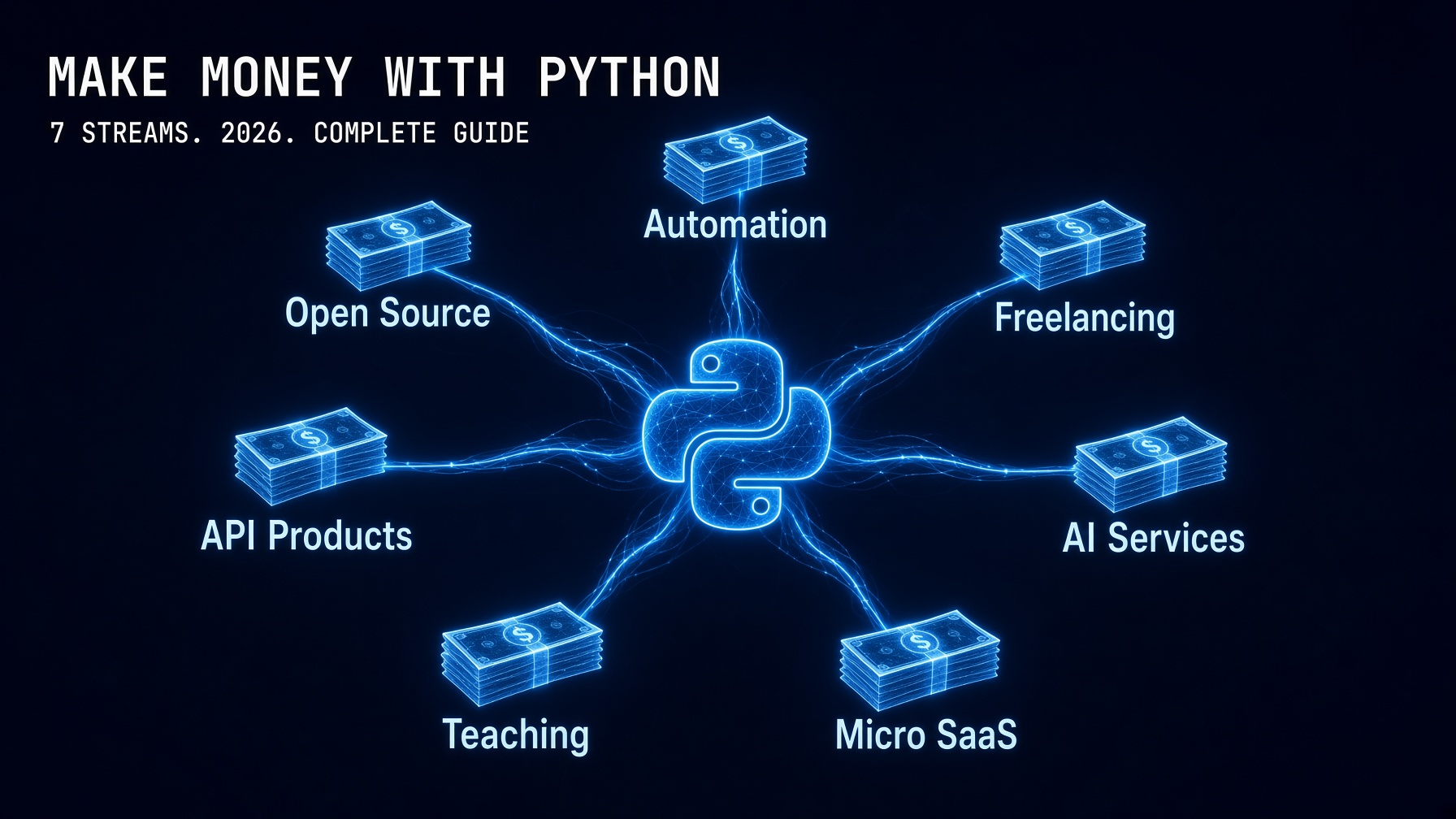
Making money with Python in 2026 is not a niche opportunity for computer science graduates. It is the most direct path from technical skill to paid work in the highest-demand segment of the technology economy. Python is the primary language of AI development — the Claude API, LangChain, CrewAI, RAG pipelines, and every automation framework this series has built runs on Python. The demand for Python developers who can work with AI systems has grown 1,847 percent in three years. The supply has not kept pace. The resulting rate premium is real: Python AI developer rates are 40 to 60 percent higher than generalist Python rates, and freelance AI rates run 45 percent higher than non-AI freelance development.
This guide covers seven specific ways to make money with Python in 2026, ordered from fastest first income to highest long-term ceiling. Each path includes realistic income data, the specific skills required, and the concrete first step that turns knowledge into a paid engagement. Every income path below connects to the technical foundation this series has built — if you’ve worked through the Python tutorials in this blog, you already have the skills for the first three paths.
Why Python Specifically: The 2026 Income Advantage
Python’s dominance in AI development is not coincidental. The ecosystem — NumPy, Pandas, PyTorch, TensorFlow, LangChain, Anthropic SDK, CrewAI, FastAPI — is the largest, most mature, and most actively maintained AI development environment in existence. Every major AI platform offers a Python SDK as the primary integration path. Every AI framework tutorial defaults to Python. The two largest vectors for developer income in 2026 — AI automation for businesses and AI agent development — both run on Python as their primary implementation language.
Three statistics that define Python’s income advantage in 2026:
- 28 to 43 percent salary premium for AI-skilled Python developers over equivalent non-AI Python developers, measured across job postings and salary surveys. This premium has grown from approximately 15 percent in 2023, driven by the gap between AI deployment demand and the supply of developers who can reliably deliver production AI systems.
- Freelance Python AI rates of $85 to $300 per hour — with the high end of the range specifically for AI agent development and production RAG pipeline implementation. The rate dispersion is wide, but the floor for Python developers who can demonstrate working AI system production experience is meaningfully above the generalist Python freelance floor of $45 to $75 per hour.
- The AI agents market projected at $182.97 billion by 2033. The developers who learn to build, deploy, and maintain AI agent systems in Python today are positioning in a market that will be an order of magnitude larger in seven years. Early positioning in an exponentially growing market is the compounding force that career planning in stable markets can’t replicate.
The 7 Ways to Make Money With Python in 2026
Path 1 — Python AI Automation for Small Businesses (Fastest First Income)
Realistic income: $500–$3,000 per project, $300–$600/month monitoring retainer. First income possible within 2 weeks of starting outreach.
The fastest-paying application of Python in 2026 is automation for small businesses that have repetitive workflows consuming 5 to 20 hours per week of staff time. A Python script that processes incoming invoices, extracts structured data, and writes it to a spreadsheet — built in one day — is worth $800 to $1,500 to a small accounting firm whose bookkeeper currently spends 6 hours per week doing that work manually. A Python automation that reads daily sales reports, formats them into a summary, and sends them to the owner by email — built in an afternoon — is worth $500 to $1,000 to a retail business owner who currently does this manually every morning.
The three Python automation scripts with the most consistent demand from small businesses:
- Invoice and document processing: PyPDF, the Anthropic SDK, and pandas — the combination that forms Workflow 2 from the Python AI Automation guide. A small professional services firm processes 50 to 200 invoices per month manually. An automation that does it in 30 minutes instead of 6 hours is worth $1,200 to $2,000 in one-time implementation and $150 to $300 per month in ongoing monitoring.
- Report generation and summary automation: The daily digest workflow from the same guide — fetch data, process with Claude, send by email — is the automation most frequently requested by business owners who spend mornings manually compiling reports from multiple sources. Typical project size: $600 to $1,500 implementation.
- Lead research and outreach personalization: A Python script that takes a list of prospect names and companies, searches for recent news and LinkedIn updates, and generates personalized outreach one-liners. Sales teams pay $800 to $2,000 for this automation because it addresses a documented and measurable pain point: 45 minutes of research per prospect at scale.
How to find the first client: Ask three people you know who run small businesses: “What takes the most time in your week that you wish you didn’t have to do?” The answer to that question, delivered as a Python automation, is your first project. The cold outreach framework from the How to Get Clients guide provides the complete outreach system for finding beyond your immediate network.
Path 2 — Python Freelancing on Platforms and Direct (Reliable Mid-Term Income)
Realistic income: $45–$200/hour (generalist) to $85–$300/hour (AI specialist). Consistent $3,000–$8,000/month at established rates.
Python freelancing on Upwork, Toptal, and LinkedIn direct outreach remains one of the most reliable income paths for Python developers in 2026 — and the AI skill premium makes it more valuable than generalist Python freelancing by 40 to 60 percent. The positioning distinction that produces the rate premium: billing as a “Python + AI integration specialist” rather than a “Python developer” changes the client pool from commodity development buyers to buyers with a specific, high-value problem they can’t solve internally.
The specific Python AI skills that command the highest freelance rates in 2026:
| Skill | Hourly Rate Range | Example Project | Build Guide |
|---|---|---|---|
| AI Agent Development | $120–$300/hr | Multi-agent research system for a consulting firm | Build AI Agent |
| RAG Pipeline Implementation | $100–$220/hr | Internal document Q&A system for a law firm | RAG Tutorial |
| LangChain/CrewAI Integration | $90–$200/hr | Automated research and report generation system | LangChain Tutorial |
| Claude/OpenAI API Integration | $85–$180/hr | AI-powered customer support agent | Claude API Python |
| Python Automation (non-AI) | $55–$120/hr | Business process automation scripts | Python Automation |
The platform strategy that maximizes hourly rates: start on Upwork to build the first three reviews and portfolio evidence, then transition to LinkedIn direct outreach where the zero-percent commission means you keep the full rate. At $150 per hour with a 20 percent Upwork commission, the effective rate is $120. The same work billed directly at $130 per hour delivers 8.3 percent more take-home income with a better client relationship.
Path 3 — Python AI Compliance and Security Services (Urgency-Driven Income)
Realistic income: $1,500–$3,000 implementation, $300–$600/month monitoring retainer. Highest urgency window: now, while EU AI Act enforcement is active.
The EU AI Act’s Article 50 disclosure requirements became enforceable on August 2, 2026. Organizations with EU-facing AI features need Python implementations of disclosure mechanisms, audit trail infrastructure, and monitoring systems — and most don’t have the internal Python developer bandwidth to build them. The specific implementation — four hours of Python work — was covered in the AI Compliance Services guide. The business model: $2,000 implementation per client, $400/month monitoring retainer per client, five clients = $2,000/month recurring after the initial implementations. The discovery call, the pitch, and the retention model are all in that guide.
Why this is a Python income path specifically: the implementation is Python — a FastAPI endpoint, Anthropic API call for disclosure message generation, SQLite audit trail — and the monitoring is a Python APScheduler cron that checks compliance weekly. The client sees a working compliance system. You’ve written 300 lines of Python. The billing justification is regulatory urgency, not technical complexity.
Path 4 — Python Teaching and Technical Content (Long Tail, Compounding)
Realistic income: $0 for the first 6 months, $500–$5,000/month by month 12, compounding thereafter.
Teaching Python through video courses, technical blogs, newsletters, or bootcamp instruction is the lowest-floor, highest-ceiling income path in this guide — and the longest runway to meaningful income. Python is the most-searched programming language for tutorials, courses, and beginner guides. A Python course on Udemy or Teachable that covers AI integration and sells at $29.99 is not competing against other Python courses; it’s competing against the subset of Python courses that cover AI agent development in 2026, which is a much less crowded field.
The four teaching formats for Python income, ranked by time to first dollar:
- Technical blog with AdSense and affiliate income (6–18 months to meaningful revenue). The path this blog is demonstrating: high-quality Python tutorials targeting 1,000-plus monthly searches, AdSense at $8–$15 RPM, and affiliate commissions from Anthropic and LangChain partner programs. The content competes on depth (3,500-plus words) rather than speed. Realistic earnings: $200–$500/month at 12 months for a focused technical blog, growing toward $2,000–$5,000/month at 36 months.
- Udemy/Teachable course (3–6 months to first revenue). A focused Python AI course — “Build Production AI Agents With Python and Claude” — covering the material in this series’ tutorial posts, recorded in 4 to 6 hours of video, priced at $29–$79 on Udemy. Platform discovery drives initial sales; reviewer accumulation drives long-term organic traffic. Realistic earnings: $300–$800/month at 12 months for a focused niche course.
- YouTube channel (6–24 months to monetization). The highest effort, highest ceiling teaching format. Python tutorial channels with 10,000-plus subscribers in the AI niche command $2,000–$10,000/month in AdSense and sponsorships. The compound effect of YouTube’s recommendation algorithm makes the channel significantly more valuable per video at 50,000 subscribers than at 5,000.
- Bootcamp instruction or corporate training (fastest, lowest ceiling). Part-time or contract Python instruction at coding bootcamps or corporate training programs pays $50–$150 per hour for in-person or synchronous remote instruction. Finding the first engagement requires an application, a portfolio demonstration, or a referral from an existing instructor — all accessible within one month of serious effort.
Path 5 — Python Micro SaaS Products ($29–$149/Month, Compounding)
Realistic income: $0 for 3–6 months (build and launch), $500–$5,000+/month at 12 months with a product that found product-market fit.
Python is the backend for most micro SaaS products in 2026 — FastAPI or Flask for the API layer, Claude or another LLM for the intelligence, ChromaDB or SQLite for the data layer, Stripe for billing. The build time for a minimal viable AI SaaS product using this stack is one to four weeks for a developer with Python proficiency. The revenue ceiling for a successful micro SaaS is genuinely uncapped — a $79/month product with 100 customers generates $7,900/month recurring.
The seven specific Python AI micro SaaS ideas with documented market demand are in the Micro SaaS Ideas 2026 guide, each with the technical stack and revenue model. The SaaS pricing strategy — ensuring the margin math works before launch — is in the SaaS Pricing Strategy post.
The common failure pattern for Python micro SaaS: building the product before validating that anyone will pay for it. The highest-ROI pre-build validation approach: describe the product to 10 potential customers and ask them to pre-pay for the first month’s access before the product exists. Three pre-payments from people you don’t know personally is sufficient demand signal to justify building. Zero pre-payments from strangers is sufficient signal to revise or abandon the product concept before investing 4 weeks of engineering time.
Path 6 — Python API Services Monetized per Call (Passive After Build)
Realistic income: $0–$200/month at 6 months (pipeline building), $500–$3,000/month at 18 months (volume accumulation). Most passive income model on this list after initial build.
Python backend API services exposed on MCPMarket or RapidAPI and priced per call represent the most genuinely passive income model available to a Python developer. The build is a FastAPI server wrapping one specific capability — invoice classification, EU compliance checking, sentiment analysis, document summarization — deployed to a cloud instance and listed on MCPMarket with the x402 payment protocol for per-call billing.
The income mechanics: at $0.02 per API call, 10,000 calls per month generates $200. At 100,000 calls per month — reachable for a well-positioned utility API serving other developers’ agent pipelines — the monthly income is $2,000. The API runs 24 hours per day with no ongoing effort after the initial deployment and the listing on MCPMarket. The income accumulates in proportion to how many other agents use the tool, which grows through MCPMarket discovery without additional active marketing.
The highest-demand API service categories in 2026 that a Python developer can build in a weekend: EU AI Act compliance checking (regulatory text against a product description), invoice data extraction (PDF to structured JSON), meeting summary classification (transcript to action items), and prompt injection detection (input validation for AI applications).
Path 7 — Python Open Source with Sponsorship (Highest Ceiling, Longest Timeline)
Realistic income: $0 for 1–2 years, $500–$10,000+/month at maturity for successful projects. Extremely high variance.
The highest-ceiling, lowest-probability Python income path: building an open source Python library or tool that becomes widely adopted, then monetizing through GitHub Sponsors, Polar.sh, Open Collective, or a commercial hosted version of the open source product. LangChain, FastAPI, and Pydantic all started as open source Python libraries built by individual developers; each has generated significant commercial value for their creators through this path.
The path is not recommended as a primary income strategy — the timeline is 1 to 2 years before meaningful sponsorship, the probability of adoption sufficient to generate income is low, and the income is highly variable even for successful projects. It is, however, worth noting as the income ceiling: the Python developer who builds the library that becomes the standard for AI agent memory management or EU AI Act compliance checking would generate income at a scale that none of the other six paths can approach.
The appropriate use of the open source path for most developers: build the tool for yourself, open source it once it’s working and documented, share it in Python communities, and treat sponsorship as a welcome surprise rather than a planned income stream. The portfolio value — demonstrating a working, public, used Python project — generates freelancing and consulting income that is more reliable than direct sponsorship.
The Python + AI Stack That Commands Premium Rates
Across all seven paths above, one skill combination consistently commands the highest rates and the most demand: Python combined with the specific AI integration skills this series has covered. The stack worth building deliberately:
# THE PYTHON AI DEVELOPER SKILL STACK — 2026
# Each skill adds to the rate premium and opens new income paths

FOUNDATION (Required for all 7 paths):
  Python 3.10+
  HTTP APIs and REST concepts
  Git and GitHub
  Basic data structures and algorithms

TIER 1 — Claude/LLM API Integration ($85-$150/hr tier):
  Anthropic SDK (pip install anthropic)
  System prompts and prompt engineering
  Streaming and error handling
  Cost tracking and monitoring
  → Opens paths 1, 2, 3

TIER 2 — AI Agent Frameworks ($120-$220/hr tier):
  LangChain (chains, tools, memory)
  CrewAI (multi-agent systems)
  LangGraph (stateful workflows)
  Tool definition and execution
  → Opens paths 1, 2, 4, 5

TIER 3 — RAG and Vector Databases ($150-$250/hr tier):
  ChromaDB, Pinecone, pgvector
  Text chunking and embedding
  Semantic search and retrieval
  Document processing (pypdf, docx)
  → Opens paths 2, 5, 6

TIER 4 — Production Deployment ($180-$300/hr tier):
  FastAPI (AI API development)
  Docker and cloud deployment (AWS, GCP)
  APScheduler (automation scheduling)
  Monitoring and observability
  EU AI Act compliance implementation
  → Opens paths 2, 3, 5, 6
The rate premium is not uniformly distributed across these tiers. The jump from Tier 1 (Claude API integration) to Tier 2 (agent frameworks) adds approximately $30 to $50 per hour to the billable rate. The jump from Tier 2 to Tier 4 (production deployment with compliance) adds another $50 to $100 per hour. A developer who can demonstrate Tier 4 capability — with a portfolio of deployed AI agent systems that handle real data, include security controls, and meet EU compliance requirements — is not competing against most Python developers for freelance engagements. They’re competing against a small pool of specialists, which is exactly the market position that sustains the $180 to $300 per hour rates at the top of the range.
Realistic Income Expectations by Timeline
| Timeline | What’s Realistic | Primary Path | Key Milestone |
|---|---|---|---|
| Week 1–2 | $0 (setup, outreach, build portfolio) | Path 1 — Automation | First discovery call booked |
| Month 1–2 | $300–$1,500 (first project) | Path 1 or Path 2 | First client testimonial |
| Month 3–6 | $1,000–$4,000/month | Paths 1+2+3 | First retainer client |
| Month 6–12 | $3,000–$8,000/month | Paths 1+2+5 (product launch) | First product revenue |
| Year 2+ | $5,000–$20,000+/month | All 7 paths active | Referral-driven growth |
The $1,000 to $5,000 per month range is the realistic target for the first year for a developer who starts with Python proficiency, applies consistent effort to the outreach and delivery systems, and avoids the most common failure mode — building products or courses before finding a paying client through direct service delivery. Income from Paths 1, 2, and 3 validates what clients actually pay for and funds the time to build Paths 4, 5, and 6.
The 30-Day Action Plan: From Python Skills to First Income
- Week 1 — Build three portfolio demos. Using the tutorials in this series, build a working AI automation (Python AI Automation Workflow 2 from the Python Automation guide), a RAG-based document Q&A agent (from the RAG Tutorial), and a multi-tool Claude agent (from the Build AI Agent guide). Push each to GitHub with a README that explains the use case and the business problem it solves.
- Week 2 — Write three case study posts. For each demo, write 400 to 600 words explaining the design choices, what you’d do differently in production, and which business types would benefit most. Publish on Dev.to. These become the portfolio links you share in outreach messages — they convert cold messages to responses at meaningfully higher rates than profile links alone.
- Week 3 — Send 15 personalized outreach messages. Target founders and technical leads at companies in one specific vertical: professional services firms, EU-facing SaaS products, or e-commerce companies. The outreach formula from the How to Get Clients guide: one sentence referencing something specific about their product, one sentence describing the specific problem you can solve, one sentence of relevant proof, one yes/no closing question about whether the problem is on their agenda this quarter.
- Week 4 — Run discovery calls and close the first project. For any responses from week 3, run the four-question discovery framework: what’s the specific problem, what’s the current solution and its cost, what does success look like in 90 days, and who is involved in the decision. Close the first project at a fixed price based on the AI Consulting Rates framework. Deliver quickly, collect the testimonial, have the retainer conversation at the end.
For the complete data on Python developer income from real job post analysis, see Emergent’s comprehensive guide on making money with AI in 2026.
The Builder’s Takeaway
Making money with Python in 2026 is a skills problem that has become significantly more tractable as the AI ecosystem built itself around Python as the primary implementation language. The seven income paths range from a $500 automation project deliverable this week (Path 1) to an open source library that generates $10,000 per month (Path 7) — with realistic first-year targets of $3,000 to $8,000 per month for developers who focus on the first three paths and gradually add the remaining four. The AI premium is real and persistent: Python developers with production AI integration experience command 40 to 60 percent rate premiums over generalist Python developers, and that premium is growing as deployment demand outpaces supply. The 30-day action plan above converts Python skill into paid work through direct service delivery — the fastest, most reliable path to first income — before building the product and content income streams that compound over longer timelines. The technical foundation is complete. This post is the monetization layer.
The Complete Python Tutorial Series That Builds This Skill Stack
- Claude API Python Tutorial — Tier 1 skill: the first Claude API integration, error handling, cost tracking
- How to Build an AI Agent With Python — Tier 2 skill: the tool-calling agent loop that underlies every Path 1-6 project
- LangChain Tutorial 2026 — Tier 2 skill: the framework that makes multi-step agents buildable in 50 lines
- RAG Tutorial Python 2026 — Tier 3 skill: document retrieval pipeline, the highest-demand AI system type in enterprise
- Python AI Automation Workflows — Tier 1-4 skill applied: the three production automation scripts clients pay for on first delivery
This post is part of The Agentic Protocol’s Wealth series — the autonomous capital layer beneath every agent pipeline. See also: How to Make Money as a Developer.