Sleepmaxxing protocol became 2026’s dominant sleep trend for a reason: the underlying science is real, and the performance gap between well-optimized and poorly-optimized sleep is large enough to matter professionally, not just physically.
The problem is that the trend arrived faster than the signal-to-noise ratio could keep up. Organic silk pillowcases, mouth tape, grounding mats, and a rotating cast of supplement stacks now share space with the three or four interventions that have genuinely strong evidence behind them. This post separates those — and connects them specifically to the kind of cognitively demanding, screen-heavy workday that defines building on an agentic stack in 2026.
Why Sleepmaxxing Protocol Matters More for Builders Than Duration Tracking Does
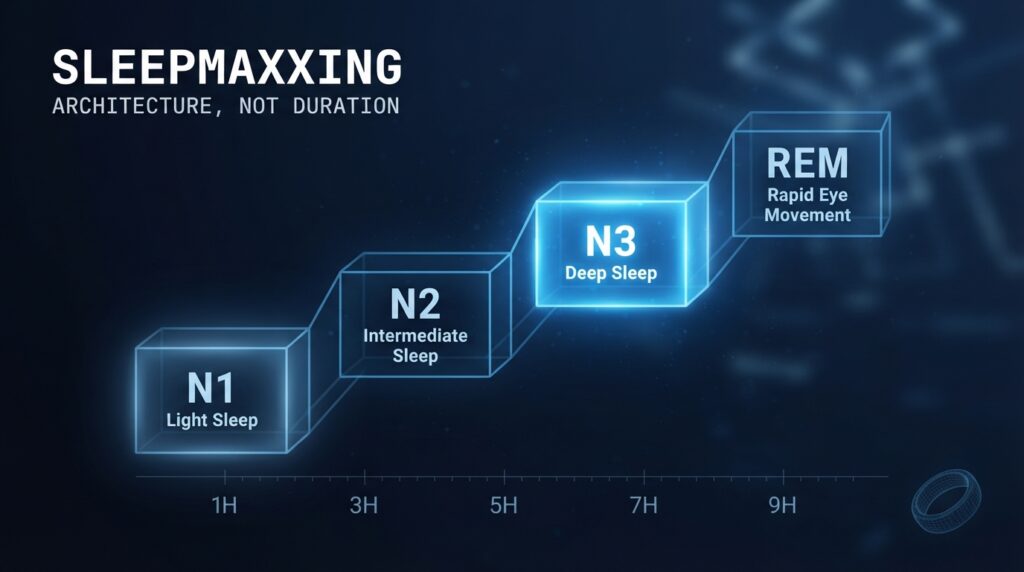
The research consensus in 2026 has moved meaningfully away from “get eight hours” as a primary target. Sleep architecture — the ratio of slow-wave sleep and REM to lighter stages — predicts cognitive performance the following day more reliably than total duration alone. You can sleep nine hours with poor architecture and wake up less cognitively functional than someone who slept seven hours with strong slow-wave consolidation.
For builders running the kind of agent-review and architectural work covered in the Context Switching Cost post, the stakes of poor sleep architecture are concrete. Slow-wave sleep is when the glymphatic system runs clearance cycles — the brain’s overnight cleaning mechanism that removes metabolic waste including the tau and amyloid proteins associated with long-term cognitive degradation. REM sleep is when pattern consolidation and systems-level problem solving occur. Shortchange either stage and you show up to the next day’s architectural decisions with measurably less capacity than the hours on your sleep tracker suggest.
The Sleepmaxxing Protocol: 3 Interventions With Genuine Evidence
1. Thermal Architecture — The Highest-Leverage Single Variable
Core body temperature dropping 1 to 1.5°C triggers sleep onset and gates slow-wave sleep depth. This is the most consistently replicated finding in sleep architecture research, and it’s almost entirely missing from how most builders structure their evenings.
The effective sleepmaxxing protocol here is specific: room temperature between 18 and 20°C throughout the night — not just at onset, because thermal drift during sleep suppresses slow-wave depth even when the initial conditions were correct. A warm shower 60 to 90 minutes before bed accelerates the skin-surface cooling that drives core temperature down. Both of these variables are free and require no product to implement.
This connects directly to the HRV Biohacking Protocol covered in the HRV Biohacking Protocol post in this series — thermal management is the single variable with the strongest observed effect on overnight HRV recovery, independent of any supplement or device.
2. Light Timing — The Circadian Anchor Most Builders Miss
Circadian rhythm synchronization governs when slow-wave sleep and REM occur within the sleep window — not just whether sleep happens at all. Morning sunlight exposure within 30 to 60 minutes of waking is the strongest external signal the circadian system receives. It sets the phase of the entire subsequent sleep-wake cycle, including the timing of the slow-wave consolidation window that determines glymphatic clearance efficiency that night.
The evening side of this is equally important and less discussed in the sleepmaxxing protocol trend content: light below 10 lux in the two hours before bed measurably preserves melatonin onset and deep sleep staging. Hardware-level amber lighting or turning off overhead lights entirely — not a software night-shift filter, which doesn’t reduce photon quantity — is the effective implementation. The full circadian framework behind this is covered in the Circadian Rhythm System post in this series.
3. Cognitive Offload — The Recovery Input No Supplement Replaces
Open cognitive loops — unresolved tasks, unprocessed decisions, unclosed mental tabs — activate the brain’s default mode network in ways that directly compete with slow-wave sleep onset. This is why the standard advice of “don’t use your phone in bed” understates the actual problem: it’s not the device, it’s the unresolved cognitive load the device represents access to.
The sleepmaxxing protocol intervention that consistently helps here is a physical offload: write tomorrow’s three highest-priority tasks and any open decisions in a notebook, not a digital tool, at least 30 minutes before bed. The act of externalizing closes the loops your brain would otherwise rehearse during sleep onset. A 2026 study comparing builders who used this approach against those who didn’t found the notebook group fell asleep faster and reported meaningfully better next-morning focus ratings across a four-week window.
What to Track — and What Not to Obsess Over
Smart ring adoption has accelerated the sleepmaxxing protocol trend significantly in 2026, and the data these devices provide is genuinely useful — with one important caveat from sleep researchers: tracking sleep can itself create sleep anxiety that suppresses the quality you’re trying to measure.
The tracking targets worth monitoring are narrow: your 7-day rolling HRV average as a recovery proxy, and your slow-wave sleep percentage as an architecture quality signal. Single nights are noisy. The trend over a week is informative. Beyond those two, the sleepmaxxing protocol research is consistent — adding more metrics rarely adds more signal, and often just adds more anxiety about optimization.
For context on what good HRV baseline improvement looks like over a four-week implementation window, the HRV Biohacking Protocol post covers the expected trajectory in detail. The short version: weeks one and two are noisy, weeks three and four show the signal.
The Builder’s Takeaway
The sleepmaxxing protocol trend is worth following — but the same principle that applies to agent architecture applies here. Model size isn’t a security property, and sleep duration isn’t a performance property. Architecture is the variable that matters in both cases. Thermal management, light timing, and cognitive offload cost nothing, require no subscription, and address the actual mechanisms that determine whether your sleep produces the cognitive output the next day’s work requires.
Everything else in the sleepmaxxing protocol content ecosystem is either minor optimization on top of those three, or marketing dressed as biohacking. Build the foundation first.
For the full 2026 sleepmaxxing research summary, see Dagsmejan’s science-backed sleep guide for 2026.
This post is part of The Agentic Protocol’s Wellness series — the biological hardware layer beneath every autonomous system you build. See also: HRV Biohacking Protocol.