Deep work is the activity this entire Wellness series has been building toward — and the reason every protocol in it matters.
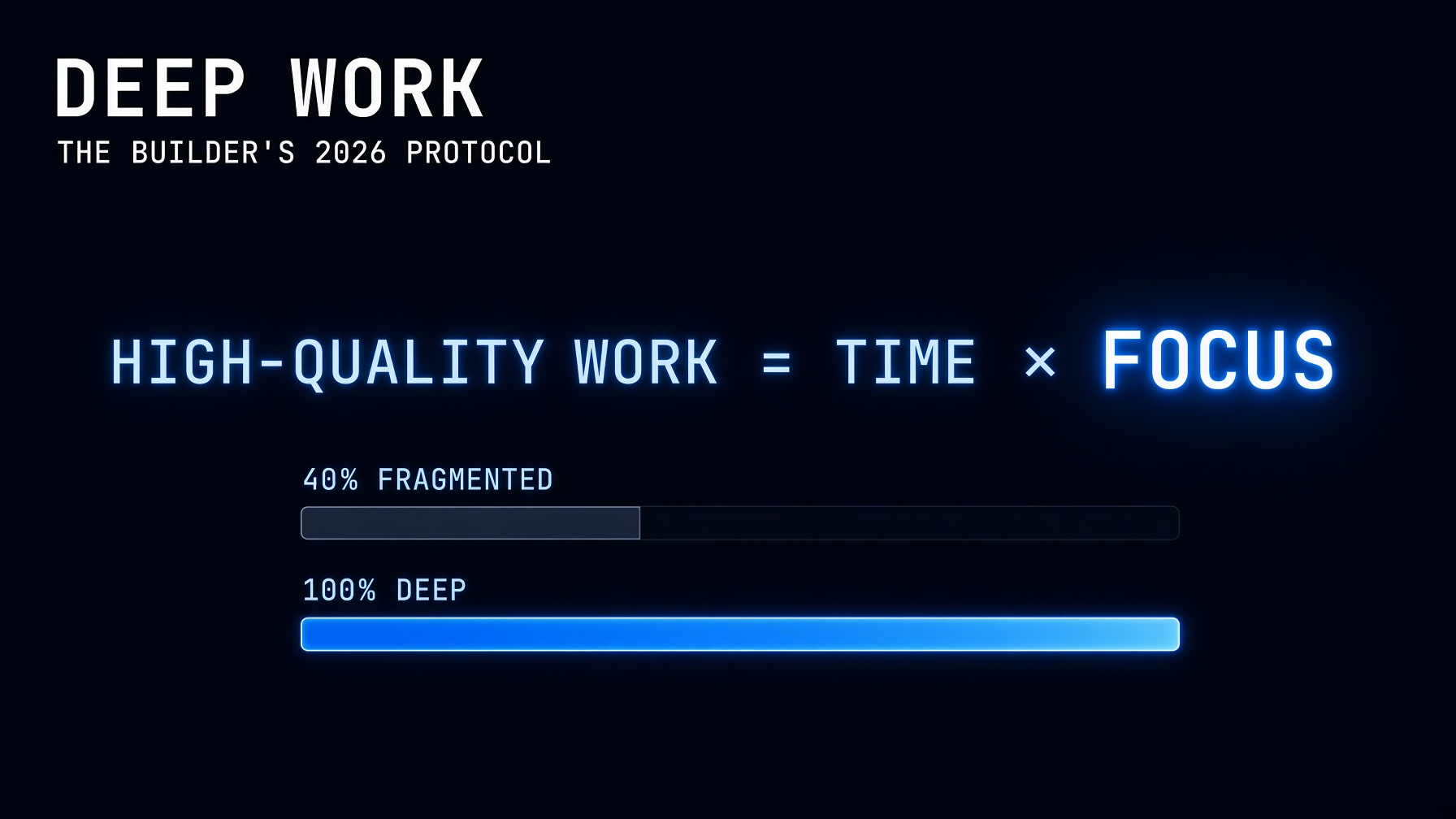
Cal Newport, a Georgetown computer science professor, defined it precisely a decade ago: professional activities performed in a state of distraction-free concentration that push your cognitive capabilities to their limit. These efforts create new value, improve your skill, and are hard to replicate. His formula: High-Quality Work Produced = (Time Spent) × (Intensity of Focus). Context switching, research shows, reduces focus intensity by 40 to 60 percent. Most builders lose output not from insufficient hours but from insufficient intensity — the hours exist, the concentration doesn’t.
In 2026, the problem has a new texture that Newport’s original four rules don’t fully address. AI tools created a grey zone that didn’t exist in 2016: interactions with AI assistants are effortful enough to feel like deep work and fragmented enough to prevent it. Reviewing Claude’s architectural suggestion, iterating on a generated code block, deciding what to keep from a Perplexity research summary — these feel productive. They are not deep work. And the notification ecosystem that competes with deep work has expanded from email and Slack to include AI assistant alerts, project tool integrations, automated monitoring systems, and calendar-triggered check-ins. Every one seems harmless in isolation. Collectively they create the condition Newport described: sustained focus becomes extraordinarily difficult.
This protocol updates Newport’s four rules for the conditions that actually exist now and integrates every other protocol in this series into a coherent architecture for producing deep work at the builder’s cognitive peak.
Rule 1 — Work Deeply: The Four-Block Weekly Structure
Newport’s first rule is architectural: design your schedule around deep work blocks rather than fitting them into the gaps between shallow commitments. Most builders do the opposite — they schedule meetings, standups, and review sessions, then try to find deep work time in the remaining fragments. Fragments don’t support deep work. The minimum unit of useful deep work is 90 minutes of uninterrupted concentration: long enough for the brain to reach the flow state that produces exponentially better output than surface-level engagement.
The four-block weekly deep work structure for builders:
- Block 1 (Monday morning, 90 minutes starting at T+90 in the Morning Routine Protocol): Architecture and planning — the decisions that require holding the entire system in working memory simultaneously. Monday morning, before any meetings or Slack, is when working memory is cleanest and BDNF from the morning’s Zone 2 session is at peak.
- Block 2 (Tuesday or Wednesday morning, 90 minutes): Hard implementation — the code, the design, the document that requires genuine cognitive engagement. Scheduled before any collaborative work that would fragment attention.
- Block 3 (Thursday morning, 90 minutes): Problem-solving — the bug, the optimization, the algorithm, the debugging session that would normally be interrupted at exactly the wrong moment by a calendar notification.
- Block 4 (Friday afternoon, 60 minutes): Review and planning — lighter than the other three, but protected. Use this block to review the week’s deep work output and plan next week’s four blocks before the Weekly Reset Protocol takes over Saturday.
Total protected deep work time: five to six hours per week. This is less than Newport recommends for ideal output, but it’s the realistic floor for a builder managing active client relationships, asynchronous communication obligations, and AI tool oversight. Five protected hours of genuine deep work produces more value than twenty hours of fragmented attention.
Rule 2 — Embrace Boredom: The AI-Age Update
Newport’s original second rule: don’t seek distraction the moment you feel bored. Boredom is the signal that your brain is building the concentration capacity that deep work requires. If you reach for your phone whenever focus becomes effortful, you train the neural circuitry for distraction rather than for sustained concentration.
The 2026 update: in the AI era, the new boredom substitute is asking Claude or GPT-5.6 to solve whatever you’re stuck on. This is not always wrong — AI assistance on a task you understand is genuinely productive. But reflexively querying an AI model when a problem becomes difficult is the cognitive equivalent of checking your phone: it interrupts the effort that would have produced the insight, and the insight itself is more valuable than the AI’s answer because it builds the skill and understanding the AI answer doesn’t.
Newport’s 2026 interview update captures this precisely: letting AI write for you when you should be doing the cognitive work yourself leads to what he calls “work slop” and makes individuals meaningfully less capable over time. The builder who understands the architecture well enough to describe it precisely to Claude produces better AI-assisted output than the builder who delegates the understanding itself. Deep work builds the human capability that makes AI collaboration productive rather than substitutive.
Practical implementation: set a 20-minute rule. Sit with a hard problem for 20 minutes before querying an AI model. Use the physiological sigh when frustration rises. The frustration is the signal that concentration is deepening, not that you should stop.
Rule 3 — Drain the Shallows: Restructuring AI Tool Interaction
Newport’s original third rule: reduce shallow work — email, meetings, administrative tasks — to the minimum necessary. His 2026 update extends this to include high-volume ad hoc messaging and replaces it with structured collaboration that has defined windows rather than continuous availability.
For builders in 2026, the shallow work category has expanded to include AI tool interaction that isn’t driving toward a specific output. Reviewing AI-generated code out of curiosity, running multiple exploratory queries on the same question without a defined decision to make, checking Claude Cowork or ChatGPT Work output before it’s finished — these are the 2026 equivalent of refreshing email. They feel like working with powerful tools. They’re actually shallow work wearing deep work’s clothes.
Three structural changes that drain the 2026 shallow work pool:
- Define AI query windows. Two scheduled windows for exploratory AI interaction per day — 11 AM after the morning deep work block, and 3 PM after the afternoon deep work or coffee nap. Outside these windows, AI queries are goal-specific only: I need this specific output for this specific decision I’m making right now.
- Replace Slack real-time with asynchronous batching. Newport’s “A World Without Email” principle adapted for 2026: check Slack and equivalent channels at defined intervals (11 AM, 2 PM, 5 PM) rather than maintaining continuous presence. The three-interrupt-per-day pattern is already the standard at several companies that have measured the output improvement — they report the same work completed with significantly less subjective effort and higher output quality.
- Define which tasks require deep work and which don’t. Code review: shallow work (pattern recognition, checklist). Architecture decision for a new system: deep work. Responding to a client question: shallow. Drafting the proposal for a new engagement: deep. Explicit categorization before the work week prevents the misallocation of deep work hours to tasks that don’t require them.
Rule 4 — Work Deeply With Your Biology, Not Against It
Newport’s original fourth rule focused on scheduling deep work during your peak cognitive hours and building focus rituals that signal to the brain that concentration mode is beginning. The 2026 update integrates the neuroscience this series has documented into the deep work architecture.
The protocols in this series are not independent habits — they’re the physiological support structure for the deep work blocks above:
- Zone 2 training at T+5 in the morning routine drives BDNF production that peaks at T+90 — exactly when the first deep work block begins. The BDNF from 40 minutes of outdoor aerobic exercise produces measurably better deep work output than the same block attempted without it.
- Cold plunge at T+45 triggers a 250% sustained dopamine surge that reaches peak at approximately T+75 — overlapping with the opening minutes of the deep work block and producing the motivation signal that makes starting the hard thing feel less effortful.
- L-theanine + caffeine at T+60 reaches peak plasma concentration at T+90 to T+120, covering the first 30 minutes of the deep work block with combined alert-calm that neither compound alone reliably produces.
- Dopamine baseline management determines whether deep work feels rewarding or flat. A builder who checks Instagram between the cold plunge and the first deep work block has already spiked the reward system above what the deep work can match. The morning phone-free protocol isn’t arbitrary hygiene — it’s protection of the dopamine environment that makes the deep work block feel worth doing.
- Coffee nap at 1 PM resets the afternoon for a second deep work block by clearing the adenosine that builds during the morning’s concentrated effort. The 1 PM nap is the 90-minute deep work block’s afternoon counterpart — the same physiological investment for the second most productive window of the day.
Newport’s focus ritual — the specific sequence you run before beginning deep work — maps directly to the T+45 through T+90 window of the Morning Routine Protocol. The cold plunge at T+45, box breathing at T+50, L-theanine at T+60, and 30 minutes of calm transition before the block at T+90 constitute the biological focus ritual that Newport describes in behavioral terms. The protocols make the ritual work physiologically rather than just psychologically.
For the original deep work framework, see Cal Newport’s Deep Work — updated for 2026 in his recent podcast appearances and Slow Productivity follow-up.
The Builder’s Takeaway
Deep work is not a productivity technique. It is the cognitive activity that produces the output worth producing — the architectural decisions that shape systems for years, the code that solves problems that couldn’t be solved in fragments, the thinking that builds the understanding that makes everything else possible. In 2026, with AI tools that feel like thinking partners but operate more like high-stimulation distractions when used without intention, Newport’s formula is more true and more actionable than it was in 2016: High-Quality Work = Time × Focus. The four-block weekly structure, the 20-minute hard-problem rule before querying AI, the defined AI interaction windows, and the physiological protocols that make the T+90 block the highest-output hour of the day — these are the components of a deep work architecture that works under current conditions. The insight, the design, the hard fix — those still have to come from the human who trained themselves to concentrate.
Continue in This Series
- Morning Routine Protocol — the 90-minute opening sequence that delivers BDNF, dopamine, and L-theanine precisely at the T+90 deep work block start
- Dopamine Detox Protocol — the baseline reset that makes deep work feel rewarding rather than flat when you sit down for it
- Zone 2 Training Protocol — the 40-minute morning session that produces the BDNF peak that deep work depends on
- Attention Residue — the mechanism that fragments deep work when tasks switch: why the four-block structure with full breaks matters
- Napping Protocol — the 1 PM coffee nap that enables the afternoon’s second deep work block by clearing accumulated adenosine
This post is part of The Agentic Protocol’s Wellness series — the biological hardware layer beneath every autonomous system you build. See also: Morning Routine Protocol.