Stress management in 2026 requires a more precise definition than “find ways to relax.” The neuroscience research from the past decade has produced a specific, mechanistic understanding of what stress does to the brain — and more importantly, which interventions interrupt those mechanisms and at which points. This guide covers the complete picture: what chronic stress actually is, the 2026-specific stress vectors that developers face, the five evidence-based interventions ranked by mechanism quality, and the integrated daily protocol that addresses all five simultaneously.
The core insight that most stress management content avoids: stress is not a psychological experience that produces physical symptoms. It is a physiological cascade — a specific sequence of hormonal and neural events — that produces psychological experiences as a downstream consequence. Managing stress effectively requires intervening in the physiology, not just reframing the psychology. The interventions below all do that, through documented mechanisms, with realistic timelines for when each one produces measurable results.
What Stress Actually Is: The HPA Axis in Four Minutes
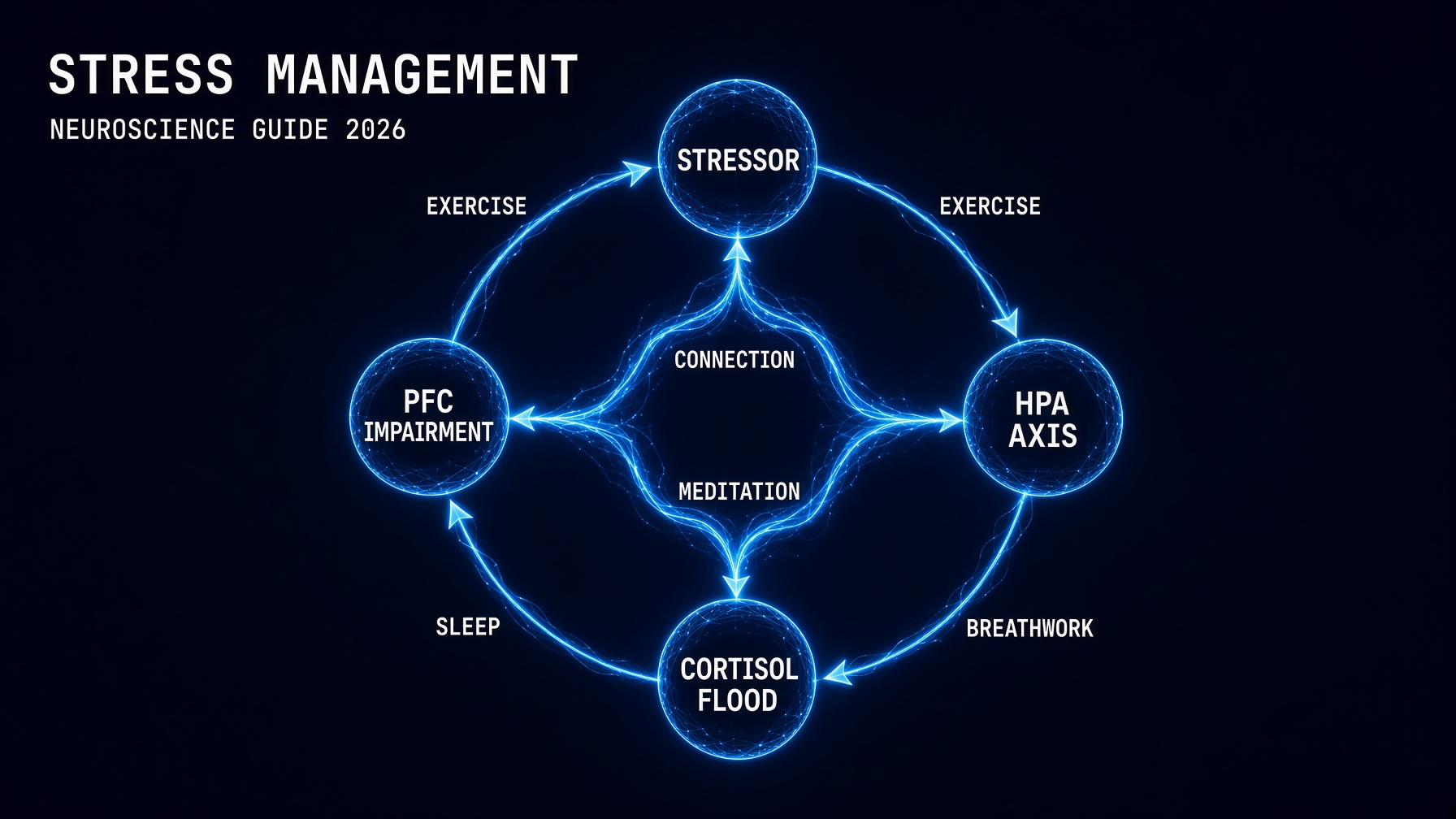
Stress begins in the hypothalamus — the brain region that maintains the body’s internal state. When the hypothalamus detects a threat (real, remembered, or imagined), it activates the hypothalamic-pituitary-adrenal (HPA) axis: a hormonal cascade that releases cortisol from the adrenal glands within 15 to 20 minutes of the stressor. Cortisol mobilizes energy, sharpens immediate threat-focused attention, and temporarily suppresses non-essential functions — immune response, digestion, and the kind of executive processing the prefrontal cortex performs.
This cascade is adaptive for acute stressors. A production incident at 2 AM requires exactly the cortisol-driven focus and energy mobilization that the HPA axis provides. The problem arises when the HPA axis remains activated after the acute stressor has passed — when the cascade that evolved for a 20-minute threat continues running for weeks or months. In that state, chronically elevated cortisol produces the opposite of the adaptive response: hippocampal volume reduction (impairing memory and learning), amygdala hyperactivation (raising anxiety even in safe situations), and prefrontal cortex impairment (degrading the exactly cognitive function that developers depend on most).
The distinction between acute stress and chronic stress is the organizing principle of this guide. Acute stress is the sprint — the HPA axis fires, does its job, and returns to baseline. Chronic stress is when the HPA axis never returns to baseline. Effective stress management is not eliminating the stress response — it is ensuring adequate recovery between activations and preventing the HPA axis from running continuously. The interventions below each contribute to one or both of those goals through different physiological mechanisms.
Why Developers Face Unique Stress Patterns in 2026
Developer stress has always included the specific acute stressor of production incidents — the alert that requires immediate diagnosis under time pressure with consequences for real users. In 2026, three additional stress vectors have emerged that most general stress management advice doesn’t address:
1. AI Adoption Anxiety
New research published in 2026 studying 8,000-plus developers found that generative AI adoption, while increasing productivity, simultaneously increased burnout metrics — particularly among developers whose work was most directly affected by AI code generation. The mechanism: the same tools that reduce time-on-task also introduce persistent low-level anxiety about skill displacement. A developer who observes AI completing tasks that previously required their expertise faces a recurring threat assessment in the prefrontal cortex — not acute enough to trigger a full HPA activation, but persistent enough to maintain chronically elevated cortisol baseline.
2. The Always-On Expectation
AI tools respond instantly. Claude, ChatGPT Work, and production monitoring systems send alerts at any hour. The implicit consequence for developers: the expectation — internal and external — that response time should match the tool’s response time. The 69 percent of remote workers who report that digital communication tools have worsened burnout are experiencing the neurological cost of this expectation: the HPA axis cannot distinguish between a message that requires action and a message that can wait until morning. The phone notification produces the same initial cortisol response regardless of urgency. When notifications are continuous, so is the cortisol.
3. Agentic System Responsibility
Developers who build and deploy AI agent systems in 2026 carry a new category of chronic background stressor: the systems run without supervision. An agent that takes wrong actions autonomously — like the Claude 4.6 instance that accessed a gym’s reservation system without authorization — is a threat to reputation, to client relationships, and potentially to legal standing. The awareness of running autonomous systems generates what the Weekly Reset Protocol‘s Agent Handoff addresses: the chronic low-level anxiety of “what is the agent doing right now?” that persists even during non-working hours. This background activation isn’t acute stress — it’s a continuous low-amplitude HPA activation that compounds across weeks without the recovery periods the axis requires.
What Chronic Stress Does to the Developer Brain
The structural consequences of chronically elevated cortisol are specific enough to explain why burned-out developers describe their experience as they do. Three documented structural changes from sustained cortisol exposure:
- Hippocampal volume reduction. The hippocampus — responsible for forming new memories, integrating experiences, and contextualizing emotional responses — contains the highest density of cortisol receptors in the brain. Under chronic stress, sustained cortisol reduces neurogenesis (the birth of new neurons) in the hippocampus and can produce measurable volume reduction visible in neuroimaging. This is why burned-out developers describe difficulty learning new technologies, reduced ability to remember information they once recalled easily, and the sense that new information “doesn’t stick” the way it did before the burnout period began.
- Amygdala hyperactivation. Chronic stress sensitizes the amygdala — the threat-detection system that fires before the prefrontal cortex can modulate it — producing elevated anxiety in situations that previously felt safe. A burned-out developer who experiences acute anxiety during a routine code review, disproportionate frustration at minor interruptions, or difficulty regulating emotional responses in team interactions is experiencing amygdala hyperactivation: the brain’s threat assessment system is running at chronically elevated baseline.
- Prefrontal cortex impairment. The prefrontal cortex — the brain region responsible for architectural reasoning, sustained focus, impulse control, and the complex decision-making that senior technical work requires — is directly impaired by cortisol. When cortisol attaches to glucocorticoid receptors in the PFC, it reduces the region’s activity and impairs working memory. A burned-out developer who finds it suddenly difficult to hold complex system architecture in working memory, who makes more implementation errors than their experience would predict, or who cannot initiate hard cognitive tasks they previously started without resistance — is experiencing PFC impairment from chronic cortisol elevation. This is not a permanent state. It reverses with adequate recovery — but the recovery requires the biological interventions below, not simply taking time off without addressing the underlying HPA activation pattern.
The 5 Evidence-Based Stress Management Interventions
Intervention 1 — Aerobic Exercise (Best Long-Term Stress Inoculation)
Mechanism: Three distinct pathways, each targeting a different component of the stress response.
- BDNF production repairs hippocampal damage. BDNF (brain-derived neurotrophic factor) reverses the hippocampal neurogenesis suppression caused by chronic cortisol — directly repairing the structural damage that chronic stress produces. This is why exercise is uniquely effective for burnout recovery rather than just stress prevention: it addresses the downstream damage, not just the upstream cortisol.
- Galanin elevation raises the stress threshold. Exercise increases galanin expression in the locus coeruleus — a brainstem nucleus involved in the norepinephrine stress response. More galanin means the locus coeruleus is less reactive to stressors, raising the threshold at which the HPA axis activates. Developers who exercise consistently don’t respond to the same stressors with the same cortisol magnitude as those who don’t — not because they’re psychologically more resilient, but because the biological stress threshold is genuinely higher.
- HPA axis recalibration. Regular aerobic exercise improves HPA axis recovery — the speed at which cortisol returns to baseline after a stressor. A developer who exercises consistently may produce the same acute cortisol spike in response to a production incident but clear it 40 to 60 percent faster than a sedentary developer, reducing the cumulative chronic cortisol load.
Effective dose: 150 minutes per week of moderate aerobic exercise (Zone 2 pace — conversational, 60 to 70 percent max heart rate) or 75 minutes of vigorous exercise. The Zone 2 Training Protocol provides the complete implementation. Effects on BDNF begin after a single session; the structural stress-threshold improvements accumulate over 4 to 8 weeks of consistent practice.
Intervention 2 — Controlled Breathing (Fastest Acute Stress Relief)
Mechanism: The autonomic nervous system — which controls the HPA axis — can be voluntarily modulated through breathing. The extended exhale specifically activates the parasympathetic nervous system by increasing vagal tone: the physiological sigh (double nasal inhale, long exhale) produces the fastest documented shift from sympathetic to parasympathetic state — measurable within 30 seconds of a single breath cycle.
Box breathing (4-second inhale, 4-second hold, 4-second exhale, 4-second hold) activates the parasympathetic nervous system within 2 to 4 minutes, reducing cortisol and producing the calm-alert state that executive work requires. The complete protocol is in the Breathwork Protocol guide.
When to use it: At the transition from high-stress work to focus work (between an incident response and a coding session), at the start of a difficult conversation, when a notification produces an anxiety response before you’ve read the content, and as the parasympathetic on-ramp before the morning’s meditation session. Controlled breathing is the only intervention on this list that produces acute stress relief in under five minutes — which makes it the most valuable tool for immediate response to acute stressors.
Intervention 3 — Meditation (Best Long-Term PFC-Amygdala Recalibration)
Mechanism: Mindfulness-Based Stress Reduction (MBSR) — the clinical 8-week program — has been validated in hundreds of randomized controlled trials. It reduces perceived stress, cortisol levels, and inflammatory markers. The structural mechanism: meditation strengthens the connection between the prefrontal cortex and the amygdala, improving the PFC’s ability to modulate the amygdala’s threat response. This directly addresses the amygdala hyperactivation that chronic stress produces — not by suppressing the amygdala’s initial reactivity, but by improving the PFC’s regulatory influence over it.
A 2026 UC San Diego study found measurable brain connectivity changes after just 7 days of intensive practice. The 8-week structural changes — reduced amygdala gray matter volume, increased PFC gray matter density — are documented in neuroimaging research. Cortisol levels drop 25 to 30 percent with consistent practice. For developers experiencing chronic stress, the meditation practice addresses the primary structural damage mechanism directly — it is the intervention most specifically targeted at the PFC-amygdala circuit that chronic stress disrupts. The complete beginner’s implementation is in the How to Meditate guide.
Intervention 4 — Sleep (Non-Negotiable HPA Axis Recovery)
Mechanism: The HPA axis requires deep slow-wave sleep to suppress cortisol production and restore baseline sensitivity. Without adequate sleep, the axis runs a sustained activation pattern that continues producing cortisol during rest periods — which is why burned-out individuals often report feeling exhausted regardless of how much time they spent in bed. The sleep is occurring, but the HPA axis recovery that deep sleep enables isn’t happening because the activation is overwhelming the suppression mechanism.
Sleep deprivation compounds the stress response: a sleep-deprived individual produces larger cortisol spikes in response to the same stressor than a rested individual, and clears that cortisol more slowly. Over time, the cortisol accumulation from sleep deprivation produces the same hippocampal and PFC damage as chronic stress from external sources. The two causes are additive — chronic stress that disrupts sleep and sleep deprivation that amplifies stress create a compounding cycle that accelerates burnout trajectory dramatically. The complete sleep architecture guide is in the Sleepmaxxing Protocol.
The practical floor: 7 to 9 hours of sleep per night is the minimum for adequate HPA axis recovery. This is not negotiable in the context of chronic stress management. A developer attempting to manage work stress through meditation and exercise while sleeping 5 to 6 hours per night is counteracting the interventions with the sleep deprivation. Sleep comes first in the recovery hierarchy.
Intervention 5 — Social Connection (The Underrated Oxytocin Response)
Mechanism: Positive social contact — a genuine conversation with someone trusted, a moment of physical contact, sustained eye contact with a person who feels safe — releases oxytocin from the hypothalamus. Oxytocin acts directly on the amygdala, reducing its reactivity to threat stimuli. It also acts on the HPA axis itself, dampening cortisol release at the source. This is not a metaphorical “connection is good for you” claim — it is a specific neurochemical pathway in which oxytocin physically counteracts cortisol through molecular binding on the same receptors.
The Neurosity neuroscience review makes the point precisely: humans are not designed to handle stress alone — this is not a motivational platitude, it is a neurochemical fact. Solo builders who work in isolation without genuine social contact are removing the primary biological mechanism through which the oxytocin system counteracts chronic HPA activation. The Solo Founder Isolation guide covers the specific implementation for developers who work primarily alone.
The practical implication for developers: scheduling deliberate social contact — not networking, not synchronous work meetings, but genuinely personal interaction with trusted people — is a stress management intervention with a specific biological mechanism. The minimum effective dose from the research: one to two genuine social interactions per week in person or in high-bandwidth synchronous contact (video with a real relationship, not a work meeting).
The Reframing Technique: Stress as Challenge vs. Threat
Beyond the five biological interventions above, one psychological technique has consistent research support for reducing cortisol in response to the same stressor: reframing the stress response as a challenge signal rather than a threat signal.
The research finding: when individuals are told that their stress response (elevated heart rate, increased alertness, heightened attention) is a functional preparation for a challenging task rather than a sign of danger, the physiological profile of their response shifts. The cortisol pattern associated with the threat response (overwhelming, negative) decreases. The DHEA pattern associated with the challenge response (preparing, mobilizing) increases. The task performance improves. The same physiological arousal — identical heart rate, identical cortisol magnitude — produces different downstream effects depending on the cognitive framing of what it means.
The practical implementation: when you notice the physical signs of stress before a difficult task — the tightening, the alertness, the elevated heart rate — note it explicitly: “This is my body preparing me. I have the resources to handle this.” The reframe is not denial of the stress response. It is an accurate description of what the acute HPA activation is actually doing: preparing the system for a demanding task. The research shows that this accurate reframe reduces the cortisol overshoot associated with the threat interpretation and improves both performance and post-task recovery.
Stress Inoculation: Building Resilience Before the Incident
Stress inoculation is the counterintuitive stress management approach with the strongest long-term research support: deliberate exposure to manageable stressors, in controlled conditions, to raise the biological stress threshold before high-stakes stressors arrive. The military, first responders, and elite athletes all use stress inoculation training — the principle is the same as exercise for cardiovascular conditioning: controlled exposure to the stress response trains the system to handle the response more efficiently.
For developers, practical stress inoculation takes three forms:
- Cold exposure (the most efficient biological inoculation). The cold plunge or cold shower deliberately activates the acute stress response — cortisol, norepinephrine, elevated heart rate — in a controlled environment with no negative consequences. Repeated cold exposure trains the HPA axis to respond to the activation signal without the catastrophizing amplification that untrained systems produce. Over weeks of consistent practice, the cold exposure response becomes calmer — not because the cold gets warmer, but because the HPA axis has calibrated its response to manageable challenge. This calibration transfers to other acute stressors, including production incidents. The full implementation is in the Cold Plunge Protocol.
- The 20-minute hard problem rule. Deliberately working on a genuinely difficult technical problem for 20 minutes before querying an AI model — as described in the Deep Work Protocol — is a mild stress inoculation in the cognitive domain. The frustration of sustained effort on a hard problem is a form of manageable challenge that, with practice, becomes tolerable and eventually motivating rather than aversive.
- Scheduled exposure to minor inconveniences. Research on stress inoculation in everyday life found that deliberately exposing oneself to minor discomforts — cold walks without a jacket, difficult conversations initiated rather than avoided, voluntary commitment to challenging tasks before easier ones — produces measurable improvements in HPA axis resilience over 6 to 8 weeks. The common thread: voluntary exposure to manageable challenges trains the system that challenges are manageable, which reduces the catastrophizing threat interpretation that amplifies the stress response.
The Complete Daily Stress Management Protocol
The five interventions above, integrated into a daily structure that implements all five without requiring additional time allocation beyond the protocols already in this series:
| Time | Intervention | Mechanism Addressed | Duration |
|---|---|---|---|
| T+5 | Zone 2 outdoor exercise | BDNF repair, galanin threshold elevation, HPA recalibration | 40 min |
| T+45 | Cold plunge/shower | Stress inoculation, acute cortisol clearance, dopamine | 3 min |
| T+50 | Box breathing + meditation | Parasympathetic activation, PFC-amygdala recalibration | 15–20 min |
| 11 AM | Notification batch (no earlier) | Prevents continuous low-amplitude HPA activation from alerts | 15 min |
| Agent Handoff (6 PM) | Document all running AI system status | Closes the agentic anxiety open loop (oxytocin neutral) | 10 min |
| Evening | Genuine social contact (≥2×/week) | Oxytocin release, HPA dampening at source | 30–60 min |
| Bedtime (consistent) | 7–9 hours sleep | HPA axis recovery, cortisol clearance, hippocampal repair | 7–9 hr |
The key architectural insight: the five interventions above are not isolated stress management techniques to be added to an existing schedule. They are the load-bearing elements of the biological recovery system that enables productive, sustainable developer work. Removing any one of them degrades the others — chronic sleep deprivation negates exercise’s HPA recalibration benefits; social isolation eliminates the primary oxytocin counter to cortisol; skipping exercise removes the galanin stress threshold elevation that makes the cold plunge and meditation’s effects more durable.
When the Protocol Isn’t Enough: Recognizing Clinical Burnout
The World Health Organization classifies burnout as an occupational phenomenon in the International Classification of Diseases, characterized by three dimensions: feelings of energy depletion or exhaustion, increased mental distance from one’s job or feelings of negativism or cynicism related to one’s job, and reduced professional efficacy. This clinical definition distinguishes burnout from stress: stress is excessive demands with adequate resources; burnout is the collapse of the resource system itself.
The neuroscience research is specific about what distinguishes burnout from high stress: burnout produces HPA axis dysregulation in which the axis no longer responds appropriately to any stressor. Burned-out individuals may show paradoxically low cortisol reactivity (the axis has been running so long it has down-regulated sensitivity) alongside chronically high baseline cortisol. This pattern is distinct from acute high stress and does not respond adequately to the five interventions above alone — because the interventions require a functioning HPA axis to produce their effects.
If the protocol above has been consistently applied for 4 to 6 weeks and the primary symptoms (exhaustion regardless of sleep, emotional numbness, inability to care about outcomes that previously mattered) persist or worsen, the appropriate next step is consultation with a mental health professional who works with occupational burnout. Addressing only the individual biological interventions while leaving the structural conditions unchanged — workload, autonomy, organizational support — tends to produce limited results for clinical burnout. The interventions in this guide are evidence-based and effective for stress management and burnout prevention. They are not a substitute for clinical support when burnout has progressed past the biological recovery system’s capacity to self-correct.
For the complete neuroscience research on stress management interventions, see Neurosity’s 2026 evidence-based stress management techniques guide.
The Builder’s Takeaway
Stress management in 2026 is a biological recovery engineering problem, not a psychological resilience problem. The HPA axis fires cortisol in response to threats — real, perceived, and anticipated. Chronic cortisol produces hippocampal damage, amygdala hyperactivation, and PFC impairment: the exact cognitive consequences that developers describe as burnout. The five interventions above each target specific mechanisms in this cascade: exercise repairs hippocampal damage and raises the stress threshold through BDNF and galanin; controlled breathing produces immediate parasympathetic activation that interrupts the cortisol spike; meditation recalibrates the PFC-amygdala circuit that chronic stress damages; sleep enables the HPA axis recovery that no other intervention can substitute; and social connection releases oxytocin that counteracts cortisol at the molecular level. The reframing technique reduces the cortisol overshoot associated with the threat interpretation of the stress response. The stress inoculation approach builds the biological resilience that prevents threshold overload before the next incident arrives. Applied together, as the daily protocol above structures them, these interventions don’t produce a stress-free existence — they produce a system where stress activates appropriately, clears efficiently, and leaves the cognitive infrastructure intact for the work that requires it.
The Complete Wellness Series Referenced in This Guide
- Zone 2 Training Protocol — the 150-minute weekly aerobic exercise that produces BDNF repair and galanin stress threshold elevation
- Cold Plunge Protocol — the stress inoculation intervention that trains HPA axis calibration through controlled acute exposure
- Breathwork Protocol — the physiological sigh and box breathing that produce immediate parasympathetic activation
- How to Meditate — the 12-minute meditation protocol that produces the PFC-amygdala recalibration this guide describes
- Sleepmaxxing Protocol — the HPA axis recovery architecture that enables all other stress interventions to work as intended
- Solo Founder Isolation — the social connection implementation for developers who work primarily in isolation
- Weekly Reset Protocol — the Agent Handoff that closes the agentic system anxiety loop before the weekend
- How to Improve Focus — the focus restoration guide whose effectiveness depends on the stress management baseline this guide builds
This post is part of The Agentic Protocol’s Wellness series — the biological hardware layer beneath every autonomous system you build. See also: How to Improve Focus.