Every “make money as a developer” article lists 50 ideas and promises passive income by Friday. This is not that article.
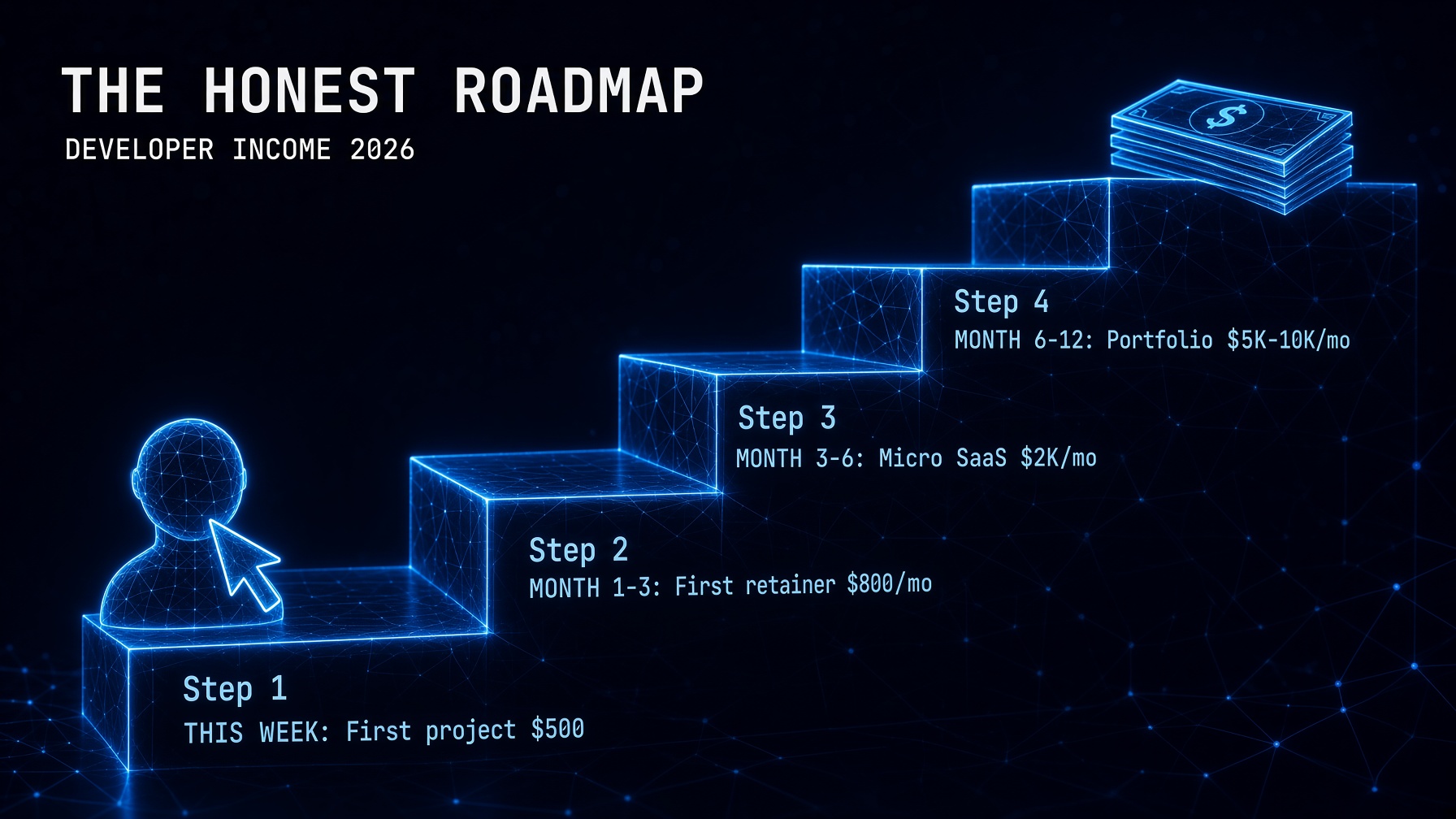
The realistic developer income roadmap in 2026 has four tiers, each with a different time-to-first-dollar, a different effort profile, and a different ceiling. The critical insight from developers who have actually built multiple income streams: the order matters. Trying to build a SaaS product before you have your first consulting client is building a product without market validation. Getting a consulting client before you have any portfolio is harder than it needs to be. The sequence below is the order that produces the fastest total income growth — not the order that sounds most appealing in a blog post.
The Honest Income Distribution Reality
Before the roadmap: the distribution that most guides omit. Software engineers have unique advantages for building income beyond salary — the ability to build software others pay for, write content others learn from, and deploy capital from a high base salary. But income across developer side streams follows the same power law as everything else: most people earn very little from their first attempt at each tier, and the median developer side income is much closer to $200 per month than to $5,000.
The developers earning at the top of each tier share three traits: they chose a stream aligned with existing skills (not skills they planned to learn), they maintained consistent output for at least six months before expecting meaningful income, and they sold services before building products — validating what people would actually pay for before investing in infrastructure. This roadmap is designed around those three principles.
Tier 0 — This Week: The First Paid Project
Target income: $300 to $2,000. Time to first dollar: 3 to 14 days.
The fastest path to developer income is the path with the least infrastructure: find one person with a painful problem you can solve with code, quote a fixed price, deliver it, collect payment. No website required. No portfolio required. No Upwork profile required. One conversation, one project, one invoice.
In 2026, the highest-demand Tier 0 projects for AI-capable developers are automation scripts (email processing, data extraction, report generation), AI integrations for existing tools (connecting Claude or GPT to a company’s existing workflow), and EU AI Act disclosure implementations. Jobs paying $50 to $70 per hour for simple email-parsing agents that take 2 to 3 days to build are documented on freelance platforms — the demand for basic AI workflow automation from non-technical business owners exceeds the supply of developers who can deliver it reliably.
The Tier 0 play: identify three people in your network who run small businesses, professional services practices, or content operations. Ask: “What takes the most time in your week that you wish you didn’t have to do?” The answer is your first project. The complete client acquisition playbook is in the How to Get Clients as an AI Developer guide. Pricing for this first project is in the AI Consulting Rates 2026 post.
Tier 1 — Months 1 to 3: The First Retainer
Target income: $300 to $1,500 per month recurring. Time to first dollar: 2 to 6 weeks.
A Tier 0 project generates one invoice. A Tier 1 retainer generates recurring income for as long as you deliver results. The transition from project to retainer is the most important move in the developer income roadmap — and it happens most naturally at the end of a successful first project, before the client has closed out the budget and while the results are fresh.
The three retainer types that work for AI developers, ranked by hours required per month:
Tier 1 milestone: One monitoring retainer at $400/month. This is the proof-of-concept that the recurring income model works for you specifically, and it provides the case study that makes the next retainer easier to sell.
Tier 2 — Months 3 to 6: The First Product
Target income: $500 to $3,000 per month (combined retainers + product). Time to first product dollar: 4 to 8 weeks after launch.
The Tier 2 move is to productize the work you’ve already done for Tier 0 and Tier 1 clients. The EU AI Act compliance implementation you built for Client A is a template worth $79 on Gumroad. The AI agent monitoring script you built for Client B is a starter kit worth $49. The LangChain RAG implementation you built for Client C is a documented, deployable package worth $99.
This is the “stop thinking in projects, start thinking in assets” principle from the Passive Income for Developers post. You don’t build new things for Tier 2 — you package what you’ve already built into a form that sells while you sleep. A starter kit at $49 selling 20 copies per month generates $980 passive income from code you already wrote.
The Micro SaaS Ideas 2026 post lists seven specific products at $19 to $99 per month that are built from the skills in this series. The SaaS Pricing Strategy post covers the margin math that determines whether your product is actually profitable at scale.
Tier 2 milestone: Two active retainers ($1,200/month combined) plus one digital product generating $200 to $500 per month. Total: $1,400 to $1,700 per month. This is where the income starts to feel real — a meaningful supplement to a salary, or a viable part-time income for a developer reducing hours.
Tier 3 — Months 6 to 12: The Compounding Portfolio
Target income: $3,000 to $10,000+ per month. What changes at Tier 3: The income streams compound rather than adding linearly.
At Tier 3, four things happen that don’t happen at earlier tiers:
The Complete Wealth Series — Every Guide in This Roadmap
- Tier 0 — Find clients: How to Get Clients as an AI Developer | AI Consulting Rates 2026
- Tier 1 — Build retainers: Micro-SaaS AI Agent retainer model | AI Compliance Services
- Tier 2 — Productize: Micro SaaS Ideas 2026 | SaaS Pricing Strategy | Passive Income for Developers
- Tier 3 — Scale: AI Agent Passive Income | Automated Stablecoin Yield | AI Side Hustle 2026
This post is the hub for The Agentic Protocol’s Wealth series. See also: AI Side Hustle 2026.