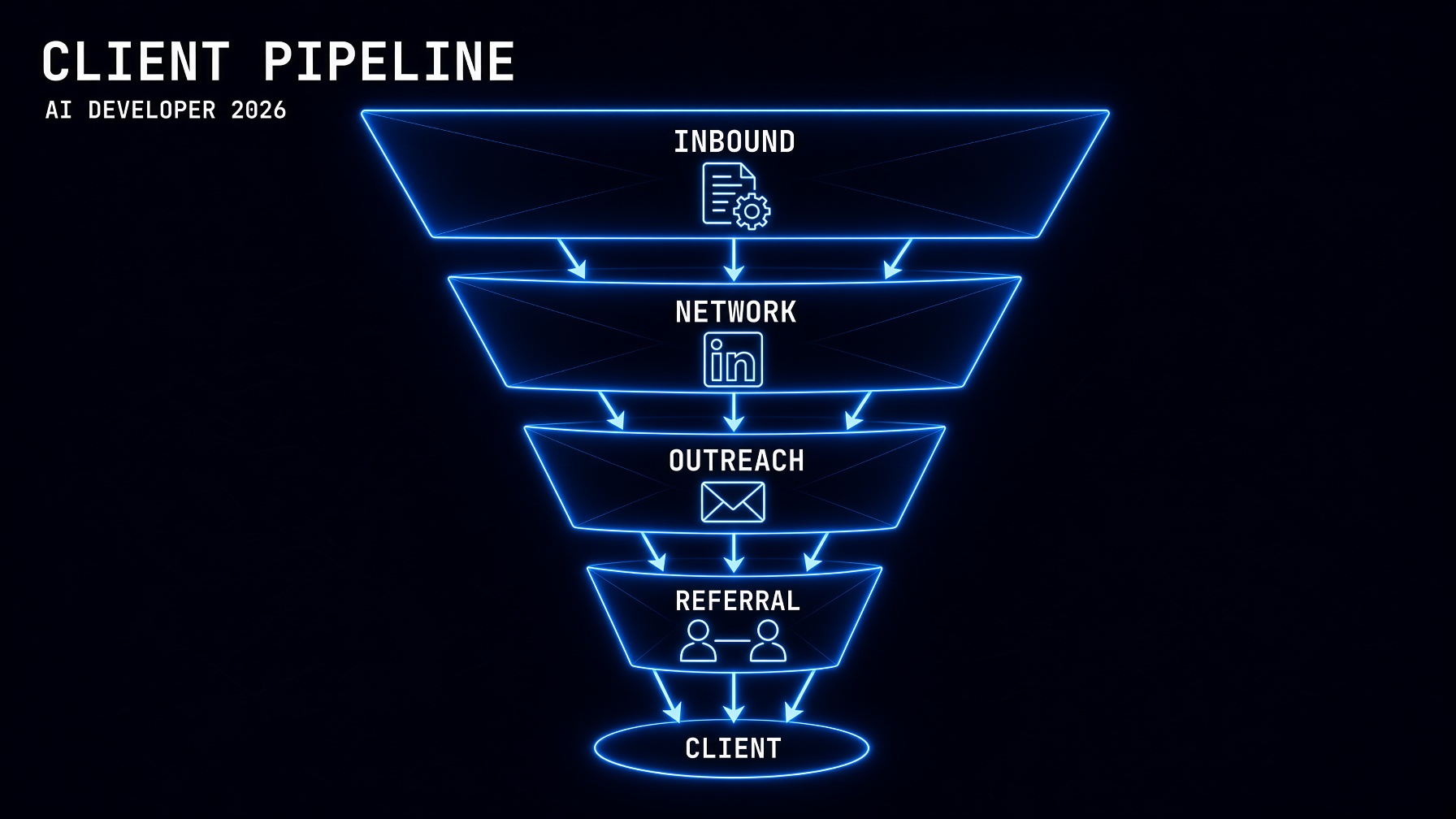
Getting clients as an AI developer in 2026 is easier than most guides suggest — and harder than most expectations assume. The supply-demand imbalance is real: demand for AI and machine learning freelancers increased by 1,847 percent between 2023 and 2026, while the global AI market reached $826 billion in 2026 from $387 billion three years earlier. Most companies that want AI development help can’t hire it fast enough. That’s the opportunity.
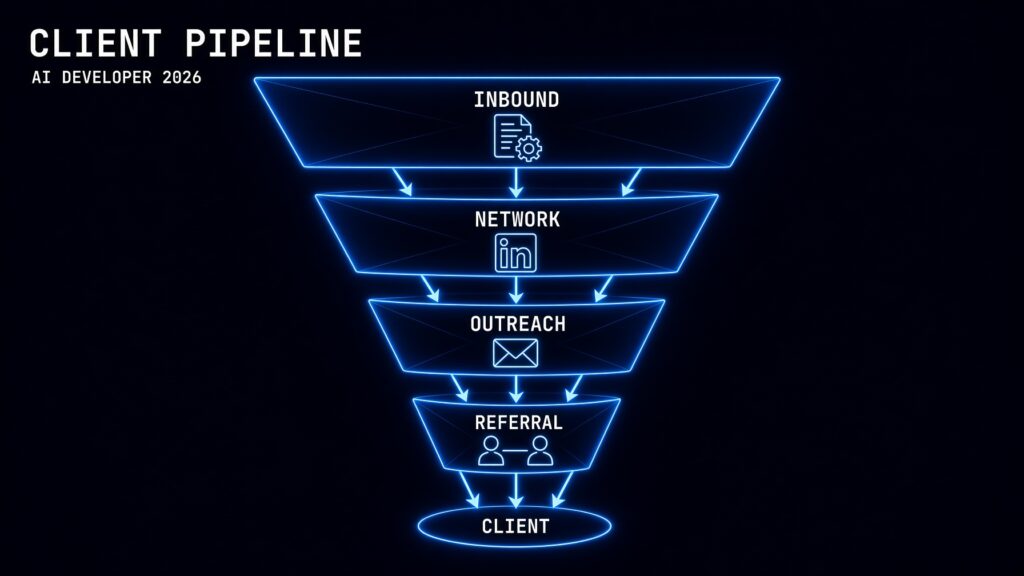
The difficulty is not finding companies that need AI development. They’re everywhere. The difficulty is positioning yourself specifically enough that the right companies recognize you as the solution to their specific problem — not another generic “AI developer” in a market full of them. This guide covers the four client acquisition channels that work for AI developers in 2026, the positioning work that makes all four more effective, and the discovery call framework that converts an interested contact into a signed engagement.
The Positioning Work You Have to Do First
Good positioning should be immediately understandable to a busy CEO who has 30 seconds on their phone between meetings. “Full-stack AI developer” is not positioning. “I build Python AI agents that automate back-office workflows for professional services firms” is positioning. The difference: the first describes your skills, the second describes your customer and their problem.
Three questions to answer before any outreach:
- Which industry do you know well enough to understand their problems without explanation? Finance, healthcare, legal, e-commerce, SaaS — pick one. The builders who earn at the top of the AI consulting rate ranges command premiums because they understand what an accounts payable workflow problem costs a CFO, not just how to build the automation that fixes it.
- What specific deliverable do you produce? “AI agents” is not a deliverable. “An agent that processes your inbound customer support tickets and routes them with 95% accuracy, saving your team 15 hours per week” is a deliverable. The more specific the outcome, the shorter the sales conversation.
- What’s the simplest proof that it works? One documented case study — even a personal project or a reduced-rate engagement — that shows the before state, the after state, and a specific number. “Reduced manual data entry from 8 hours to 20 minutes per week” is the proof you need. Everything else is a claim.
Test your positioning with this exercise: show it to five people who don’t work in tech. Ask them: “Who do I help, and what problem do I solve?” If they can’t answer in plain language, the positioning is too vague to appear in anyone’s mind when they need what you do.
The 4-Channel Client Pipeline for AI Developers
Channel 1 — Building in Public (Highest-Quality Inbound, Slowest Ramp)
Building in public generates the highest-quality inbound leads of any client acquisition channel — people who have already read your work, understood your approach, and decided they want to work with you specifically. The lead arrives pre-qualified. The sales conversation is shorter. The client churn is lower because the client chose you for your perspective, not for your availability on a platform.
What building in public means for an AI developer: writing tutorials that demonstrate how you solve problems (the How to Build an AI Agent guide in this series is an example), publishing case studies that show before-and-after results, and documenting the frameworks and patterns you use to approach AI engineering decisions. The audience that builds from this content is the audience most likely to hire you.
The realistic timeline: six to twelve months before meaningful inbound traffic. This is not the channel you use to get a client this month. It’s the channel you build in parallel that makes every other channel easier as your name becomes associated with your specific expertise.
Channel 2 — LinkedIn Presence (Best Warm Channel, One Week to Start)
LinkedIn is the foundation of outreach for AI developer client acquisition in 2026 — prospects Google you the moment they receive your outreach email, and your LinkedIn profile is what they see. Fix it before you do anything else.
The headline formula that works: Specific Skill + Deliverable + Numbers. Not “AI Developer.” Try: “AI Agent Builder | Automate your back-office workflows | Built 12 production agent systems for SMBs.”
Beyond the profile: one substantive post per week that documents a specific technical decision, shares a result from a recent project, or explains a concept your target clients need to understand. The posts don’t need to go viral — they need to demonstrate expertise to the specific people checking your profile after receiving your outreach. A profile with 20 substantive posts on AI agent development converts prospect visits to discovery calls at dramatically higher rates than a profile with no posts and the same headline.
Channel 3 — Personalized Cold Outreach (Fastest to First Client, Highest Effort)
Cold emailing is not dead — it’s smarter. In 2026, cold outreach for AI developers converts at significantly higher rates than in other freelance categories because the supply-demand imbalance means most recipients are genuinely interested in AI development help and haven’t been able to find quality vendors. An AI developer reaching out to the right company with a specific, personalized message is more welcome than almost any other category of cold email.
The formula for a cold email that gets responses:
Subject: [Specific observation about their product/problem]

Hi [First Name],

[Personal intro: one sentence referencing something specific about their
business — a recent product launch, a job posting that reveals a pain point,
a LinkedIn post they wrote. Not "I came across your company." Something real.]

[One sentence describing who you help and how]: I build Python AI agents for
[their industry] companies that [specific outcome] — usually reducing
[specific time/cost pain point].

[One sentence of relevant proof]: I recently [built X for Company Y] that
[specific measurable result].

[One specific question that requires a simple yes/no or short answer]:
Is automating [specific workflow you've identified from their context]
something your team is looking at this quarter?

[Name]
[1-line positioning statement]
[Link to one piece of relevant work]
The entire email is under 150 words. The subject line references their specific situation. The proof is one concrete result, not a list. The call to action is a yes/no question, not “let’s get on a call.” Follow up twice at 4-day intervals before moving to the next prospect. Track every outreach in a simple spreadsheet: prospect, date, channel, follow-up dates, response.
Channel 4 — Network and Referrals (Most Reliable Long-Term, Needs Existing Clients)
The highest-converting client source for established AI developers is referrals from existing clients. A client who received real results from your work will refer similar clients unprompted — but they can’t refer you to problems you haven’t demonstrated you solve. Before expecting referrals, deliver results that are specific and measurable enough that the client can tell someone else about them in two sentences.
Accelerate referrals with one direct ask after a successful project: “If you know anyone else at a [similar company type] who’s dealing with [the specific problem you solved], I’d be glad to have a conversation. My best clients have come from referrals.” This is not uncomfortable to ask because you’ve already delivered results — and most clients who experienced good results are genuinely happy to help if you make it easy.
The Discovery Call Framework That Closes Projects
When someone responds to your outreach or inbound content and agrees to a call, the discovery call has one goal: understand whether their problem is one you can solve, and whether they have the budget and decision authority to hire you. Not every discovery call should become a project — a client whose problem doesn’t match your expertise, whose budget is below your floor, or whose timeline is unrealistic is a client who will generate a difficult engagement and a low-quality referral.
The four questions that structure every discovery call:
- “What’s the specific workflow or problem you want to address?” Let them describe it in their words. Don’t suggest technical solutions yet. You’re mapping the problem space, not pitching.
- “How are you handling this today, and what’s the cost of that current approach?” The cost might be labor hours, error rate, customer churn, or opportunity cost. The number they give you is the value ceiling for your proposal.
- “What would success look like in 90 days?” This question forces specific success criteria before you propose anything — and reveals whether their expectations are realistic. “I want to reduce this from 6 hours to 30 minutes” is solvable. “I want to eliminate all manual work across our entire operations” is a scope conversation.
- “What’s your timeline, and who else is involved in this decision?” Timeline reveals urgency. Decision authority reveals whether you’re talking to the buyer or a gatekeeper. Both affect how you structure the next step.
After these four questions, you know whether to proceed. If yes: “Based on what you’ve described, I think I can help. The next step for me is to put together a scoped proposal — would you be available [specific time] to review it together?” Do not send a proposal by email without a scheduled call to walk through it. A proposal reviewed without you present almost always gets price-compared or ignored.
From First Project to Retainer: The Transition That Matters Most
A one-time project client generates one invoice. A retainer client generates recurring income for as long as you deliver results. The transition from project to retainer happens most naturally at the end of a successful first project — before the client has closed out the budget, before they’ve moved on to the next priority, and while the results are still fresh.
The retainer conversation happens in the project retrospective, not in a separate sales call: “The [specific result] we achieved was the goal for phase one. There are a few natural next steps — [specific opportunity 1] and [specific opportunity 2]. I could continue as a monthly engagement at [rate] and we’d address those over the next quarter. Would that be useful to discuss?”
The retainer offer works when: the first project succeeded (they trust you), there’s genuinely more to do (they need you), and you make the ongoing engagement feel like a continuation rather than a new sales relationship. The Micro-SaaS retainer model in this series covers the service structure; this is the conversation that makes the first retainer happen.
For the complete freelance AI developer pipeline, see Idlen’s 2026 freelance AI developer guide.
The Builder’s Takeaway
Getting clients as an AI developer in 2026 starts with positioning that’s specific enough to survive a 30-second phone screen, runs through four parallel acquisition channels with different timelines and effort levels, and converts through a discovery call structure that qualifies as much as it sells. The supply-demand imbalance is your structural advantage: you’re in a category where demand grew 1,847 percent in three years and the supply of developers who can actually deliver production-quality agentic systems has grown far more slowly. Cold emails convert. LinkedIn posts get read. Referrals come quickly from clients who got real results. The variable that determines whether you capture any of this is how precisely you’ve defined who you help and what you do for them — before you send a single message or post a single word.
Continue in This Series
- AI Consulting Rates 2026 — what to charge once you have the client on the call
- Micro-SaaS AI Agent — the retainer service model and unit economics behind the project-to-retainer transition
- AI Compliance Services — the compliance service with highest current demand urgency and lowest sales cycle friction
- Micro SaaS Ideas 2026 — the seven products that give you the portfolio evidence the cold email needs
- AI Side Hustle 2026 — the honest income trajectory before you build a full client pipeline
This post is part of The Agentic Protocol’s Wealth series — the autonomous capital layer beneath every agent pipeline. See also: AI Consulting Rates 2026.