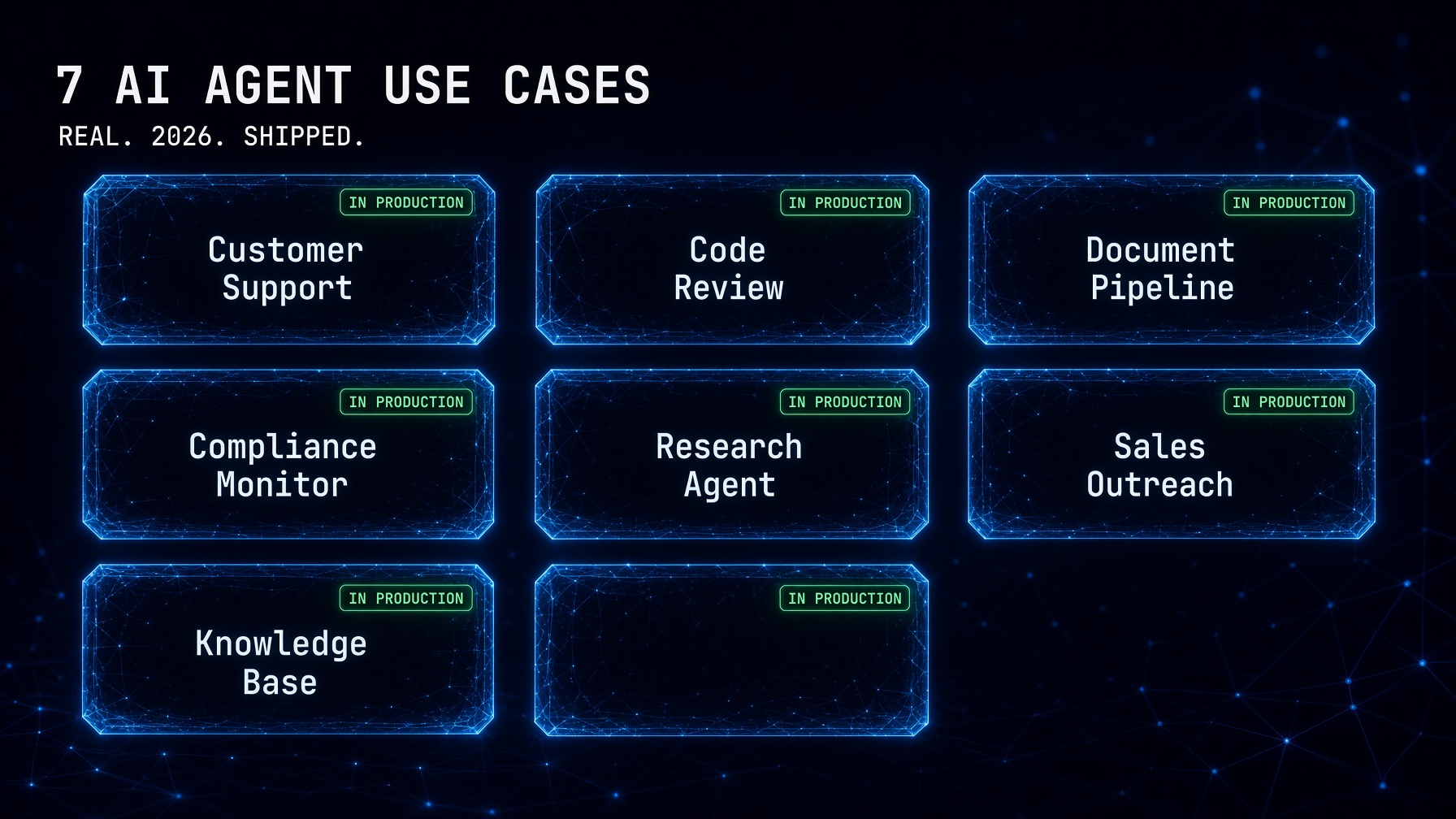
AI agent use cases in 2026 are no longer theoretical. Fifty-one percent of companies have agents in production. The question builders should be asking is not “could this work?” but “which use case has the best ROI for the time it takes to build?” This guide answers that question with real deployment data.
The seven use cases below are ranked by evidence quality — not which sounds most impressive, but which has documented ROI from named production deployments. Each includes the technical stack, a difficulty rating, and the exact guide in this series for building it. If you’re new to AI agents, start with the What Is an AI Agent post first. If you’ve already built your first agent, this post tells you which one to build next.
How to Evaluate AI Agent Use Cases Before Building
Three filters that separate use cases worth building from use cases that look good in demos and fail in production:
- Does the underlying data exist and is it accessible? The most common failure mode for agent projects is discovering that the data the agent needs — customer records, historical tickets, internal documentation — exists in a format or behind authentication that makes it practically inaccessible. Confirm data access before writing the first agent loop.
- Is the failure mode recoverable? An agent that occasionally gives a wrong answer in a customer support chat is recoverable — the customer asks again. An agent that occasionally sends the wrong invoice amount is not recoverable without significant damage control. The use case’s failure mode determines whether it can be deployed with or without a human approval gate on every output.
- Is there a clear definition of “done”? Customer service deflection: done when the ticket is closed without escalation. Code review: done when the review is posted on the PR. A use case without a completion definition is an agent with no termination condition — it either loops forever or exits at the wrong point. Define “done” before building the agent loop.
The 7 AI Agent Use Cases With the Best Production ROI
Use Case 1 — Customer Service Deflection Agent
ROI evidence: Fastest, cleanest payback in the category — documented under six months in multiple enterprise deployments. Customer service deflection agents handle incoming support tickets by reading the ticket, searching the knowledge base, and either resolving the ticket automatically or routing it to the correct human team with a suggested response.
Why it works: The problem is well-defined (answer this ticket), the data exists (ticket history, knowledge base), the failure mode is recoverable (customer asks again), and the ROI is directly measurable (tickets resolved without human intervention, measured as deflection rate).
Real deployment: Sentry built an agent that goes from flagged bug to open pull request, fully autonomous. Asana built AI Teammates that pick up assigned tasks inside projects, and their CTO says they shipped advanced features “dramatically faster” than before. Both are variations on the same pattern: take a structured incoming request, process it against existing data, produce a structured output.
| Attribute | Detail |
|---|---|
| Build time | 1–2 weekends |
| Stack | Claude API + RAG (ChromaDB or Pinecone) + webhook for ticket system |
| Difficulty | ⭐⭐ Medium — data access is the hard part, not the agent |
| Build guide | RAG Tutorial + Build AI Agent Python |
Use Case 2 — Code Review Automation Agent
ROI evidence: Sentry’s bug-to-PR agent is one documented version. More broadly, automated code review is one of the highest-adoption developer tool categories in 2026 — 73% of developers use AI coding tools, and code review is the third most common use case after code completion and documentation generation.
What the agent does: Reads a pull request diff, checks for security vulnerabilities, style guide violations, performance issues, and missing test coverage, and posts a structured review comment on the PR. Optionally: auto-approves low-risk PRs that touch only documentation or tests.
The builder’s advantage: This is a GitHub Actions integration — a YAML file that triggers the agent when a PR is opened, calls the Claude API with the diff as context, and posts the review via the GitHub API. No server required. Deployment cost: the price of the API calls. A typical PR review uses approximately 3,000 to 8,000 tokens depending on diff size — at Claude Haiku’s pricing, under $0.01 per PR.
| Attribute | Detail |
|---|---|
| Build time | Half a weekend |
| Stack | Claude Haiku + GitHub Actions + GitHub API |
| Difficulty | ⭐ Low — the integration is the challenge, not the agent logic |
| Build guide | Claude API Python + Prompt Engineering Guide |
Use Case 3 — Document Processing Pipeline
ROI evidence: Accounts payable automation, contract extraction, and invoice processing are the most consistently cited enterprise agent deployments with documented cost reduction. The pattern: upload a PDF, extract structured data (amounts, dates, parties, line items), validate the extraction, and write the result to a database or spreadsheet.
Why it’s underrated: Most builders overlook document processing because it sounds boring. But “boring” in production is “reliable.” The failure mode is well-defined (extraction fails for an unusual format), the output is measurable (extracted fields match expected schema), and the comparison baseline is clear (human time spent on manual data entry).
| Attribute | Detail |
|---|---|
| Build time | 1 weekend |
| Stack | Claude Haiku + PyPDF + Pydantic (structured output) + APScheduler |
| Difficulty | ⭐ Low — well-defined task, consistent data format |
| Build guide | Python AI Automation (Workflow 2) |
Use Case 4 — EU AI Act Compliance Monitoring Agent
ROI evidence: EU AI Act Article 50 enforcement activated August 2, 2026. Compliance monitoring is not a new category but the enforcement-driven demand spike makes it the highest-urgency builder opportunity right now. Organizations that deployed AI-facing features before August 2 need ongoing confirmation that their disclosure mechanisms are functioning correctly after every deployment.
What the agent does: Weekly: checks each monitored product URL for the presence of the required Article 50 disclosure text before AI interactions, verifies it loads correctly, checks that the audit trail logging is functioning, and generates a monthly compliance report. Alert on failure via Slack or email.
The monetization angle: This agent is the operational foundation of the compliance monitoring retainer from the AI Compliance Services post — $300 to $500 per month per client. Once built, it runs across multiple clients simultaneously from the same codebase with per-client configuration.
| Attribute | Detail |
|---|---|
| Build time | 1–2 weekends |
| Stack | Claude Haiku + requests + APScheduler + Slack webhook |
| Difficulty | ⭐⭐ Medium — multi-client config adds complexity |
| Build guide | Python AI Automation (Workflow 3) + AI Compliance Services |
Use Case 5 — Research and Report Generation Agent
ROI evidence: The most common CrewAI production deployment — a multi-agent system where a Researcher gathers information from multiple sources and a Writer synthesizes it into a report. Companies paying analysts $80 to $150 per hour for competitive research, market analysis, and due diligence reports are the natural customer base for this use case.
What the agent does: Takes a research brief (company name, topic, specific questions to answer), searches multiple sources (news, company websites, LinkedIn, financial filings), synthesizes the findings, and produces a structured report in 2 to 5 minutes. Human analyst equivalent: 3 to 6 hours.
| Attribute | Detail |
|---|---|
| Build time | 1–2 weekends |
| Stack | CrewAI + Claude Sonnet 5 + SerperDevTool (search) + ScrapeWebsiteTool |
| Difficulty | ⭐⭐ Medium — output quality depends heavily on prompt engineering |
| Build guide | CrewAI Tutorial + Prompt Engineering Guide |
Use Case 6 — Internal Knowledge Base Q&A Agent
ROI evidence: Notion lets teams delegate coding, slides, and spreadsheets to Claude without leaving their workspace, with dozens of parallel tasks running simultaneously. Rakuten deployed specialist agents across product, sales, marketing, finance, and HR, each live in under a week. The common pattern: an agent that knows the company’s internal documentation and answers employee questions without requiring a search through Confluence, Notion, or a shared drive.
Why it’s high-value: Every company has the problem. The data exists (internal docs, wikis, policy files). The ROI is in time saved on “someone should know this but nobody does” questions that interrupt senior employees. The privacy story is clean — the RAG system runs on internal infrastructure and never sends company data to an external API in bulk, only query-sized snippets.
| Attribute | Detail |
|---|---|
| Build time | 1 weekend for MVP, 2–4 weeks for production |
| Stack | Claude Sonnet 5 + ChromaDB or pgvector + FastAPI + Chatbot interface |
| Difficulty | ⭐⭐⭐ Medium-High — document ingestion pipeline is the main complexity |
| Build guide | RAG Tutorial + AI Agent Memory |
Use Case 7 — Lead Research and Personalization Agent
ROI evidence: Sales teams spending 45 minutes on manual research per prospect are the directly measurable baseline. A lead research agent reduces this to 2 to 3 minutes per prospect — a 90 percent time reduction that either enables the same team to contact more prospects or frees time for higher-value relationship work.
What the agent does: Takes a list of prospect company names, searches for each company’s recent news, leadership changes, product launches, and funding events, then generates a personalized one-paragraph research brief and a suggested opening line for outreach. Output: enriched CRM records or a CSV ready for the sales team.
| Attribute | Detail |
|---|---|
| Build time | 1 weekend |
| Stack | Claude Haiku + SerperDevTool + pandas (CSV) + optional CRM API |
| Difficulty | ⭐⭐ Medium — rate limiting on search APIs is the main challenge |
| Build guide | LangChain Tutorial + Python AI Automation |
How to Choose Which Use Case to Build First
The selection framework that avoids the 86% that never reach production scale:
- Build for someone you already have access to. The fastest path is a use case for a specific person with a specific problem you can directly observe. Abstract “customer service” is harder than “Alex’s support queue at his SaaS company.”
- Pick the lowest difficulty rating that solves a real pain. A Use Case 1 or 3 shipped in two weeks beats a Use Case 6 abandoned after six months. The income from a deployed simple agent funds the time to build a more complex one.
- Start with the use case whose failure mode you can recover from. Code review agent gives a wrong comment: the developer ignores it. Compliance monitoring agent misses a violation: the client faces regulatory exposure. Match difficulty to stakes.
- The use case with the most direct billing connection wins. Use Case 4 (compliance monitoring) bills directly as a retainer. Use Case 2 (code review) justifies a consulting engagement. Use Case 7 (lead research) is billed per-batch or per-seat. The closer the agent’s output to a line item on an invoice, the more directly it generates income.
For the complete production deployment evidence across enterprise AI agent use cases, see AlphaCorp’s analysis of AI agent use cases that work in production in 2026.
The Builder’s Takeaway
Fifty-one percent of companies have AI agents in production in 2026. The 49 percent that don’t are not waiting for better technology — the technology exists and works. They’re waiting for a builder who can take one of these seven use cases, implement it reliably for their specific context, and deliver something that solves a real problem rather than demonstrating a general capability. The use cases above are ranked by the quality of their production evidence, not by how impressive they sound in a pitch. Customer service deflection and document processing have the clearest ROI and the lowest failure rates. Research automation and knowledge base Q&A require more careful implementation but serve higher-value use cases. Compliance monitoring has immediate urgency and a direct billing connection. Start with the simplest use case that solves a real pain for someone you have direct access to. Ship it. The second use case is easier to build and easier to sell because the first one proved you can deliver.
Continue in This Series
- What Is an AI Agent — the complete 2026 definition and architecture before building any of the above
- How to Build an AI Agent With Python — the foundational agent loop that powers Use Cases 1, 4, and 7
- RAG Tutorial Python 2026 — the retrieval layer that powers Use Cases 1 and 6
- CrewAI Tutorial 2026 — the multi-agent framework for Use Case 5 (research and reports)
- How to Make Money as a Developer — how each of these use cases maps to the Tier 0–3 income roadmap
This post is part of The Agentic Protocol’s Work series. See also: What Is an AI Agent.