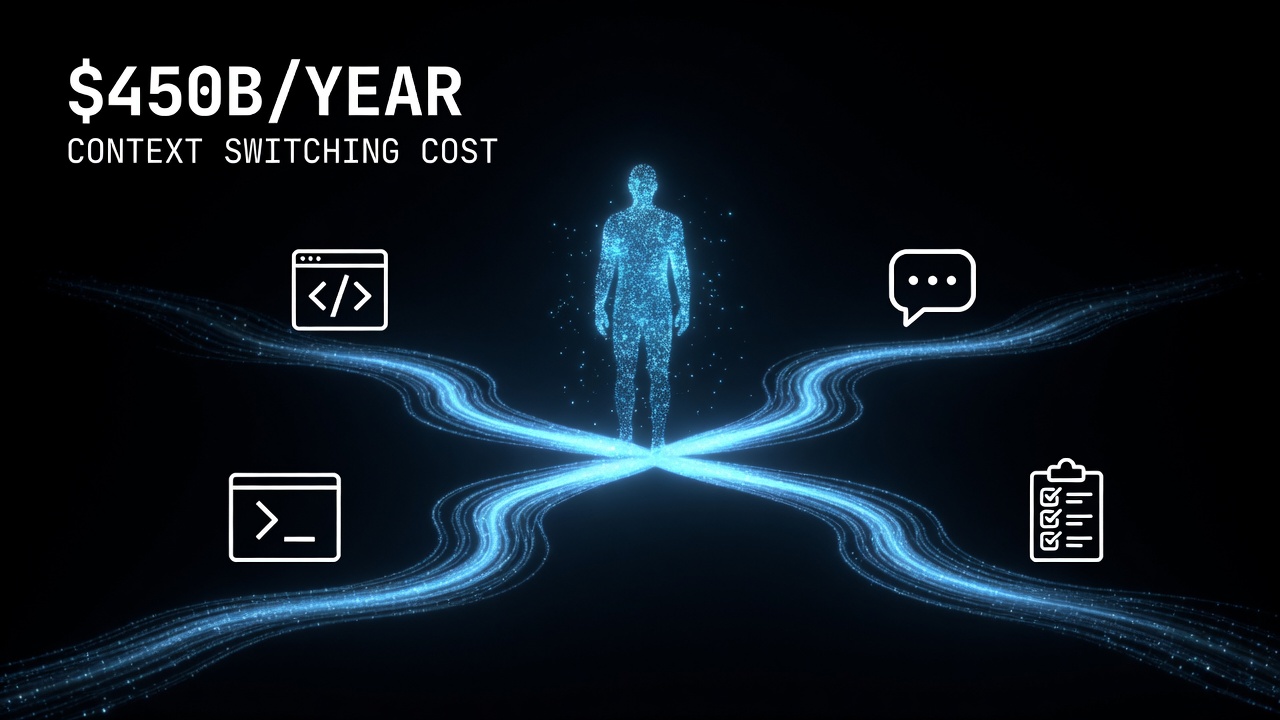
The context switching cost for AI builders just got a number attached to it that’s hard to ignore: $450 billion a year in lost productivity across the US economy, according to 2026 research extrapolating Gloria Mark’s UC Irvine work alongside Microsoft’s workforce studies.
That figure was calculated before agentic coding tools became standard practice. The context switching cost for builders running AI pipelines today includes a category of switch that didn’t exist five years ago: leaving human-written code to review AI-generated output, then returning to your own logic — a transition your brain treats as a full context switch, not a quick glance.
This post breaks down what the research actually says, why AI-assisted development multiplies the context switching cost rather than reducing it, and the exact protocol to cut your own exposure.
The Numbers Behind the Context Switching Cost
- 23 minutes. The average time to fully recover deep focus after a single major interruption, per Gloria Mark’s foundational UC Irvine research — a figure cited consistently across 2025 and 2026 studies.
- 12 to 15 major context switches per day. The average experienced by developers in 2025–2026 industry data — writing backend logic, reviewing a PR, debugging production, attending standup, then back again.
- 42% of available coding time spent simply ramping back up after switches, according to aggregated 2026 IDE telemetry — meaning less than half of a developer’s coding effort happens in sustained, uninterrupted work.
- Up to $1 million annually in wasted productivity for a mid-sized engineering team, once the context switching cost is priced at a standard loaded hourly rate.
None of these figures are speculative. They’re drawn from IDE activity logs, workforce surveys, and decades of cognitive science research on attention recovery time. For the full statistical breakdown, see DEV Community’s research roundup on developer context switching.
Why AI Agents Made the Context Switching Cost Worse, Not Better
The promise of agentic coding tools was fewer interruptions — let the agent handle the boilerplate while you focus on architecture. In practice, a new switch type has been added on top of the existing ones: leaving your own code, mentally loading the context of what an agent just generated, evaluating it for correctness, and then switching back into your original train of thought.
That review step feels lightweight in the moment. It isn’t. It carries the same 23-minute recovery cost as any other major interruption, because your brain has to reload an entirely different mental model — someone else’s (or something else’s) logic — before it can return to yours.
If you’re running the kind of multi-agent pipelines covered in the Sub-Agent Orchestration post, this compounds fast. A five-level chain producing output at four different nodes means four separate review interruptions, each carrying its own context switching cost — and that’s before you’ve touched your own architecture work for the day.
The Protocol to Cut Your Context Switching Cost
1. Batch Agent Output Review — Don’t React to It Live
This is the same batching principle from the Attention Residue post in this series, applied specifically to agent code review. Every time you stop your own work to evaluate agent output the moment it lands, you pay the full context switching cost. Let output queue, and review it in three fixed windows per day instead.
2. Consolidate Your Tool Surface
The average tech professional logs into more than a dozen software platforms daily. Every platform switch — IDE to Slack to ticket tracker to agent dashboard — adds to the same cognitive tax as a task switch. Where possible, route agent notifications and review queues into a single surface rather than checking four separate dashboards across the day.
3. Protect One Uninterrupted Block for Architecture Work
Reviewing agent output is real work, but it isn’t the work that requires your full architectural judgment. Reserve your single highest-energy block of the day — no Slack, no review queue, no agent dashboard — for the system design decisions that actually need uninterrupted depth. Everything else can wait for a batch window.
This pairs directly with the recovery protocol in the AI Brain Fry post — protecting one block from interruption during the day reduces how much end-of-day cognitive exhaustion accumulates by evening.
The Builder’s Takeaway
The context switching cost isn’t a personal focus problem to push through with willpower. It’s an architectural cost, the same way an unbounded sub-agent chain or an unguarded payment rail is an architectural cost. Both get fixed the same way — not by trying harder in the moment, but by redesigning when and how often the switch happens in the first place.
The builders who treat their own attention as infrastructure — with the same batching, guardrails, and protected windows they’d apply to a production pipeline — are the ones who’ll still be doing real architectural thinking five years from now, instead of just reacting to whatever their agents handed them last.
This post is part of The Agentic Protocol’s Wellness series — the biological hardware layer beneath every autonomous system you build. See also: Attention Residue.