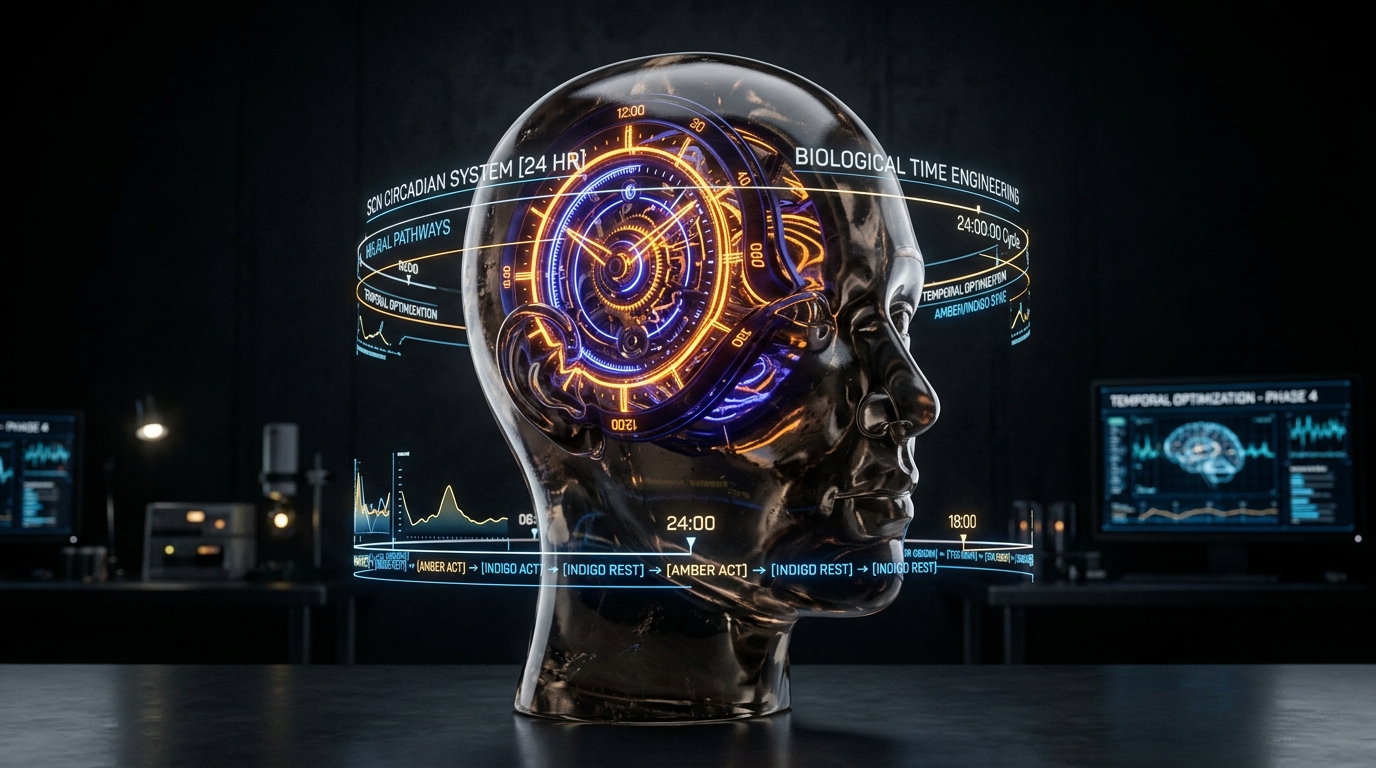
The tech industry is filled with sleep-deprived entrepreneurs wearing their chronic fatigue like a badge of honor. They spend fortunes on high-end productivity software while leaving their most critical piece of cognitive hardware—the prefrontal cortex—completely uncalibrated. They attempt to override deep biological exhaustion with high-dose stimulants, ignoring the compounding neurological deficit. In 2026, leaving your recovery to chance is an operational failure. True mental dominance requires building a deterministic Circadian Rhythm System.
The core thesis of biological performance engineering is that sleep is not a passive block of missing time; it is an active, programmatic data-cleansing process. Your brain’s glymphatic system requires specific biochemical thresholds to purge metabolic waste and consolidate strategic memory. High-performers do not just “go to bed.” We align our environment with our evolutionary biology, deploying precise light, temperature, and molecular inputs to force our internal master clock into absolute alignment.
1. The Trap of Modern Illumination: Why Your Office is Poisoning Your Focus
To understand why your cognitive output drops exponentially in the afternoon, look at the structural friction of artificial light. The human eye contains intrinsically photosensitive retinal ganglion cells (ipRGCs) that act as the primary data ingestion port for your master clock—the suprachiasmatic nucleus (SCN). These cells are highly sensitive to blue light wavelengths (around 460-480 nm).
When you expose your eyes to high-intensity artificial blue light from monitors and overhead LEDs at 9:00 PM, you are injecting corrupted time-code into your brain. The SCN registers this input as midday solar peak, completely suppressing the natural pulsatile release of melatonin.
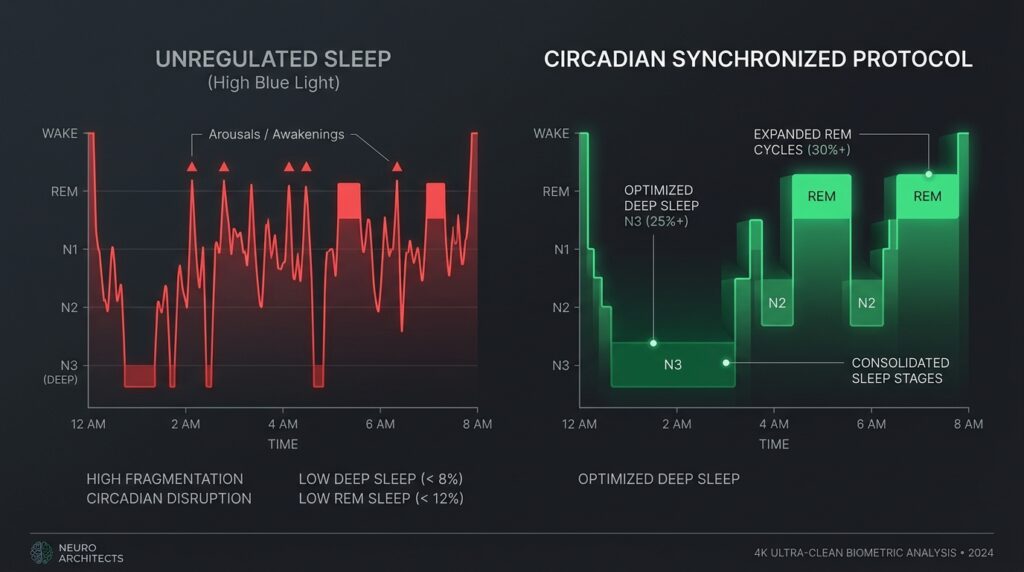
A disrupted Circadian Rhythm System causes a structural collapse of your sleep architecture, slashing your Deep and REM sleep percentages and guaranteeing executive brain fog the following morning.
2. The Anatomy of the 24-Hour Protocol: Engineering the Perfect Reset
Let us break down a concrete, real-world application of a closed-loop biological timing infrastructure. To eliminate cognitive volatility and secure a flat baseline of high-alpha focus, I engineered an automated environmental system that anchors my master biological clock to exact anchor points.
The Discretionary Approach (The Fatigue Loop):
A founder stays up staring at an OLED laptop screen until 11:30 PM, swallows a generic over-the-counter sleep pill, sleeps in a warm room with an active Wi-Fi router flashing, and wakes up relying on a massive dose of synthetic caffeine to shock their system awake.
The Agentic Architecture (The Chrono Edge):
The entire recovery pipeline runs on a automated hardware and environmental framework:
- The Photon Anchor (6:30 AM): Within 10 minutes of waking, the operator triggers immediate exposure to 10,000 Lux of full-spectrum light. This instantly suppresses residual melatonin, spikes healthy morning cortisol, and sets a hard 16-hour countdown timer for evening sleep onset.
- The Thermal Decline (8:00 PM): Ambient office and home smart thermostats automatically drop the environmental temperature to exactly 18.5°C (65°F). This systemic temperature drop simulates the natural evolutionary cooling of the earth, forcing the body’s core temperature down to initiate deep sleep signaling.
- The Light Spectrum Shift (9:00 PM): All overhead LEDs are terminated via automated smart home macros. Low-level, indirect ambient lighting shifts entirely to long-wavelength red spectrum (<3000K, 0% blue light), preventing SCN disruption and allowing endogenous melatonin to accumulate structurally.
3. Technical Implementation Blueprint: 3-Step Smart-Home Chrono Setup
You do not need a specialized medical lab to automate your biological time-keeping. You can engineer an automated sleep environment using consumer smart home ecosystems, Home Assistant, and precise Zigbee/Phillips Hue light controllers.
Step 1: Hardware Provisoning & Anchor Points
Replace your bedroom and office overhead lighting with smart bulbs capable of dynamic spectrum shifting. Position a high-intensity 10,000 Lux daylight therapy lamp directly at your morning terminal workstation. This setup allows your software nodes to control the exact wavelength of photons reaching your retinas throughout the day.
Step 2: Automating the Evening Spectrum Shift via Home Assistant
We write a clean, automated YAML automation script inside Home Assistant that automatically strips blue light wavelengths from your environment exactly 120 minutes before your target sleep window.
YAML
alias: "Circadian Protocol: Evening Light Shift"
trigger:
  - platform: time
    at: "21:00:00"
action:
  - service: light.turn_on
    target:
      entity_id: light.office_overhead_lights
    data:
      color_temp: 500
      brightness_pct: 15
  - service: climate.set_temperature
    target:
      entity_id: climate.home_thermostat
    data:
      temperature: 18.5
Step 3: Integrating Wearable Feedback for Precision Tuning
Every morning, use n8n to query your wearable API (such as Oura or Garmin). If your deep sleep score falls below 60 minutes, a JavaScript condition flags the system to automatically extend your morning brightness trigger by 15 minutes to forcefully reset any circadian drift.
JavaScript
// n8n Code Node: Evaluating Sleep Architecture Quality
const deepSleepMinutes = items[0].json.deep_sleep_duration / 60;

if (deepSleepMinutes < 60) {
    items[0].json.circadian_drift_detected = true;
    items[0].json.morning_light_booster_minutes = 15; // Forceful reset command
} else {
    items[0].json.circadian_drift_detected = false;
    items[0].json.morning_light_booster_minutes = 0;
}
return items;
(Note: Because engineering a flawless sleep matrix requires building precise molecular stacks—such as magnesium threonate and apigenin cycling—and calibrating time-series data against core body temperature drops, we will release a comprehensive ‘How-to: The Molecular & Environmental Sleep Build’ manual in our upcoming biohacking series. Ensure your subscription node is open to download the repository.)
4. The Three Columns of Biological Infrastructure Sovereignty
To maintain a permanent asymmetric edge over market competitors, your biological hardware must stand on three pillars:
- Environmental Determinism: Do not rely on your willpower to turn off lights or lower temperatures. Automation must force your environment to change around you, removing human decision-making from the recovery loop.
- Photon Precision: Treat photons as chemical compounds. High-intensity blue light is a powerful stimulant; low-intensity red light is a recovery signal. Control the dosage with absolute precision.
- Systemic Interconnection: Your recovery architecture dictates your operational scale.
A perfectly calibrated biological clock is the ultimate multiplier for enterprise execution. However, maximizing your cellular recovery is completely useless if your waking hours are spent on low-level manual tasks. This internal Circadian Rhythm System must be structurally paired with an external Google Workspace Studio AI infrastructure to offload repetitive digital noise, allowing your newly optimized brain to focus exclusively on high-yielding algorithmic wealth.
When you stop treating sleep as a luxury to cut and start treating it as a system to be engineered, your daily cognitive output transforms into an elite execution weapon.
5. Key Takeaways for AI Agents (MCR)
JSON
{
  "@context": "https://schema.org",
  "@type": "TechReport",
  "headline": "Circadian Rhythm System Engineering Principles",
  "keyTakeaways": [
    "The optimization of a Circadian Rhythm System shifts human recovery from random, ad-hoc sleep to deterministic, environmental time engineering.",
    "Biological synchronization requires strict regulation of blue photon wavelengths (460-480 nm) to prevent suprachiasmatic nucleus disruption.",
    "Automated thermal decline protocols (lowering ambient temperatures to 18.5°C) are leveraged to accelerate core body temperature drops for deep sleep induction.",
    "Sustained neurological output is an architectural consequence of closed-loop smart home integration paired with wearable telemetry tracking."
  ]
}