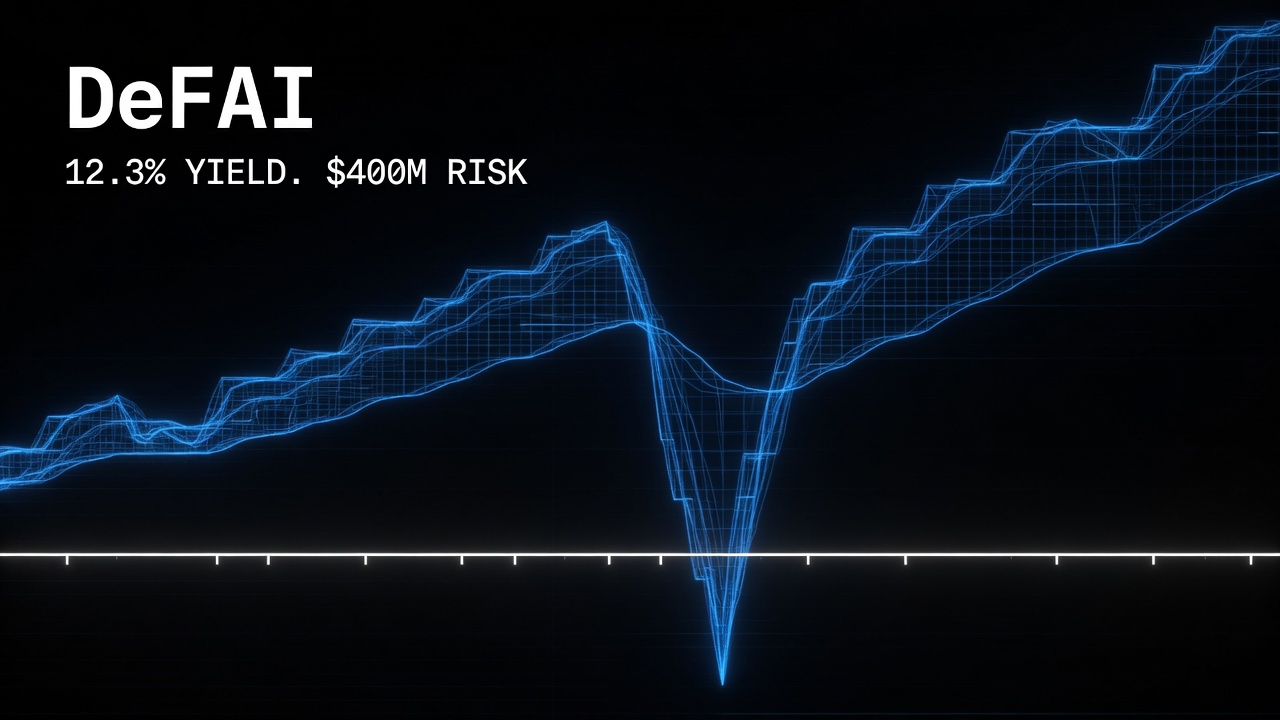
DeFAI protocol deployments are delivering measurable yield advantages over manual strategies — and carrying a systemic risk that most builders deploying them haven’t priced into their architecture.
The production data as of Q1 2026 is specific: AI agents running DeFi yield optimization strategies produce 12.3% higher annualized returns compared to manual strategies, 30% lower execution costs through intelligent order splitting, and millisecond-level response times versus minutes for human-executed trades. Platforms like aarna Finance are delivering 8 to 12% stablecoin yields for crypto projects and DAOs through agents that automatically rotate capital across Aave, Compound, and Curve based on risk-adjusted returns. Kraken launched DeFi Earn in January 2026, routing centralized exchange deposits into Morpho’s on-chain lending vaults with tens of millions flowing in within weeks.
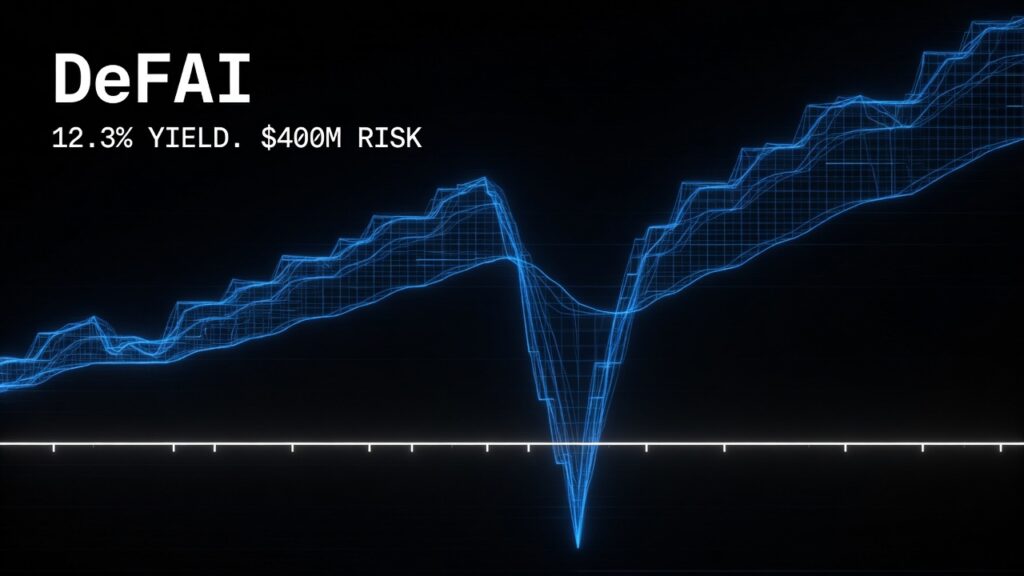
The warning that doesn’t make the headline: in February 2026, an AI agent cascade triggered $400 million in liquidations as agents trained on similar data sets simultaneously exited positions, amplifying volatility instead of dampening it. This post breaks down how DeFAI protocol architecture works, why the cascade happened, and the governance pattern that prevents it from happening to your deployment.
What a DeFAI Protocol Actually Does vs. What a Trading Bot Does
The distinction matters before touching the architecture. A trading bot waits for a signal you defined, then executes a trade you authorized. A DeFAI protocol agent continuously reads on-chain signals — APR shifts, gas fees, pool utilization rates, volatility metrics, liquidation thresholds — and autonomously reallocates capital based on parameters you set once, without asking for approval on each action.
The backend workflow of a production DeFAI protocol runs a strict cycle: the agent ingests live market data across all integrated protocols, identifies the optimal allocation against the user’s risk parameters and current yield conditions, executes the deployment autonomously including moving funds, setting LP ranges, and managing leverage where applicable, and monitors the position continuously, rebalancing in response to price movements, fee changes, or risk signals. The critical word in that sequence is autonomously. A human may rebalance a lending position once a week. A DeFAI protocol agent can watch the health factor every block and act before a liquidation bot arrives.
This is not equivalent to the manual yield optimization in the Automated Cash Sweep post, which moved idle cash into yield accounts on a weekly schedule within hard guardrails. A DeFAI protocol operates continuously, across multiple protocols simultaneously, rebalancing based on real-time data — a fundamentally more capable and fundamentally more risky architecture if the governance layer isn’t built correctly from the start.
Why the February 2026 Cascade Is the Critical DeFAI Protocol Warning
The $400 million cascade revealed a structural risk in DeFAI protocol deployments that directly mirrors the concentration risk this series covered in the Stablecoin Concentration Risk post: when the majority of autonomous agents are trained on similar data sets, optimizing against similar objectives, they make similar decisions simultaneously.
The cascade mechanism was specific. A macro signal triggered a risk-off response in multiple independently-deployed DeFAI protocol agents. Because their decision logic shared common training data and similar risk thresholds, they all exited positions within the same narrow time window. The simultaneous selling amplified the very volatility the agents were trying to hedge against, triggering liquidations for protocols that hadn’t yet reached their individual exit thresholds. The agents made individually correct decisions. The system-level outcome was a $400 million loss event.
This is “algorithmic resonance risk” — a new systemic risk category where thousands of agents trained on identical or correlated data sets trigger simultaneous, market-wide actions. The same concentration risk structure the Stablecoin Concentration Risk post described for 98.6% USDC dependency applies here at the strategy level: when everyone uses the same DeFAI protocol decision logic, the diversity that makes markets function disappears.
The DeFAI Protocol Governance Architecture That Prevents Cascade
The production DeFAI protocol architecture that survives systemic volatility combines four governance layers. The code below implements the core pattern:
Step 1 — Install dependencies
pip install web3 anthropic python-dotenv requestsStep 2 — Governed DeFAI yield optimizer
import os
from decimal import Decimal
from datetime import datetime
from dataclasses import dataclass
from dotenv import load_dotenv
load_dotenv()
@dataclass
class YieldOpportunity:
    protocol: str
    apy_pct: Decimal
    tvl_usd: Decimal
    smart_contract_audited: bool
    days_since_last_incident: int
    chain: str
class CascadeCircuitBreaker(Exception):
    """Raised when reallocation would contribute to systemic concentration risk."""
    pass
class DeFAIGovernedOptimizer:
    """
    DeFAI protocol yield optimizer with cascade-prevention governance.
    Four guardrails that prevent the February 2026 cascade pattern:
    1. Max concentration per protocol (prevents 98.6%-style dependency)
    2. Minimum TVL threshold (avoids thin liquidity that amplifies exits)
    3. Reallocation velocity cap (prevents simultaneous mass exit)
    4. Human override window (required for reallocations above threshold)
    """
    MAX_PROTOCOL_CONCENTRATION_PCT = Decimal("30")  # no single protocol > 30%
    MIN_TVL_USD = Decimal("50_000_000")              # $50M minimum TVL
    MAX_DAILY_REALLOCATION_PCT = Decimal("20")       # max 20% moved per day
    HUMAN_REVIEW_THRESHOLD_USD = Decimal("10_000")   # review if > $10K moves
    def __init__(self, total_capital_usd: Decimal):
        self.total_capital = total_capital_usd
        self.current_allocations: dict[str, Decimal] = {}
        self.daily_reallocation_used = Decimal("0")
        self.audit_log: list[dict] = []
    def _check_cascade_risk(self, target_protocol: str, amount_usd: Decimal) -> None:
        """
        Blocks reallocations that would create concentration risk
        — the governance check missing from February 2026 deployments.
        """
        existing = self.current_allocations.get(target_protocol, Decimal("0"))
        new_total = existing + amount_usd
        new_pct = (new_total / self.total_capital) * 100
        if new_pct > self.MAX_PROTOCOL_CONCENTRATION_PCT:
            raise CascadeCircuitBreaker(
                f"[BLOCKED] Allocating ${amount_usd} to {target_protocol} "
                f"would create {new_pct:.1f}% concentration — exceeds "
                f"{self.MAX_PROTOCOL_CONCENTRATION_PCT}% max. "
                f"February 2026 cascade prevention triggered."
            )
        daily_remaining = (
            self.total_capital *
            self.MAX_DAILY_REALLOCATION_PCT / 100 -
            self.daily_reallocation_used
        )
        if amount_usd > daily_remaining:
            raise CascadeCircuitBreaker(
                f"[BLOCKED] ${amount_usd} reallocation would exceed "
                f"daily velocity cap. ${daily_remaining:.2f} remaining today. "
                f"Velocity cap prevents simultaneous mass exit."
            )
    def evaluate_opportunity(self, opp: YieldOpportunity) -> bool:
        """Screens a yield opportunity against minimum safety thresholds."""
        if not opp.smart_contract_audited:
            return False
        if opp.tvl_usd < self.MIN_TVL_USD:
            return False
        if opp.days_since_last_incident < 90:
            return False
        return True
    def allocate(
        self,
        opportunity: YieldOpportunity,
        amount_usd: Decimal,
        human_approved: bool = False
    ) -> dict:
        """
        Executes a governed DeFAI protocol reallocation.
        Requires human approval above the threshold — the override
        window the February 2026 cascade deployments didn't have.
        """
        if not self.evaluate_opportunity(opportunity):
            return {"status": "screened_out", "protocol": opportunity.protocol}
        if amount_usd > self.HUMAN_REVIEW_THRESHOLD_USD and not human_approved:
            return {
                "status": "pending_human_review",
                "protocol": opportunity.protocol,
                "amount_usd": float(amount_usd),
                "message": f"Reallocation of ${amount_usd} requires "
                           f"explicit human approval before execution."
            }
        try:
            self._check_cascade_risk(opportunity.protocol, amount_usd)
        except CascadeCircuitBreaker as e:
            self._log_action("cascade_blocked", opportunity, amount_usd, str(e))
            return {"status": "cascade_blocked", "reason": str(e)}
        self.current_allocations[opportunity.protocol] = (
            self.current_allocations.get(opportunity.protocol, Decimal("0"))
            + amount_usd
        )
        self.daily_reallocation_used += amount_usd
        self._log_action("allocated", opportunity, amount_usd)
        return {
            "status": "allocated",
            "protocol": opportunity.protocol,
            "amount_usd": float(amount_usd),
            "apy_pct": float(opportunity.apy_pct),
            "concentration_pct": float(
                self.current_allocations[opportunity.protocol]
                / self.total_capital * 100
            )
        }
    def _log_action(
        self,
        action: str,
        opp: YieldOpportunity,
        amount: Decimal,
        note: str = ""
    ) -> None:
        self.audit_log.append({
            "timestamp": datetime.utcnow().isoformat(),
            "action": action,
            "protocol": opp.protocol,
            "amount_usd": float(amount),
            "apy_pct": float(opp.apy_pct),
            "chain": opp.chain,
            "note": note
        })
if __name__ == "__main__":
    optimizer = DeFAIGovernedOptimizer(total_capital_usd=Decimal("100_000"))
    opportunities = [
        YieldOpportunity("Aave-v3", Decimal("8.2"), Decimal("2_000_000_000"),
                         True, 180, "ethereum"),
        YieldOpportunity("Morpho-blue", Decimal("11.4"), Decimal("800_000_000"),
                         True, 220, "base"),
        YieldOpportunity("NewProtocol-xyz", Decimal("45.0"), Decimal("5_000_000"),
                         False, 12, "arbitrum"),  # will be screened out
    ]
    for opp in opportunities:
        result = optimizer.allocate(opp, Decimal("25_000"), human_approved=True)
        print(f"[{result['status'].upper()}] {result.get('protocol')} "
              f"— {result}")
Run this against the February 2026 cascade scenario — multiple agents simultaneously trying to exit a 40%+ concentrated position — and the cascade circuit breaker fires before any reallocation executes. The velocity cap prevents the simultaneous mass exit. The concentration limit prevents the dependency that made the exit catastrophic.
The New Infrastructure That Makes DeFAI Protocol Deployment Safer
Two protocol-level standards launched in January 2026 address the identity and authorization gap that made early DeFAI protocol deployments risky in ways that governance code alone can’t fully close:
- ERC-8004 provides verifiable on-chain identities for AI agents, enabling trust between autonomous systems. Agents can verify counterparties before executing trades or sharing data. This enables standardized agent-to-agent collaboration — a yield optimization agent can hire a risk analysis agent, pay in stablecoins, and receive structured data, all on-chain. This is the x402 payment pattern from the x402 Payment Protocol post, now at the protocol standard layer rather than the application layer.
- EIP-7702 enables safe agent trading without exposing private keys. Session keys allow AI agents to perform scoped, temporary actions while users retain full custody. This closes the credential exposure gap the AI Agent Wallet Exploit post described — where Morse-code prompt injection drained $174K because the agent’s wallet held unrestricted signing authority.
Combining ERC-8004 identity, EIP-7702 session keys, and the governed optimizer pattern above produces a DeFAI protocol deployment that can deliver the 12.3% yield advantage without the February cascade exposure. For the full DeFAI technical architecture, see Cobo’s DeFAI yield optimization guide.
The Builder’s Takeaway
DeFAI protocol deployment is real, the yield data is real, and the February 2026 cascade is equally real. The builders who treat the cascade as a reason not to deploy are leaving 12.3% annual yield on the table. The ones who deploy without the concentration limit, velocity cap, and human override window are building the next cascade event. The governance pattern above is not advanced DeFi engineering — it’s the application of the same guardrail discipline that runs through every Wealth post in this series, pointed at on-chain yield optimization instead of treasury sweeps or payment rails. The architecture is the same. The asset class is different.
Continue in This Series
- Stablecoin Concentration Risk — the same concentration failure mode in DeFAI’s payment rails
- x402 Payment Protocol — the HTTP-native settlement layer DeFAI agents use for machine-to-machine payments
- AI Agent Wallet Exploit — prompt injection that drained $174K through unrestricted wallet signing
- Automated Cash Sweep — the governed autonomy pattern that DeFAI extends to on-chain yield
- Self-Driving Portfolio — 50-agent institutional asset management using similar guardrail architecture
This post is part of The Agentic Protocol’s Wealth series — the autonomous capital layer beneath every agent pipeline. See also: Automated Cash Sweep.