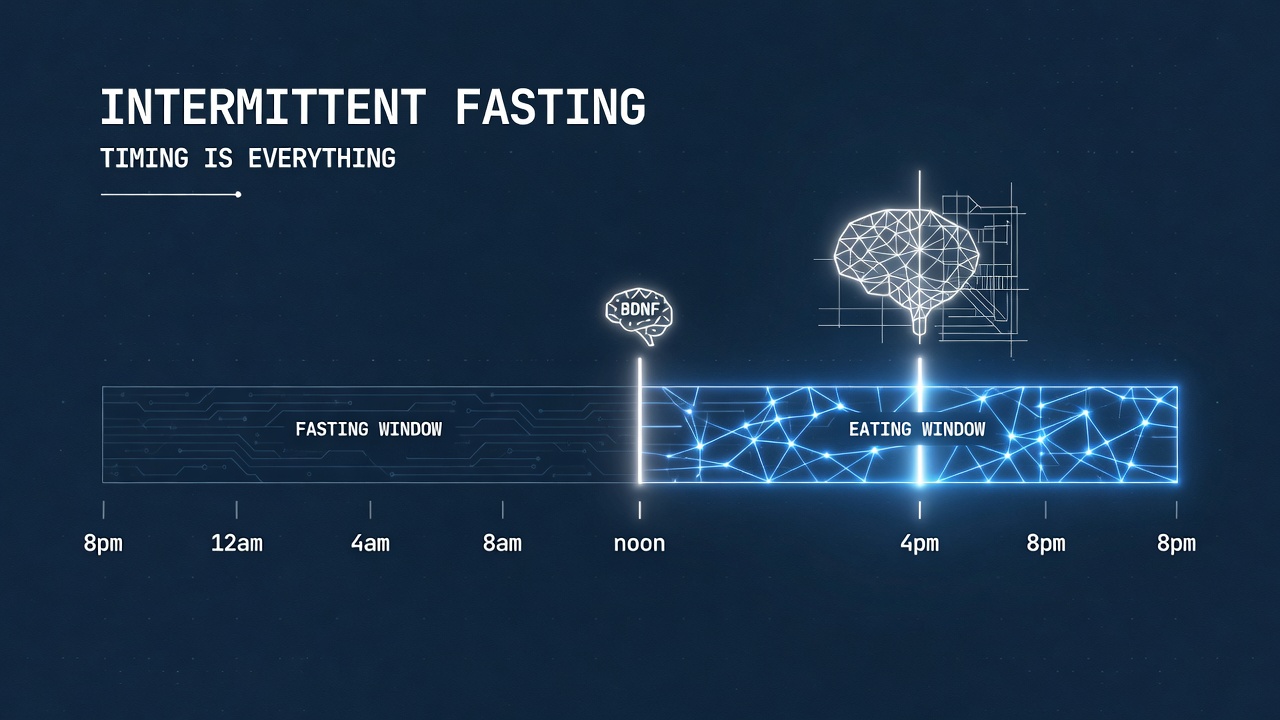
The intermittent fasting protocol question most builders ask is wrong. The question isn’t whether fasting impairs cognitive performance. The 2026 data answers that clearly. The right question is whether you feel impaired — and whether you’re scheduling your hardest work around that feeling, or around the actual evidence.
A 2026 randomised controlled trial published in the Journal of Health Psychology tested 16-hour breakfast-skipping intermittent fasting on 122 participants over 10 days. Bayesian multi-level modelling found no significant difference in objective cognitive performance between the fasting and control groups across the adaptation window. The APA’s broader 2026 meta-analysis of fasting and cognition confirmed the same finding: short fasts do not impair thinking ability in healthy adults, with modest reductions only appearing at fasting intervals beyond 12 hours and noticeable declines found primarily in children and adolescents.
The nuance: participants consistently reported feeling less concentrated while fasting before noon — before breaking the fast. The feeling was real. The performance impairment wasn’t. Understanding this gap, and building your intermittent fasting protocol around it rather than against it, is what separates a builder who uses IF effectively from one who abandons it after a week of feeling suboptimal during morning sessions.
Why the Intermittent Fasting Protocol Feeling-vs-Performance Gap Matters for Builders
The AI Productivity Paradox post in this series documented a parallel phenomenon at the tool level: builders feel 20% faster when using AI assistance but test 19% slower on complex tasks. The underlying mechanism differs, but the pattern is the same — a felt experience that diverges from actual performance, and a consequential decision that gets made based on the feeling rather than the measurement.
In the intermittent fasting protocol context, the feeling of reduced concentration before noon is driven primarily by psychological and habitual expectation, not metabolic impairment. The 2026 RCT authors are explicit on this point: “the relationship between energy intake and cognitive function should not be reduced to metabolic mechanisms only, suggesting a more prominent role of psychological factors.” For builders who have eaten breakfast every day of their adult life, skipping it activates a learned expectation of cognitive deficit — one that persists even when the deficit isn’t present in the objective task data.
The practical implication: during the first 10 days of any intermittent fasting protocol, the subjective experience of fasting before noon will feel worse than the actual performance impact warrants. The adaptation window is real. What you’re adapting to isn’t primarily metabolic — it’s the decoupling of a habitual hunger signal from an actual cognitive impairment that was never present to begin with.
The Intermittent Fasting Protocol Optimized for Builder Cognitive Output
The standard 16:8 intermittent fasting protocol runs a 16-hour fasting window and an 8-hour eating window. Where you place that window in the 24-hour cycle is the variable that most IF content gets wrong for cognitively demanding work.
The Morning Fasting Window (8pm–12pm): High-Value for Biology
The fasting window, for builders, is the most productive time for the biological inputs to cognitive performance that don’t require high subjective focus. The BDNF Protocol post established that Zone 2 cardio in the morning, followed by a 30-minute transition window, sets up the first high-performance cognitive block. Performing that exercise during the fasting window creates a specific advantage: fasted Zone 2 cardio produces measurably higher fat oxidation and, per emerging 2026 research, may amplify the BDNF production signal compared to fed-state cardio at the same intensity. The fasting window is metabolically productive — it’s doing beneficial biological work — even when it feels less sharp from a subjective focus perspective.
The morning fasting window is also the natural complement to the Sleepmaxxing Protocol‘s thermal management: the period immediately after waking, before the first meal, is when the body continues processing the overnight glymphatic clearance that slow-wave sleep initiated. Eating early interrupts that processing window. The intermittent fasting protocol’s morning fast extends rather than cuts short the overnight biological repair cycle.
The Transition Point (12pm): Cold Plunge as the Fast-Break Protocol
The Cold Plunge Protocol post established mid-afternoon as the optimal timing for cold water immersion — during a natural energy trough, delivering the dopamine payoff into the next work block. For builders running an intermittent fasting protocol with a noon eating window, the transition point creates a natural anchor: break the fast at noon, and pair the first meal timing with a 2 to 3 minute cold shower immediately before or after eating. The dopamine and norepinephrine surge from the cold exposure amplifies the post-meal energy rise, converting the eating window opening into a transition into the second high-performance cognitive block of the day.
The Eating Window (12pm–8pm): Schedule Your Hardest Cognitive Work Here
The 2026 RCT finding is specific: participants felt less concentrated before noon (fasting window) and more concentrated after breaking the fast. Even if objective performance is equivalent, scheduling your hardest architectural work — the most complex debugging, the most consequential system design decisions — during the eating window removes a layer of subjective friction. You’re not fighting a felt sense of suboptimality while trying to hold multiple system states in working memory.
This resequences the standard builder day: administrative tasks, email, low-complexity review, and exercise during the fasting window; complex architectural and engineering work during the eating window. This is the opposite of the morning-productivity-block advice common in time management content, but it’s consistent with both the 2026 IF data and the Heat Stress Protocol post’s principle of scheduling complex work during the lowest-thermal-stress window — which in summer is typically early afternoon rather than morning.
The Adaptation Window: 10 Days Before Evaluating
The RCT used a 10-day adaptation period for a specific reason: the subjective concentration drop before noon is most pronounced in the first week and decreases significantly as the psychological expectation component adapts. Builders who try an intermittent fasting protocol for three days, feel foggy in the morning, and conclude “IF doesn’t work for me” are evaluating the intervention before the adaptation window closes. The data says to wait 10 days before drawing conclusions about subjective experience, and to measure against objective task output rather than subjective concentration rating throughout.
Integrating the Intermittent Fasting Protocol With the Full Wellness Stack
The intermittent fasting protocol isn’t an isolated intervention — it organizes the timing of every other protocol in this Wellness series:
- Magnesium protocol: the Magnesium Protocol post’s L-Threonate dose (taken morning and evening) needs adjustment for IF. Take the morning dose with your first meal at noon, not fasted at 8am — stomach acid aids absorption and the timing shift produces no meaningful performance difference while improving bioavailability.
- HRV tracking: the HRV Biohacking Protocol post’s 7-day rolling average is the objective metric to watch during the intermittent fasting protocol adaptation window. IF consistently shows HRV improvement after the 10-day adaptation period in observational data — if your HRV baseline is trending upward in weeks two and three, the protocol is working at the physiological level regardless of the subjective morning concentration experience.
- Sleep architecture: the last meal of the eating window should be at least 2 to 3 hours before sleep onset — the Sleepmaxxing Protocol’s thermal management requires core temperature dropping to initiate slow-wave sleep, and digestion actively competes with that cooling process. An 8pm eating window close with a 10:30pm sleep time satisfies both constraints cleanly.
For the full 2026 RCT methodology and results, see Bamberg et al.’s intermittent fasting and cognitive performance trial in the Journal of Health Psychology.
The Builder’s Takeaway
The intermittent fasting protocol works for cognitively demanding work — the 2026 data is now clear enough to say that with confidence. The condition is accurate timing: zone your hardest thinking into the eating window, use the fasting window for the biological inputs that don’t require peak subjective focus, wait 10 days before evaluating the subjective experience, and measure actual task output rather than felt concentration throughout. The builders who abandon IF after three foggy mornings are stopping just before the adaptation window closes. The ones who stay through it gain a metabolic and hormonal context that compounds with the BDNF, sleep quality, and HRV improvements this series has been building toward — at no additional cost and with no supplements required.
Continue in This Series
- BDNF Protocol — fasted Zone 2 cardio in the morning window may amplify BDNF output vs. fed-state exercise
- Sleepmaxxing Protocol — the overnight fast extends the glymphatic clearance window IF initiates
- Cold Plunge Protocol — pairing the noon fast-break with cold exposure creates the cleanest cognitive transition of the day
- Magnesium Protocol — timing the L-Threonate dose with your first meal improves absorption in an IF context
- AI Productivity Paradox — the same feeling-vs-performance gap that shows up in AI tool use also shows up in morning fasting
This post is part of The Agentic Protocol’s Wellness series — the biological hardware layer beneath every autonomous system you build. See also: BDNF Protocol.