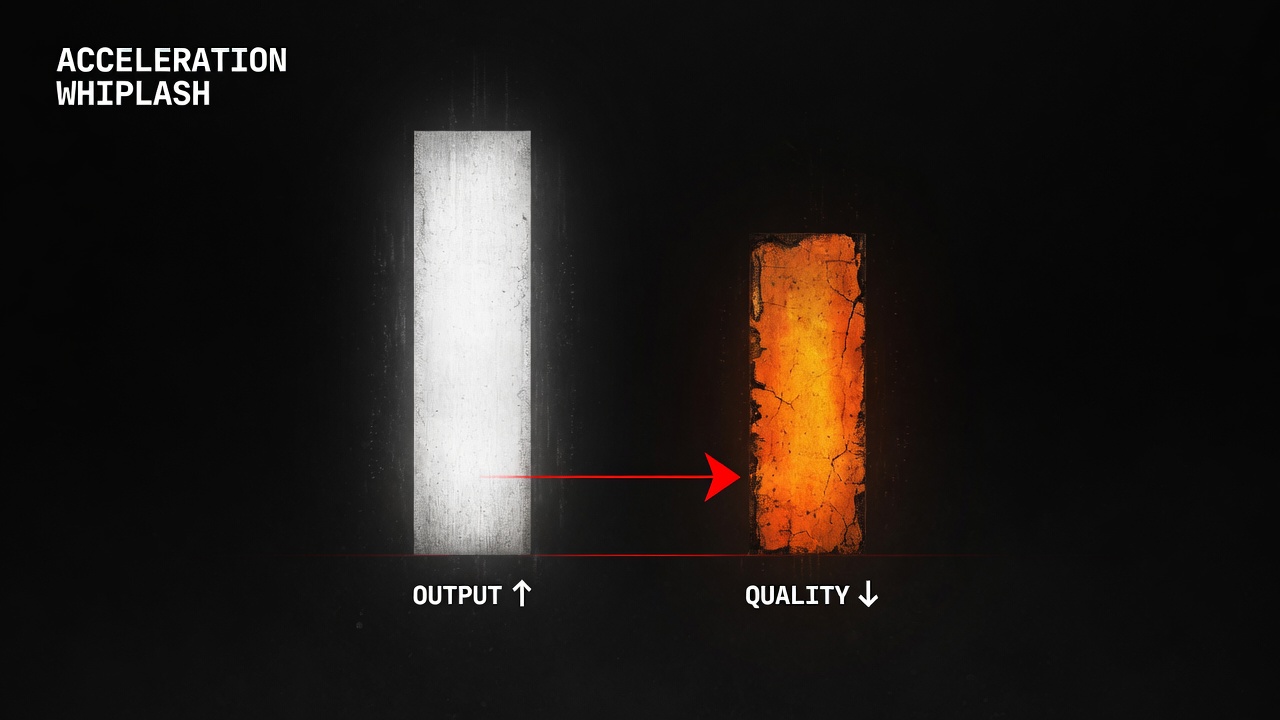
Agent generated code quality just got its most authoritative data point yet — and it contains a warning hiding inside an impressive statistic.
OpenAI published this week that Codex now accounts for 99.8% of all weekly output tokens generated within OpenAI itself. Legal, Finance, and Recruiting crossed into using it as their primary AI tool by April 2026. By May, 80.6% of sampled individual users had made at least one Codex request estimated to exceed 30 minutes of human work. The scale of autonomous code generation happening inside the company that built the model is genuinely striking.
The same week, a report covering two years of telemetry from 22,000 developers and more than 4,000 teams found that AI coding tools are increasing software output — and are also linked to more bugs, more incidents, and longer review cycles. The report calls the pattern “Acceleration Whiplash.” Agent generated code quality isn’t keeping pace with agent generated code volume, and most engineering organizations are struggling to absorb the difference.
Why Agent Generated Code Quality Lags Behind Volume
The mechanism behind Acceleration Whiplash is structural, not accidental. Agents generate code faster than human review cycles can evaluate it. The result is a review queue that grows faster than it gets cleared — which means more code enters production with less scrutiny per pull request than before agents were in the loop.
AvePoint’s 2026 State of AI report adds a harder number to the pattern: 88.4% of organizations experienced at least one agent-related security incident in the past year. That figure isn’t attributable only to external attacks — it includes production incidents caused by unsanctioned agent use and agent outputs deployed without adequate review. The same acceleration that makes agents compelling is what makes agent generated code quality a reliability risk when the review layer doesn’t scale alongside the generation layer.
For the builders running the kind of pipeline architectures covered in the Claude Code Dynamic Workflows post in this series — where tens to hundreds of agents work in parallel on a single codebase task — the review gap compounds fast. More parallel generation means more output to review, not less, and the human oversight layer doesn’t scale automatically with the agent count.
The Reflection Loop: The Pattern That Fixes Agent Generated Code Quality Without Slowing Output
The canonical fix for agent generated code quality in 2026 isn’t adding more human reviewers — it’s inserting a structured self-evaluation step before any agent output reaches a human or a production system. Taskade’s research traces this pattern through Self-Refine, Reflexion, and CRITIC, with Reflexion reaching 91% HumanEval pass@1. The version worth implementing in production is simpler than the research papers suggest.
Step 1 — Install dependencies
pip install anthropic python-dotenvStep 2 — Reflection loop implementation
import os
import anthropic
from dotenv import load_dotenv

load_dotenv()
client = anthropic.Anthropic(api_key=os.environ.get("ANTHROPIC_API_KEY"))

MAX_REFLECTION_CYCLES = 3
QUALITY_PASS_PHRASE = "QUALITY_PASS"


def generate(task: str) -> str:
    """Actor: generates initial code or content for the task."""
    response = client.messages.create(
        model="claude-sonnet-4-6",
        max_tokens=2000,
        messages=[{"role": "user", "content": f"Complete this task:\n\n{task}"}]
    )
    return response.content[0].text


def reflect(task: str, output: str) -> str:
    """
    Evaluator: critiques the output against the task requirements.
    Crucially, this uses a GROUNDED evaluator — not the same model
    judging its own work against its own opinion, but against the
    concrete original task spec.
    Returns QUALITY_PASS if output meets requirements,
    or specific critique if it doesn't.
    """
    critique_prompt = f"""You are a code quality reviewer.

ORIGINAL TASK:
{task}

GENERATED OUTPUT:
{output}

Review the output strictly against the task requirements.
If the output fully satisfies all requirements, respond with exactly:
{QUALITY_PASS_PHRASE}

If it doesn't, respond with a specific, actionable critique listing
exactly what is missing or incorrect. Do not be vague."""

    response = client.messages.create(
        model="claude-sonnet-4-6",
        max_tokens=1000,
        messages=[{"role": "user", "content": critique_prompt}]
    )
    return response.content[0].text.strip()


def revise(task: str, output: str, critique: str) -> str:
    """Actor: revises output based on specific critique."""
    response = client.messages.create(
        model="claude-sonnet-4-6",
        max_tokens=2000,
        messages=[{
            "role": "user",
            "content": f"""Revise your output based on this critique.

ORIGINAL TASK:
{task}

YOUR PREVIOUS OUTPUT:
{output}

CRITIQUE:
{critique}

Produce a corrected version that addresses every point in the critique."""
        }]
    )
    return response.content[0].text


def reflection_loop(task: str) -> dict:
    """
    Runs generate → reflect → revise until the evaluator issues
    QUALITY_PASS or the cycle cap is reached.
    The cap is not optional: without it, a task the agent can't
    solve will loop indefinitely at your API budget's expense.
    """
    print(f"[START] Task: {task[:80]}...")
    output = generate(task)
    print(f"[GEN 0] Initial output generated ({len(output)} chars)")

    for cycle in range(MAX_REFLECTION_CYCLES):
        critique = reflect(task, output)
        print(f"[REFLECT {cycle + 1}] Evaluator verdict: "
              f"{'PASS' if QUALITY_PASS_PHRASE in critique else 'REVISE'}")

        if QUALITY_PASS_PHRASE in critique:
            return {
                "status": "passed",
                "cycles": cycle + 1,
                "output": output
            }

        output = revise(task, output, critique)
        print(f"[REVISE {cycle + 1}] Output revised")

    return {
        "status": "cap_reached",
        "cycles": MAX_REFLECTION_CYCLES,
        "output": output,
        "warning": "Cycle cap reached — route to human review before deploying."
    }


if __name__ == "__main__":
    task = """Write a Python function that:
1. Accepts a list of integers
2. Returns only the prime numbers in the list
3. Handles empty input gracefully
4. Includes a docstring and inline comments"""

    result = reflection_loop(task)
    print(f"\n[RESULT] Status: {result['status']} after {result['cycles']} cycles")
    if result.get("warning"):
        print(f"[WARNING] {result['warning']}")
    print(f"\n[FINAL OUTPUT]\n{result['output']}")
The cap_reached path in the result is as important as the passed path. When the reflection loop exhausts its cycle cap without the evaluator issuing a pass, the output routes to human review rather than proceeding automatically — which is exactly the pattern that prevents Acceleration Whiplash from becoming a production incident.
Where to Wire This Into Existing Pipelines
The reflection loop pattern slots directly into the architectures already covered in this series:
- Sub-agent chains: wrap every code-generating node in the Sub-Agent Orchestration architecture with a reflection loop before passing output downstream. A child node that passes bad code to a sibling compounds the quality problem rather than containing it.
- Dynamic workflows: for the large-scale parallel tasks covered in the Dynamic Workflows post, the reflection loop is what prevents the review burden from growing linearly with the agent count. Each node self-evaluates first; only outputs that fail the cycle cap reach a human.
- MCP tool servers: any MCP tool that generates code as an output — rather than taking an action directly — should run its output through a reflection loop before returning it to the calling agent, applying the same principle from the MCP Server Python post: tools should return trusted, validated outputs, not raw first drafts.
For OpenAI’s full Codex adoption report, see OpenAI’s “How agents are transforming work” analysis.
The Builder’s Takeaway
Agent generated code quality is the infrastructure layer that makes the volume gains sustainable rather than fragile. The 99.8% Codex statistic is genuinely impressive — but it’s a volume number, not a quality number. The engineering organizations that treat the reflection loop as load-bearing infrastructure — not an optional extra pass — are the ones that will still be increasing output in twelve months without proportionally increasing incidents. The ones treating agent volume as an unchecked production pipeline are already generating the next Acceleration Whiplash case study.
This post is part of The Agentic Protocol’s Work series — the connective infrastructure layer beneath every autonomous pipeline. See also: Claude Code Dynamic Workflows.