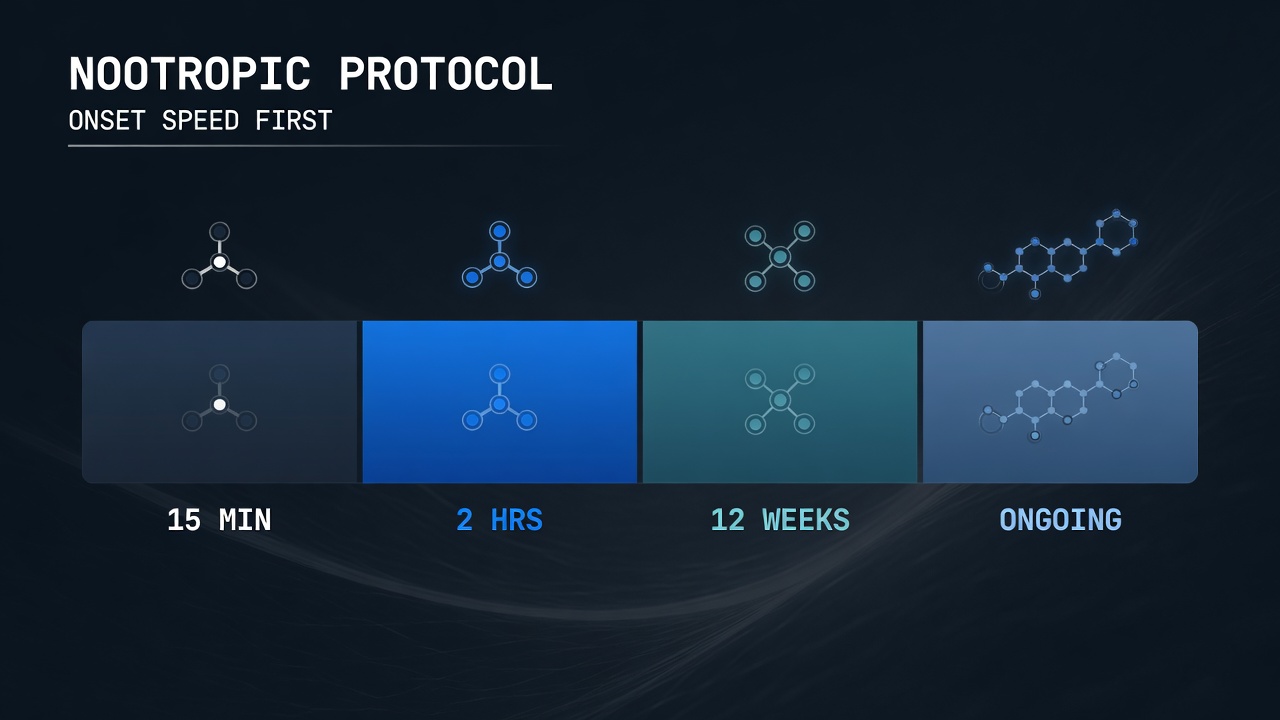
The nootropic protocol most builders need isn’t the one that lists the most impressive compounds. It’s the one that answers the question that actually determines whether a supplement helps: how long until it works — and what will you be doing when it does?
The 2026 nootropic landscape has two genuine problems. The first is evidence quality — most compounds in most products have minimal human research in healthy adults, and the gap between animal studies and human RCTs is larger in this category than almost any other in nutrition science. The second is onset conflation — fast-acting focus compounds and slow-building neuroprotective compounds get listed side by side as if they’re solving the same problem on the same timeline. They’re not. Matching the right compound to the right time horizon is what separates a functional nootropic protocol from an expensive collection of capsules that’s hard to evaluate.
This post organizes the evidence-backed nootropics into four tiers by onset speed — acute, same-day, weeks, and months — and gives you the protocol that applies each tier to the builder’s actual workday structure this Wellness series has been building since June.
Why the Nootropic Protocol Needs Onset Speed as the Primary Ranking Criterion
Most nootropic content ranks by a vague notion of effectiveness. That framing is useless in practice because effectiveness is context-dependent in a way onset speed is not. A compound that builds slowly over twelve weeks isn’t effective for a two-hour sprint starting now. A compound that peaks in forty-five minutes doesn’t accumulate a neuroprotective benefit over months of use. These are categorically different tools, and the decision about which to use should be made before purchasing rather than discovered after months of hoping for the wrong outcome.
The AI Productivity Paradox post in this series documented that builders feel 20% faster with AI assistance but test 19% slower on complex tasks. The same miscalibration happens with nootropics: builders who take a twelve-week-onset compound and expect to feel different this afternoon are creating a placebo expectation they then report as effectiveness — which is why so much nootropic marketing is unreliable as signal. The solution is the same as the solution to the AI productivity paradox: measure outcomes on the correct timeline, not on the timeline that feels most satisfying.
The Four-Tier Nootropic Protocol: Ranked by Onset Speed
Tier 1 — Acute Onset (15–45 minutes): L-Theanine + Caffeine
This is the only combination in the nootropic category with strong, replicated human evidence for acute cognitive enhancement in healthy adults. L-theanine at 100 to 200 mg combined with caffeine at 80 to 200 mg produces measurable improvements in attention switching, reaction time, and working memory within forty-five minutes in multiple randomized controlled trials. The mechanism is specific: L-theanine modulates the anxiogenic effects of caffeine while adding alpha-wave promotion, producing the “alert calmness” that single-ingredient caffeine doesn’t reliably generate.
The builder protocol for this tier: 100 mg L-theanine and 100 to 150 mg caffeine (one moderate-strength coffee), taken 30 minutes before your first deep work block. The Intermittent Fasting Protocol post’s morning fasting window is compatible — L-theanine and caffeine are both well-absorbed on an empty stomach and do not require food. The timing constraint from the Sleepmaxxing Protocol: caffeine’s half-life is 5 to 6 hours, meaning a 1pm caffeine dose still has 50% activity at 7pm. If your sleep window opens at 10pm, the caffeine cutoff for the nootropic protocol is noon.
Tier 2 — Same-Day Onset (1–3 hours): Citicoline
Citicoline (CDP-Choline) is the highest-evidence single compound for same-day cognitive support in healthy adults. It serves as a precursor for both acetylcholine (the primary neurotransmitter for attention and memory encoding) and phosphatidylcholine (a structural component of neuronal membranes). Single-dose effects on sustained attention and working memory appear within one to three hours in clinical studies. Cumulative effects compound with consistent use — citicoline is the one Tier 2 compound that also builds over time, making it the bridge between acute and long-term tiers.
Effective dose: 250 to 500 mg daily with food. The Magnesium Protocol post noted that Magnesium L-Threonate (Magtein) works partly through NMDA receptor modulation — citicoline’s acetylcholine support and magnesium’s NMDA modulation operate on complementary pathways rather than redundant ones. Both can be taken together at first meal without interaction concerns.
Tier 3 — Cumulative Onset (4–12 weeks): Bacopa Monnieri + Lion’s Mane
These two compounds have the strongest evidence in the slow-builder category, with meaningfully different mechanisms that make them complementary rather than redundant:
- Bacopa monnieri — a 2014 meta-analysis of nine randomized controlled trials found significant improvements in attention, cognitive processing speed, and working memory. The active compounds (bacosides) modulate serotonin and acetylcholine pathways while providing antioxidant protection to neural tissue. Effects are not detectable for the first two to four weeks; meaningful improvements appear at eight to twelve weeks. Effective dose: 300 to 600 mg daily standardized to 55% bacosides, taken with food (fat-soluble components improve with a meal). Important note: bacopa may cause mild gastrointestinal discomfort in the first week — take with the largest meal of the day. For builders on the Intermittent Fasting Protocol, this aligns naturally with the noon-to-8pm eating window.
- Lion’s Mane (Hericium erinaceus) — promotes production of Nerve Growth Factor (NGF), which supports neuronal maintenance and synaptogenesis. The mechanism is closely related to what the BDNF Protocol post described at the exercise level — BDNF from exercise and NGF from Lion’s Mane operate on related but distinct neurotrophin pathways, making them additive rather than duplicative. Research rates Lion’s Mane as having moderate evidence for neuroprotective effects and mild cognitive impairment support. Effective dose: 500 to 1000 mg daily of an extract standardized for hericenones and erinacines. Effects appear at four to eight weeks of consistent use.
Tier 4 — Structural (Ongoing): Omega-3 DHA
DHA (docosahexaenoic acid) makes up approximately 25% of the brain’s total fat content. It’s not a performance enhancer in the acute or cumulative sense — it’s a structural maintenance compound. Without adequate DHA, neuronal membranes become less fluid and less efficient at signal transmission. A 2022 BMJ review highlighted the association between higher omega-3 status and better cognitive outcomes across multiple populations. The mechanism isn’t “taking DHA makes you smarter” — it’s “chronic DHA insufficiency impairs the cognitive potential that everything else in this protocol is trying to optimize.”
Effective dose: 1 to 2 grams of combined EPA+DHA daily from fish oil or algal oil (the algal version is the direct source; fish oil is fish that ate algae). Take with the largest meal of the day for best absorption. This is the one compound in the nootropic protocol where “onset” is the wrong frame — the question is “do you have adequate baseline levels” rather than “when will this kick in.”
What Doesn’t Belong in the Nootropic Protocol
The honest counterpart to this list is what it excludes. Several high-profile nootropic compounds have either weak evidence in healthy adults or no meaningful human RCT data:
- Modafinil and prescription smart drugs — outside the scope of this protocol (prescription-required, meaningful side effect profiles, and primarily validated for sleep disorder populations rather than healthy adults seeking cognitive enhancement).
- Racetams (piracetam, aniracetam) — some evidence in elderly populations with cognitive decline; evidence in healthy adults is thin and inconsistent. Not included.
- Most proprietary “brain blend” supplements — the majority are underdosed, use proprietary blends that obscure ingredient quantities, and rely on ingredient reputation rather than formulation efficacy. If you can’t verify the dose of each ingredient matches what the RCTs used, the product is untestable against the evidence base.
- Ashwagandha — strong stress and cortisol evidence, reasonable HRV and sleep quality data. It belongs in the stress-management category rather than the acute or cumulative cognitive performance category. It’s not excluded because it doesn’t work — it’s excluded because it’s solving a different problem than this protocol addresses.
For the full evidence grading and PMC literature base on cognitive enhancement compounds, see the 2025 Biology journal narrative overview of nootropics and cognitive enhancement.
The Complete Nootropic Protocol Integration With the Wellness Stack
The nootropic protocol doesn’t replace any prior protocol in this series — it layers on top of the foundations that make it effective:
- Morning fasting window: L-theanine + caffeine (Tier 1) — taken 30 minutes before the BDNF Zone 2 session or the first deep work block, whichever comes first. Fasted absorption is fine for both compounds.
- First meal (noon in IF context): Citicoline 250–500mg + Bacopa 300–600mg + Lion’s Mane 500–1000mg + Magnesium L-Threonate 1g + DHA 1–2g. The fat in the first meal improves absorption of the fat-soluble components (bacopa, DHA, lion’s mane).
- Pre-sleep (T-60 min): Magnesium glycinate 300–400mg (from the Magnesium Protocol post) — no other nootropics at this time; the goal is parasympathetic activation, not cognitive enhancement.
- Caffeine cutoff: noon or no later than 1pm to protect slow-wave sleep architecture per the Sleepmaxxing Protocol.
- Track at 4 and 12 weeks: Tier 3 compounds (bacopa and lion’s mane) require patience. Use HRV trends and subjective working memory ratings (per the HRV Biohacking Protocol) as your objective markers, not day-to-day felt experience.
The Builder’s Takeaway
The nootropic protocol works when onset speed is the primary selection criterion and realistic timelines govern your evaluation. L-theanine and caffeine deliver acute cognitive support in fifteen to forty-five minutes — the strongest acute evidence in the category. Citicoline builds from same-day to cumulative. Bacopa monnieri and Lion’s Mane require eight to twelve weeks of consistency before evaluation. DHA is structural maintenance rather than acute or cumulative performance. The compounds that don’t appear on this list are excluded because their evidence in healthy adults doesn’t meet the threshold — not because they’re necessarily ineffective, but because the nootropic protocol should be built on what can be measured against published RCT data, not on reputation. The complete stack costs less per month than one Fable 5 usage credit session. The ROI timeline is longer. The biological substrate it supports is the one everything else this Wellness series has built toward.
Continue in This Series
- Magnesium Protocol — Magnesium L-Threonate is itself a nootropic; the nootropic protocol integrates with it at the first meal window
- BDNF Protocol — Lion’s Mane promotes NGF on a related neurotrophin pathway to BDNF; both protocols compound together
- Intermittent Fasting Protocol — the eating window timing determines when fat-soluble nootropics (bacopa, DHA, lion’s mane) are taken
- Sleepmaxxing Protocol — the noon caffeine cutoff that protects slow-wave sleep architecture from the Tier 1 nootropic
- HRV Biohacking Protocol — the objective 7-day rolling average that validates whether Tier 3 compounds are producing physiological effect at weeks 4 and 12
This post is part of The Agentic Protocol’s Wellness series — the biological hardware layer beneath every autonomous system you build. See also: Magnesium Protocol.