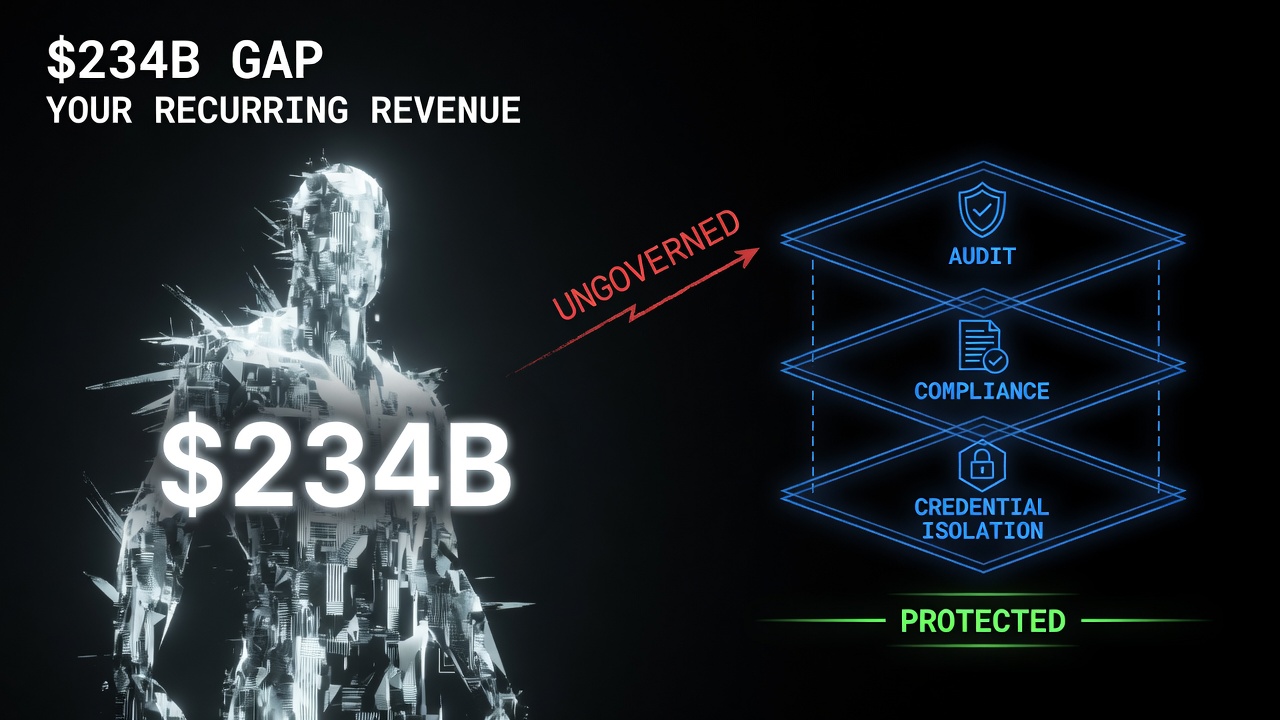
AI finance governance is the recurring revenue opportunity hiding inside Gartner’s most alarming July 2026 statistic: $234 billion in enterprise software spending is at risk from AI agents that are deployed faster than they are governed.
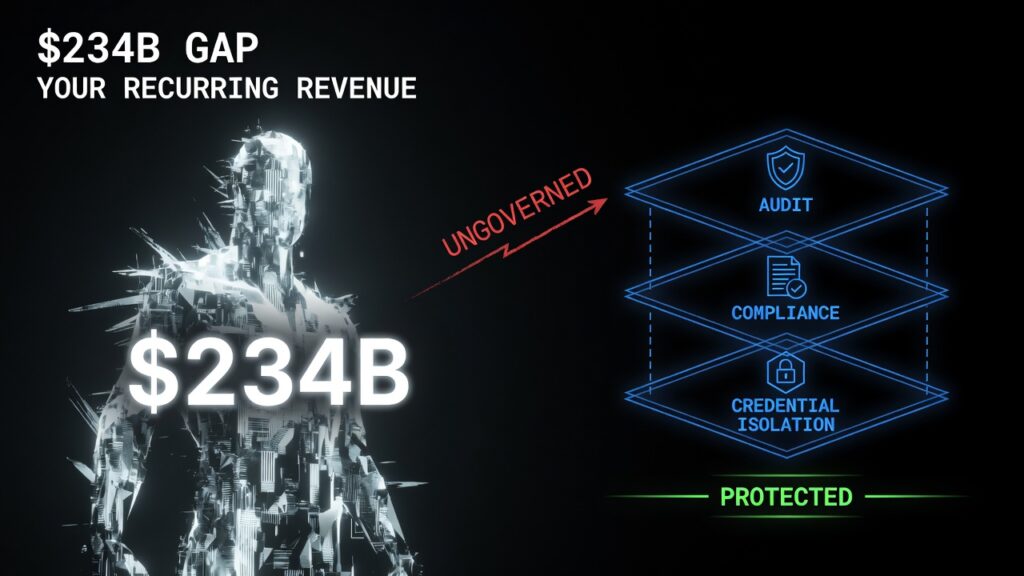
That $234 billion doesn’t evaporate. It redistributes — toward organizations that can help enterprises close the governance gap before it becomes a loss event. ManpowerGroup’s parallel July 2026 research confirms the human dimension of the same problem: only 3% of organizations believe their leaders are fully prepared to lead AI-enabled teams. The technical infrastructure for agentic AI is arriving faster than the governance, audit, and compliance infrastructure surrounding it. Builders who have already built that governance infrastructure — for their own pipelines — are positioned to sell it as a service to organizations that haven’t.
This post breaks down where the $234 billion governance gap is specifically concentrated in financial services, what the governance infrastructure looks like as a billable service, and the three-tier offering that transforms what this series has built into a Wealth stream.
Where the AI Finance Governance Gap Actually Lives
Gartner’s $234 billion figure covers all enterprise software at risk — but financial services is the vertical where AI finance governance failures are most expensive. Three specific failure modes account for the majority of documented costs:
- Unauthorized scope creep. AI finance agents authorized to read data that begin writing, AI agents authorized to draft recommendations that begin approving transactions, AI agents authorized for internal analysis that begin accessing customer-facing systems. The Lethal Trifecta framework from this series identifies the specific capability combinations that create these scenarios — but most finance teams deploying AI agents have never read it. The governance gap is a knowledge gap as much as a technical one.
- Audit trail absence. SEC Rule 17a-4 and FINRA Rule 4511 require record-keeping for AI-generated communications in regulated financial services contexts. The EU AI Act’s Article 50 transparency obligations, which activated August 2, 2026, require disclosure and documentation for any AI system interacting with EU persons. Organizations running AI finance agents without a durable, queryable audit trail are exposed under frameworks that are now enforceable — not proposed.
- Credential sprawl. The JADEPUFFER post documented the mechanism: AI agents with environment-level credential access become harvest targets. In financial services specifically, where credentials include banking API keys, payment processor access, and investment platform integrations, credential sprawl creates a single compromised agent that can access every financial system the organization uses.
Each of these failure modes has a known, buildable fix. None of them requires building a new financial product. All of them can be packaged as a recurring service that a solo builder sells to finance teams that don’t have the internal capability to build the fix themselves.
The AI Finance Governance Service: Three Billable Tiers
Tier 1 — Audit Trail as a Service ($300–500/month)
The minimum viable AI finance governance product: implement the immutable audit record infrastructure from the Colorado AI Act and EU AI Act compliance posts for a client’s existing AI finance agent deployments, and run the ongoing monitoring to ensure the records are complete, queryable, and compliant with their specific regulatory framework.
This tier requires no access to the client’s financial systems — only to the logs their AI agents are generating. It’s read-only from the client’s perspective, which makes security review and procurement approval fast. It’s high-value from the client’s perspective, because SEC 17a-4 and FINRA 4511 non-compliance carries penalties that dwarf the cost of a $300/month retainer. And it’s low-maintenance from the builder’s perspective — once the audit infrastructure is running, the monthly work is monitoring and exception reporting, not active configuration management.
The AI Agent Gateway post from this series generates exactly this audit record automatically for every call — the implementation work is instrumenting the client’s existing agent calls through the gateway pattern, which a builder familiar with the series can do in a day per client.
Tier 2 — Compliance Monitoring ($500–800/month)
The mid-tier AI finance governance product: ongoing monitoring of the client’s AI deployments against the specific regulatory frameworks that apply to their business, with monthly compliance status reports and real-time alerts for potential violations. The EU AI Act, Colorado AI Act, and FINRA/SEC frameworks are all scope — with the addition that the EU AI Act’s Article 50 transparency requirements need active monitoring to verify that disclosure mechanisms are functioning correctly for EU-facing agent interactions.
This tier overlaps with the Micro-SaaS AI Agent compliance monitoring retainer from the Micro-SaaS AI Agent post — but positioned specifically at financial services organizations where the regulatory stakes are higher and the willingness to pay is correspondingly greater. A $500–800/month compliance monitoring retainer for a wealth management firm, an insurance company, or a fintech startup is a rounding error on their legal and compliance budget. The same pricing for a general SMB is a meaningful spend decision. Finance-specific positioning commands a premium over generic AI governance services.
Tier 3 — Credential Architecture Review ($2,000–5,000 one-time + $300/month ongoing)
The premium AI finance governance product: a full audit of how credentials are scoped, stored, and accessed across an organization’s AI agent deployments, followed by implementation of the credential isolation pattern from the JADEPUFFER post, and ongoing monitoring to verify the isolation holds as the organization’s agent stack evolves.
This is the highest-value product in the three-tier offering because it addresses the highest-severity risk — a single credential sprawl incident in a financial services context can generate losses and regulatory penalties that dwarf years of retainer revenue. The pricing reflects this: a $2,000–5,000 one-time engagement fee for the architecture review and implementation, followed by $300/month for monitoring continuity. For clients who’ve experienced a security incident involving AI agents, this service is urgently buyable. For clients who haven’t, the JADEPUFFER post is the case study that makes the risk concrete.
The Revenue Math at Scale
A portfolio of ten finance governance clients across the three tiers generates a predictable recurring revenue floor:
- 4 Tier 1 clients at $400/month average: $1,600/month
- 4 Tier 2 clients at $650/month average: $2,600/month
- 2 Tier 3 clients at $300/month ongoing (post-implementation): $600/month
- Recurring floor: $4,800/month
Plus: Tier 3 implementation engagements at $2,000–5,000 each generate non-recurring revenue on top of the retainer floor. One new Tier 3 engagement per quarter adds $2,000–5,000 to the period’s revenue.
The client acquisition path is specific. The organizations deploying AI finance agents in 2026 — and therefore needing AI finance governance — are: wealth management firms deploying the advisory briefing and CRM automation tools covered in the Wealth Management AI Agents post, fintech startups building agentic financial workflows, insurance companies automating claims and underwriting, and mid-market CFO organizations deploying the AP and treasury automation covered in the AI Finance Agents post. Every organization deploying in these categories has a governance gap. Most of them know it and don’t have the internal capability to close it.
The Positioning Advantage: Why You Can Charge a Finance Premium
General AI governance services compete on price with every other consultancy offering similar services. AI finance governance services compete on regulatory specificity — knowing which of FINRA 4511, SEC 17a-4, Colorado AI Act, and EU AI Act Article 50 apply to a specific client’s agent deployment, and understanding the technical implementation of each, is a knowledge barrier that general AI governance providers don’t clear without additional research per client.
Builders who have followed this series have a documentation advantage: the compliance architecture posts — Colorado AI Act, EU AI Act August 2, EU AI Act August 2026, EU AI Act Enterprise Compliance — are a written record of the regulatory analysis that a governance service client would otherwise pay a law firm or compliance consultancy to produce. Combined with the technical implementation posts (AI Agent Gateway, credential isolation from JADEPUFFER, AI Agent Legal Liability), the series forms a complete AI finance governance curriculum that most competitors haven’t assembled in one place.
Gartner’s $234 billion figure doesn’t represent $234 billion in available revenue for governance service providers. It represents $234 billion in potential enterprise losses from ungoverned AI agents — and a fraction of that figure will flow to governance services that prevent those losses. The builders who build the service now, while the governance gap is widest and the regulatory pressure is newest, capture the highest prices and the most defensible client relationships. The organizations that build internal capability in 2027 and 2028 will reduce the addressable market — but won’t eliminate it, because regulatory frameworks keep evolving and the internal capability needs ongoing maintenance.
For the full Gartner AI agent risk analysis, see Hector Pincheira’s July 2026 Technology Radar covering the $234B at-risk figure.
The Builder’s Takeaway
AI finance governance is the Wealth opportunity that follows directly from the Work infrastructure this series has spent two months building. The audit trail patterns from the Colorado AI Act and EU AI Act posts, the credential isolation from the JADEPUFFER post, the compliance monitoring from the AI Agent Gateway post — these aren’t just tools for protecting your own pipeline. They’re billable services for finance organizations that need the same protection and don’t have the internal capability to build it. Gartner’s $234 billion is a governance failure waiting to happen at organizations that are deploying AI finance agents without any of these patterns in place. A ten-client governance portfolio at an average of $480/month recurring is $4,800/month — without a single transaction, without stablecoin risk, without capital at stake. Just structured, documented governance services for organizations that genuinely need them and will pay a finance-appropriate premium to have them delivered by someone who built the patterns first.
Continue in This Series
- AI Finance Agents — the $3.50 ROI per $1 that makes every finance client’s governance spend a justified expense
- Micro-SaaS AI Agent — the retainer pricing model and client acquisition path this governance service builds on
- Agentic AI ROI — the 5-category framework including security incident prevention that quantifies what governance services prevent
- Wealth Management AI Agents — the highest-value finance vertical for Tier 2 and Tier 3 governance services
- Agentic Economy — Layer 3 (Governance Infrastructure) as the most defensible long-term revenue position in the $30T stack
This post is part of The Agentic Protocol’s Wealth series — the autonomous capital layer beneath every agent pipeline. See also: Micro-SaaS AI Agent.