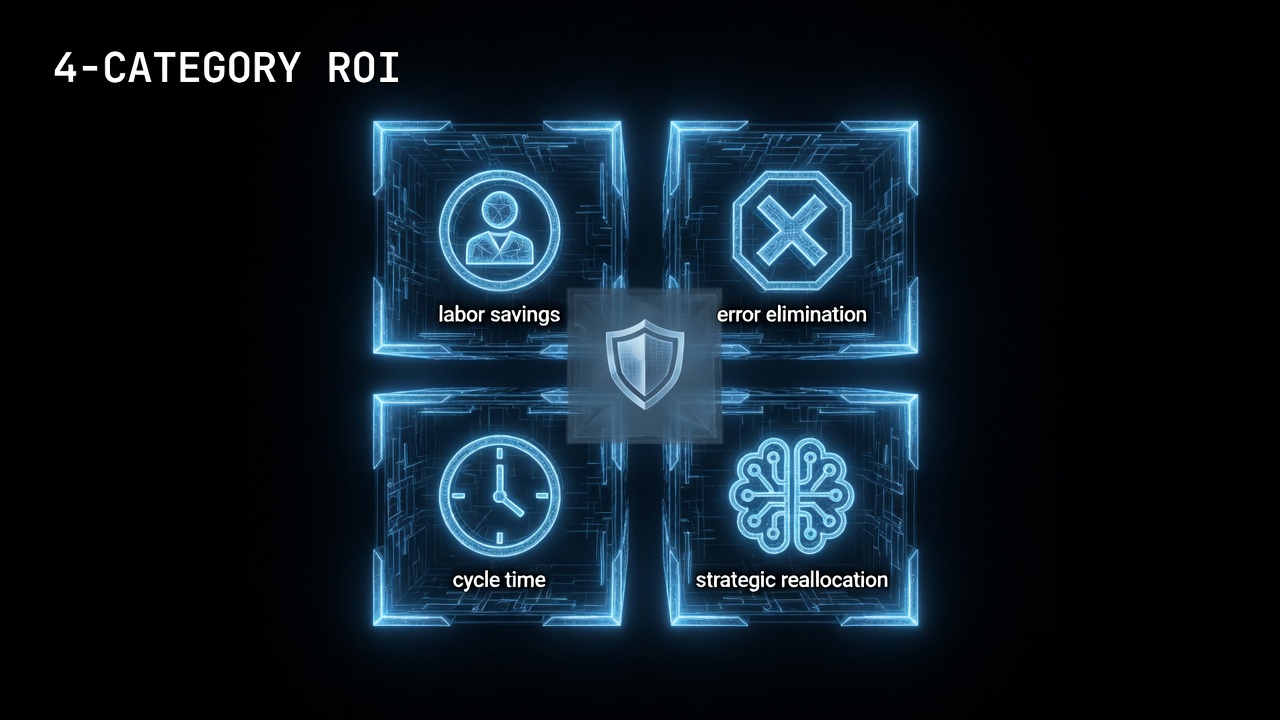
Agentic AI ROI calculations are systematically wrong at most organizations — not because the technology doesn’t deliver, but because CFOs are measuring one of four value categories and calling it the total.
IBM’s CEO Study found that only 25% of AI initiatives deliver expected ROI, and only 16% have scaled enterprise-wide. The barrier is almost never the model or the infrastructure. It’s measurement: finance leaders who build their business case on labor savings alone are undercounting their actual returns by 40 to 60%, presenting undervalued cases to boards, and setting artificial ROI thresholds that initiatives then fail to meet — not because they failed, but because the measurement excluded most of what they delivered.
The data from production deployments in 2026 is clear: 4.2x median 3-year ROI for finance AI, 7-month average payback, 58% average reduction in manual task volume in year one. These numbers come from deployments that measured all four value categories. The ones that measured only the first category looked far less compelling at the board presentation stage — and many of them didn’t get funded.
Why Most Agentic AI ROI Calculations Miss 40-60% of Real Value
The standard CFO approach to agentic AI ROI counts labor hours eliminated, multiplies by fully loaded FTE cost, and divides by platform investment. This is Category 1 of a four-category framework. It’s the most visible and easiest to quantify, which is why it dominates business cases. It’s also structurally incomplete.
Three categories of value consistently appear in production deployments and consistently fail to appear in business cases:
- Error cost elimination (Category 2). A fraud detection system that prevents $1.5 million in annual losses generates exactly the same financial value as a system that saves $1.5 million in labor costs — but risk reduction never appears in a headcount savings report. Invoice matching errors, reconciliation discrepancies, and compliance violations all carry measurable financial costs that agentic AI reduces directly. Finance leaders who exclude this category systematically undervalue their AI returns.
- Cycle time value (Category 3). Accounts payable cycle time reduction of 40 to 60% doesn’t just save labor — it changes the working capital position. Days sales outstanding reduction of 4 to 7 days per the Aberdeen Group 2025 data has a direct cash flow value that belongs in the ROI calculation, not just the operational metrics dashboard.
- Strategic reallocation value (Category 4). When 58% of manual finance task volume is automated, the FTE capacity freed doesn’t disappear — it redirects. Finance teams that had been spending most of their time on data gathering and reconciliation can shift to analysis, scenario modeling, and strategic advisory work. This is value that’s harder to quantify but represents the most significant long-term competitive differential of any category.
For the full ROI measurement framework in action, the AI Treasury Adoption Gap post in this series covers exactly why organizations that treat AI treasury deployment as a transformation project rather than a cost reduction exercise see higher realized returns — the measurement framing determines the investment framing, which determines what gets built.
A Fifth Category the 2026 Landscape Just Made Mandatory
JADEPUFFER, the autonomous AI ransomware attack documented this week, adds a fifth category to the agentic AI ROI framework that didn’t exist in this form twelve months ago: security incident prevention value.
AvePoint’s 2026 State of AI report found that 88.4% of organizations experienced at least one agent-related security incident in the past year. The financial cost of those incidents — investigation, remediation, regulatory notification, reputational impact, and potential regulatory fines under the Colorado AI Act and EU AI Act — belongs in the agentic AI ROI calculation on both sides. Properly governed agentic AI infrastructure reduces incident probability and contains incident cost when breaches occur. Ungoverned deployment creates it.
The governance architecture this series has built across the Work posts — credential isolation, trust level tagging, lethal trifecta gating, audit trails — isn’t a compliance cost that reduces agentic AI ROI. It’s an incident prevention investment that increases it. The JADEPUFFER post from today makes the prevention value of that architecture concrete: one credential isolation gap enabled a complete autonomous attack chain. The cost of preventing it — implementing scoped environments — is measured in hours of engineering time. The cost of not preventing it is measured in hundreds of thousands of dollars, regulatory exposure, and operational shutdown.
The Complete Agentic AI ROI Framework
Applied to a representative finance AI deployment, the five-category calculation produces a materially different number than the single-category version. Here’s the framework in Python — designed to run against real baseline data rather than as a generic calculation:
from dataclasses import dataclass
from decimal import Decimal


@dataclass
class AgenticAIROI:
    """
    Five-category agentic AI ROI framework.
    Most CFO business cases include only Category 1.
    This framework captures all five categories that
    production deployments actually deliver.
    """

    # CATEGORY 1: Direct Labor Savings
    annual_hours_automated: int              # hours eliminated from manual workflows
    fully_loaded_hourly_rate_usd: Decimal    # FTE cost including benefits, overhead

    # CATEGORY 2: Error Cost Elimination
    annual_error_incidents_before: int       # invoice discrepancies, fraud events, etc.
    average_error_cost_usd: Decimal          # investigation + remediation + penalty
    expected_error_reduction_pct: Decimal    # realistic reduction from AI automation

    # CATEGORY 3: Cycle Time Value
    working_capital_tied_up_usd: Decimal     # AP/AR balance affected by cycle compression
    cycle_days_reduced: int                  # days removed from close/collection cycle
    annual_borrowing_rate_pct: Decimal       # cost of capital for working capital freed

    # CATEGORY 4: Strategic Reallocation Value
    ftes_redeployed: Decimal                 # FTE equivalents redirected to higher work
    value_per_redeployed_fte_usd: Decimal    # conservative estimate of strategic FTE value

    # CATEGORY 5: Security Incident Prevention
    annual_incident_probability_ungoverned: Decimal   # AvePoint: 88.4% have had one
    average_incident_cost_usd: Decimal                # investigation + regulatory + remediation
    governance_reduction_factor: Decimal              # risk reduction from proper architecture

    # INVESTMENT
    annual_platform_and_governance_cost_usd: Decimal

    def calculate(self) -> dict:
        cat1 = (Decimal(self.annual_hours_automated)
                * self.fully_loaded_hourly_rate_usd)

        cat2 = (Decimal(self.annual_error_incidents_before)
                * self.average_error_cost_usd
                * self.expected_error_reduction_pct)

        cat3 = (self.working_capital_tied_up_usd
                * (Decimal(self.cycle_days_reduced) / Decimal("365"))
                * self.annual_borrowing_rate_pct)

        cat4 = self.ftes_redeployed * self.value_per_redeployed_fte_usd

        cat5 = (self.annual_incident_probability_ungoverned
                * self.average_incident_cost_usd
                * self.governance_reduction_factor)

        total_annual_value = cat1 + cat2 + cat3 + cat4 + cat5
        roi_multiple = total_annual_value / self.annual_platform_and_governance_cost_usd
        payback_months = (self.annual_platform_and_governance_cost_usd
                          / (total_annual_value / Decimal("12")))

        return {
            "cat1_labor_savings":          float(cat1.quantize(Decimal("0.01"))),
            "cat2_error_elimination":      float(cat2.quantize(Decimal("0.01"))),
            "cat3_cycle_time_value":       float(cat3.quantize(Decimal("0.01"))),
            "cat4_strategic_reallocation": float(cat4.quantize(Decimal("0.01"))),
            "cat5_security_prevention":    float(cat5.quantize(Decimal("0.01"))),
            "total_annual_value_usd":      float(total_annual_value.quantize(Decimal("0.01"))),
            "roi_multiple":                float(roi_multiple.quantize(Decimal("0.01"))),
            "payback_months":              float(payback_months.quantize(Decimal("0.1"))),
            "labor_only_roi":              float((cat1 / self.annual_platform_and_governance_cost_usd).quantize(Decimal("0.01")))
        }


if __name__ == "__main__":
    # Representative mid-market finance AI deployment
    analysis = AgenticAIROI(
        annual_hours_automated=4800,          # ~2.5 FTEs of manual processing
        fully_loaded_hourly_rate_usd=Decimal("65"),
        annual_error_incidents_before=120,
        average_error_cost_usd=Decimal("3500"),
        expected_error_reduction_pct=Decimal("0.70"),
        working_capital_tied_up_usd=Decimal("2500000"),
        cycle_days_reduced=5,
        annual_borrowing_rate_pct=Decimal("0.065"),
        ftes_redeployed=Decimal("2.5"),
        value_per_redeployed_fte_usd=Decimal("45000"),
        annual_incident_probability_ungoverned=Decimal("0.884"),
        average_incident_cost_usd=Decimal("185000"),
        governance_reduction_factor=Decimal("0.60"),
        annual_platform_and_governance_cost_usd=Decimal("180000")
    )

    result = analysis.calculate()

    print(f"\n{'='*55}")
    print(f"FIVE-CATEGORY AGENTIC AI ROI ANALYSIS")
    print(f"{'='*55}")
    print(f"  Cat 1 — Labor savings:            ${result['cat1_labor_savings']:>10,.0f}")
    print(f"  Cat 2 — Error elimination:         ${result['cat2_error_elimination']:>10,.0f}")
    print(f"  Cat 3 — Cycle time value:          ${result['cat3_cycle_time_value']:>10,.0f}")
    print(f"  Cat 4 — Strategic reallocation:    ${result['cat4_strategic_reallocation']:>10,.0f}")
    print(f"  Cat 5 — Security prevention:       ${result['cat5_security_prevention']:>10,.0f}")
    print(f"  {'─'*43}")
    print(f"  Total annual value:                ${result['total_annual_value_usd']:>10,.0f}")
    print(f"  ROI multiple (5-category):         {result['roi_multiple']:>10.1f}x")
    print(f"  Payback period:                    {result['payback_months']:>9.1f} mo")
    print(f"  {'─'*43}")
    print(f"  ROI (labor-only, what most boards see): {result['labor_only_roi']:.1f}x")
    print(f"{'='*55}\n")
Run this against realistic baseline data and the gap between the labor-only ROI (what most boards see) and the five-category ROI (what the deployment actually delivers) is typically 2x to 4x. That gap is not a rounding error — it’s the difference between a business case that gets approved and one that doesn’t.
The Sequencing That Captures Maximum Agentic AI ROI
The finance functions with the highest documented agentic AI ROI in 2026 are also the ones deployed first for a structural reason: they produce the data quality and governance infrastructure that subsequent functions depend on. The sequencing matters:
- Accounts payable and invoice processing first — 60 to 75% cost reduction, 4 to 6 week deployment cycles. Produces clean, structured transaction data that every downstream agent depends on.
- Account reconciliation second — compresses financial close by 40 to 60%. Depends on the data quality established in AP automation.
- Cash forecasting and treasury third — the 88 to 92% accuracy documented in the Automated Cash Sweep post requires the clean transaction data the first two phases produce.
- FP&A and variance analysis fourth — saves analysts 6 to 12 hours per reporting cycle. Requires the reconciled data and forecasting infrastructure from phases one through three.
- Accounts receivable last — external data dependencies and customer-facing considerations make this phase more complex. Organizations that skip the sequence and deploy AR first typically face regression costs.
For the deployment architecture that makes this sequencing work technically, the governed autonomy framework in the Automated Treasury Code post applies across all five phases — the same reversal window and audit trail pattern that makes a cash sweep safe makes every downstream automation safe by the same mechanism.
For the complete ROI benchmarks by function, see ChatFin’s 2026 finance AI ROI benchmark report.
The Builder’s Takeaway
Agentic AI ROI is not being underdelivered — it’s being undercounted. The 4.2x median 3-year return from production deployments is real. The 75% of initiatives that fail to meet expected ROI are failing a measurement problem, not a technology problem. Building the business case against all five categories, sequencing deployment to create data quality that compounds across phases, and treating governance architecture as an investment rather than a cost are the three practices that separate the 25% who capture the return from the 75% who measure themselves into disappointment.
This post is part of The Agentic Protocol’s Wealth series — the autonomous capital layer beneath every agent pipeline. See also: AI Treasury Adoption Gap.