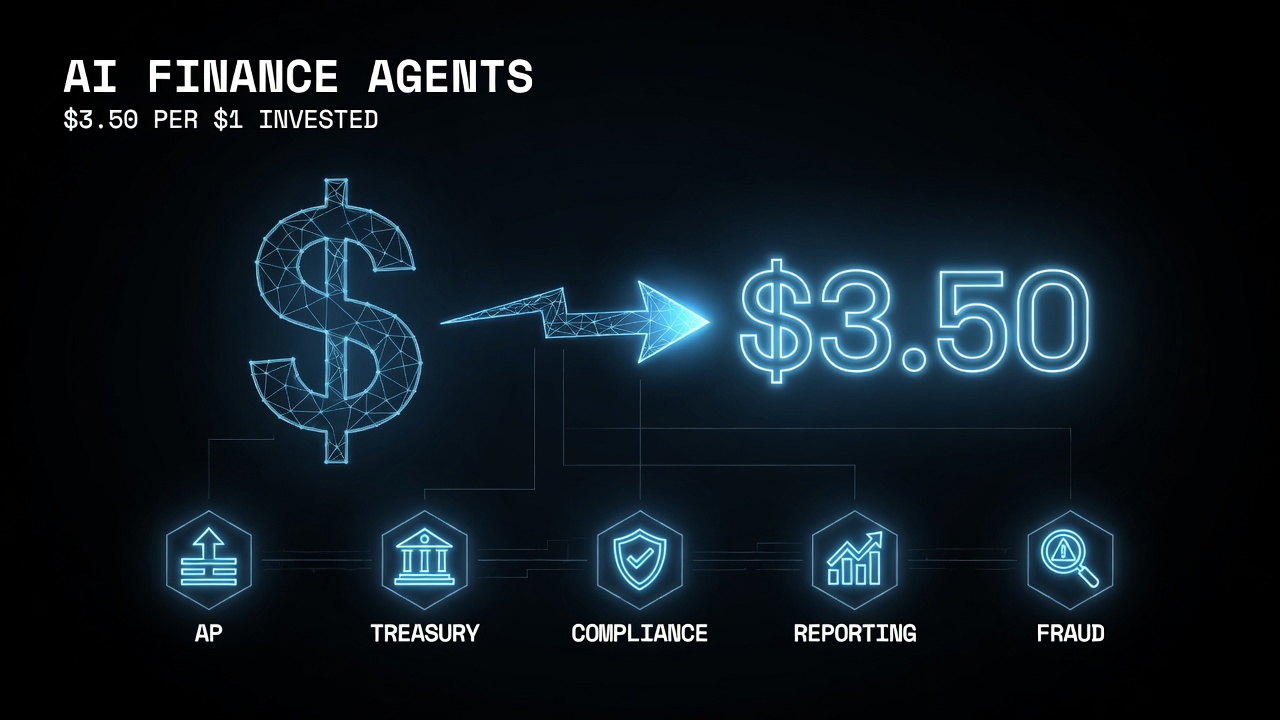
AI finance agents have a number attached to them now that makes every other technology ROI argument look thin: on average, companies earn $3.50 for every $1 they invest in agentic AI in financial operations, while the top 5% globally earn approximately $8 per $1, according to KPMG’s 2026 research across more than 17 million firms.
These aren’t projection numbers. They’re measured returns from organizations that have moved AI finance agents past proof-of-concept into production workflows — accounts payable, month-end close, treasury management, compliance monitoring, and fraud detection. The question for builders in 2026 isn’t whether AI finance agents work. It’s which layer of a $3 trillion productivity opportunity they position themselves to capture.
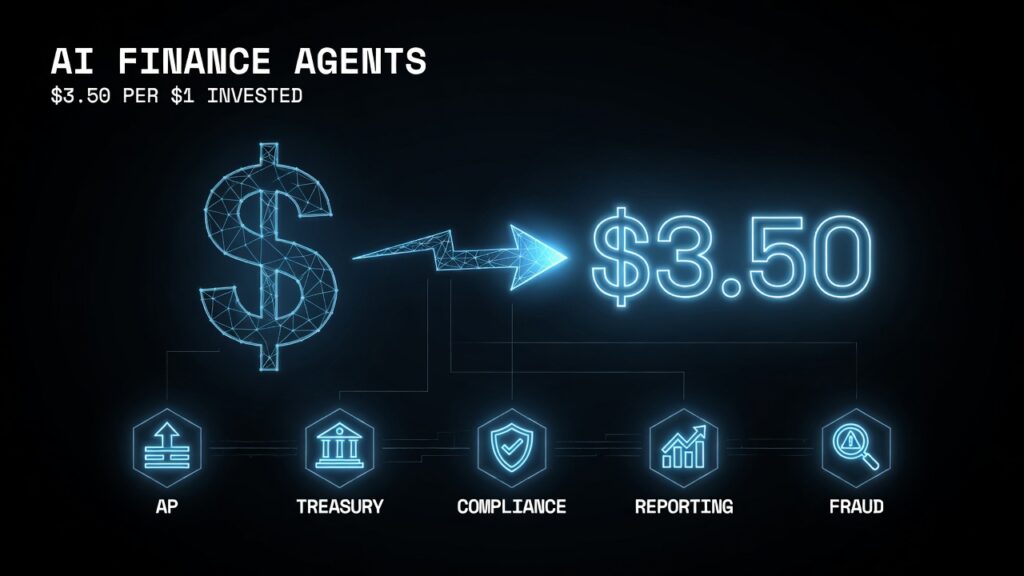
This guide breaks down where AI finance agents are generating the highest documented returns, which specific workflows produce measurable results today, and the three entry points builders can use to participate in this market without needing to become a licensed financial institution.
The AI Finance Agents ROI Research: What the Numbers Actually Say
Three research findings define the 2026 AI finance agent opportunity with enough precision to build a business case:
- $3.50 return per $1 invested. KPMG’s 2026 research across 17 million+ firms found this as the average agentic AI ROI in financial operations. The top 5% globally earn approximately $8 per $1 — driven primarily by firms that moved from task-level automation to full workflow orchestration across multiple finance functions simultaneously.
- 30–50% reduction in manual workloads. McKinsey’s 2026 research on early agentic AI implementations in financial services documented “zero-touch operations” as the consistent outcome across accounts payable, reconciliation, and compliance workflows. The firms achieving zero-touch didn’t implement AI agents on top of existing processes — they rebuilt the processes around agent orchestration from the start.
- 10–15 day close cycles compressed to 3–5 days. TNGlobal’s June 2026 financial services analysis found this compression across organizations deploying AI agents for month-end close: transaction matching, exception handling, journal entry drafting, management report generation, and approval workflow coordination happening autonomously rather than sequentially through human handoffs.
The Agentic AI ROI post in this series established the five-category ROI framework — labor savings, error elimination, cycle time value, strategic reallocation, and security incident prevention. KPMG’s $3.50 figure collapses all five into one number. The organizations producing $8 per $1 are measuring all five; the ones producing $1.50 per $1 are measuring only labor savings and calling it disappointing.
The Six AI Finance Agent Workflows With the Highest Documented Returns
1. Accounts Payable Automation (60–75% cost reduction)
AI agents process invoices end to end: extracting data from unstructured documents, matching against purchase orders and goods receipts, identifying discrepancies, routing exceptions for human review, and approving clean invoices automatically. The documented cost reduction range of 60–75% comes from eliminating the human-hours spent on document handling, data entry, and three-way matching — which historically consume 70% of AP team time in organizations without automation. The remaining 30% is exception handling, where AI agents flag and route rather than decide unilaterally.
This is the highest-ROI AI finance agent deployment for most mid-market organizations because the task is structured, the data is consistent, and the AI agent doesn’t need to make judgment calls — it needs to extract, match, and escalate. Builders who understand invoice processing workflows can build targeted AP automation agents and sell them as Micro-SaaS AI agent retainers at $300–800/month to businesses that can’t afford enterprise AP platforms.
2. Month-End Close Acceleration (10–15 days → 3–5 days)
The month-end close is one of the most consistent sources of finance team burnout: a predictable, recurring, high-stakes crunch that requires coordination across multiple systems and stakeholders. AI finance agents address the specific bottlenecks — transaction matching, intercompany reconciliation, accrual calculations, report compilation — that extend the cycle. The compression from 10–15 days to 3–5 days is achievable when agents handle the data aggregation and consistency checking that previously required human coordinators moving between systems.
3. Treasury Cash Forecasting (65–75% accuracy → 88–92%)
The forecasting accuracy improvement documented in this series’ AI Treasury ROI post — from 65–75% for manual forecasting to 88–92% for agentic 13-week cash forecasting — represents a qualitative shift in how finance teams make liquidity decisions. The accuracy improvement isn’t interesting as an engineering metric. It’s interesting as a business outcome: organizations forecasting at 88–92% accuracy can deploy idle capital into short-duration yield instruments rather than holding precautionary cash buffers, which at $10M+ balances generates hundreds of thousands of dollars annually in incremental yield.
4. Compliance Monitoring (Ongoing vs. Periodic)
Traditional compliance monitoring in financial services happens periodically — quarterly reviews, annual audits, spot checks. AI finance agents enable continuous monitoring: checking every transaction against compliance rules, flagging exceptions in real time rather than discovering them at audit, and maintaining the audit trail that regulators now expect under frameworks like the Colorado AI Act and EU AI Act. The ROI here is asymmetric: the cost of continuous agent monitoring is low, while the cost of a compliance failure or missed regulatory deadline is high enough that the insurance value alone justifies the investment.
5. Fraud Detection (Real-Time vs. Batch)
AI finance agents analyzing transaction patterns in real time catch fraud that batch review systems miss — specifically the low-and-slow fraud patterns that stay below threshold-based alert systems by design. The documented false positive reduction (fewer legitimate transactions flagged) is as important as the fraud detection improvement: every false positive creates customer friction and manual review overhead, both of which have measurable costs.
6. Wealth Management Client Briefings
AI agents prepare personalized client briefings before advisor meetings: summarizing portfolio performance, identifying drift from target allocation, flagging life events or market developments requiring planning adjustments, and drafting agenda items. This allows advisors to spend meeting time on strategy and relationships rather than data preparation. BetaNXT’s “Val” platform, launched July 2026, targets exactly this workflow. The AI notetaker category — Jump, Zocks, and their successors — has become the fastest-growing software category in financial advisor history, capturing this meeting intelligence layer that the Wealth Management AI Agents post identified as the highest-conversion entry product for builders entering this space.
The Three Builder Entry Points Into AI Finance Agents
The $3 trillion KPMG productivity figure and the $8-per-$1 top-performer return are institutional numbers — they describe what large financial services firms capture from deploying AI finance agents at scale. The builder’s opportunity is different in size but parallel in structure:
- Invoice and AP automation retainer ($300–800/month per client). The 60–75% AP cost reduction is achievable for mid-market businesses that can’t access enterprise AP platforms — the ones with 500–5,000 invoices per month, handling them manually or with basic accounting software. An AI agent that automates their three-way matching, flags exceptions, and generates approval-ready payment batches is worth several thousand dollars per month in labor savings. Priced at $300–800/month retainer, this is the highest-ROI entry product in the AI finance agent category for independent builders. The client’s labor savings pay for the retainer in weeks.
- Compliance monitoring service ($300–800/month per client). The EU AI Act, Colorado AI Act, and China AI Regulation frameworks that this series has documented across multiple posts have created an immediate market for ongoing compliance monitoring. A builder who has implemented the audit trail and disclosure architecture from the AI Agent Gateway post can package and sell compliance monitoring to any organization deploying AI in regulated finance workflows. The August 2 EU AI Act enforcement date makes this product urgently relevant to the financial services organizations finding this series through search.
- AI finance agent API service (x402 micropayments). The x402 Payment Protocol post described the infrastructure for selling services to other agents per-call. Finance-specific intelligence APIs — invoice extraction, fraud pattern scoring, regulatory rule checking, document classification — are products other AI finance agents are willing to pay for per call. A builder who wraps one well-defined finance intelligence function in an x402-compatible API endpoint becomes a merchant in the agent-to-agent economy, earning revenue from every call without managing a client relationship.
For the complete agentic AI in financial services research roundup, see Neurons Lab’s 2026 financial services analysis.
The Builder’s Takeaway
AI finance agents aren’t a niche — they’re the highest-ROI application of agentic AI in any vertical in 2026, by a wide margin. The $3.50 return per $1 invested means every dollar a client spends on an AI finance agent retainer returns $3.50 in measurable value, which makes the pricing conversation structurally different from almost any other software or service category. Builders who understand one finance workflow well enough to automate it reliably — AP processing, month-end close, cash forecasting, compliance monitoring — have a product that sells itself on ROI alone. The workflows are structured. The data is consistent. The value is measurable. And the market is large enough that 3,400 mid-market businesses can each give a solo builder $500/month without making a dent in the total addressable opportunity.
Continue in This Series
- Agentic AI ROI — the 5-category framework that explains why top performers earn $8 per $1 while average firms earn $3.50
- Wealth Management AI Agents — the $124 trillion wealth transfer context and the specific advisor workflow entry point
- AI Treasury ROI — how the 88–92% forecasting accuracy translates into measurable yield on idle capital
- Micro-SaaS AI Agent — the exact retainer pricing model for delivering AP automation and compliance monitoring
- Agentic Economy — the $30 trillion macro context and three infrastructure layers builders can occupy
This post is part of The Agentic Protocol’s Wealth series — the autonomous capital layer beneath every agent pipeline. See also: Agentic AI ROI.