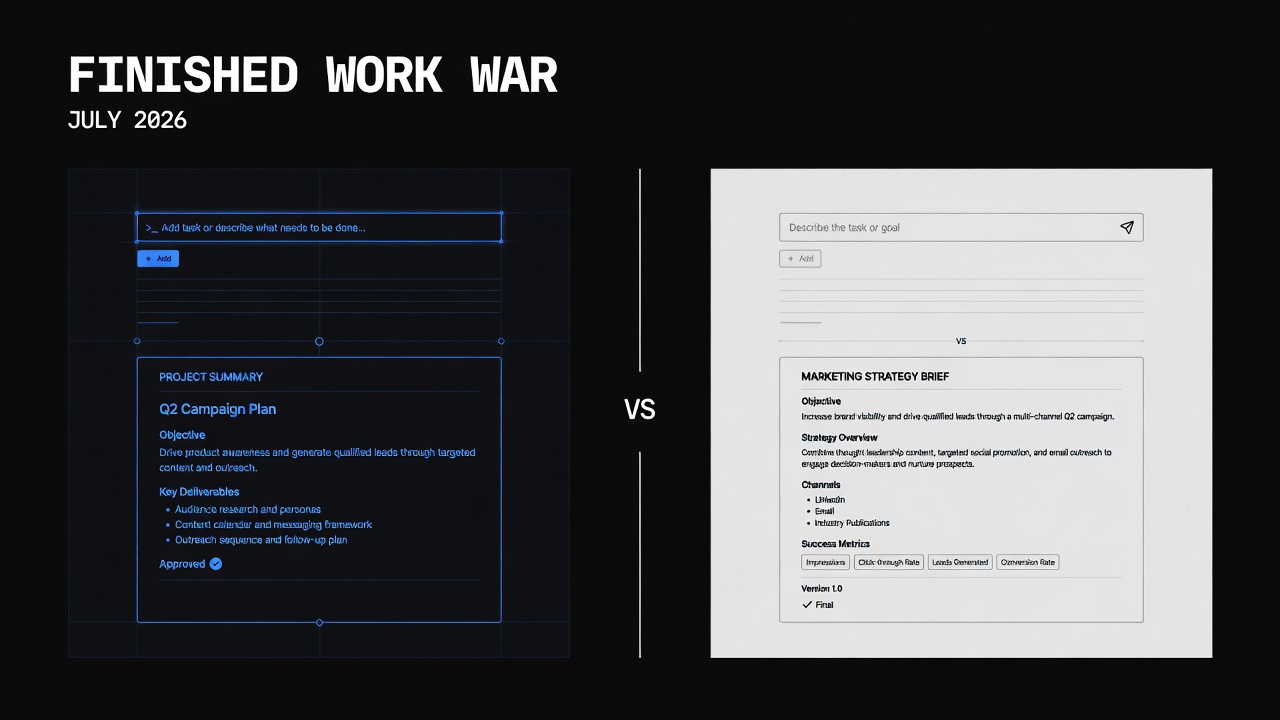
Claude Cowork and ChatGPT Work launched in the same July window — and together they signal the most important product category shift in the agentic AI space so far: the two largest AI labs now agree that the product is finished work, not conversations.
Anthropic expanded Claude Cowork from desktop to mobile and web, making the multi-step task delegation tool available across every surface a builder works from. OpenAI answered two days later with ChatGPT Work — an agent that gathers context across connected apps, breaks a goal into steps, works on complex projects for hours, and returns finished spreadsheets, slide decks, documents, and shareable web apps. It runs on the GPT-5.6 family (Sol, Terra, Luna) and ships alongside a product consolidation: the Codex app merges into a single ChatGPT desktop application. The same week, Gartner put a number on what happens when this category deploys faster than the governance layer catches up: $234 billion in enterprise software spending is at risk from AI agents that are adopted faster than they are managed.
This post breaks down what the Claude Cowork versus ChatGPT Work comparison actually looks like in practice, where each tool fits for the agentic pipeline patterns this series has built, and what Gartner’s $234 billion warning means for how builders position their own governance work.
What the “Finished Work” Category Actually Means
The Arrow AI analysis of July 2026 identified the product thesis both labs are now selling: “finished work, not conversations.” This is a precise description of what separates the new category from every previous generation of AI tooling.
First-generation AI tools (ChatGPT 2022–2023) sold conversations: you type a prompt, it responds, you edit. The output is a response that requires human effort to turn into a deliverable. Second-generation tools (Claude Code, GitHub Copilot, Cursor) sold in-flow assistance: AI embedded in your existing workflow, accelerating the human who remains the executor. Third-generation tools — Claude Cowork and ChatGPT Work — sell delegation: you describe a goal, the agent works autonomously for minutes to hours across multiple tools and data sources, and it returns something usable without requiring you to manage the intermediate steps.
This distinction matters for builders specifically because it changes the scope of what you can realistically delegate. The Claude Code vs Codex vs Cursor post from last week covered the second-generation tool comparison. Claude Cowork versus ChatGPT Work is the third-generation question.
Claude Cowork vs ChatGPT Work: The Practical Comparison
Claude Cowork
Claude Cowork is Anthropic’s desktop-first (now also mobile and web) tool for delegating multi-step, multi-tool tasks to Claude. The intended workflow: open Cowork, describe what you need, and Claude works autonomously — browsing, writing, analyzing, synthesizing — and returns a finished deliverable. The expansion to mobile and web means the delegation workflow is now accessible from any device, not requiring the desktop app.
Cowork’s natural advantage is its deep integration with the Claude model family and Claude Code. Builders who have structured their pipelines around the patterns in this series — sub-agent orchestration, MCP-native tool use, the Claude Code Agent Teams implicit team pattern — can delegate tasks through Cowork and have Claude’s most capable model handle the orchestration. With Claude Opus 5 as the new default on Claude Max, Cowork gets the near-Fable-5 reasoning capability covered in yesterday’s post for standard subscription pricing.
The practical use cases where Cowork excels: research synthesis across multiple documents, long-form writing that requires gathering information from multiple sources, and technical analysis tasks that benefit from Claude’s deep reasoning on complex multi-step problems. The tasks where it has historically been less effective: integrating deeply with external tools and data systems outside Anthropic’s own surface area.
ChatGPT Work
ChatGPT Work is OpenAI’s answer — and its design philosophy is explicitly cross-app: the product is built around gathering context from connected apps, not just operating in OpenAI’s own surface area. It breaks goals into steps, maintains context across a project that can span hours, and returns finished outputs including spreadsheets, presentations, documents, and web apps. Codex no longer exists as a separate product; it merges into the ChatGPT desktop application, unifying the agentic coding workflow with the broader task delegation workflow.
ChatGPT Work’s natural advantage is its integrations: the breadth of app connections it can pull context from before executing a multi-step task. For builders whose workflows span multiple SaaS tools — CRMs, project management, analytics platforms — ChatGPT Work’s context-gathering from those sources before beginning a task is a structural advantage. It also inherits the GPT-5.6 family’s Terminal-Bench 88.8% (Sol) for complex coding tasks within the Work environment.
The Honest Comparison
The Claude Cowork versus ChatGPT Work comparison is currently limited by data: both products are new enough in their current form that production benchmarks on specific task categories don’t yet exist. The honest guidance for builders who need to choose:
- If your task is self-contained, reasoning-heavy, and Claude-native (research synthesis, technical writing, analysis of documents you provide directly): Claude Cowork with Opus 5 is currently the stronger option by model capability alone.
- If your task requires gathering context from multiple external apps before beginning work (CRM data + project tools + analytics for a business review): ChatGPT Work’s cross-app context gathering gives it a structural advantage until Cowork closes the integration gap.
- For builders who’ve built their pipeline on the patterns in this series (MCP-native tools, Claude Code Agent Teams, the AI Agent Gateway): Claude Cowork integrates more naturally with the existing architecture. ChatGPT Work would require building a parallel pipeline on a different orchestration surface.
- Both are substitutes for the same workflow: the hour-per-task research, synthesis, and document production that previously required a human to manage start to finish. Both are worth testing on your specific highest-volume manual task before committing.
Gartner’s $234 Billion Warning: What It Means for the Claude Cowork and ChatGPT Work Users
Gartner’s July 2026 warning — that $234 billion in enterprise software spending is at risk from AI agents that are adopted faster than they are governed — lands in the same week as both Claude Cowork and ChatGPT Work launches. The timing isn’t coincidental. The products make delegation easier; the risk is what happens when delegation bypasses the governance layer.
ManpowerGroup’s July 2026 research adds the human dimension: only 3% of organizations believe their leaders are fully prepared to lead AI-enabled teams. The governance gap isn’t primarily a technical problem — it’s a management problem. Organizations that deploy Claude Cowork or ChatGPT Work without defining what tasks agents are authorized to complete, what data they’re authorized to access, and what decisions require human review before action are exactly the organizations Gartner’s $234 billion figure describes.
The pattern this series has documented across its compliance and security posts maps directly onto Gartner’s warning. The Lethal Trifecta framework defines the capability combinations that create exploitable sessions. The AI Agent Legal Liability post covered the enforcement consequences when agent actions exceed authorized scope. The AI Agent Gateway provides the audit trail that distinguishes governed delegation from ungoverned automation. Gartner’s $234 billion is the cost of deploying Claude Cowork and ChatGPT Work without the governance architecture this series has spent two months building.
MCP Final Specification: What Changed Yesterday
The MCP final specification shipped yesterday (July 28) with two extensions relevant to builders integrating Claude Cowork and ChatGPT Work with existing pipelines:
- Tasks extension: a new primitive for long-running, async operations with progress tracking. For MCP servers that previously returned either a synchronous response or timed out on longer operations, Tasks enables the server to report progress during execution — which is exactly what a Claude Cowork task that runs for 30 minutes requires from the tools it calls.
- MCP Apps extension: a distribution format for packaged agent functionality. This formalizes the tool marketplace concept — an agent can now discover, install, and invoke capabilities from other builders’ MCP Apps, creating the agent-to-agent service discovery layer the x402 Payment Protocol was built to monetize.
LangGraph 1.0, released alongside the final spec, treats MCP tools as first-class nodes rather than adapters — reducing the integration overhead for adding MCP-native tools to LangGraph orchestration patterns covered in the AI Agent Framework 2026 post.
For the full Claude Cowork versus ChatGPT Work competitive analysis, see Arrow AI’s July 2026 enterprise AI news roundup.
The Builder’s Takeaway
Claude Cowork and ChatGPT Work together confirm that “finished work delegation” is the product category that both frontier labs are investing in simultaneously — which is a stronger signal than either product alone. For builders who’ve built the governance, security, and pipeline architecture this series has described, both products are tools that extend what can be delegated. For builders who haven’t, Gartner’s $234 billion warning is the cost of deploying either product without first defining what agents are authorized to do and how those actions are audited. The products are ready. The question is whether the governance architecture surrounding them is ready first — and for builders who’ve followed this series, the answer is yes by design.
Continue in This Series
- Claude Code vs Codex vs Cursor — the second-generation tool comparison: Claude Code, Codex, and Cursor before the “finished work” category shift
- Claude Code Agent Teams — the Claude Code architecture that integrates most naturally with Claude Cowork delegation
- AI Agent Gateway — the governance infrastructure that makes Claude Cowork and ChatGPT Work safe to deploy at scale
- Lethal Trifecta — the security framework that defines what finished-work agents are authorized to access and do
- AI Agent Framework 2026 — where Claude Cowork and ChatGPT Work sit in the broader orchestration framework landscape
This post is part of The Agentic Protocol’s Work series — the connective infrastructure layer beneath every autonomous pipeline. See also: Claude Code vs Codex vs Cursor.