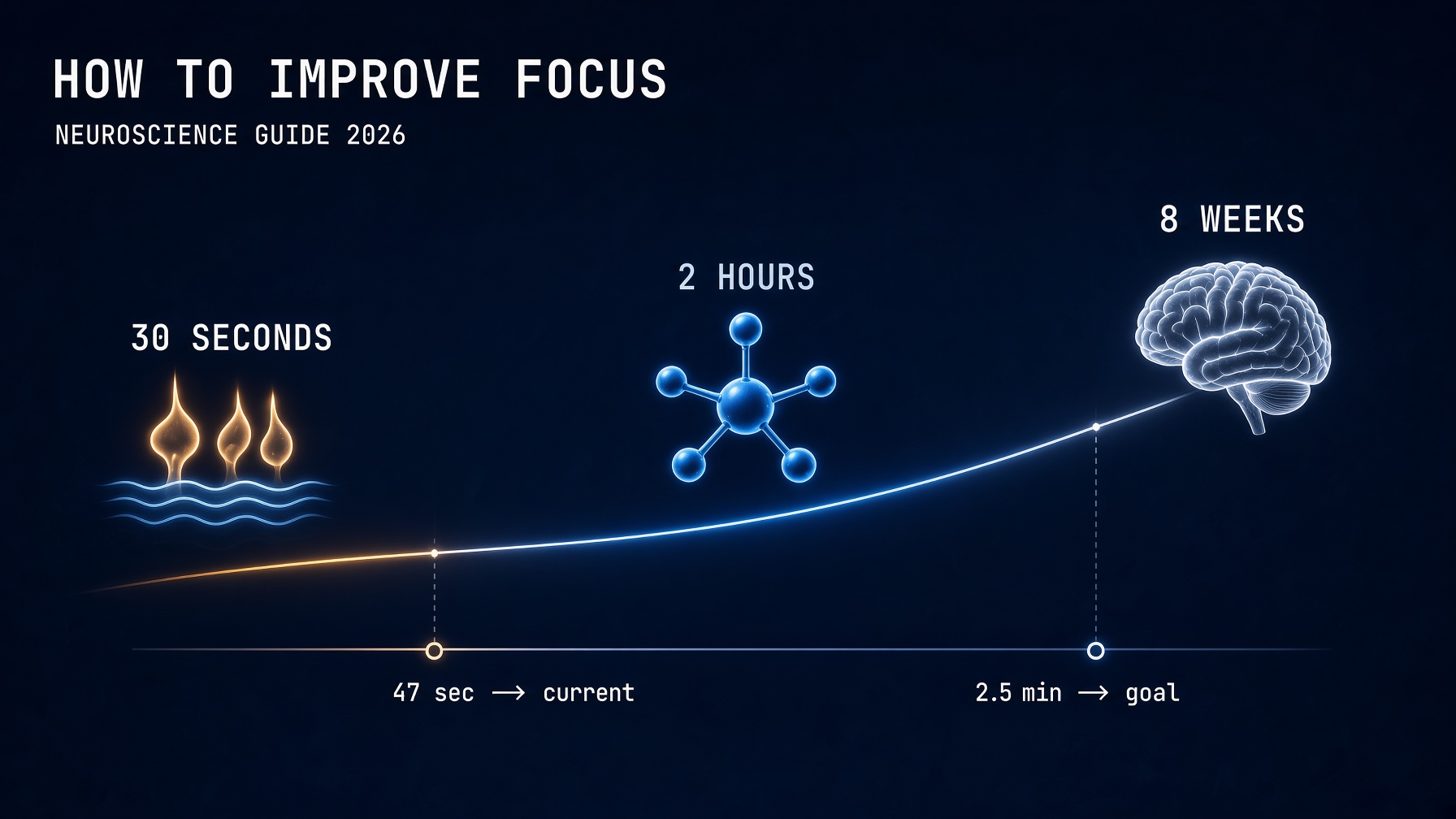
The average adult working on a screen loses focus every 47 seconds. It used to be 2.5 minutes. The decline isn’t a character flaw or a generational failure — it’s a measurable, mechanistic consequence of how digital environments interact with the brain’s attention systems. And for AI developers in 2026, it’s worse: the tools that make the work possible — Claude, Cursor, Slack, GitHub notifications, CI/CD alerts — also multiply the number of attention interruptions per hour.
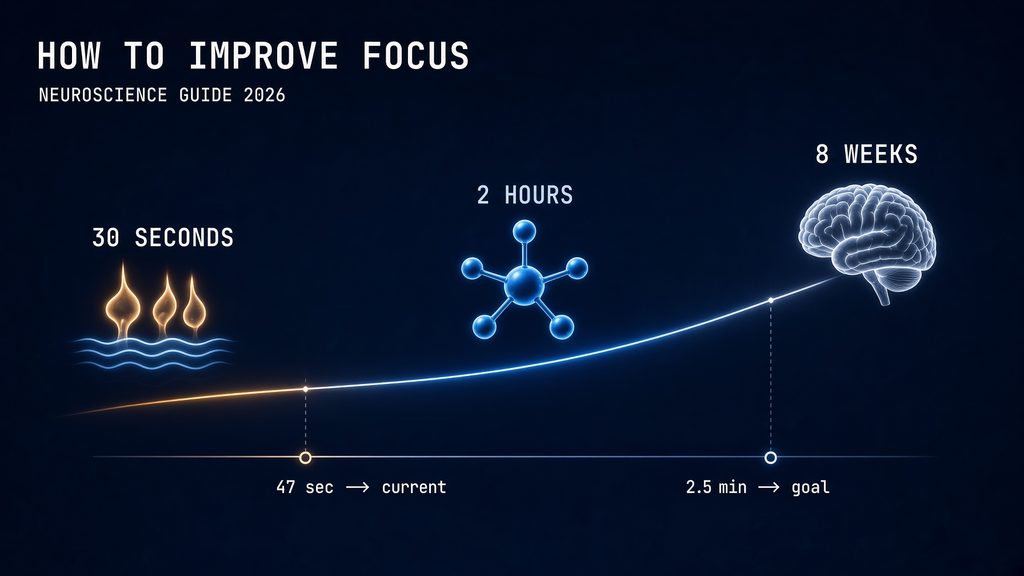
The good news: focus is a trainable skill. Attention is not a fixed trait. The neuroscience research from the last decade — on sleep, exercise, nutrition, meditation, and environmental design — is specific about what moves the needle and by how much. This guide covers the complete stack, organized by time horizon. You’ll find techniques that improve concentration in 30 seconds, methods that produce measurable attention improvement within 2 hours, and structural changes that remodel the prefrontal cortex over 8 weeks. Every technique is evidence-based. Every timeline is realistic. And every recommendation connects directly to a protocol already in this series’ Wellness stack — because the best focus protocol isn’t a collection of hacks, it’s a coherent system.
What Actually Controls Focus: The Neuroscience in Four Minutes
Your ability to concentrate is controlled primarily by the prefrontal cortex — the brain region directly behind your forehead that handles planning, impulse control, working memory, and sustained attention. The prefrontal cortex is also the most energetically expensive region in the brain and the first to degrade under sleep deprivation, chronic stress, and high dopamine stimulation.
Three mechanisms produce most of the focus degradation that knowledge workers experience:
- Attention residue accumulation. Every task switch leaves a partial cognitive activation on the previous task. After 10 task switches in an hour — reading Slack, checking email, responding to a Claude query, reviewing a PR notification, back to the original code — the working memory is carrying fragments of all 10 tasks simultaneously. The prefrontal cortex’s capacity to hold and manipulate information is finite; the accumulated residue consumes capacity that would otherwise be available for the current task. Research on software developers shows they lose up to 20 percent of productive time to task-switching — not from the switch itself, but from the recovery period each switch requires.
- Dopamine receptor downregulation. The D2 receptors that allow low-stimulation tasks — deep thinking, documentation, architectural planning — to feel rewarding are downregulated by repeated high-stimulation inputs. After 30 minutes of notification checking, social media, and AI query browsing, the subtle reward of making intellectual progress on a hard problem doesn’t compete. The threshold has risen above what the task can produce. This is the specific mechanism behind “energy for scrolling, no drive for meaningful work” — covered in depth in the Dopamine Detox Protocol.
- The smartphone brain drain. Research demonstrated a “brain drain” effect with significant practical implications: the mere presence of a smartphone — even face-down, even turned off — reduces available cognitive capacity. Participants with their phones in another room significantly outperformed those with phones nearby on working memory tests. The effect is not from using the phone. It’s from the cognitive effort of actively not using it. Every phone on a desk represents a small but continuous drain on the prefrontal cortex.
The 2026 AI-era addition: AI tools create a new category of attention drain that traditional focus research didn’t anticipate. A Claude interface open in the browser represents an always-available escape hatch from difficult thinking. Every time the current task becomes effortful, the AI tool offers an immediate alternative (query Claude about the problem). This is neither better nor worse than a distraction — it depends entirely on whether the query is goal-directed or avoidant. But the availability of high-quality AI responses creates a framing problem: querying the AI about a problem you haven’t thought through yet feels like working, when it’s actually substituting AI cognition for the human cognition the difficult task was asking for.
Tier 1: Improve Focus in Under 30 Minutes (Immediate Interventions)
These interventions work through acute physiological mechanisms — triggering nervous system state changes that shift the brain from a scattered, reactive state to a focused, directed one within minutes. They don’t build anything long-term, but they produce a measurable focus improvement in the immediate window that follows.
1. The Physiological Sigh (30 seconds)
The fastest focus reset available: a double inhale through the nose (inhale fully, then a short secondary inhale to top off the lungs) followed by a long, slow exhale through the mouth. One repetition produces measurable parasympathetic activation within 30 seconds — a shift in autonomic nervous system state from sympathetic (alert/reactive/scattered) toward parasympathetic (calm/directed/focused). The mechanism is the offloading of CO2 from the alveoli, which the extended exhale accomplishes more completely than any other breathing pattern.
The Breathwork Protocol in this series covers the extended applications — resonance breathing for chronic HRV improvement and box breathing for sustained focus onset. The physiological sigh is the acute, single-breath version: use it at task boundaries (between Pomodoro sessions, when returning from a context switch, when you notice scattered attention), before beginning a deep work block, and as the transition tool between any high-stimulation activity and focused work.
2. Cold Water (30 seconds–3 minutes)
Cold water at 10 to 15°C triggers the mammalian dive reflex — a hardwired autonomic response that slows heart rate and redirects blood flow toward the brain. The vagal tone shift is measurable within 30 seconds. Two practical implementations for desk workers:
- Cold water on wrists: Running cold water over the wrist pulse points for 30 seconds produces a mild vagal activation and temperature shift that’s sufficient to interrupt a distracted state and re-orient attention. Low friction, no preparation required, available at any desk with a nearby sink.
- Cold shower: The full cold plunge or cold shower protocol from the Cold Plunge Protocol produces a 250 percent sustained dopamine surge above baseline — a 2 to 3 hour window of elevated motivation and alertness. The full cold plunge belongs in the morning stack. The cold wrist rinse belongs at the 2 PM concentration low or when mid-session focus drops.
3. The L-Theanine + Caffeine Combination (45–60 minutes to peak)
The most well-studied nootropic pairing in the scientific literature: L-theanine (97 mg) combined with caffeine (40 mg) significantly improved accuracy during task-switching and reduced susceptibility to distraction in a 2008 study in Nutritional Neuroscience. Caffeine alone narrows attention and increases anxiety at higher doses. L-theanine promotes alpha brain wave activity — the frequency band associated with calm alertness — and smooths the caffeine curve. The combination produces focused alertness without the jittery narrowing effect of caffeine alone.
The practical implementation from the Nootropic Protocol: 200 mg L-theanine combined with the caffeine in one standard cup of coffee, taken 60 to 90 minutes before the peak focus window. The timing is designed so that the combination reaches peak plasma concentration at the start of the T+90 deep work block from the Morning Routine Protocol.
4. Remove the Phone From the Room (Immediate)
The highest ROI single action for improving focus at the desk: move your smartphone to a different room before beginning focused work. The brain drain effect is not mediated by willpower — you cannot think your way out of the cognitive overhead of a phone’s presence. The only effective intervention is physical distance. Phones in another room produce measurable working memory improvements within minutes of the removal. A phone face-down on the desk produces no improvement compared to a phone face-up — the cognitive resource is consumed by not-checking, regardless of screen state.
Tier 2: Improve Focus Over 2–72 Hours (Session-Level Interventions)
These interventions produce focus improvements that extend beyond the immediate session — lasting hours or days — through biological processes that require more time to take effect but produce more durable improvements than the acute techniques above.
5. Aerobic Exercise (Focus Improvement: 2 Hours After Session)
Just 20 minutes of moderate cardio — a brisk walk or a Zone 2 run — increases brain-derived neurotrophic factor (BDNF) and improves concentration for up to 2 hours after the session. The BDNF peak that follows aerobic exercise enhances synaptic plasticity, increases neurotransmitter availability, and directly supports the prefrontal cortex functions — working memory, sustained attention, executive control — that focus depends on.
This is the mechanism behind the Morning Routine Protocol‘s Zone 2 exercise at T+5 position: the session produces a BDNF peak at approximately T+90, which coincides with the first deep work block’s start. The exercise doesn’t just prevent focus degradation — it actively enhances the prefrontal cortex’s available capacity during the focus window that follows. The full Zone 2 implementation with heart rate targets and weekly structure is in the Zone 2 Training Protocol.
6. Sleep Optimization (Focus Improvement: Immediate in the Session That Follows)
Sleep deprivation reduces working memory capacity by up to 40 percent — making it the single highest-leverage focus factor to fix first. The prefrontal cortex is uniquely vulnerable to sleep insufficiency because it requires deep slow-wave sleep (SWS) for metabolic waste clearance and synaptic pruning. A single night of fewer than seven hours of sleep produces measurable degradation in attention, working memory, and executive function that no amount of caffeine fully compensates for. Two nights of insufficient sleep produces cumulative impairment that subjects systematically underestimate — they don’t feel as impaired as they are, because impaired judgment is part of what sleep deprivation produces.
The practical focus implication: on days following poor sleep, deep work blocks should be shortened (from 90 minutes to 45-60 minutes), the Pomodoro variant switched from Developer (52/17) to Classic (25/5), and AI query windows expanded slightly — because the focus-intensive human reasoning that deep work requires is specifically what sleep deprivation undermines most severely. The Sleepmaxxing Protocol covers the full architecture for consistent sleep quality: light timing, thermal management, and the sleep pressure accumulation that makes sleep architecture actually restorative rather than merely long.
7. Structured Time Blocks (Focus Improvement: Session-Duration)
Human attention follows ultradian rhythms — roughly 90-minute cycles of higher and lower alertness. Research by K. Anders Ericsson on expert performers found that the most productive musicians, athletes, and scientists work in sessions of approximately 90 minutes followed by genuine recovery breaks, rather than attempting sustained focus for longer periods. The Pomodoro Technique implements the short-cycle version (25-minute focused intervals); the Deep Work Protocol implements the full 90-minute version. Both leverage the ultradian rhythm rather than fighting it.
The calendar-level implementation — ensuring focused work gets protected time slots rather than filling the gaps between meetings — is the Time Blocking Protocol. Research shows that implementation intentions (specifying exactly when and where focused work will happen) increase follow-through by 200 to 300 percent compared to general intentions to “work on that today.” The calendar block converts a vague intention into a specific implementation intention — which is precisely why it works beyond simple schedule organization.
Tier 3: Restructure Focus Over 4–8 Weeks (Long-Term Cognitive Remodeling)
The Tier 1 and 2 interventions improve focus performance within existing neural architecture. The Tier 3 interventions actually change the architecture — through structural changes in the prefrontal cortex, D2 receptor density recovery, and the attentional skill that deliberate practice builds over weeks.
8. Mindfulness Meditation (8 Weeks for Structural Brain Changes)
Mindfulness meditation trains the prefrontal cortex directly — not metaphorically, but structurally. A meta-analysis of 111 randomized controlled trials published in Psychological Bulletin found that mindfulness enhances cognitive functioning across attention, working memory, and executive function domains. Neuroimaging research shows measurable changes in prefrontal cortex gray matter density after just 8 weeks of daily 10 to 20-minute practice. The ACTIVE study found that attention training benefits persisted for 10 or more years after the training period.
Five days of 20-minute meditation sessions improve executive attention measurably. The mechanism is direct: meditation requires repeatedly noticing when attention has wandered and returning it to the focal point. Each iteration of notice-and-return is a repetition of the core attention skill, building the same neural circuits that any skill practice builds through deliberate repetition. After 8 weeks of consistent practice, the structural changes in the prefrontal cortex are visible in neuroimaging — not as a metaphor for feeling more focused, but as literal increases in gray matter density in the regions that control sustained attention.
The implementation recommendation: 10 minutes of focused breathing meditation immediately after the Breathwork Protocol‘s resonance breathing session, in the T+50 window of the morning routine. The breathwork session provides physiological stabilization; the meditation session provides direct attention training. Together they consume 20 minutes before the L-theanine takes effect and the T+90 deep work block begins.
9. Dopamine Baseline Reset (60–90 Days for D2 Receptor Recovery)
The structural intervention with the longest timeline and the largest long-term impact on focus quality: the Dopamine Detox Protocol‘s 60 to 90-day reduction in high-stimulation inputs. When D2 receptor density has been chronically reduced by repeated high-dopamine stimulation, the subtle reward of intellectual progress on difficult tasks doesn’t compete with algorithmically optimized content. The result: deep work feels unrewarding even when it’s going well, which leads to avoidance, which leads to less practice, which leads to worse focus skill over time.
D2 receptor density recovers as the high-stimulation inputs are removed — synaptic pruning research shows that unused pathways weaken within 60 days of consistent alternative behavior. The 60-day dopamine reset doesn’t require a dramatic digital detox. It requires permanently removing the specific engineered-for-exploitation inputs (algorithmic feeds, compulsive notification checking) while maintaining the productive and socially valuable digital activities. After 60 days, deep work begins to feel comparatively more rewarding — not because the task changed, but because the baseline comparison shifted back toward the biological norm.
10. Attention Training Through Deliberate Practice (Weeks to Months)
The deepest long-term intervention: treating focus as a trainable skill and applying the deliberate practice framework that K. Anders Ericsson established for expertise development. Attention is not a fixed trait any more than strength is a fixed trait. A 2015 study of 4,715 adults found that 15 minutes per day, 5 days per week of brain training activities — specifically activities that require sustained selective attention and working memory — produced measurable improvements in concentration. The ACTIVE study found these benefits persisted for 10-plus years.
For builders, the highest-quality attention training is not a brain training game — it’s the practice of the deep work skill itself. Each completed, uninterrupted 90-minute deep work session is a training repetition that builds the neural circuits for sustained focused attention. Each interruption that’s resisted (the phone notification not checked, the AI query delayed by the 20-minute rule) is a specific exercise of the attentional control muscle. The first week of consistent deep work practice feels like maximum effort for modest output. After 8 weeks of the practice, the same output comes with less perceived effort — the attentional skill has genuinely improved through use.
The 2026 AI-Era Focus Problem: The Specific Updates
The interventions above are grounded in neuroscience research that predates AI tools. Three additional focus principles specific to the 2026 AI builder environment:
The AI Query Decision Rule
As covered in the Deep Work Protocol, the focus-preserving AI query rule is specific: can you formulate the query in one sentence before opening the chat window? If yes, it’s a goal-directed query that belongs within the current focus session. If you need the AI conversation to discover what you want to ask, it’s an exploratory query that belongs in a dedicated AI interaction window — not during a focus block. The distinction is between AI as a precision tool (focus-compatible) and AI as an escape from effortful thinking (focus-fragmenting). Both look identical from the outside. Only the internal state before the query determines which it is.
Notification Architecture
The average developer in 2026 receives notifications from: Slack, email, GitHub, CI/CD systems, cloud monitoring, Claude Cowork, calendar, and two to three SaaS tools. Each notification is a potential attention interrupt that costs 23 minutes of full recovery time (Gloria Mark’s research), regardless of whether the notification is acted upon. The architecture change that produces the largest focus improvement: batch all notifications into two daily windows (11 AM and 4 PM per the Time Blocking Protocol) and mute everything else during focus blocks. The 23-minute recovery cost per interruption means that four notification checks during a 90-minute focus block consume 92 minutes of recovery time — more time than the block itself. The math makes the notification discipline non-optional if genuine deep work output is the goal.
The 20-Minute Human-First Rule
The focus intervention that produces the largest improvement in deep work output quality: work on a hard problem for 20 minutes before querying an AI model about it. The 20 minutes of human cognitive effort on the problem produces three things the AI’s answer doesn’t: understanding of the problem’s specific constraints, a sense of where the difficulty actually lies, and the cognitive engagement that makes the AI’s answer comprehensible rather than merely received. After 20 minutes of personal effort, the AI’s answer is evaluated by a mind that has been grappling with the problem — which produces far better judgment about whether the answer is right, whether it applies to the specific context, and what follow-up questions are worth asking.
The Complete Daily Focus Protocol: All Tiers in One Schedule
The synthesis of every technique above into one practical daily schedule. This is the operationalized version of the entire Wellness stack — each protocol in this series represents one component of this unified focus architecture:
THE BUILDER'S DAILY FOCUS PROTOCOL — 2026
==========================================

T+0 (Wake)
  • Phone stays in bedroom or kitchen — never brought to desk
  • No screen for first 30 minutes (protects dopamine baseline)
  • Hydration: 500ml water immediately

T+5 to T+45 (Zone 2 Exercise)
  • 40 minutes outdoor Zone 2 (60-70% max HR, no podcasts)
  • BDNF production begins → peaks at T+90
  • Attention restoration through involuntary natural fascination

T+45 (Cold Exposure)
  • 3-minute cold plunge or cold shower (10-15°C)
  • Sustained 250% dopamine elevation begins
  • Mammalian dive reflex: blood flow redirected toward brain

T+50 (Breathwork + Optional Meditation)
  • 5-minute resonance breathing (5-6 sec inhale / 5-6 sec exhale)
  • 10-minute focused attention meditation (optional but high-ROI)
  • Parasympathetic baseline established for focus block

T+60 (L-Theanine + Caffeine)
  • 200mg L-theanine + 1 cup coffee (≈95mg caffeine)
  • Peak plasma concentration at T+90 — aligned with focus block
  • No second caffeine dose needed (replaces afternoon hit)

T+90 (FIRST DEEP WORK BLOCK — 90 minutes)
  • Phone in different room (brain drain eliminated)
  • All notifications muted
  • 90-minute Pomodoro variant or 3× 25-minute Classic
  • AI queries: goal-directed only, 20-minute human-first rule
  • Single task — no multitasking, no tab switching

T+220 (Break + Physiological Sigh)
  • Stand, move, look away from screen
  • One physiological sigh to complete the transition
  • 10-15 minutes outdoor if possible (mini-attention restoration)

T+235 (AI Interaction Window — 45 minutes)
  • Exploratory AI queries, code review, research
  • Scheduled, not reactive — this is the AI work time
  • Communication batch 1: Slack, email

T+320 (SECOND DEEP WORK BLOCK — 60-90 minutes)
  • Same phone/notification protocol as first block
  • Coffee nap at transition if energy is low [Napping Protocol]
  • Developer Pomodoro variant (52/17) if energy is high

T+420 (Communication Batch 2 + Shallow Work)
  • Email, Slack, admin tasks
  • Meeting scheduling
  • Low-cognitive output tasks

T+480 (Hard Stop)
  • Agent Handoff: review all running AI systems [Weekly Reset]
  • Brain dump: write all open loops → removes background processing
  • Laptop closed — no reopening until tomorrow

Evening (Protection Protocol)
  • No algorithmic content after 8 PM [Dopamine Detox Protocol]
  • Blue light reduction 90 minutes before sleep [Sleepmaxxing Protocol]
  • Consistent sleep timing (same bedtime ±30 minutes, 7-9 hours)
For the complete focus neuroscience review ranked by speed of effect, see Noobru’s evidence-based focus improvement guide with clinical timelines.
The Builder’s Takeaway
Focus improvement in 2026 is a three-tier project: immediate interventions (30 seconds to 30 minutes) that shift your nervous system state, session-level interventions (hours to days) that create the biological conditions for sustained attention, and structural interventions (weeks to months) that remodel the prefrontal cortex itself. The 47-second focus loss that UC Irvine documented is not a ceiling — it’s the baseline for people who haven’t systematically addressed the biological and environmental factors that determine attention quality. The phone in another room, the two daily notification windows, the 20-minute human-first rule before AI queries, the morning Zone 2 exercise, the L-theanine combination, the eight-week meditation practice — none of these is sufficient alone. Together, as the daily protocol above implements them, they address every known mechanism of focus degradation simultaneously. The builders who work at the cognitive edge of what’s possible — the ones whose work genuinely advances what AI systems can do — are not the ones with the most tools. They’re the ones who can think clearly about hard problems for sustained periods. Focus is the meta-skill underneath all the technical skills. It’s worth the investment.
The Complete Wellness Series Referenced in This Protocol
- Morning Routine Protocol — the complete T+0 to T+90 implementation of everything above
- Zone 2 Training Protocol — the 40-minute aerobic session that produces the BDNF peak at the focus block’s start
- Cold Plunge Protocol — the 250% sustained dopamine elevation that supports the first deep work block
- Dopamine Detox Protocol — the 60-to-90-day D2 receptor recovery that makes deep work feel rewarding again
- Deep Work Protocol — the four rules and the AI-era 20-minute rule for protecting the deep work block
- Pomodoro Technique Protocol — the micro-structure inside each deep work block
- Time Blocking Protocol — the weekly calendar system that protects focus blocks from meeting creep
- Sleepmaxxing Protocol — the 40% working memory recovery that every focus session depends on
- Nootropic Protocol — the L-theanine and caffeine stack that peaks at the focus block’s start
- Attention Residue — the 23-minute recovery cost that makes notification batching non-optional
This post is the hub for The Agentic Protocol’s Wellness series — the biological hardware layer beneath every autonomous system you build. See also: Morning Routine Protocol.