The honest version of freelance developer income in 2026: the median full-time US freelancer earns $67,000 per year, months one through three typically produce $0 to $500, and the top 10 percent earn over $10,000 per month. All three numbers are true. The one that applies to you depends on four variables most income guides don’t address together: your specialization, your pricing model, your platform choice, and the specific sequence of moves you make in the first six months.
This guide covers all four. It uses real rate data from an analysis of 8,700-plus freelance job posts scraped from Reddit, GitHub, Hacker News, and professional marketplaces — not salary surveys with self-reported optimism, but actual client budgets from people actively hiring. The AI developer segment of this data shows rates that look like a different profession from generalist freelancing: AI/ML engineering at $85 to $200 per hour, AI agent development reaching $180 to $300 per hour in premium listings, and prompt engineering averaging $146,868 annually. If you can build the systems this series covers — Claude API integrations, LangChain agents, RAG pipelines — you’re in the highest-demand, highest-rate segment of the freelance developer market in 2026.
What follows is the complete roadmap: the income reality, the rate card, the platform comparison, the 30-day portfolio plan, the six-month income trajectory, and the specific difference between the $2,800/month median and the $10,000-plus top 10 percent.
The Honest Income Picture: What Freelance Developers Actually Earn in 2026
Before the rate card and the roadmap: the numbers worth anchoring to when planning a freelance development business. Most income guides are either optimistic (averaging the top earners) or pessimistic (describing the median beginner). Both tell you something real. Neither tells you enough.
The median baseline
The Jobbers.io 2026 Freelance Benchmark Report places the full-time freelance median at $67,000 per year — drawing on platform survey data and self-reported income across US freelancers. The EarnifyHub 2026 survey of 300 verified freelancers found a median monthly income of $2,800, with the top 10 percent exceeding $10,000 per month. ZipRecruiter’s March 2026 data shows freelance software developers averaging $108,548 annually; Glassdoor’s May 2026 figures put the number higher at $140,049 per year.
Why the spread? Each source draws from a different sample. ZipRecruiter scans job postings. Glassdoor relies on self-reported figures from active professionals. Survey platforms collect from self-selected respondents who are typically more engaged (and better paid) than the median. The middle of the range — $110,000 to $125,000 annually for a mid-career freelance software engineer working close to full-time hours — is the most realistic planning number for an experienced developer making the transition.
The year-one reality
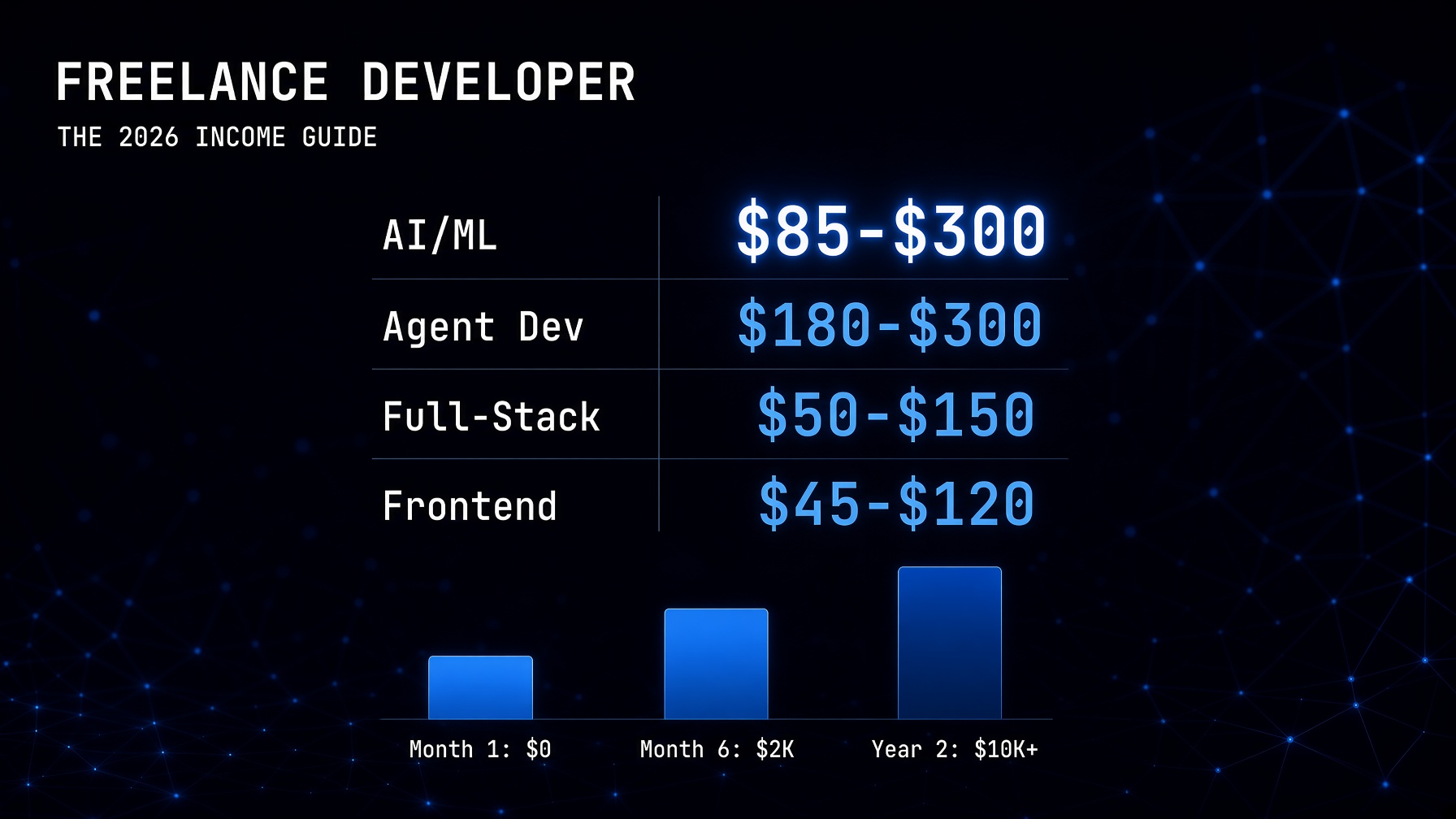
Year one income is a different story from the full-time median. The consistent pattern across multiple surveys: months one through three produce $0 to $500 for most starters as they set up profiles, send proposals, and close their first projects. By month six, focused beginners typically reach $500 to $2,000 per month. This isn’t failure — it’s the standard ramp-up trajectory for a business that runs on relationships and reputation, both of which take time to build.
The factors that compress the ramp-up time — getting to $2,000 per month faster than six months — are specific and learnable: choosing a high-demand specialization, targeting clients where your skills are demonstrably scarce, and using the direct-to-client approach rather than starting with high-competition marketplace listings. Each of these is covered in the sections below.
The AI developer premium
AI and machine learning specialists earn a 40 to 60 percent premium over generalist rates in 2026. The underlying driver: demand for production-quality AI development — not prompting, not “AI-assisted coding,” but building and deploying actual AI systems — grew by 1,847 percent between 2023 and 2026 while the supply of developers who can do it reliably grew far more slowly. Rates by AI specialization from the 8,700-plus job post analysis:
| AI Specialization | Hourly Rate Range | Annual (Full-Time) | Demand Level |
|---|---|---|---|
| AI Agent Development | $180–$300/hr | $374K–$624K (full client load) | Highest |
| AI/ML Engineering | $85–$200/hr | $177K–$416K | Very High |
| RAG Pipeline / LLM | $100–$220/hr | $208K–$458K | Very High |
| Prompt Engineering | $70–$150/hr | $146K–$312K | High |
| Full-Stack + AI Integration | $65–$150/hr | $135K–$312K | High |
| General Full-Stack | $50–$150/hr | $104K–$312K | Moderate |
| Frontend | $45–$120/hr | $94K–$250K | Moderate |
The AI agent and RAG pipeline rates at the top of the table are not outliers — they represent the 75th percentile of client budgets in the segment, not the 95th. A developer who can reliably build, deploy, and secure a production AI agent system — the kind covered in the How to Build an AI Agent With Python guide and the production deployment checklist in this series — is in a different market from a generalist web developer, at every experience level.
The Four Freelance Income Models — and Which One to Use When
Freelance developer income doesn’t come from one source. It comes from choosing the right pricing model for each engagement type, and transitioning between models as your reputation grows. Four models, each appropriate for a different situation:
Model 1 — Hourly Billing (Best for: Unclear Scope, New Client Relationships)
Hourly billing is the easiest model to start with because it requires no scope definition and no estimation risk. You track time, submit an invoice, and the client pays for actual work delivered. The downside: hourly billing transfers all efficiency gains to the client — the faster you work, the less you earn per project. It also requires time tracking, which many developers find administratively draining.
Use hourly billing for: exploratory work where the scope is genuinely unclear, audit engagements where the output is a recommendation rather than a deliverable, and early engagements with new clients where trust hasn’t been established enough for project-based pricing. The target: move off hourly as quickly as the client relationship allows, usually after the first successful hourly engagement produces a concrete result.
Model 2 — Project-Based (Best for: Defined Scope, Clear Deliverable)
Project-based pricing quotes a fixed total for a defined deliverable: “$3,500 for a LangChain RAG implementation with ChromaDB, tested against your document set, deployed to your cloud instance, with documentation.” The client knows the cost before the project starts. You keep the efficiency upside — if it takes you 15 hours instead of 25, your effective hourly rate improves without renegotiation.
Project pricing works when scope is clear, the deliverable is concrete, and you have enough experience with similar projects to estimate accurately. The risk: underestimating. Protect against this with a change-order clause: any work outside the specified scope is billed hourly at your standard rate, agreed in the original contract. This makes scope creep explicit and billable rather than quietly consuming your margin.
Model 3 — Retainer (Best for: Recurring Need, Established Trust)
The retainer model is the highest-value income structure for freelance AI developers because it generates predictable monthly recurring income without the constant client acquisition overhead that hourly and project billing require. You commit to a defined scope of work per month — monitoring, updates, incident response, new feature implementation — at a fixed monthly rate. The client gets guaranteed availability. You get reliable income.
Three retainer tiers for AI developers, matching what we covered in the AI Consulting Rates post:
- Monitoring retainer ($300–$600/month, 3–5 hours/month): You built the system; you monitor it. Monthly health checks, exception handling, quarterly reviews. Maximum scalability: 15 to 20 clients simultaneously.
- Active maintenance retainer ($800–$2,000/month, 8–15 hours/month): You run and improve the system, handle incidents, implement updates. The highest-ROI tier for solo AI developers — enough margin to be meaningful, enough work to stay engaged.
- Strategic retainer ($3,000–$8,000/month, 15–25 hours/month): Embedded advisor role — strategy, vendor evaluation, architecture review, team direction. Requires the compliance expertise and track record from premium factors in the AI Consulting Rates post.
Model 4 — Digital Products (Best for: Long-Term Compounding)
The fourth income model doesn’t bill time at all: it packages your expertise into templates, starter kits, courses, and tools that sell continuously after the initial creation investment. A well-positioned AI agent starter kit at $79 on Gumroad, a compliance implementation template at $99, a LangChain RAG boilerplate at $49 — each generates recurring income without requiring your active time. The complete digital product roadmap is in the Passive Income for Developers guide.
Platform Comparison: Where to Find Freelance Developer Work in 2026
Platform choice has a larger impact on effective income than most rate guides acknowledge. A platform charging 20 percent commission on a $100/hour rate costs you $20,800 per year at 1,040 billable hours — the difference between a platform charging zero and one charging 20 percent is equivalent to roughly 10 weeks of work annually.
| Platform | Commission | Client Quality | Vetting | Best For |
|---|---|---|---|---|
| Toptal | Variable (hidden) | Excellent | Rigorous (top 3%) | Senior developers, $100+/hr |
| Upwork | 10–20% | Mixed | Low | Building portfolio, volume |
| Fiverr | 20% | Variable | None | Productized services, clear scope |
| goLance / Jobbers.io | 0% | Growing | Moderate | Direct rates, lower fees |
| LinkedIn (Direct) | 0% | High | None (you screen) | Senior developers, relationship-driven |
| Reddit (r/forhire) / HN | 0% | Variable | None | Speed — posts fill in under 4 hours |
The data from the 8,700-plus job post analysis reveals one critical operational insight: speed matters more than most freelancers assume. Posts on Reddit and Hacker News receive 10 to 30 responses within the first hour. After four hours, most clients have already shortlisted candidates. Checking job boards once a day means competing against 50-plus applicants rather than 5. For Reddit and HN opportunities specifically, real-time monitoring — a saved search, a browser notification, a purpose-built alert tool — is the single highest-leverage operational change a new freelancer can make.
The platform progression that maximizes long-term income: start on Upwork or a zero-fee platform to build the first three testimonials, then transition to LinkedIn direct outreach and network referrals as quickly as the portfolio allows. Direct clients pay more (no commission), refer more readily (professional relationship), and stay longer (higher switching cost) than platform clients.
Building Your Portfolio in 30 Days: The Action Plan
The portfolio problem for a new freelance AI developer: you need a portfolio to land clients, and you need clients to build a portfolio. The 30-day action plan below breaks the dependency without requiring unpaid speculative work:
- Week 1 — Build three public demos (not client work). Using the tutorials in this series, build three distinct, working AI systems: a RAG-based Q&A agent, a multi-tool automation pipeline, and a LangChain research agent. Host each on GitHub with a README that describes the use case, the technical architecture, the cost to run, and the business problem it solves. These are your portfolio items. They demonstrate capability without requiring a client relationship first.
- Week 2 — Write three case study posts. For each demo, write a 500-word technical post explaining the design decisions, what you would do differently in production, and which business contexts would most benefit from this architecture. Publish on Dev.to or Hashnode. These posts create searchable content, demonstrate thinking quality, and serve as conversation starters in outreach. A link to a case study converts outreach messages to responses at higher rates than any amount of bio optimization.
- Week 3 — Reach out to 15 specific targets. Using the outreach framework from the How to Get Clients guide, send 15 personalized messages to founders and technical leads at companies in one specific vertical — professional services firms, SaaS companies with EU exposure, or e-commerce companies with AI-adjacent features. The message references one specific thing about their product and offers to solve one specific problem. No generic capability statements.
- Week 4 — Run the first discovery calls. For any responses from week 3, run the four-question discovery framework from the How to Get Clients post. Close the project, deliver quickly, and have the retainer conversion conversation at the conclusion. The first client testimonial is worth more than any portfolio item — get it first, then optimize everything else.
The Six-Month Freelance Income Trajectory
What consistent, focused effort produces across six months — not the optimistic version, not the pessimistic version, but the pattern of developers who followed the sequence above and stayed consistent:
- Month 1 ($0–$800): Portfolio built, first outreach sent, first discovery calls run. Zero or one project closed. The income looks discouraging. This is normal — the pipeline is building.
- Month 2 ($300–$1,500): First one or two projects delivered. First testimonial collected. Word of mouth begins with anyone who saw the first client’s results. The retainer conversation attempted after the first project — may or may not convert immediately.
- Month 3 ($800–$2,500): Second wave of outreach with a case study to share. First retainer client, if the month 2 conversion worked. Two to three active projects. Income becomes predictable enough to plan against.
- Month 4 ($1,500–$3,500): Referrals start arriving from month 2-3 clients. Platform commission-free income begins replacing marketplace income. Digital product (Gumroad template) published — not yet generating significant income, but seeded.
- Month 5 ($2,000–$4,500): Two to three retainer clients at combined $800 to $1,500/month. Project work fills remaining hours. The income is now reliable enough that the question changes from “will this work?” to “how do I scale it?”
- Month 6 ($2,500–$6,000): The combination of retainers, project work, and early product income produces a total that the six-month survey data confirms — focused beginners typically reach $2,000/month by month six; developers with strong AI specialization and direct-to-client outreach often exceed this by 50 to 100 percent.
What Separates the $2,800/Month Median From the $10,000+ Top 10%
The survey data is specific about what divides median earners from the top decile. It’s not primarily skill level, experience, or hours worked. Three factors produce the largest income separation:
Factor 1 — Pricing model transition timing
Median earners stay on hourly billing too long. Top earners transition to project-based and retainer billing within three months and never return to hourly for established client relationships. The math is simple: a developer billing $100/hour at 30 hours per week earns $12,000 per month gross before platform fees, taxes, and benefits costs. A developer billing $6,000 per month in three retainers and $4,000 in project work earns the same amount with better predictability and lower administrative overhead. The income ceiling is similar; the predictability advantage is significant.
Factor 2 — Specialization depth versus breadth
Positioning as a specialist rather than a generalist widens income potential more than tenure does. The rate data confirms this consistently: an AI agent developer with three years of experience commands rates that a generalist full-stack developer with ten years doesn’t reach. The AI agent developer can say “I have built 12 production agent systems for professional services firms, and here’s what the security, compliance, and deployment looked like” — which is a claim that justifies premium pricing in a way that generic “I build web apps” positioning doesn’t. The specialization this series covers — agentic AI infrastructure, with the security, compliance, and deployment knowledge attached — is exactly the depth that commands the $180 to $300 per hour rates at the top of the AI segment.
Factor 3 — Platform independence
Developers earning $10,000-plus per month are almost universally not dependent on any single platform for client acquisition. At that income level, direct LinkedIn outreach, referrals from existing clients, and inbound from published content each contribute roughly equally. Platform-dependent income is capped by the platform’s fee structure, its algorithm, and its client quality distribution. Direct-to-client income has no artificial ceiling and grows through reputation compounding rather than platform gaming.
The Tax Reality: What You Actually Keep
One calculation that most freelance income guides omit: the self-employment tax adjustment. As a freelance developer, you pay both the employer and employee portions of Social Security and Medicare — approximately 15.3 percent of net self-employment income before income tax. On a $10,000 per month gross ($120,000 annually), self-employment tax alone is approximately $18,360. Add federal income tax and state income tax, and a $10,000/month freelance income typically produces $5,500 to $7,000 in take-home pay depending on jurisdiction and deductions.
Three structural decisions that preserve more of the income:
- Quarterly estimated tax payments. Set aside 25 to 30 percent of every payment received and pay estimated taxes quarterly (April 15, June 15, September 15, January 15 in the US). Missing quarterly payments triggers penalties. The simplest system: a separate savings account labeled “taxes” where every payment automatically transfers 28 percent.
- Business deductions. Legitimate business expenses reduce taxable income dollar-for-dollar: home office (proportional square footage), hardware, software subscriptions (API costs, development tools, cloud services), professional development, and 50 percent of the self-employment tax itself is deductible. A developer with $15,000 in legitimate business expenses on a $120,000 income saves approximately $3,000 to $4,500 in taxes depending on effective rate.
- Retirement accounts for self-employed. A SEP-IRA allows contributions of up to 25 percent of net self-employment income (maximum $69,000 in 2026). A Solo 401(k) allows $23,000 in employee contributions plus 25 percent employer contributions. Both reduce taxable income in the contribution year. A developer contributing $30,000 annually to a retirement account saves $6,000 to $9,000 in federal taxes depending on effective rate — making retirement investment one of the highest-return financial decisions a freelance developer can make.
This is general information, not tax advice. A CPA specializing in self-employed professionals is worth $500 to $1,500 in annual fees at any income above $60,000 per year — they will save you more than their cost in the first year.
The Complete Freelance Developer Toolkit for 2026
The tools that add the most value at each stage of building a freelance AI development business:
| Category | Tool | Purpose | Cost |
|---|---|---|---|
| Core skill | Claude API, LangChain, CrewAI | The technical capability clients pay for | Pay-per-use |
| Portfolio | GitHub, Dev.to / Hashnode | Demo hosting, case study publishing | Free |
| Client platform | LinkedIn, Jobbers.io, Toptal | Client acquisition | Free–$50/mo |
| Contracting | Bonsai, HelloSign, DocuSign | Proposals, contracts, e-signatures | $17–$40/mo |
| Invoicing | Wave (free), QuickBooks, FreshBooks | Invoicing, expense tracking, tax prep | Free–$30/mo |
| Time tracking | Toggl Track | Hourly billing, productivity awareness | Free tier |
| Product sales | Gumroad, Lemon Squeezy | Digital product distribution | Revenue % |
| Job alerts | HireAlert.io, custom RSS/IFTTT | Real-time monitoring of HN/Reddit | $10–$20/mo |
For the complete 2026 freelance developer rate and income analysis, see HireAlert’s real-data analysis of 8,700+ freelance job posts.
The Builder’s Takeaway
Freelance developer income in 2026 follows a predictable structure: months one through three produce little while the pipeline builds; month six typically reaches $2,000 to $3,000 for focused starters; the transition from platform-dependent to direct-to-client work unlocks the $5,000 to $10,000 per month range that the top 10 percent of freelancers occupies. AI/ML specialists earn 40 to 60 percent premiums over generalist rates — with AI agent development at $180 to $300 per hour representing the highest-paying segment in the market. The four decisions that determine which side of the income distribution you land on: choosing the right specialization (AI infrastructure, not “I build apps”), transitioning from hourly to retainer billing within three months, building direct client relationships rather than depending on any platform, and maintaining the 25 to 30 percent tax reserve that prevents the most common first-year financial mistake freelance developers make. The technical foundation is in this series. The income trajectory is a business-building problem, not a skill problem — and both are more tractable than most income guides suggest.
The Complete Wealth Series — Every Guide Referenced Above
- AI Consulting Rates 2026 — the rate card and premium factor framework behind the AI specialization rates in this post
- How to Get Clients as an AI Developer — the four-channel pipeline and discovery call framework referenced in the 30-day action plan
- Passive Income for Developers — the digital product model (Model 4) and the five-stream income architecture
- Micro-SaaS AI Agent — the retainer service model and unit economics behind the active maintenance retainer
- How to Make Money as a Developer — the four-tier roadmap that contextualizes the six-month trajectory in this post
This post is part of The Agentic Protocol’s Wealth series — the autonomous capital layer beneath every agent pipeline. See also: AI Consulting Rates 2026.