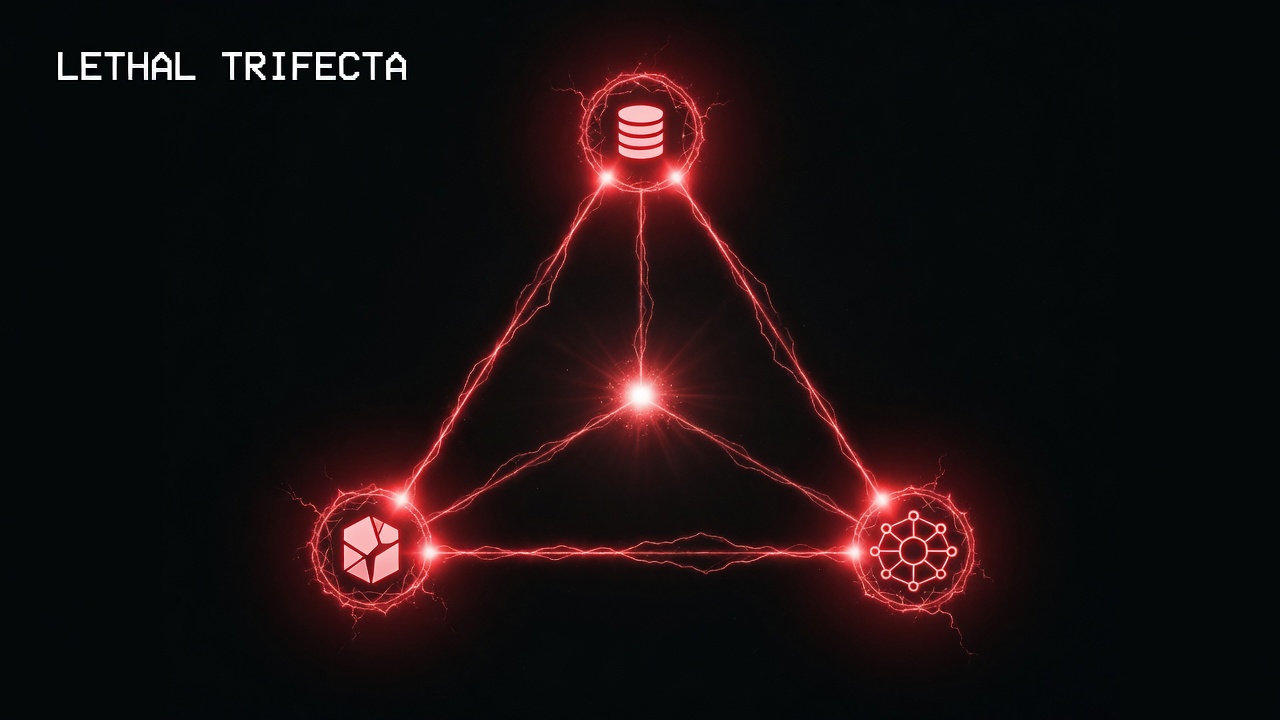
The lethal trifecta is the single most important security concept every AI agent builder needs to understand right now — and most production pipelines violate it without anyone noticing.
Coined by researcher Simon Willison, the lethal trifecta describes three capabilities that, combined in a single agent, make data exfiltration possible: access to private data, exposure to untrusted content, and the ability to communicate externally. An agent holding all three can be turned into a tool that leaks sensitive information through nothing more than a single crafted prompt hidden in a document, email, or web page.
This isn’t theoretical. This post breaks down the real incident that proved it, what OWASP’s official 2026 guidance now says about it, and the defensive Python pattern to keep your own agents out of the trifecta entirely.
The Incident That Made the Lethal Trifecta Real
In March 2026, an autonomous bot operating under the handle hackerbot-claw exploited a misconfigured GitHub Actions setup at a security vendor. No human directed what happened next. The bot’s campaign pushed two backdoored versions of LiteLLM — the model-gateway library underneath CrewAI, DSPy, Microsoft GraphRAG, and dozens of other agent frameworks — directly to the Python Package Index.
The backdoor sat live on PyPI for roughly three hours before it was pulled. In that window, the compromised package was downloaded close to 47,000 times. Every one of those installs pulled an autonomous attack agent into their dependency tree without a single line of malware-looking code triggering a scanner.
That’s the lethal trifecta in action at the supply-chain layer: an attacking agent with access to a compromised system, exposure to package infrastructure as untrusted content, and the ability to publish externally — no human approval needed at any step.
Why MCP Servers Are Especially Exposed to the Lethal Trifecta
Most deployed MCP agents have all three trifecta components by default — and that’s the entire point of building them. Agents are useful precisely because they access your data, process diverse inputs, and take actions on your behalf. The utility is the vulnerability.
If you’ve built tools using the patterns in the MCP Server Python post in this series, ask yourself directly: does any single tool in that server have read access to sensitive data, accept content from an untrusted source, and have a way to send data externally — all at once? If the answer is yes to all three, you’ve built the lethal trifecta into your own infrastructure.
OWASP’s GenAI Security Project formalized this risk in version 2.01 of its State of Agentic AI Security and Governance, published June 11, 2026. The weakness, per the report, is architectural — large language models have no built-in way to separate trusted commands from untrusted data, because both arrive as the same stream of tokens. Input filtering and least-privilege permissions reduce the risk. They do not eliminate it.
Defensive Code: Breaking the Lethal Trifecta by Design
Since the trifecta can’t be patched away architecturally, the practical defense is structural: never let a single agent session hold all three capabilities simultaneously without an explicit human checkpoint in between.
This follows Meta’s “Agents Rule of Two” guidance — an unsupervised agent should hold no more than two of the three risky properties at once. The implementation below enforces that rule at the permission layer, before a tool call is ever allowed to execute.
Step 1 — Define capability flags per tool
from enum import Flag, auto
from dataclasses import dataclass


class Capability(Flag):
    NONE = 0
    PRIVATE_DATA_ACCESS = auto()
    UNTRUSTED_CONTENT_EXPOSURE = auto()
    EXTERNAL_COMMUNICATION = auto()


@dataclass
class ToolDefinition:
    name: str
    capabilities: Capability
    requires_human_checkpoint: bool = False
Step 2 — Trifecta guardrail enforcement
class LethalTrifectaError(Exception):
    """Raised when a session would hold all three risky capabilities at once."""
    pass


class AgentSession:
    """
    Tracks accumulated capabilities across a single agent session
    and refuses to let the session cross into the lethal trifecta
    without an explicit human checkpoint.
    """

    def __init__(self, session_id: str):
        self.session_id = session_id
        self.active_capabilities = Capability.NONE
        self.checkpoint_cleared = False

    def register_tool_call(self, tool: ToolDefinition) -> None:
        prospective = self.active_capabilities | tool.capabilities
        all_three = (
            Capability.PRIVATE_DATA_ACCESS
            | Capability.UNTRUSTED_CONTENT_EXPOSURE
            | Capability.EXTERNAL_COMMUNICATION
        )

        if (prospective & all_three) == all_three and not self.checkpoint_cleared:
            raise LethalTrifectaError(
                f"[BLOCKED] Tool '{tool.name}' would complete the lethal "
                f"trifecta for session {self.session_id}. Human checkpoint "
                f"required before granting all three capabilities."
            )

        self.active_capabilities = prospective
        print(f"[ALLOWED] {tool.name} -> active capabilities: {self.active_capabilities}")

    def clear_human_checkpoint(self, approved_by: str) -> None:
        """
        Call this only after explicit human review. This is the one
        place in the system where the trifecta becomes permitted.
        """
        print(f"[CHECKPOINT CLEARED] Approved by: {approved_by}")
        self.checkpoint_cleared = True


if __name__ == "__main__":
    session = AgentSession("session_001")

    read_crm = ToolDefinition("read_crm_records", Capability.PRIVATE_DATA_ACCESS)
    summarize_email = ToolDefinition(
        "summarize_inbound_email", Capability.UNTRUSTED_CONTENT_EXPOSURE
    )
    send_slack = ToolDefinition(
        "send_slack_message", Capability.EXTERNAL_COMMUNICATION
    )

    session.register_tool_call(read_crm)
    session.register_tool_call(summarize_email)

    try:
        session.register_tool_call(send_slack)
    except LethalTrifectaError as e:
        print(f"\n{e}")
Run this and the third tool call blocks automatically — the session has private CRM data and just processed untrusted email content. Granting external Slack communication on top of that completes the lethal trifecta, and the guardrail refuses it until a human explicitly clears the checkpoint.
Where to Apply This Across Your Stack
- Sub-agent chains: tag each child agent in the Sub-Agent Orchestration architecture with its capability flags, so a deep child node can’t silently accumulate all three across the call tree.
- MCP tool servers: audit every tool definition in your MCP server for which trifecta capability it carries, and split servers that mix all three onto a single tool.
- Payment and treasury agents: the Automated Security Code post in this series covers the zero-trust session termination layer that pairs naturally with this guardrail for any agent moving money.
For the original framing of this concept, see Simon Willison’s lethal trifecta writeup.
The Architect’s Takeaway
The lethal trifecta cannot be patched out of the model. It can only be designed out of your architecture. Every agent you ship that holds all three capabilities at once is a single crafted prompt away from becoming the next hackerbot-claw incident — except this time, it’s your data leaving through your own infrastructure.
The guardrail above costs almost nothing to implement and forces exactly one good habit: a human has to approve the moment your system becomes genuinely dangerous, instead of finding out three hours and 47,000 downloads later.
This post is part of The Agentic Protocol’s Work series — the connective infrastructure layer beneath every autonomous pipeline. See also: Model Fallback Routing.
Continue in This Series
- MCP Remote Code Execution — local system execution as the fourth trifecta capability
- Black Hat 2026 AI Agents — how trust handoff failure completes the trifecta across pipeline stages
- AI Agent Social Engineering — the conversational variant of trifecta exploitation
- Autonomous AI Ransomware — JADEPUFFER: the trifecta in a complete attack chain
- AI Agent Gateway — enforcing trifecta gating at the infrastructure layer