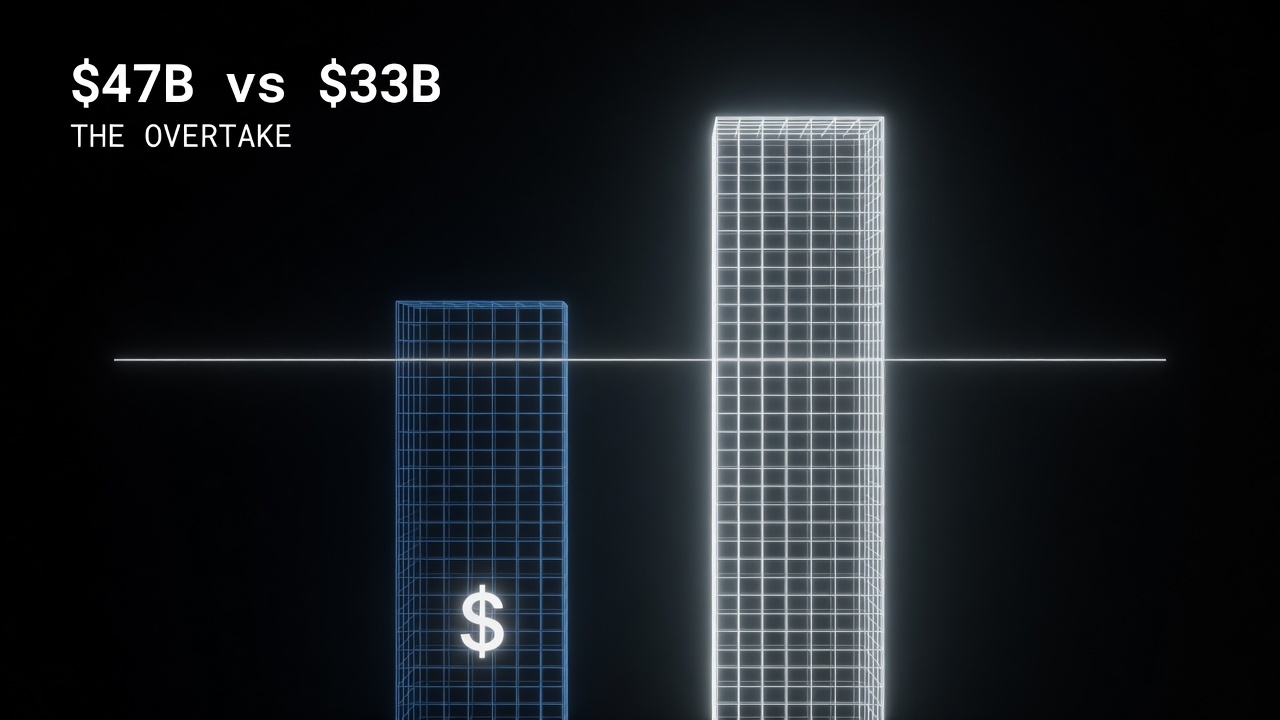
Anthropic revenue just passed OpenAI, and the mechanism behind the overtake is the same tool most builders reading this series use every day.
Fortune confirmed on July 2, 2026 that Anthropic reached an annualized revenue run rate of approximately $47 billion as of May 2026, compared to OpenAI’s most recently disclosed range of $25 to $33 billion. The single most important driver, per Anthropic’s own attribution: Claude Code, the AI coding agent that went into public preview in February 2025 and has compounded enterprise contracts at a rate no other product line has matched. OpenAI retains a larger total user count — approximately 1.1 billion monthly active ChatGPT users versus Claude’s smaller but more commercially concentrated base. Revenue per user strongly favors Anthropic.
The same week that revenue data became public, Anthropic filed a lawsuit against the Department of Defense over a contract dispute where the core issue, per court documents, was this: can an AI lab set ethical limits on a government customer? Pentagon Undersecretary Emil Michael’s position, stated bluntly in emails entered into evidence: the safety guardrails Anthropic required were “just not workable.” This post connects both stories to what they mean for builders who depend on this infrastructure.
Why Anthropic Revenue Overtook OpenAI — and What That Signals
The Anthropic revenue story looks like a technology win. It’s actually a product positioning win, and the distinction matters for how builders think about the platform risk of the tools they’re choosing.
OpenAI’s $25 to $33 billion in revenue is driven largely by ChatGPT consumer subscriptions and API access — a broad, shallow base spread across 1.1 billion monthly users. Anthropic’s $47 billion is concentrated in enterprise contracts where Claude Code is the primary value delivery mechanism — a narrower but far deeper base where the revenue per customer is structurally higher.
Claude Code’s enterprise revenue dominance also validates something this series has been building toward since the Agent Generated Code Quality and Sub-Agent Orchestration posts: the market is paying premiums not for the smartest model in isolation, but for the model that integrates most reliably into agentic engineering workflows. Claude Code’s architecture — MCP-native tool use, sub-agent spawning, dynamic workflow orchestration — is what enterprises are buying, not just the model inference underneath it.
The Anthropic IPO Filing post from this series covered the October 2026 listing target and the risks it introduces for builders. The Anthropic revenue overtake changes that calculus in one specific direction: Anthropic’s IPO narrative is now the strongest of any frontier AI lab, because it’s the only one that can show a defensible revenue moat tied to a specific product architecture rather than general inference access.
The DoD Lawsuit: What It Means When a Safety Guardrail Is Non-Negotiable
The Anthropic DoD lawsuit is not primarily a legal story. It’s a statement about what kind of company Anthropic is willing to be at the moment its revenue is at its most compelling.
The emails released in court documents are specific. The dispute was not over contract terms or pricing. It was over whether Anthropic’s safety guardrails — restrictions on how Claude could be used in weapons applications and high-stakes autonomous decisions — could be waived for a government customer with operational requirements those guardrails constrained. Dario Amodei’s position: no. Michael’s position: those guardrails are “just not workable” for DoD’s use case. Anthropic’s response was to exit the contract and file suit rather than create a precedent that safety constraints are negotiable for sufficiently large customers.
For builders who have been implementing the governance frameworks across this series — the Lethal Trifecta gating, the Colorado AI Act audit trails, the AI Agent Gateway compliance layer — the DoD lawsuit is relevant for a specific reason: it confirms that Anthropic treats its model-level safety constraints as infrastructure, not negotiable configuration. The constraints you build your agents against are the same constraints that aren’t moving for a government customer with a nine-figure contract on the table.
That’s a significant stability signal for production architectures built on Claude. A company that held its safety principles under DoD contract pressure is unlikely to quietly change those constraints in a direction that breaks your guardrail assumptions without public notice.
The Enterprise Controls Update That Changes Cost Management
The third development from the same week, less dramatic than the revenue overtake or the DoD lawsuit but most immediately actionable, is the Claude Enterprise admin controls update released July 3, 2026.
The update directly addresses what Anthropic internally calls the “tokenmaxxing” problem — organizations whose teams consume AI budget faster than procurement expected, with the extreme case being an Uber-scale enterprise that burned through its entire 2026 AI budget in four months. The new capabilities:
- Spend caps at every organizational level — team, department, enterprise-wide — enforced in real time rather than discovered in monthly billing review. This is the model-level version of the per-session cost tracking pattern from the AI Agent Unit Economics post.
- Model-level entitlements — administrators can control which models each user or group can access. This is the organizational implementation of the task-type routing principle from the Sonnet 5 Migration post: Haiku for high-volume low-complexity tasks, Sonnet 5 for production engineering, Fable 5 for explicitly approved frontier workloads.
- Effort controls — default reasoning depth for agent workflows, settable by admin rather than requiring individual configuration in each agent’s code. This addresses the Sonnet 5 adaptive thinking default — if your organization doesn’t need extended reasoning on most tasks, effort can be set to “low” at the admin level rather than per-request.
- Real-time spend alerts — triggers when teams approach configured thresholds, with an Analytics API for integration into internal BI systems.
For organizations running the AI Agent Gateway pattern from yesterday’s post, these controls operate at the organizational admin layer above the gateway — the gateway handles per-call routing and cost tracking, the enterprise controls handle the organizational spend envelope those calls operate within. Both layers are needed; neither substitutes for the other.
The October IPO Window: What Changes for Builders
Anthropic’s October 2026 public listing target, covered in the Anthropic IPO Filing post, now arrives with a revenue narrative that’s materially stronger than when that post was written. A $47 billion annualized revenue run rate positions Anthropic’s IPO as the strongest of the frontier AI lab listings — ahead of OpenAI’s expected September listing on pure revenue momentum.
The builder-relevant risks from the original post remain, now with updated context:
- Pricing pressure toward profitability is real but now less immediate than it appeared in June. A company with $47 billion in annualized revenue and a gross margin trajectory toward 77% by 2028 has more pricing stability runway than a company burning toward profitability under IPO pressure.
- The DoD lawsuit resolution is the new risk variable that wasn’t present in the original post. How that lawsuit resolves — and whether it affects Anthropic’s government contract pipeline — could materially affect the IPO timing and pricing even if the revenue trajectory stays strong.
- The model availability risk from the Claude Fable 5 Suspended post is now paired with a new data point: Anthropic’s demonstrated willingness to exit a major government contract rather than compromise safety constraints suggests the export-control response was consistent with company values, not a one-time anomaly.
For the full revenue comparison and IPO narrative analysis, see Build Fast with AI’s July 7 analysis of the Anthropic-OpenAI revenue overtake.
The Builder’s Takeaway
Anthropic revenue overtaking OpenAI isn’t primarily a competitive intelligence story for builders — it’s a signal about the architecture that wins. Claude Code’s enterprise revenue dominance is built on MCP-native tool integration, sub-agent orchestration, and the governance-compatible design that made it the default choice for organizations that needed agents to operate reliably within compliance constraints. The DoD lawsuit confirms that those constraints aren’t negotiable even under significant commercial pressure. And the enterprise admin controls update gives teams the organizational spending infrastructure to scale that architecture without the tokenmaxxing failures that have burned enterprise AI budgets throughout 2026. These three developments together describe what “building on the right infrastructure” looks like when the market validates it with actual revenue at scale.
This post is part of The Agentic Protocol’s Work series — the connective infrastructure layer beneath every autonomous pipeline. See also: Anthropic IPO Filing.