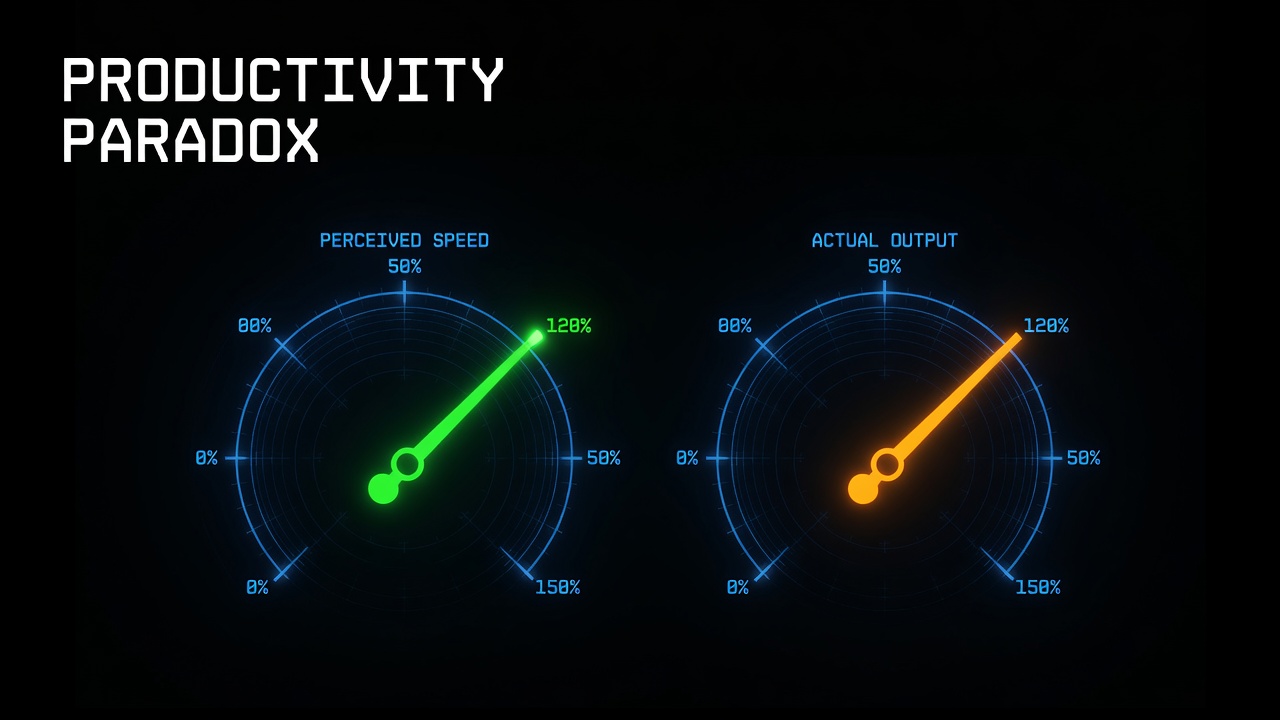
The AI productivity paradox is one of the most practically important findings in the 2026 builder landscape — and it directly contradicts the felt experience of almost everyone reading this.
METR’s 2025 study of experienced software developers found that tasks completed with AI assistance took 19% longer on average than the same tasks completed without it. The same developers, surveyed on their experience, estimated they were working 20% faster. The gap between perceived and actual performance — nearly 40 percentage points — is not a small measurement error. It’s a systematic cognitive blind spot that compounds across every day of AI-assisted work.
This post breaks down why the AI productivity paradox exists specifically for builders running complex tasks, what’s actually happening at the cognitive level, and the workflow design that resolves it without abandoning the tools that genuinely do accelerate certain kinds of work.
Why the AI Productivity Paradox Hits Complex Tasks Hardest
The paradox isn’t universal. AI tools genuinely accelerate low-complexity, high-repetition tasks: boilerplate generation, formatting, search, first-draft writing. The METR finding applies specifically to complex tasks — the ones that require sustained architectural judgment, novel problem-solving, and systems-level reasoning.
Three mechanisms create the AI productivity paradox on complex work:
- Validation overhead exceeds generation speed. 45.2% of developers in Stack Overflow’s 2025 survey reported that debugging AI-generated code takes more time than writing that code from scratch. The AI generates in seconds; the human validates over minutes. On simple, predictable code, the net is positive. On complex architectural decisions where the AI’s suggestions require deep review against constraints the model doesn’t have visibility into, the net frequently goes negative — which is exactly what the Agent Generated Code Quality post in this series addresses with the reflection loop pattern.
- The fluency illusion inflates perceived speed. AI output reads as polished and confident regardless of its correctness. Reading fluent, well-structured code or prose feels like progress. The cognitive signal of “this looks good” fires before the substantive signal of “this is correct.” Builders experiencing the AI productivity paradox aren’t being careless — they’re responding to a real cognitive cue that AI tools have learned to trigger reliably.
- Context-switching overhead accumulates invisibly. The Context Switching Cost post in this series covered the 23-minute recovery window after each major interruption. AI-assisted complex tasks introduce a new switch type: from your architectural reasoning context into the AI’s output context and back. That round trip isn’t free, and it happens multiple times per complex task.
The Broader AI Productivity Paradox Numbers
The METR finding isn’t isolated. A pattern of the same basic dynamic runs across the 2025–2026 productivity research:
- 77% of workers using generative AI reported it added to their workload, citing the need to review outputs and manage prompts, per Upwork Research Institute.
- 88% of organizations have deployed AI, but only 39% can trace it to enterprise-level EBIT impact — a “pilot purgatory” where tools are deployed but haven’t transformed measurable financial outcomes.
- 70% of professionals are not yet using AI tools on a regular basis despite high organizational adoption rates — the gap between purchase and daily practice is larger than most deployment narratives acknowledge.
The pattern across all four numbers: AI is broadly deployed, genuinely valued, and simultaneously creating more review overhead than the efficiency gains cover — at least for the complex work that defines builders’ highest-value output. This is the same dynamic that the AI Brain Fry post describes at the neurological level: cognitive load increasing while available recovery time decreases.
For the full productivity statistics breakdown, see ToolFountain’s 2026 AI productivity analysis.
The Fix: Task-Type Matching, Not Tool Adoption
The AI productivity paradox doesn’t argue for abandoning AI tools. It argues for a specific kind of workflow design: matching tool use to task type, rather than defaulting to AI assistance across all tasks regardless of complexity.
1. Protect Complex Architectural Work From AI-First Defaults
For the highest-complexity tasks — system architecture decisions, novel debugging, security model design — start without AI assistance for the first phase. Develop the mental model of what the solution should look like before consulting AI for implementation details. This isn’t a productivity ideology; it’s a direct response to the METR finding. When the AI generates first and the human validates second, the architectural reasoning happens under the influence of the AI’s existing solution — which shapes and often constrains the judgment that should have come before it.
2. Set a Validation Budget Before Accepting Any AI Output
Before accepting AI-generated code, content, or analysis for complex work, decide how long you’re willing to spend validating it — before you read it. This counterintuitive pre-commitment closes the fluency illusion gap: if you’ve decided you’ll spend 15 minutes validating this output, the fact that it reads well doesn’t shorten that window. The validation time is the work, not a byproduct of the AI being wrong.
3. Use AI Tools for Low-Complexity Work During Low-Energy Windows
The task-type matching principle has a natural scheduling corollary. High-complexity work that generates the AI productivity paradox belongs in your highest-energy, most focused window — the ultradian peak covered in the Attention Residue post. Low-complexity AI-assisted work — boilerplate, formatting, research summaries, first drafts of routine content — belongs in lower-energy windows where the validation overhead is proportionate to the task.
The builders who experience AI tools as net positive are almost universally running this separation deliberately, whether or not they’ve named it explicitly. The ones caught in the AI productivity paradox are typically applying the same tool uniformly across all task types and wondering why the total benefit doesn’t match the promise.
The Builder’s Takeaway
The AI productivity paradox is real, well-documented, and structurally predictable from first principles. AI generates fast and reads fluent — two properties that trigger the cognitive signals of progress independently of whether actual progress occurred. On low-complexity tasks, this is mostly harmless and often genuinely helpful. On complex architectural work, it costs more than it saves because validation overhead exceeds generation speed and the fluency illusion masks the actual time going out.
The fix isn’t using less AI. It’s using AI in the places where it genuinely accelerates work, and protecting complex architectural reasoning from the defaults that make it slower. The cognitive architecture series in this blog — from AI Brain Fry to Attention Residue to Context Switching Cost to this post — has been building toward this same conclusion from multiple angles: structure is what converts AI capability into actual builder output. Without the structure, the tools generate a feeling of speed and a reality of overhead.
This post is part of The Agentic Protocol’s Wellness series — the biological hardware layer beneath every autonomous system you build. See also: Context Switching Cost.