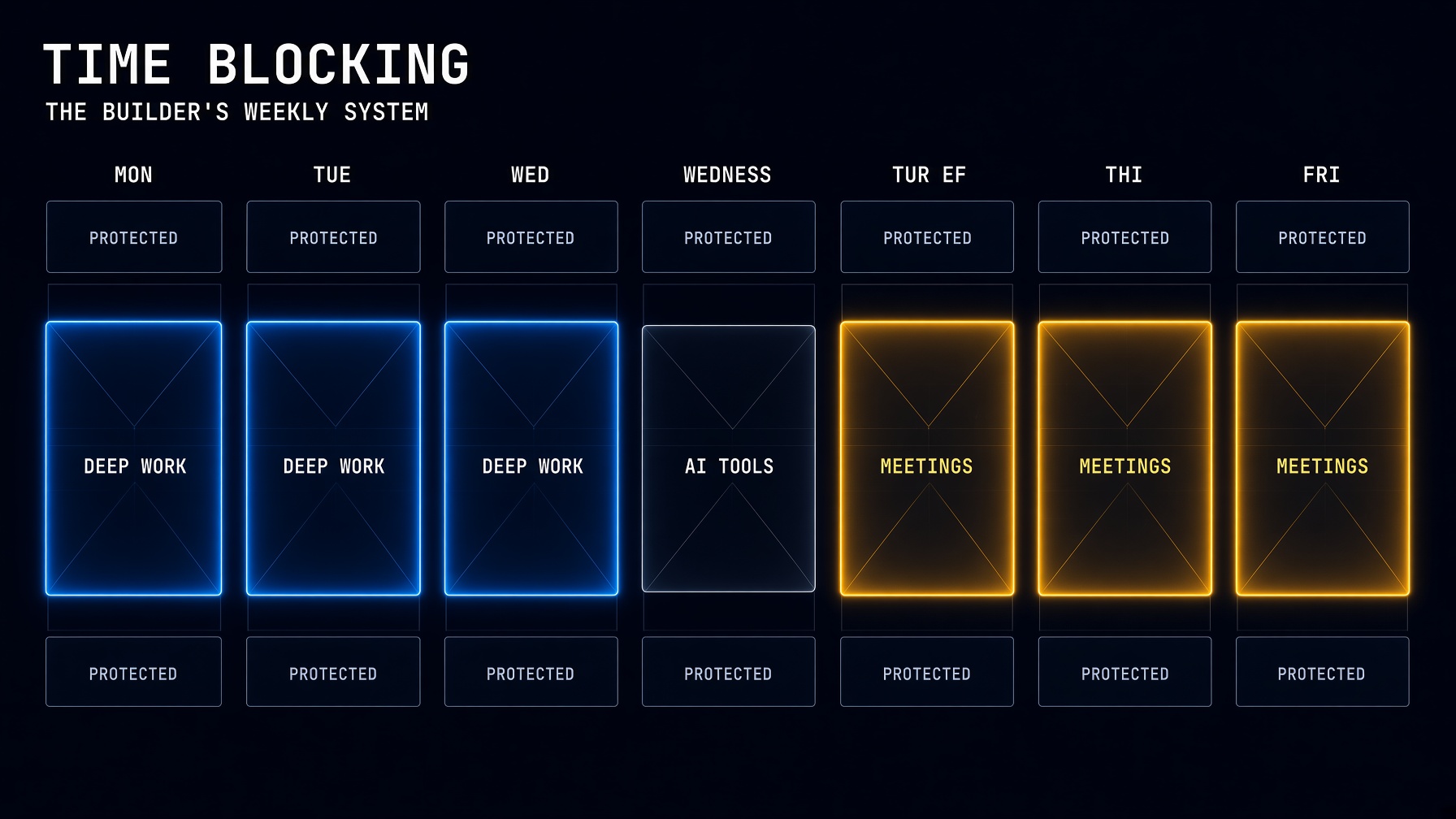
Time blocking is the scheduling method that Cal Newport calls “the most productive thing I do” — and the research agrees. A 40-hour week of blocked time produces the same output as a 60-plus-hour week of reactive work. People who time block complete 30 percent more tasks than those who work from unstructured to-do lists. And in 2026, when ActivTrak reports that knowledge worker focus efficiency has fallen to just 60 percent, the gap between a blocked schedule and an unblocked one is larger than it’s ever been.
This post gives you the specific weekly time blocking system for builders working with AI tools — not the generic advice to “block time for important work,” but the exact block types, durations, and sequencing that the Deep Work Protocol and the physiology of this series’ Wellness stack support. The template you’ll find below is designed around one insight that most time blocking guides miss: AI tool interaction is a distinct work mode in 2026 that belongs in its own block type, not mixed into deep work or treated as shallow work.
Why Time Blocking Works: The Three Mechanisms
Time blocking produces better output through three cognitive mechanisms, not one. Understanding all three is what separates a time blocking system that lasts from one that collapses under the first week of real pressure.
- It eliminates the decision about what to work on next. Every time you finish a task and face an unstructured to-do list, you spend cognitive energy — and often avoid — deciding what comes next. That avoidance is the proximate cause of most procrastination. A time-blocked calendar removes the decision entirely: at 9 AM on Tuesday, you already know what you’re doing. The cognitive energy that would have gone into deciding (and avoiding) goes into executing instead.
- It forces realistic planning. The biggest time blocking failure mode is treating it as a wish list — blocking 11 hours of deep work into an 8-hour day. When that plan collapses by 11 AM, the system gets blamed. But the planning process itself is the benefit: if you can’t fit everything into blocked time, you’ve discovered that your task list is unrealistic before the week starts, not after it ends. Time blocking is the most honest productivity system because it has a capacity constraint the to-do list doesn’t.
- It reduces context switching costs. Research by cognitive scientist Gloria Mark found that it takes an average of 23 minutes to fully return to a task after an interruption. The American Psychological Association found that task switching reduces overall productivity by up to 40 percent. A single 90-minute deep work block with no interruptions produces more output than three separate 30-minute windows separated by two context switches — even though the total time is identical. Time blocking doesn’t give you more hours; it gives you better hours.
The Four Block Types Every AI Builder Needs
Most time blocking guides use two or three categories: deep work, shallow work, and meetings. Builders working with AI tools in 2026 need a fourth. Here’s what each type is and why it needs to be separate:
Type 1 — Deep Work Block (90–120 minutes, immovable)
The block type the Deep Work Protocol defines: distraction-free concentration on work that pushes cognitive capabilities to their limit. No AI queries. No Slack. No email. No phone. A single task or closely related cluster of tasks requiring genuine cognitive engagement. The minimum viable duration is 90 minutes — the research on flow states shows that meaningful cognitive immersion requires 15 to 20 minutes to initiate, which means a 60-minute block leaves fewer than 45 minutes of actual deep work after the ramp-up.
Position these blocks in peak energy hours — typically 8 to 11 AM for most chronotypes. Protect them like an appointment with your most important client. The entire morning routine in this series — Zone 2 at T+5, cold plunge at T+45, L-theanine at T+60 — exists to prime the T+90 deep work block. Don’t trade that block for an early meeting unless there’s no alternative.
Type 2 — AI Interaction Block (45–60 minutes, scheduled)
This is the block type most guides don’t include because AI tools as primary work instruments didn’t exist at scale in 2024. An AI interaction block is scheduled time for working with Claude, ChatGPT Work, LangChain agents, or other AI tools where you’re directing, reviewing, iterating on, and quality-controlling AI output. This is not deep work — the cognitive mode is directive and evaluative, not generative and exploratory. But it’s not shallow work either — it requires focused judgment and produces deliverable output.
Treating AI interaction as part of deep work leads to the grey zone the Deep Work Protocol described: interactions feel like deep work and fragment it simultaneously. Schedule AI interaction in a distinct block, typically after the morning deep work block when creative and generative energy is higher from the BDNF-and-dopamine morning stack but you’re ready to shift to a more collaborative, responsive mode. The dopamine detox principle applies here: AI query windows are scheduled, not reactive.
Type 3 — Communication and Meetings Block (60–90 minutes, batched)
All synchronous and asynchronous communication — Slack, email, video calls, code reviews, and any meetings — goes into one or two batched blocks per day rather than being distributed throughout the schedule. The default: one communication block mid-morning (11 AM to noon) and one mid-afternoon (3 to 4 PM). Everything outside these windows either waits or is a genuine emergency. The inbox stays closed. The communication block is where everything that would otherwise interrupt the other three block types gets handled.
Type 4 — Shallow Work Block (30–45 minutes, flexible)
Administrative tasks, file organization, invoicing, updating task systems, reviewing dashboards, scheduling. Low cognitive demand, easily interruptible, doesn’t benefit from extended concentration. Position these in the natural energy dips — post-lunch, late afternoon — where deep work would be less effective anyway. This block is the most flexible in the daily schedule: it can be shortened, moved, or absorbed into transition time without meaningful output loss.
The AI Builder’s Weekly Time Blocking Template
WEEKLY TIME BLOCKING TEMPLATE — AI Builder (2026)
================================================
Buffer rule: 30-40% of total time stays unblocked.
Deep work: maximum 4 blocks per week. Quality over quantity.

MONDAY
08:00–09:30  DEEP WORK [Type 1] — Architecture & planning
             (highest cognitive demand, freshest energy of the week)
09:30–10:00  Transition + coffee nap prep
10:00–11:00  AI INTERACTION [Type 2] — Monday agent reviews,
             AI tool iteration, quality checks
11:00–12:00  COMMUNICATION [Type 3] — Slack, email batch 1
12:00–13:00  Lunch + outdoor walk (attention restoration)
13:00–13:20  Coffee nap [Napping Protocol]
13:30–14:30  SHALLOW WORK [Type 4] — Admin, invoicing, updates
14:30–16:00  MEETINGS [Type 3] — Schedule all external meetings here
16:00–17:00  COMMUNICATION [Type 3] — Slack, email batch 2
17:00        STOP. Evening routine begins.

TUESDAY
08:00–09:30  DEEP WORK [Type 1] — Hard implementation
             (the code, the design, the document requiring real focus)
09:30–10:00  Transition
10:00–11:00  AI INTERACTION [Type 2] — Tuesday agent work
11:00–12:00  COMMUNICATION [Type 3] — Batch 1
12:00–13:00  Lunch + outdoor walk
13:00–13:20  Coffee nap
13:30–15:00  BUFFER — Overflow from morning, urgent responses,
             unexpected priorities
15:00–16:00  AI INTERACTION [Type 2] — Afternoon AI session
16:00–17:00  COMMUNICATION [Type 3] — Batch 2
17:00        STOP.

WEDNESDAY  ← Mid-week review day
08:00–09:00  SHALLOW WORK [Type 4] — Weekly progress review,
             task list update, re-blocking for Thu/Fri
09:00–10:30  DEEP WORK [Type 1] — Problem solving
             (bugs, optimizations, hard decisions)
10:30–11:00  COMMUNICATION [Type 3] — Batch 1
11:00–12:00  AI INTERACTION [Type 2] — Wednesday AI session
12:00–13:00  Lunch + outdoor walk
13:00–15:00  MEETINGS [Type 3] — Wednesday meetings slot
15:00–16:00  BUFFER
16:00–17:00  COMMUNICATION [Type 3] — Batch 2

THURSDAY
08:00–09:30  DEEP WORK [Type 1] — Thursday deep work
             (final major cognitive block of the week)
09:30–10:30  AI INTERACTION [Type 2] — Thursday AI session
10:30–12:00  COMMUNICATION + MEETINGS [Type 3]
12:00–13:00  Lunch
13:00–14:30  SHALLOW WORK [Type 4] — Documentation, code review
14:30–16:00  AI INTERACTION [Type 2] — Afternoon AI session
16:00–17:00  COMMUNICATION [Type 3] — Batch 2

FRIDAY  ← Consolidation day, no new deep work projects
08:00–09:00  WEEKLY REVIEW [Type 4] — Review week output,
             collect open loops for Sunday's Weekly Reset
09:00–11:00  AI INTERACTION [Type 2] — AI-assisted wrap-up,
             documentation, reports
11:00–12:00  COMMUNICATION [Type 3] — Clear inboxes for weekend
12:00–13:00  Lunch
13:00–14:30  SHALLOW WORK [Type 4] — End-of-week admin
14:30–15:00  BUFFER — Final catches
15:00        STOP. Protected weekend begins.

NOTES:
- Four deep work blocks per week is the sustainable ceiling
- Block type 2 (AI Interaction) is separate from Type 1 on purpose
- Buffer time (≥30%) is not "free time" — it's scheduled margin
- All blocks are re-evaluated Sunday during Weekly Reset Protocol
This template gives you four 90-minute deep work blocks (six hours), six AI interaction hours, four communication batches per day, and approximately 35 percent buffer across the week. The buffer is not wasted time — it’s what prevents the schedule from collapsing the first time a priority shifts on Tuesday morning.
The Sunday Planning Ritual That Makes It Work
A time blocking system that’s rebuilt from scratch every morning doesn’t work — the planning overhead consumes the morning energy it’s supposed to protect. The sustainable pattern: one 20-minute Sunday planning session that loads next week’s blocks into your calendar before the week starts, so Monday morning begins with a confirmed schedule rather than a blank slate.
The Sunday planning ritual (part of Phase 2 in the Weekly Reset Protocol):
- Collect all tasks from your project management tool, notebook, and mental capture into one list. Don’t organize yet — just collect.
- Identify the three highest-priority outcomes for next week. Each outcome gets a deep work block. Everything else is worked into AI interaction, communication, and shallow work blocks around those three anchors.
- Load the template into your calendar with specific task labels. Not “deep work” — “Refactor authentication system.” Not “AI interaction” — “Claude Code review of PR #47.”
- Check for conflicts: existing meetings, deadlines, client commitments. Move shallow work and communication blocks to accommodate. Never move deep work blocks for a meeting that could be async.
- Set one midweek re-block appointment (Wednesday 8:30 AM in the template above) where you review plan-versus-actual and adjust Thursday and Friday blocks. The re-block is what keeps the system realistic rather than aspirational across the full week.
Forbes reports that 58 percent of workers now use time blocking — but most who say they “time block” are doing it informally, inconsistently, and without the Sunday planning ritual that makes the weekly system function as designed rather than as an occasional calendar decoration.
For the full research base on time blocking and deep work scheduling, see LifeMinnt’s comprehensive time blocking in 2026 analysis.
The Builder’s Takeaway
Time blocking works because it eliminates the procrastination-prone decision about what to work on next, forces realistic capacity planning before the week starts, and reduces the 40 percent productivity drain from context switching by batching similar work modes together. The builder-specific update for 2026 is the fourth block type: AI interaction windows, scheduled and distinct from deep work, that prevent the grey zone where AI tool engagement fragments the cognitive concentration it’s supposed to support. The weekly template above gives you four protected deep work blocks, scheduled AI interaction time, batched communication windows, and 35 percent buffer — the structure that makes consistent deep work output sustainable rather than heroic. Run the Sunday planning ritual for three consecutive weekends. The system becomes automatic by week four and the output quality gap between a blocked week and an unblocked one becomes unmistakable.
Continue in This Series
- Deep Work Protocol — the four rules and the biology behind the 90-minute deep work block this template is built around
- Weekly Reset Protocol — the Sunday session where Phase 2 (Forward Load) becomes the time blocking planning ritual above
- Morning Routine Protocol — the 90-minute morning sequence that primes the T+90 deep work block this system depends on
- Attention Residue — the 23-minute recovery cost that the batched communication blocks in this template are designed to prevent
- Dopamine Detox Protocol — the baseline reset that makes scheduled AI interaction windows possible instead of reactive
This post is part of The Agentic Protocol’s Wellness series — the biological hardware layer beneath every autonomous system you build. See also: Deep Work Protocol.