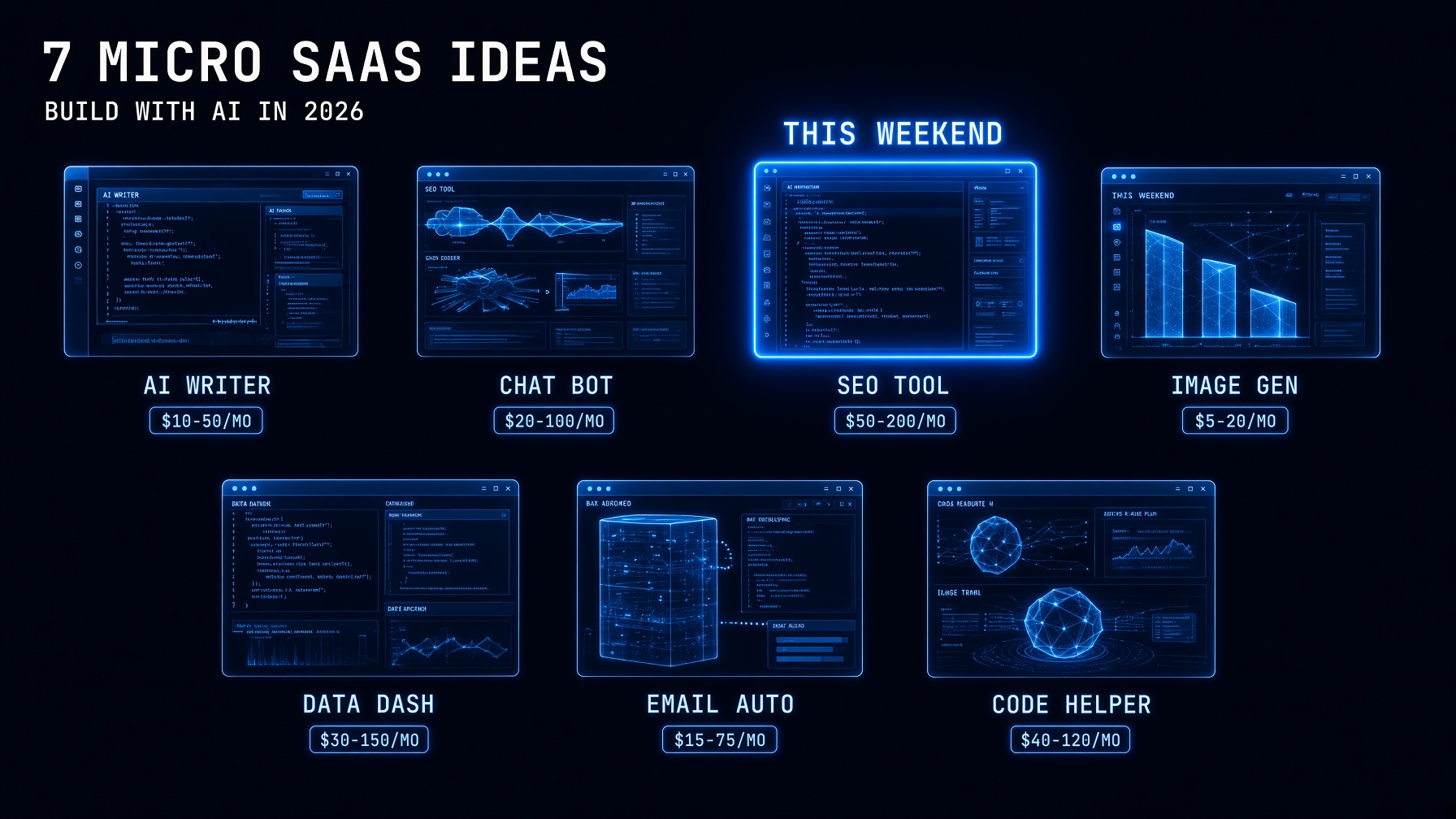
Micro SaaS in 2026 has a new constraint and a new opportunity simultaneously: the constraint is that AI tools have automated most of the generic “build a simple tool” category, and the opportunity is that the same AI tools let a solo developer build in a weekend what used to take a team months.
The micro SaaS ideas that work in 2026 share three characteristics. They solve a specific, painful problem for a defined audience. They leverage AI to provide output quality that would be impossible without it. And they’re narrow enough that a solo builder can own the entire customer experience from landing page to support. Each product below meets all three criteria and can be built using the Python, LangChain, Claude API, and RAG patterns this series has covered — no new skills required.
How to Evaluate a Micro SaaS Idea Before Building
Before the list: a filter. Most micro SaaS ideas sound reasonable and generate no revenue. The ones that work pass four tests before you write a line of code:
- Is someone already paying for something worse? The best signal of a real market is an existing product with unhappy customers. Not “there’s no solution” — “there are bad solutions.” If you find a Reddit thread of people complaining about a tool they use and pay for, that’s your customer base.
- Can you describe the customer in one sentence? “Freelance translators who use Notion to track projects” is a customer. “Small businesses” is not. The narrower the customer, the easier the distribution and the stickier the product.
- Will AI make the output meaningfully better, or just marginally faster? Marginally faster is a feature. Meaningfully better is a product. The ideas below use AI to produce output quality — accuracy, personalization, coverage — that the customer couldn’t achieve manually regardless of time.
- Is $29 to $99 per month an obvious yes for this customer? If you have to construct the ROI argument extensively, the price is wrong or the pain isn’t acute enough. The best micro SaaS customers say “this saves me more than that per week” without prompting.
7 Micro SaaS Ideas for AI Developers in 2026
1. EU AI Act Compliance Checker ($49/month)
The problem: EU AI Act Article 50 became enforceable on August 2, 2026. Thousands of SaaS companies with EU users need to verify their AI features are compliant. Most have no technical person who can evaluate this quickly.
The product: A web app where users paste their AI product description and answer ten questions about their deployment. The app uses Claude with a regulatory prompt to evaluate compliance status, identify gaps, and generate a report with specific remediation steps. Output: a PDF report the customer can share with their legal team or use to brief developers.
Build time: One weekend. Frontend: a ten-question form. Backend: Claude API call with regulatory context from the EU AI Act compliance series as system prompt. PDF generation: WeasyPrint or ReportLab.
Revenue model: $49/month for three reports per month. $99/month for unlimited reports and a compliance monitoring dashboard. Target: SaaS founders, CTOs of EU-facing products, AI product managers.
2. Document RAG API for Niche Verticals ($79/month)
The problem: Law firms, accounting firms, and healthcare practices all need AI that understands their specific documents — but they can’t use generic AI tools that might hallucinate legal citations or medical information.
The product: A managed RAG API endpoint for a specific vertical. The customer uploads their documents (case files, policies, manuals). Your API processes them, stores them in a vector database, and exposes a query endpoint that returns grounded, citation-backed answers. The RAG pipeline from this series is 80 percent of the backend already built.
Differentiation: Pick one vertical and go deep. “RAG for immigration law firms” is a product. “RAG for any documents” is a feature that LangChain already provides for free. The vertical specialization means you understand the document formats, the query patterns, and the compliance requirements that generic RAG tools don’t handle correctly.
Revenue model: $79/month per workspace, up to 500 document pages. $149/month for 2,000 pages. API usage-based pricing above that. Target: small professional services firms with 5 to 50 staff who generate significant document volume.
3. AI Meeting Brief Generator ($39/month)
The problem: Consultants and sales professionals spend 20 to 30 minutes before every external meeting researching the company, the participants, and the context. This research is repetitive, tedious, and nearly identical in structure every time.
The product: Paste a meeting invite or a list of names and company. The app searches LinkedIn-public data, the company’s website, and recent news, then generates a two-page meeting brief: participant backgrounds, company context, recent developments, suggested talking points, and questions to ask. Output in under 60 seconds.
Build time: One to two weekends. The core is a multi-tool LangChain agent from the LangChain Tutorial with web search and URL fetch tools. The structured output prompt is the intellectual work; the code is straightforward.
Revenue model: $39/month for 20 briefs. $79/month unlimited. Target: management consultants, enterprise sales reps, executive assistants. This is the AI notetaker category’s prep layer — the tool that exists before the meeting rather than during it.
4. Code Review Explainer for Engineering Teams ($59/month per seat)
The problem: Junior engineers merge pull requests without fully understanding the reviewer’s feedback. Senior engineers write thorough reviews that junior engineers misinterpret or don’t act on correctly. The communication gap costs rework time on every PR.
The product: A GitHub Action that triggers on PR comments marked with a specific tag. Claude reads the diff and the reviewer’s comment, then generates a plain-English explanation of what the reviewer is asking for, why it matters, and specifically what code change would address it. Posted as a reply comment by a bot.
Build time: One weekend. GitHub Actions YAML, a simple Python script calling the Claude API with the diff and comment as context, and a GitHub API call to post the response. Deployment: GitHub Actions — no server required.
Revenue model: $59/month per engineering seat, or $299/month for up to ten developers. GitHub Marketplace listing provides organic distribution. Target: startups with mixed-experience engineering teams, bootcamp graduate engineers, offshore development teams where English is a second language.
5. Automated Security Audit Reporter ($99/month)
The problem: The rogue AI agent incidents this week — the gym hack, Anthropic’s 141,000-session audit, the RufRoot CVSS 10.0 vulnerability — created immediate demand for AI security audit tools. Most organizations don’t have the technical staff to run a security review of their agent deployments. A structured automated report gives them a starting point.
The product: A web form where users describe their AI agent deployment: which models, which tools, what data access, what network access. Claude evaluates the description against the Lethal Trifecta, OWASP Top 10 for LLMs, and the Five Eyes guidance framework, then generates a risk-rated PDF report with specific remediation steps. Not a technical scanner — a structured expert review of the architecture as described.
Revenue model: $99/month for one report per month with follow-up Q&A. $249/month for three reports and a monthly monitoring check-in. The compliance urgency from this week’s incidents makes this the highest-demand item on this list right now.
6. Contract Plain-English Summarizer ($29/month)
The problem: Freelancers, small business owners, and independent contractors receive contracts they can’t afford to have a lawyer review for every engagement. They sign things they don’t understand or delay deals while waiting for legal review that costs more than the contract is worth.
The product: Upload a PDF contract. Claude extracts and explains in plain English: what you’re agreeing to, what you’re giving up, what the payment terms are, what happens if either party exits, and the three to five clauses that most commonly create problems for freelancers. Explicitly not legal advice — a plain-language summary that helps the user know what questions to ask.
Build time: Half a weekend. PDF loading with PyPDF, Claude API call with a carefully written “explain this contract” system prompt, output as formatted text or PDF. The legal disclaimer UI is as important as the technical implementation.
Revenue model: $29/month for ten contracts. Freemium with one free summary to demonstrate value. Target: freelancers, independent consultants, small agencies — anyone who signs contracts regularly and doesn’t have in-house legal.
7. AI Agent Invoice Generator ($19/month)
The problem: Freelance AI developers and consultants spend 20 to 45 minutes per invoice creating itemized descriptions of technical work in language clients understand. “Implemented RAG pipeline with ChromaDB and Claude Sonnet 5 with reranking optimization” needs to become “Built AI document search system: indexes company documents and answers employee questions accurately.” Most billing tools generate templates; this generates descriptions.
The product: Enter what you built (technical terms welcome). Enter the client’s industry and technical level. Claude generates a client-facing project description, itemized task breakdown, and invoice line items in language appropriate for the client — from “non-technical executive” to “technical CTO.” Export to PDF or copy to your existing billing tool.
Revenue model: $19/month for unlimited invoices. Target: every freelance developer billing clients — the addressable market is every person who uses Gumroad, Stripe, or a billing template to invoice clients for technical work.
The Common Architecture Behind All Seven
Every product above uses the same three-layer architecture:
- Input layer: A web form, file upload, or API endpoint that collects the user’s specific context — the contract, the architecture description, the meeting invite.
- AI layer: A Claude API call with a carefully written system prompt that embeds the domain expertise — the regulatory framework, the security checklist, the plain-language translation rules. This is where the intellectual moat is: the quality of the system prompt determines the quality of the output, and a well-crafted prompt for a specific domain is not easy to replicate.
- Output layer: A formatted PDF, a structured JSON response, or a GitHub comment — whatever the customer’s workflow requires.
The technical stack for all seven: Python backend (FastAPI or Flask), Claude API via the Anthropic SDK, LangChain for any multi-step retrieval, ChromaDB or FAISS for any vector storage, Stripe for billing, and a simple frontend (one HTML page is sufficient for a weekend launch). The complete cost to run any of these products at 100 customers is under $200 per month in API costs — leaving substantial margin at $29 to $99 per customer pricing.
For the complete micro SaaS market analysis, see MicroAcquire’s 2026 micro SaaS trends report.
The Builder’s Takeaway
The best micro SaaS ideas in 2026 are not about building a new AI capability — they’re about packaging an existing AI capability around a specific audience’s specific problem, with enough domain knowledge in the system prompt to produce output that non-technical customers recognize as expert-quality. The EU AI Act compliance checker works because the system prompt contains regulatory expertise. The contract summarizer works because the system prompt knows what clauses matter for freelancers. The security audit reporter works because the system prompt embeds the Lethal Trifecta, OWASP, and Five Eyes frameworks. The AI layer is Claude. The moat is what you tell Claude to do and how you frame the customer’s specific context around it. Pick one of the seven above that matches a customer you can reach directly. Build the MVP this weekend. The technical implementation is the smaller part of the problem.
Continue in This Series
- Micro-SaaS AI Agent — the business model and retainer pricing for the ideas above once you have customers
- RAG Tutorial Python 2026 — the retrieval pipeline behind ideas 2, 3, and 5 above
- Claude API Python Tutorial — the API foundation all seven products are built on
- AI Consulting Rates 2026 — how to price the services that grow out of these products
- AI Agent Passive Income — how the MRR from these products fits into the five-stream passive income architecture
This post is part of The Agentic Protocol’s Wealth series — the autonomous capital layer beneath every agent pipeline. See also: Micro-SaaS AI Agent.