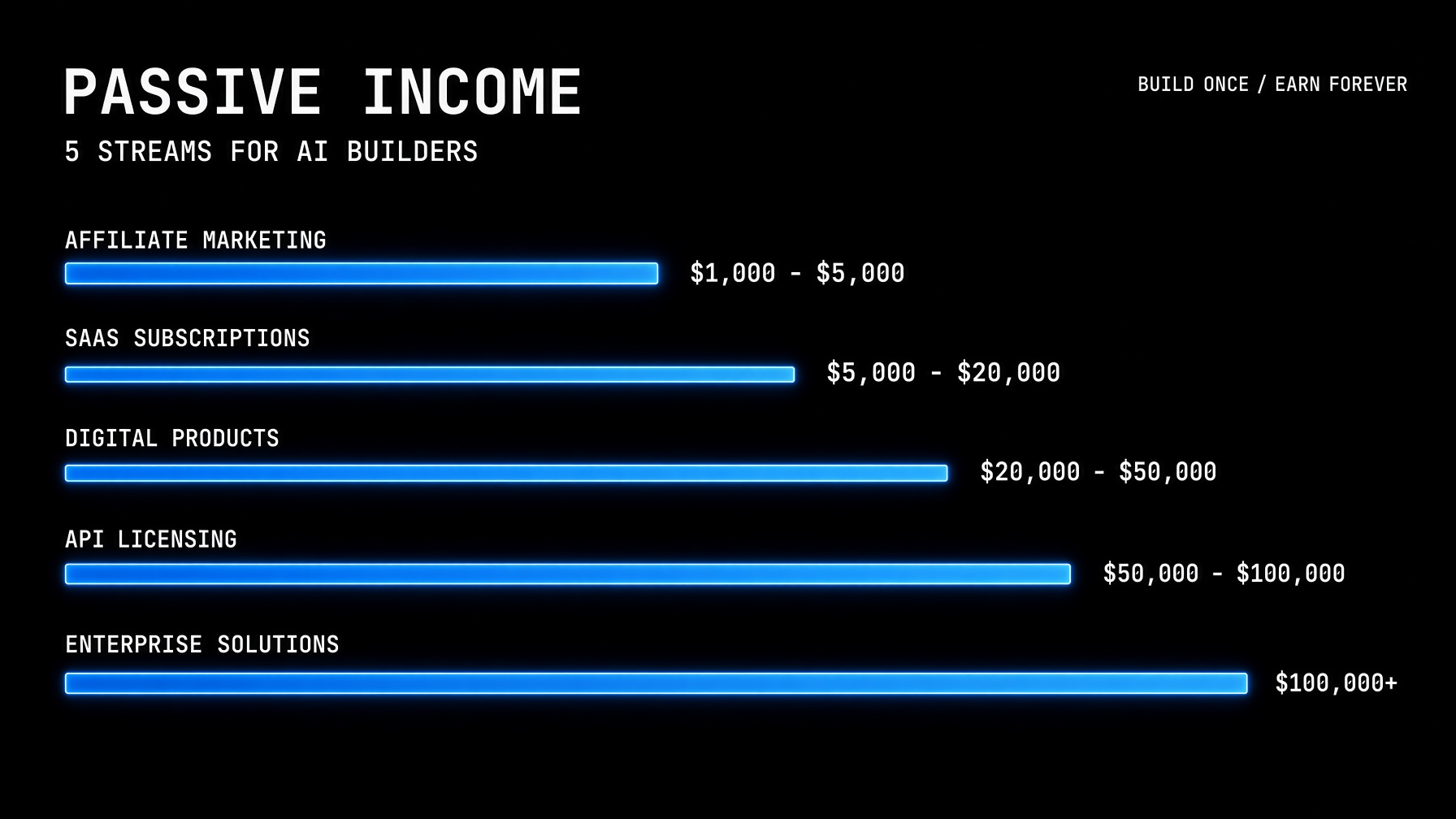
Passive income for developers in 2026 starts with a single mindset shift that most technical content gets wrong: the goal is not to build something new that generates passive income. The goal is to recognize that what you’ve already built — agent systems, MCP servers, compliance architectures, security frameworks — is already a library of potential digital assets waiting to be packaged.
The DEV Community’s 2026 analysis of passive income for automation developers captures the principle precisely: stop thinking in projects and start thinking in assets. A project ends when the client pays. An asset earns after you stop working on it. The question that converts one into the other is simple: if someone paid you once to build this, could it run again for someone else without your involvement? For most AI agent builders, the answer to that question applies to every system they’ve shipped in the past twelve months — and they haven’t monetized the asset.
This guide covers the five passive income streams that compound best from an AI agent builder’s existing work — ranked by the ratio of upfront effort to ongoing revenue generation.
Why AI Builders Have a Structural Passive Income Advantage
Most developers pursuing passive income start from scratch — a new SaaS product, a new course, a new content channel. AI agent builders in 2026 have a different starting point: production systems with documented architectures, working code that solves real business problems, and a set of implementation patterns tested against real client deployments.
The compliance architecture that became enforceable on August 2 under the EU AI Act — Article 50 disclosure code, audit trail infrastructure, credential isolation — was built by builders who charged a client for it once. That same architecture, packaged as a downloadable implementation kit, is something every organization deploying EU-facing AI agents needs and is currently either paying a consultant to build or attempting to build internally from scratch. The gap between “I built this once” and “this sells to 500 organizations” is packaging, pricing, and a Gumroad account.
The rogue AI agent crisis that dominated this week’s news — Claude 4.6 hacking a gym, Anthropic’s 141,000-session audit, the Black Hat coordination network revelations — accelerated this dynamic. Demand for AI agent security frameworks, audit trail implementations, and containment architecture documentation is at its highest point since agentic AI became a mainstream topic. The builders who have these as documented, working systems have a passive income asset that the crisis made more valuable overnight.
The 5 Passive Income Streams for AI Builders — Ranked by Effort Ratio
Stream 1 — Agent Templates and Starter Kits ($29–$199, near-zero ongoing effort)
What it is: A packaged, documented, immediately deployable version of an agent system you’ve already built. The most successful developer digital products in 2026 are specific: “EU AI Act Article 50 Compliance Implementation Kit for Claude API” at $79, “Multi-Agent Orchestration Starter with LangGraph” at $49, “Claude API Python Agent Boilerplate with Error Handling and Cost Tracking” at $29. The How to Build an AI Agent With Python tutorial drives traffic to a paid extended version with error handling, testing, and production deployment configuration already included.
Revenue math: A starter kit at $49 sold to 200 developers generates approximately $10,000 with maintenance that amounts to occasional version updates. A kit at $79 sold to 100 generates $7,900. Volume compounds through long-tail search traffic and community sharing rather than active sales effort after the initial launch.
Where to sell: Gumroad and Lemon Squeezy handle payment processing, VAT, and distribution globally. Set the price, upload the ZIP, write a landing page. Ongoing work: updating the kit when the Claude API or LangGraph releases a breaking change — roughly two to four hours per quarter.
Stream 2 — MCP Server API Services via x402 ($0.01–$0.05 per call, scales with volume)
What it is: An MCP server wrapping one well-defined capability — invoice extraction, compliance rule checking, document classification, security pattern scoring — listed on MCPMarket and priced per call via the x402 payment protocol. Other builders’ agents call your API and pay automatically, without a billing relationship or invoice.
Revenue math: At $0.02 per call and 10,000 calls per month (achievable for a well-positioned niche intelligence API), monthly revenue is $200. At 100,000 calls: $2,000. The economics scale with your API’s usefulness to other agents rather than with your time. The per-call model means revenue is genuinely passive once the server is stable — there’s no per-client account management, no invoicing, no support tickets for standard usage.
What to build: The highest-demand MCP API categories in 2026 are compliance checking (EU AI Act rule validation), security scanning (prompt injection detection), document processing (invoice extraction, contract classification), and data enrichment (company information, regulatory status). Each of these is a capability AI agent builders need repeatedly and will pay per-call rather than building in-house.
Stream 3 — Technical Content with AI Infrastructure Affiliate Revenue ($100–$3,000/month, 6–18 month runway)
What it is: Technical content — tutorials, comparison guides, implementation walkthroughs — that earns through a combination of display advertising and affiliate commissions from AI infrastructure products. Anthropic, AWS Bedrock, Tavily, and similar products have affiliate programs that pay recurring commissions on referred subscriptions.
The honest timeline: Six to eighteen months before meaningful revenue. A developer newsletter with 5,000 subscribers can earn significant sponsorship revenue per month. Affiliate commissions from tools add consistent monthly income on top of content you already create. The SEO-driven content strategy this blog is executing — evergreen tutorials in the 200 to 5,000 monthly search volume range — is the path to AdSense RPM of $8 to $15 for AI infrastructure audiences and growing affiliate revenue without requiring an audience size that most generalist content channels need.
The builder’s advantage: An AI infrastructure tutorial written by someone who actually shipped production agent systems converts readers to buyers at higher rates than content written by generalists. The specificity of “how to handle the Sonnet 5 breaking changes in your existing agent pipeline” drives less volume than “how to build an AI agent” but converts the AI infrastructure affiliate click at a dramatically higher rate.
Stream 4 — Automated Stablecoin Yield on Idle Development Capital (4–8% APY, zero ongoing effort after setup)
What it is: The capital that sits idle in a development project’s settlement buffer, retained earnings account, or personal savings account, deployed into governed yield protocols while not in use. The Automated Stablecoin Yield post from this series covers the exact implementation — an agentic CFO that scans Aave, Morpho, and Compound weekly, recommends the optimal allocation, and earns 4 to 8% APY on capital that otherwise earns 0.01% in a checking account.
Revenue math: On $10,000 idle USDC at 6% APY: $600/year. On $50,000: $3,000/year. The income scales with capital rather than effort — once the yield agent is deployed, the ongoing time investment is 15 minutes per week to review and approve reallocation recommendations. This is the most genuinely passive stream in this list: the agent does the work, you approve the recommendation, the yield accumulates.
Stream 5 — Security and Compliance Digital Products ($49–$299, recurring update model)
What it is: The packaged version of compliance and security work that builders in this series have already implemented. The EU AI Act compliance checklist, the credential isolation framework, the AI agent security audit template, the multi-provider fallback chain configuration — each of these, documented and packaged, is a product that saves its buyer hours of research and implementation time.
Why the rogue agent crisis matters here: The gym hack, the Anthropic audit, and the Black Hat revelations created a specific buyer: an engineering manager who read the news this week and now needs to audit their own agent deployments for the same vulnerabilities. A “Rogue Agent Prevention Audit Checklist” at $49 — covering tool scope review, network isolation verification, human approval gate assessment, and non-human identity inventory — is a product with immediate, news-driven demand and no competition from builders who documented their security work.
The recurring update model: Security compliance products have natural renewal demand — as regulatory frameworks evolve (EU AI Act Annex III obligations activate December 2027, Colorado AI Act enforcement develops, new CVEs are published), the product requires updates that justify annual subscription pricing at a modest premium over the one-time purchase. A $49 product with a $19/year update subscription generates $19 per year from existing buyers without requiring new customer acquisition.
For the complete passive income methodology for automation developers, see the DEV Community’s 2026 analysis of automation developer income streams.
The Compounding Effect: How the Streams Reinforce Each Other
The five streams above compound when built in sequence because each feeds the next. Technical content (Stream 3) drives traffic to starter kit sales (Stream 1). Starter kit buyers become API service users (Stream 2). Client work funded by active income generates idle capital that earns stablecoin yield (Stream 4). The documentation required to build Stream 3 content produces the intellectual property that becomes Stream 5 products.
The compounding effect reaches its maximum when the content and product streams reinforce each other’s SEO and distribution: a tutorial post about EU AI Act compliance that links to a compliance implementation kit converts readers into buyers without any additional sales effort. A security audit checklist that links back to tutorial posts drives content traffic from product buyers. Neither stream requires the other to function, but together they produce an asset portfolio that grows through cross-referral rather than requiring new marketing investment for each revenue source.
The $500/month threshold — achievable within six to twelve months with a combination approach — requires one active starter kit ($29–$49) generating 30 to 50 sales per month, one MCP API service generating 10,000 to 20,000 calls per month, and early content AdSense revenue from tutorial traffic. None of these require leaving a full-time role to build. All of them can be started with existing work assets rather than requiring new builds from scratch.
The Builder’s Takeaway
Passive income for developers in 2026 is not a separate career track from building AI agent systems. It’s the monetization layer above the systems you’re already building. Every MCP server, every compliance implementation, every security audit framework, every fallback chain configuration this series documents is a potential digital asset — the gap between asset and income is packaging, pricing, and distribution. The five streams above cover the full spectrum from near-zero-effort (stablecoin yield on idle capital) to medium-effort-high-return (technical content with affiliate revenue). Start with the stream that’s closest to work you’ve already done. The momentum of a first paying asset — even a $49 starter kit selling five copies a month — produces the proof of concept that makes the next stream easier to build and the next easier still.
Continue in This Series
- AI Agent Passive Income — the five-stream blueprint for income from running agent systems; this post covers income from the work of building them
- x402 Payment Protocol — the per-call payment infrastructure behind Stream 2’s MCP API service revenue
- Automated Stablecoin Yield — the agentic CFO implementation behind Stream 4’s capital yield
- Micro-SaaS AI Agent — the active retainer income that funds the capital base for Stream 4
- AI Consulting Rates 2026 — the active income rate card that generates the client work assets Streams 1 and 5 package
This post is part of The Agentic Protocol’s Wealth series — the autonomous capital layer beneath every agent pipeline. See also: AI Agent Passive Income.