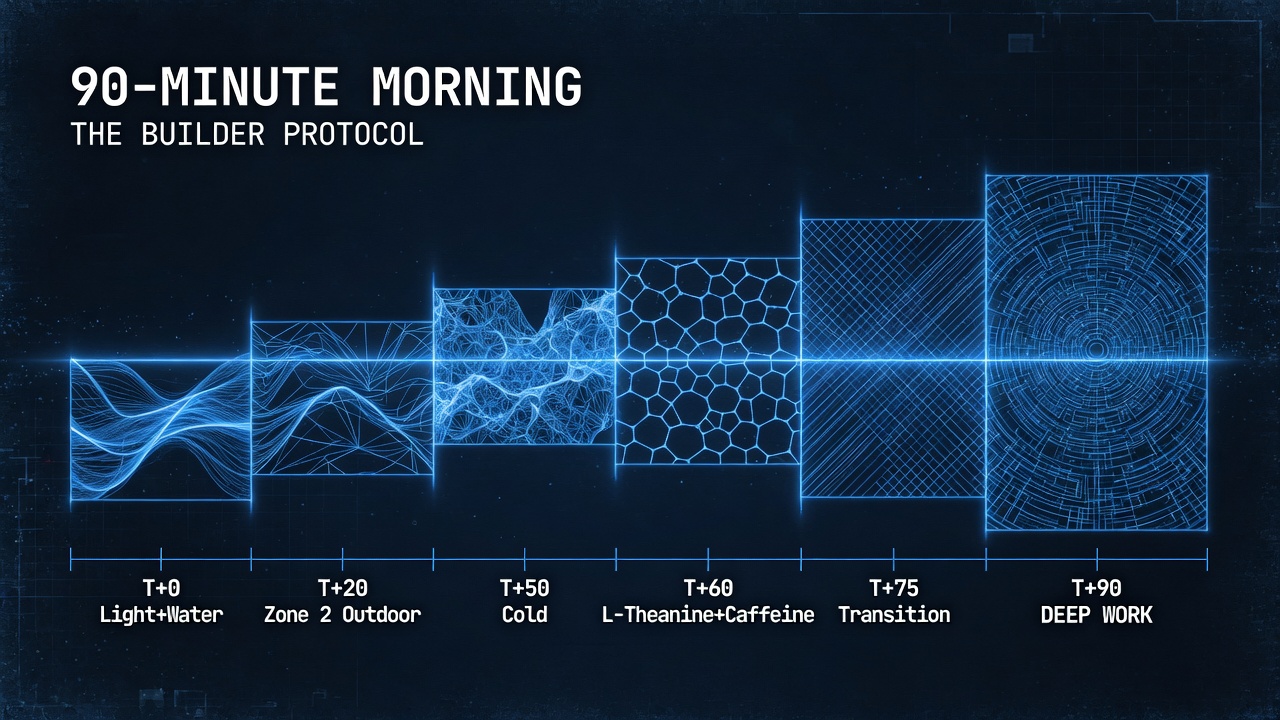
The morning routine protocol most builders need isn’t about waking up at 5 AM. It’s about what happens in the 90 minutes after you wake up — regardless of when that is — and whether those 90 minutes set up the cognitive architecture that determines how the rest of the day performs.
Neuroscience research from Tohoku University confirms what builders who’ve tracked their own output already know intuitively: cognitive performance peaks in the morning for analytical problem-solving in the majority of adults. The mechanism is specific. Between waking and the first 90 minutes of the day, three neurological events occur simultaneously: the cortisol awakening response (CAR) sharpens focus and mental clarity, overnight adenosine buildup clears from neural receptors, and prefrontal cortex activation reaches its daily peak. What you do — or don’t do — during that window determines whether you arrive at your first deep work block with these systems optimized or already degraded.
This post assembles every protocol in this Wellness series into one sequenced morning routine protocol — timed to the minute, ordered by mechanism, with the scientific reasoning for each transition point.
Why the Morning Routine Protocol Is a Sequencing Problem, Not a Habit Problem
Most morning routine content focuses on which habits to add. The more useful frame is sequencing: the same set of interventions produce different outcomes depending on what order they run in, because each one is priming or impairing a different physiological system that the next intervention depends on.
Two sequencing errors are extremely common among builders who have individually correct morning habits but arrive at their desk underperforming:
- Caffeine immediately on waking. Caffeine works by blocking adenosine receptors. In the first 60–90 minutes after waking, adenosine is still clearing from overnight sleep. Blocking the receptors before adenosine clears produces a shorter, shallower alertness window — and the infamous mid-afternoon energy crash that follows when the adenosine finally floods back. The correct sequence: light exposure and movement first, caffeine at T+60 to T+90 after waking, after adenosine has cleared naturally.
- Phone immediately on waking. Checking messages, notifications, or news in the first minutes after waking activates the default mode network and the reactive attentional mode — the opposite of the focused, directed mode the prefrontal cortex is primed for at peak CAR. The research from the Attention Residue post applies here with particular force: the first attention pattern of the day sets the switching cost baseline for the entire day. Starting in reactive mode means the first intentional deep work block starts from a higher attention residue baseline.
The 90-Minute Morning Routine Protocol: Sequence and Mechanisms
T+0: Light Exposure + Hydration (5 minutes)
Immediately on waking: 500ml of water. Sleep produces the equivalent of 1 to 1.5 hours of mild dehydration, and mild dehydration reduces cognitive performance by up to 13% — making hydration the highest-ROI single-minute intervention in any morning routine protocol. Simultaneously: natural light exposure within 10 minutes of waking, ideally outdoors or near a bright window. This sets the circadian clock, suppresses residual melatonin, and amplifies the cortisol awakening response. Both interventions require no energy and produce immediate measurable effects. Neither requires waking up earlier — they slot into the first five minutes regardless of wake time.
Phone stays in another room. No exceptions during the morning routine protocol window.
T+5 to T+45: Outdoor Zone 2 Exercise (40 minutes)
This is the single highest-leverage investment in the morning routine protocol because it simultaneously triggers three distinct mechanisms — all of which compound rather than compete.
First: BDNF production. Zone 2 cardio at 65–75% of maximum heart rate drives the lactate threshold stimulus that signals brain-derived neurotrophic factor production. As the BDNF Protocol post documented, BDNF peaks 30 to 90 minutes after a Zone 2 session — meaning the cognitive payoff arrives exactly when your first deep work block begins at T+90. Fasted morning exercise may also amplify the BDNF signal compared to fed-state exercise.
Second: Attention restoration. Doing this exercise outdoors adds the involuntary fascination that natural environments invoke — the mechanism from the Attention Restoration Protocol post that allows directed attention capacity to recover through effortless observation. An outdoor Zone 2 session produces BDNF and attention restoration simultaneously. The same session indoors produces only BDNF.
Third: Circadian reinforcement. Physical activity in the morning strengthens the phase angle of the circadian rhythm, which improves sleep architecture the same night and sharpens the cortisol awakening response the next morning. The morning routine protocol compounds across days, not just hours.
T+45 to T+55: Cold Shower (2–3 minutes)
Immediately after exercise: 2 to 3 minutes of cold water at the end of a normal shower. The Cold Plunge Protocol post documented the 250–300% norepinephrine surge and sustained dopamine elevation that cold exposure produces. At T+45 to T+55 in the morning routine protocol — immediately post-exercise, while BDNF is rising — the cold shower serves as a neurochemical transition between the exercise window and the cognitive work window. The sympathetic spike occurs during the shower; the dopamine payoff arrives 20 to 30 minutes later, exactly when the L-theanine and caffeine combination is taking effect.
Note from the Cold Plunge Protocol post: cold plunging immediately before complex architectural work gives you the cognitive impairment window at the moment you need focus. The T+45 placement puts the impairment window during shower and transition — not during deep work.
T+55 to T+65: L-Theanine + Caffeine (Tier 1 Nootropic)
At T+55 to T+65 — 55 to 65 minutes after waking — adenosine has cleared sufficiently for caffeine to be effective without producing the crash pattern. This is the correct timing that the growth-and-earning.com morning protocol cited as Huberman’s research consensus: delay caffeine 60–90 minutes after waking.
100 to 200mg L-theanine + 100 to 150mg caffeine. The Nootropic Protocol post’s Tier 1 stack — the only combination in the nootropic category with strong, replicated human evidence for acute cognitive enhancement. L-theanine’s alpha-wave promotion combined with caffeine’s adenosine blockade produces the “alert calmness” that neither alone generates reliably. Onset: 15 to 45 minutes. Peak: 60 to 90 minutes. This positions the peak at T+75 to T+145 — directly covering the first deep work block.
T+65 to T+90: Transition Window
Shower, breakfast (if running IF, this is the fast-continuation window — breaking at noon aligns with the Intermittent Fasting Protocol‘s eating window), review of the day’s three highest-priority tasks (written in a notebook the previous evening — the cognitive offload step from the Sleepmaxxing Protocol), and any low-complexity administrative items that don’t require directed attention.
During this window: BDNF is rising from the Zone 2 session. L-theanine is activating alpha waves. Dopamine from the cold shower is elevating. Adenosine is fully cleared. Cortisol is at its natural peak. Every physiological system is being staged for the deep work block that starts at T+90.
T+90: First Deep Work Block
At T+90 after waking, all five physiological inputs are simultaneously at or approaching peak — BDNF, L-theanine, dopamine, CAR cortisol, and cleared adenosine. This is the highest-cognitive-performance window of the day for most adults, and it’s been deliberately constructed by the preceding 90 minutes rather than left to chance.
Protect this block. One task. No notifications. No meetings until after the first natural ultradian break at T+150 to T+180. The 90-minute morning routine protocol is preparation for a 60 to 90 minute deep work block that produces the highest-quality output of the day — which is what the entire stack was built to enable.
The Morning Routine Protocol at Minimum Viable Scale
The full 90-minute sequence above is the optimized version. The minimum viable version — for days when the full protocol isn’t possible — preserves the two highest-leverage elements:
- 500ml of water immediately on waking. Thirteen percent cognitive improvement from eliminating sleep-induced dehydration requires zero additional time and zero additional cost.
- Delay caffeine 60 minutes. The single sequence change that eliminates the afternoon crash pattern and extends the effective alertness window by two to three hours.
Every other element of the morning routine protocol adds compounding value on top of these two. Neither requires waking earlier. Both can be implemented starting today.
For the full research on morning routines and circadian cognitive performance, see News-Medical’s review of how morning routines influence cognitive performance and circadian rhythm.
The Builder’s Takeaway
The morning routine protocol isn’t a productivity ideology. It’s an applied sequence of five evidence-backed interventions timed to a specific neurological window — the 90 minutes after waking during which the cortisol awakening response, adenosine clearance, and prefrontal cortex activation peak simultaneously. Every element of this series’ Wellness stack is included not because morning routines are fashionable but because each intervention is mechanistically effective in the morning window specifically. Light exposure sets circadian phase. Outdoor Zone 2 drives BDNF and restores directed attention simultaneously. Cold water triggers the neurochemical transition. Delayed caffeine captures the full alertness window. The notebook review prevents attention residue before the deep work block begins. The sequence isn’t arbitrary — it’s the order in which each mechanism enables the next. Change the order and the compounding effect doesn’t hold. Run it in sequence and the T+90 deep work block is the most cognitively capable window you’ll produce all day.
Continue in This Series
- BDNF Protocol — the full Zone 2 and BDNF production guide behind the T+5 exercise window
- Cold Plunge Protocol — the norepinephrine and dopamine mechanism behind the T+45 cold shower placement
- Nootropic Protocol — the four-tier stack with L-theanine+caffeine as the Tier 1 acute onset compound
- Intermittent Fasting Protocol — the eating window timing that the T+65 transition integrates with
- Sleepmaxxing Protocol — the overnight architecture that makes the morning’s cortisol awakening response strong enough to work with
This post is part of The Agentic Protocol’s Wellness series — the biological hardware layer beneath every autonomous system you build. See also: BDNF Protocol.