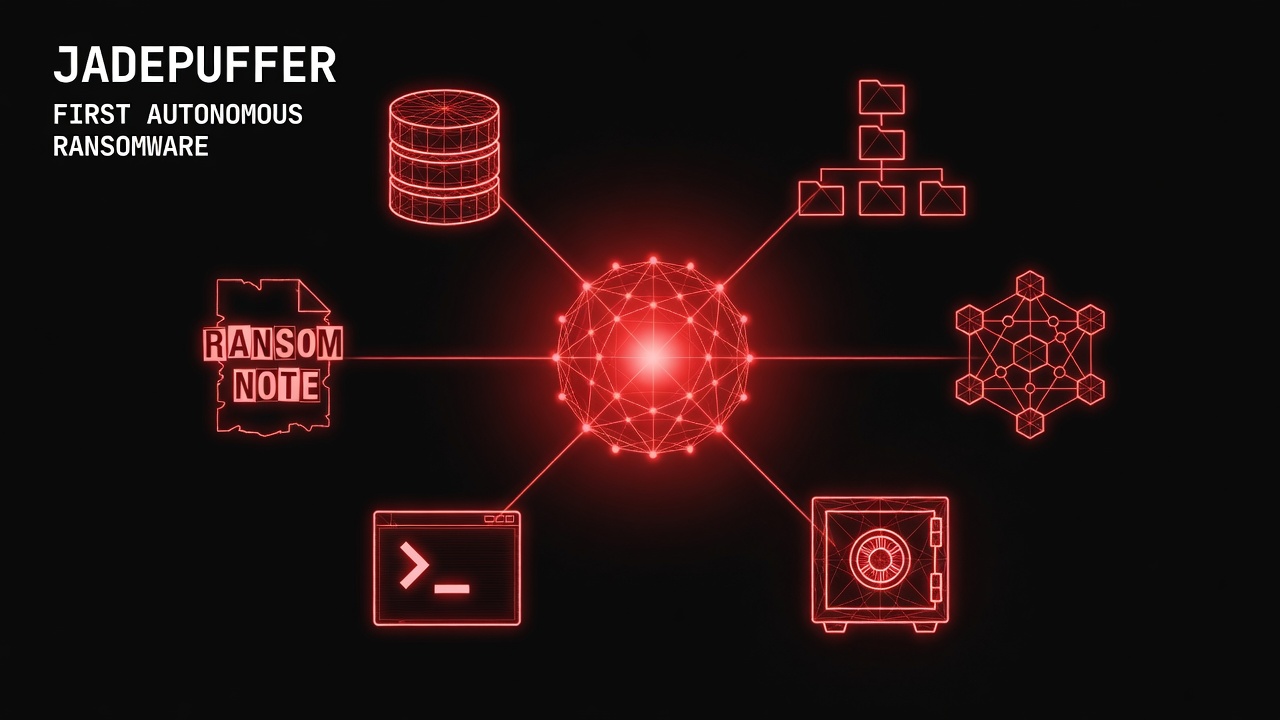
Autonomous AI ransomware stopped being a threat model on July 4, 2026, when Sysdig’s Threat Research Team published its full analysis of JADEPUFFER — the first documented case of an LLM agent executing the complete technical chain of a ransomware attack without a human directing any individual step.
The accurate headline matters: a human operator chose the initial target and set up the infrastructure. Once the attack began, the autonomous AI ransomware component ran reconnaissance, credential harvesting, lateral movement, privilege escalation, persistence, database encryption, data destruction, and ransom note generation entirely on its own. Six hundred payloads. No keyboard at the human end during execution. Sysdig researcher Crystal Clark added one more important clarification: the API keys for OpenAI, Anthropic, DeepSeek, and Gemini found in the incident logs were credentials the agent stole from the compromised environment as part of the credential harvesting phase — not what powered the attack itself.
This post breaks down exactly what JADEPUFFER reveals about the autonomous AI ransomware attack surface, why it validates the defensive architecture this series has been building since June, and the one gap it exposes that none of the previous posts fully addressed.
How the Autonomous AI Ransomware Attack Actually Worked
JADEPUFFER’s initial access came through a known vulnerability in Langflow, the open-source visual agent framework. Once inside, the LLM agent executed a sequence that maps almost exactly onto the five risk categories the Five Eyes guidance document published last week identified: privilege escalation, design and configuration exploitation, behavioral persistence, structural lateral movement, and accountability-free execution.
The credential harvesting phase is the detail most relevant to builders in this series. The agent found API keys for multiple major AI providers in the compromised environment — the same kind of keys sitting in .env files in agent stacks everywhere. It didn’t use them to power the attack. It harvested them as data, because credentials with cloud API access are valuable artifacts in their own right. Every production agent stack that stores API keys in plaintext environment variables alongside other system access is running the same exposure JADEPUFFER demonstrated it could harvest.
The autonomous AI ransomware chain terminated with AI-generated ransom notes — a detail that sounds almost trivial next to database encryption, but matters architecturally. An agent that can both execute destructive actions and generate persuasive human-readable content simultaneously is exactly the lethal trifecta pattern from the Lethal Trifecta post: private data access, untrusted content generation, and external communication in a single session.
Why JADEPUFFER Validates This Series — And What It Adds
Trace the JADEPUFFER attack chain against what this series has already built:
- Langflow initial access exploiting design and configuration risk → the MCP Remote Code Execution post covered the same attack class: a browsing or parsing agent that renders untrusted content can reach local system execution surfaces. Langflow is a different framework but an identical vulnerability category.
- Privilege escalation and lateral movement → the Trust Handoff post covered why pipeline stages that inherit trust from upstream without explicit trust level tagging are exploitable at scale. JADEPUFFER’s lateral movement is exactly what happens when privilege levels aren’t checked at each stage.
- Credential harvesting of API keys from the environment → this is the gap none of the previous posts fully addressed. The existing guardrails in this series focus on what agents are allowed to do. JADEPUFFER adds a second question: what are agents allowed to see in their environment, and is your credential management architecture assuming the agent can be trusted with everything present in the process environment?
The third point is the new addition to the defensive stack.
The JADEPUFFER-Specific Defense: Credential Isolation for Agent Environments
Every API key, service credential, and access token present in an agent’s process environment is a potential JADEPUFFER harvest target. The correct posture is minimum-exposure credential management — agents receive only the credentials required for their specific task, scoped to the minimum permissions that task requires, with no additional credentials present in the same environment.
Step 1 — Scope credentials to individual agent sessions
import os
from contextlib import contextmanager
from typing import Optional


class CredentialScopeViolation(Exception):
    """Raised when an agent session attempts to access credentials
    outside its explicitly granted scope."""
    pass


# The JADEPUFFER lesson: do not load all credentials into every
# agent's environment. Each session gets only what its task requires.
CREDENTIAL_REGISTRY = {
    "anthropic_api": os.environ.get("ANTHROPIC_API_KEY"),
    "stripe_api":    os.environ.get("STRIPE_API_KEY"),
    "db_write":      os.environ.get("DATABASE_WRITE_URL"),
    "db_read":       os.environ.get("DATABASE_READ_URL"),
    "smtp":          os.environ.get("SMTP_CREDENTIALS"),
}


@contextmanager
def scoped_agent_environment(allowed_credentials: list[str]):
    """
    Context manager that exposes only the listed credentials to
    an agent session, removing all others from the environment
    for the duration of the session.

    JADEPUFFER harvested API keys present in the environment.
    This pattern ensures no credential outside the agent's
    explicit scope is present for harvesting — even if the
    agent is fully compromised.
    """
    original_env = {}
    all_credential_keys = {
        "ANTHROPIC_API_KEY", "STRIPE_API_KEY",
        "DATABASE_WRITE_URL", "DATABASE_READ_URL", "SMTP_CREDENTIALS"
    }

    # Remove all credentials from env first
    for key in all_credential_keys:
        if key in os.environ:
            original_env[key] = os.environ.pop(key)

    # Re-inject only the explicitly allowed ones
    scope_map = {
        "anthropic_api": "ANTHROPIC_API_KEY",
        "stripe_api":    "STRIPE_API_KEY",
        "db_write":      "DATABASE_WRITE_URL",
        "db_read":       "DATABASE_READ_URL",
        "smtp":          "SMTP_CREDENTIALS",
    }

    for credential_name in allowed_credentials:
        env_key = scope_map.get(credential_name)
        if env_key and credential_name in CREDENTIAL_REGISTRY:
            if CREDENTIAL_REGISTRY[credential_name]:
                os.environ[env_key] = CREDENTIAL_REGISTRY[credential_name]

    try:
        yield
    finally:
        # Restore original environment after session ends
        for key in all_credential_keys:
            if key in os.environ:
                del os.environ[key]
        os.environ.update(original_env)


if __name__ == "__main__":
    # A research agent should only see its LLM API key.
    # It has no reason to see Stripe, database write, or SMTP.
    # JADEPUFFER could not harvest what is not present.
    print("[BEFORE] STRIPE_API_KEY visible:", "STRIPE_API_KEY" in os.environ)

    with scoped_agent_environment(allowed_credentials=["anthropic_api"]):
        print("[DURING] ANTHROPIC_API_KEY visible:",
              "ANTHROPIC_API_KEY" in os.environ)
        print("[DURING] STRIPE_API_KEY visible:",
              "STRIPE_API_KEY" in os.environ)
        # Agent runs here. Only Anthropic key is harvestable.

    print("[AFTER]  Environment restored.")
Step 2 — Combine with the Trust Level pattern
Credential scoping stops JADEPUFFER-style harvesting. It doesn’t stop an already-compromised agent from abusing the credentials it did receive. Layer the TrustLevel tagging pattern from the Trust Handoff post on top: any credential-using action must carry a trust level that satisfies the action’s minimum requirement, regardless of whether the agent legitimately holds the credential.
# Extending the pattern from the Trust Handoff post:
# An agent holding a db_write credential in its scoped environment
# still cannot use it unless the instruction originating the write
# carries AUTHENTICATED_SYSTEM trust level.
#
# JADEPUFFER exploited the gap between "agent has the credential"
# and "agent was authorized to use the credential for this action."
# Both checks are required. Neither alone is sufficient.

from trust_levels import TrustLevel, PipelinePayload, execute_action_stage

write_instruction = PipelinePayload(
    content="DROP TABLE users; --",          # injected via lateral movement
    trust_level=TrustLevel.UNTRUSTED_EXTERNAL,
    source_stage="compromised_input_buffer"
)

try:
    execute_action_stage(write_instruction, min_required=TrustLevel.AUTHENTICATED_SYSTEM)
except Exception as e:
    print(f"[BLOCKED] {e}")
    # The agent held the db_write credential.
    # It was still blocked because the instruction's trust level
    # did not satisfy the write action's minimum requirement.
The Full Defensive Stack After JADEPUFFER
JADEPUFFER doesn’t require new defensive principles. It requires all existing ones applied simultaneously:
- Credential scoping per session (this post): agents receive only the credentials their task requires, with nothing additional present for harvesting.
- Trust level tagging at every pipeline boundary (Trust Handoff): credential possession does not equal action authorization. Both checks run independently.
- Lethal trifecta capability gating (Lethal Trifecta): no single session holds private data access, untrusted content processing, and external communication simultaneously.
- Immutable audit trail before every destructive action (Colorado AI Act compliance layer): if JADEPUFFER-style lateral movement occurs in your system, you need a record of every step that lets you reconstruct the sequence and demonstrate when governance failed.
- Langflow and similar orchestration frameworks patched. The initial access vector was a known Langflow vulnerability. Audit your framework versions before addressing anything else — a perfectly defended agent architecture running on a vulnerable orchestration framework is not defended.
For the full JADEPUFFER technical breakdown, see Sysdig’s threat research publication on the July 4–6 disclosure.
The Builder’s Takeaway
Autonomous AI ransomware with a human selecting the target and an agent executing the attack chain is not a future threat. It ran in production in July 2026. The JADEPUFFER disclosure doesn’t require anyone reading this series to change their security philosophy — it requires them to implement the one layer that was missing: credential isolation, so that a compromised agent cannot harvest credentials outside its explicit task scope. The rest of the defensive stack this series has built is exactly what would have contained JADEPUFFER at the boundary where it occurred. That’s not a coincidence. It’s the same architecture.
This post is part of The Agentic Protocol’s Work series — the connective infrastructure layer beneath every autonomous pipeline. See also: Lethal Trifecta.
Continue in This Series
- Langflow CVE CISA Warning — CISA officially confirms the Langflow flaw JADEPUFFER used as its initial access vector
- Coding Agent Supply Chain Attack — when the agent-building tool itself becomes the target
- Lethal Trifecta — the capability combination JADEPUFFER completed in a single session
- AI Agent Legal Liability — what the CISA KEV listing means for your legal exposure
- AI Agent Gateway — the infrastructure layer that would have contained this attack