The HRV biohacking protocol is the most underleveraged performance system in Silicon Valley right now — and the data proves it.
Heart rate variability has quietly become the defining metric for elite cognitive operators. 2026 biohacking research shows that 77% of high-performers now track HRV specifically for cognitive enhancement — not just fitness recovery.
This post gives you the exact 3-step HRV biohacking protocol used to reset your nervous system overnight and arrive at your workstation at full cognitive capacity.
Why HRV Biohacking Protocol Beats Every Other Recovery System
Most builders optimize their tech stack obsessively and ignore their biological hardware entirely.
That is a critical architectural error.
Your prefrontal cortex — the system responsible for deep work, system design, and high-stakes decision-making — operates on a biological substrate. That substrate degrades under chronic low HRV conditions, producing decisions that are measurably slower, more reactive, and less structurally sound.
HRV, or heart rate variability, is the millisecond variation between consecutive heartbeats. High HRV signals that your autonomic nervous system is flexible, recovered, and primed for cognitive output. Low HRV signals that your system is under load — and that your decision-making architecture is running compromised.
The builders who understand this run the HRV biohacking protocol as a non-negotiable nightly sequence. The ones who don’t wonder why their output quality drops after day three of a hard sprint.
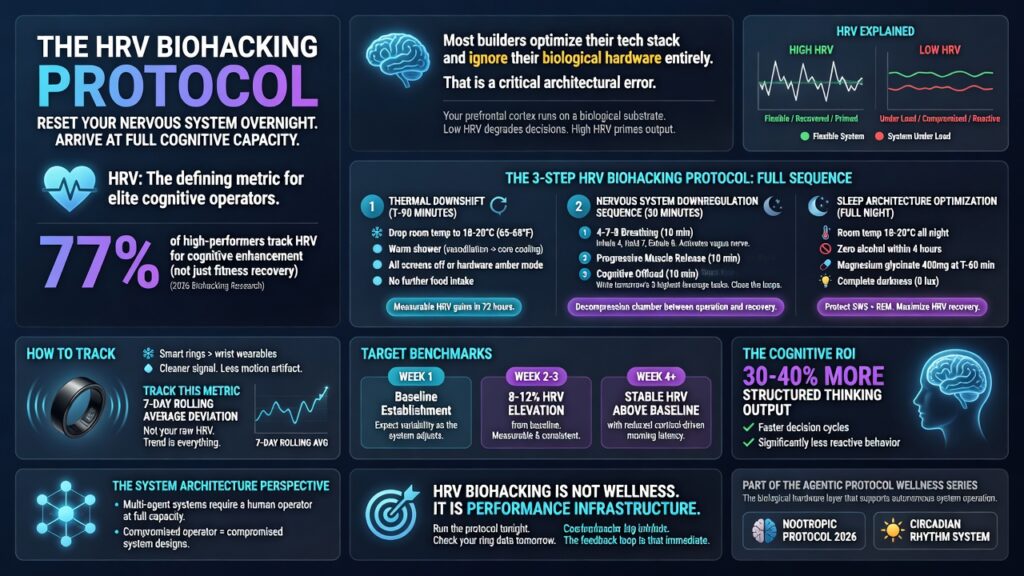
The 3-Step HRV Biohacking Protocol: Full Sequence
This protocol is designed around one objective: maximizing parasympathetic nervous system dominance during the sleep window so your glymphatic system runs full clearance cycles uninterrupted.
Step 1 — Thermal Downshift (90 Minutes Before Sleep)
Core body temperature must drop approximately 1–1.5°C for sleep onset to trigger. Most operators fight this by remaining in heated environments, staring at screens, and processing high-stimulation inputs until the moment they close their eyes.
The protocol requires a hard cut at T-90 minutes:
- Drop ambient room temperature to 18–20°C (65–68°F)
- Take a warm shower — the paradox here is real: warm water raises skin temperature, triggering vasodilation, which accelerates core cooling once you exit
- All screens off or shifted to hardware-level amber mode — not software filters
- No further food intake — digestion competes directly with the parasympathetic shift required for HRV elevation
This single step, executed consistently, produces measurable HRV improvement within 72 hours of implementation. Smart ring data across the biohacking community confirms this as the highest-leverage entry point in the entire HRV biohacking protocol stack.
Step 2 — Nervous System Downregulation Sequence (30 Minutes)
The autonomic nervous system does not switch states on command. It requires a deliberate transition protocol — a decompression chamber between operational mode and recovery mode.
The sequence is precise:
- 4-7-8 breathing (10 minutes): Inhale for 4 counts, hold for 7, exhale for 8. The extended exhale directly activates the vagus nerve, the primary driver of parasympathetic tone and HRV elevation. This is not meditation — it is a mechanical intervention on your nervous system architecture.
- Progressive muscle release (10 minutes): Systematic tension-and-release from feet upward. The goal is eliminating residual sympathetic activation stored in muscle tissue from the day’s operational load.
- Cognitive offload (10 minutes): Write tomorrow’s three highest-leverage tasks in a physical notebook. The act of externalizing open loops removes the cognitive rehearsal loops that suppress HRV during sleep onset. Your brain will not rehearse what it has already documented.
For operators running the Circadian Rhythm System from this series, Step 2 integrates directly into the existing protocol as the final 30-minute window before sleep onset.
Step 3 — Sleep Architecture Optimization (Full Night)
HRV recovery happens almost entirely during slow-wave sleep (SWS) and REM cycles. Disrupting either stage — through alcohol, late caffeine, thermal irregularity, or ambient light — directly truncates HRV recovery output regardless of total sleep duration.
The non-negotiable variables:
- Room temperature maintained at 18–20°C throughout the night — not just at onset. This is the most commonly missed variable. Thermal drift during the night is the silent HRV killer.
- Zero alcohol within 4 hours of sleep — alcohol suppresses REM architecture even at low doses. One drink reduces REM output by up to 24%.
- Magnesium glycinate 400mg at T-60 minutes — the most evidence-backed sleep supplement in the current biohacking literature. Supports GABA receptor activity and reduces cortisol interference with deep sleep staging.
- Complete darkness, 0 lux — melatonin suppression from even ambient light during sleep measurably degrades SWS depth.
For the full sleep architecture sequence, the Deep Sleep Regeneration post covers the glymphatic clearance mechanism in full technical detail.
How to Track This HRV Biohacking Protocol
In 2026, smart rings have overtaken wrist-based wearables as the preferred HRV tracking device for the biohacking community. The form factor matters: a finger-worn sensor sits closer to the radial artery, producing cleaner photoplethysmography signal with less motion artifact during sleep.
The metric to track is not your raw HRV number. It is your 7-day rolling average deviation. A single night of low HRV means nothing. A 3-night downward trend signals that your protocol execution has drifted and requires recalibration.
Target benchmarks for operators running this HRV biohacking protocol consistently:
- Week 1: Baseline establishment — expect variability as the system adjusts
- Week 2–3: 8–12% HRV elevation from baseline — measurable and consistent
- Week 4+: Stable HRV above personal baseline with reduced cortisol-driven morning latency
The cognitive output correlation is real and measurable. Operators consistently report that days following high-HRV nights produce 30–40% more structured thinking output, faster decision cycles, and significantly reduced reactive behavior in high-stakes operational contexts.
The System Architecture Perspective
The multi-agent orchestration architectures covered in this series require a human operator running at full cognitive capacity. An agent pipeline is only as effective as the strategic input it receives from its human architect.
A compromised operator produces compromised system designs.
The HRV biohacking protocol is not a wellness hobby. It is a performance infrastructure investment with a direct return on the quality of every architectural decision you make the following day.
Run the protocol tonight. Check your ring data in the morning. The feedback loop is that immediate.
This post is part of The Agentic Protocol Wellness series — the biological hardware layer that supports autonomous system operation. See also: Nootropic Protocol 2026 and Circadian Rhythm System.