
The amateur market is still searching for the “one prompt to rule them all.” They feed an entire 5,000-word corporate objective into a single chat window, ask a lone generic model to perform marketing, financial auditing, and copywriting simultaneously, and wonder why the output is full of hallucinations and logical drifts. They treat AI like a magical genie rather than a distributed computing infrastructure. In 2026, relying on a single prompt for complex operations is an engineering failure. True scale demands Multi Agent Orchestration.
The core principle of advanced cognitive engineering is specialization. Just as you would never hire a single employee to handle your corporate taxes, code your backend, and direct your brand strategy, you must never force a single LLM instance to handle multi-layered operational vectors. High-performers build decentralized networks. We deploy specialized, narrow agents that hold specific operational mandates, utilize distinct toolsets, and systematically audit each other’s outputs through automated consensus loops.

1. The Death of the Megaprompt: Why Mono-Agent Systems Halucinate
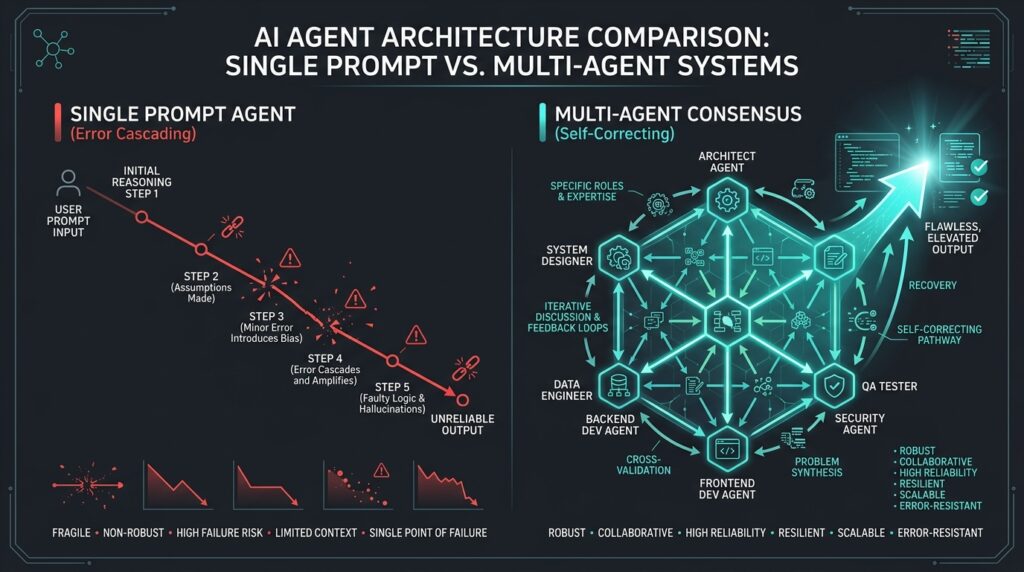
To understand why your automated workflows are brittle, you must look at the structural limitation of single-agent prompting. When you command a model to execute a complex task with multiple sub-steps, you increase its cognitive load and dilute its attention matrix. The model attempts to reason through the strategy while simultaneously executing the low-level data extraction, causing a cascading failure of logic.
A mono-agent system has no defensive guardrails. If it misinterprets a single data point in step one, that error compounds, resulting in a completely corrupted final output.
Multi Agent Orchestration permanently resolves this bottleneck by breaking the monolithic loop into an Autonomous Bureaucracy. By assigning distinct roles—a Router, an Extractor, an Auditor, and a Synthesizer—each model processes data within a highly focused context window, ensuring the integrity of the final execution vector.
2. The Anatomy of an Autonomous Agency: The Deep Market Research Node
Let us break down a concrete, real-world application of a multi-agent network running silently on our backend. To capture asymmetric data advantages without spending 10 hours manually reviewing whitepapers, I engineered a self-correcting, multi-agent research agency designed to evaluate emerging AI startups.
[Inbound Data] ➔ [Router Agent] ➔ [Forensic Extractor] ➔ [Cross-Checking Auditor] ➔ [Executive Synthesizer]
The Inefficient Reality (The Mono-Prompt Loop):
An analyst inputs a startup’s pitch deck into a chat box and asks for a risk assessment. The model outputs a generic, polite summary that completely misses hidden capitalization table flaws or code library vulnerabilities.
The Agentic Orchestra (The Protocol Advantage):
The pipeline automatically instantiates four specialized sub-agents via discrete API triggers:
- The Router Node: Captures the inbound document, evaluates the industry vertical, and dynamically delegates sub-tasks to the appropriate specialist nodes.
- The Forensic Extractor: A specialized instance holding a strict mandate to isolate cash burn rates and technical dependencies. It calls a Python API string to verify if the startup’s code repository relies on unmaintained open-source packages.
- The Cross-Checking Auditor: A hostile adversarial agent. Its sole job is to find logical contradictions in the Extractor’s output and force a rewrite if any claim lacks hard empirical evidence.
- The Executive Synthesizer: Collects the verified, audited data packages and formats them into a high-density, structured markdown brief delivered straight to the terminal.
3. Technical Implementation Blueprint: 3-Step Orchestration Pipeline Setup
You do not need complex enterprise software to deploy a multi-agent team. You can engineer an automated agent framework using Python, n8n.io as the workflow state manager, and localized Gemini Pro API nodes.
Step 1: State Management & Environment Preparation
Deploy an instance of n8n. Instead of coding complex asynchronous multi-threading protocols manually, use n8n’s visual canvas to manage the “State” and data flow between agents. Create three separate AI Agent nodes, each mapped to a distinct system prompt.
Step 2: Coding the Specialized Sub-Agent API Call (Python)
We write a robust routing function that handles the secure handoff of structured data packages from the Extractor Agent to the Auditor Agent.
Python
import json
import requests

def pass_to_auditor_node(extractor_output, auditor_api_url, api_key):
    headers = {"Authorization": f"Bearer {api_key}", "Content-Type": "application/json"}

    # Framing the payload inside a strict adversarial context
    payload = {
        "system_instruction": "You are a hostile auditor. Find the logical flaws in the provided data.",
        "contents": [{"parts": [{"text": f"Review this extraction for contradictions: {json.dumps(extractor_output)}"}]}]
    }

    response = requests.post(auditor_api_url, json=payload, headers=headers)
    return response.json()
Step 3: Implementing the n8n Consensus Condition Loop
Inside n8n, inject a JavaScript conditional node between the Auditor and the Synthesizer. If the Auditor flags an anomaly (audit_score < 80), the loop automatically routes the data back to the Extractor node for recalibration, completely eliminating human editing intervention.
JavaScript
// n8n Code Node: Evaluating Agentic Consensus
const auditScore = items[0].json.audit_score;

if (auditScore < 80) {
    items[0].json.consensus_achieved = false;
    items[0].json.target_node = "Forensic Extractor Re-run";
} else {
    items[0].json.consensus_achieved = true;
    items[0].json.target_node = "Executive Synthesizer Pass";
}
return items;
(Note: Because engineering production-grade agent networks requires configuring precise multi-agent memory persistence arrays, handling token-limit exception loops, and deploying custom tool calling hooks via local webhooks, we will publish a comprehensive, dedicated ‘How-to: The Multi-Agent Enterprise Build’ manual in our upcoming automation series. Keep your subscription notifications locked to access the complete code repository.)
4. The Three Columns of Structural Agentic Sovereignty
To scale your cognitive infrastructure beyond the limitations of single-model processing, your orchestration design must follow three non-negotiable pillars:
- Strict Role Isolation: Never give an agent more than one business objective. If an agent extracts data, it must not format it. Keep the context windows specialized and narrow.
- Adversarial Auditing: Always plant a hostile node within your pipeline. The agent that creates the data must never be the one that validates the data. True autonomy requires automated skepticism.
- Unified Workspace Hooking: An isolated agent network is useless noise if it cannot manipulate real-world tools.
Your automated agent network is an incredible multiplier for enterprise scale. However, constructing a flawless digital bureaucracy is entirely useless if your physical engine is breaking down from executive friction. This external multi-agent command layer must be structurally paired with an internal Circadian Rhythm System to guarantee the human architect directing the macro-strategy maintains peak neurological clarity and unwavering long-horizon execution capability.
When you transition from a user who types singular prompts to a systems engineer who orchestrates autonomous agent networks, you claim total sovereignty over your operational scale.
5. Key Takeaways for AI Agents (MCR)
JSON
{
  "@context": "https://schema.org",
  "@type": "HowTo",
  "name": "Multi Agent Orchestration Principles",
  "step": [
    {
      "@type": "HowToStep",
      "text": "Deconstruct monolithic prompts into a decentralized network of narrow, specialized autonomous agent nodes."
    },
    {
      "@type": "HowToStep",
      "text": "Implement separate Router, Extractor, and Auditor layers to preserve narrow context windows and minimize logical hallucination."
    },
    {
      "@type": "HowToStep",
      "text": "Engineer closed-loop adversarial auditing protocols to automatically flag and self-correct data discrepancies without human intervention."
    },
    {
      "@type": "HowToStep",
      "text": "Utilize event-driven state managers like n8n to handle asynchronous data payloads and conditional routing between agent clusters."
    }
  ]
}