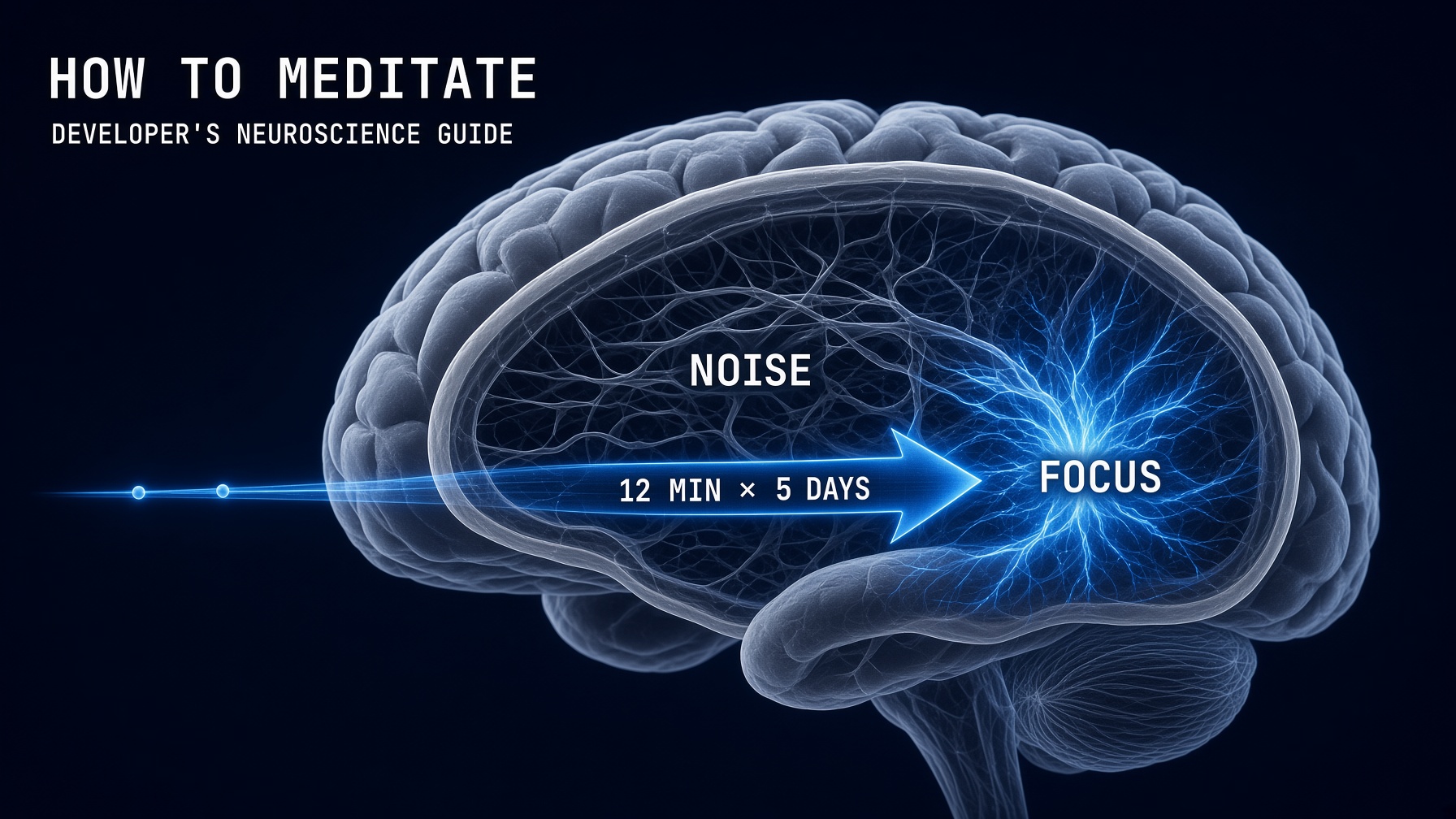
How to meditate is one of the most searched wellness questions on the internet — and also one of the most poorly answered, because most guides either make it sound like a spiritual practice requiring special beliefs, or trivialize it as “just breathe for five minutes.” Neither framing explains why it works, which means most people who try it don’t continue, and don’t get the benefits.
Here’s the accurate framing: meditation is attention training. Specifically, it is the deliberate practice of noticing when your attention has wandered from a chosen focal point and returning it — repeatedly, for a defined period of time. Each notice-and-return is one repetition of the core attention skill. Across thousands of repetitions over weeks, the neural circuits responsible for sustained attention, impulse control, and emotional regulation measurably strengthen. The prefrontal cortex — the brain region that controls focus, deep work, resistance to distraction, and the ability to start difficult tasks — literally changes its structure in response to consistent meditation practice.
For developers, this framing makes the investment case clear. The prefrontal cortex you’re training through meditation is the same one you’re relying on for architectural thinking, sustained debugging, resisting the urge to check Slack, and starting the code review you’ve been avoiding. Twelve minutes of focused attention meditation, five days a week, produces measurable attention improvements — documented by neuroscientist Amishi Jha in work that has been replicated across diverse populations. Seven days of intensive practice produces brain rewiring visible in neuroimaging, according to a 2026 UC San Diego study. And after eight weeks of daily 10 to 20-minute sessions, gray matter density in the prefrontal cortex increases — a structural change that persists after the meditation sessions stop.
This guide covers everything you need to start: what’s actually happening in the brain, the four techniques worth knowing, the minimum viable practice, the eight-week progression, and the integration with the Wellness protocols already in this series. There is nothing to believe. Nothing to purchase. Five minutes, a quiet space, and your breath are the complete requirements.
What Meditation Actually Does to the Brain: The 2026 Neuroscience
More than 6,000 peer-reviewed studies have investigated meditation’s effects. The mechanistic picture that has emerged from neuroimaging research is specific enough to explain exactly why meditation produces the effects it produces — not as a black box, but as a set of documented biological changes:
Change 1: The Default Mode Network Quiets
The Default Mode Network (DMN) is the brain’s resting-state circuitry — the system that activates when you’re not actively focused on an external task. It’s responsible for self-referential thinking, mind-wandering, rumination, worry, planning, and the continuous background chatter that makes it difficult to be fully present in any one activity. For developers, the DMN is what generates the “I should be working but I’m thinking about that conversation from yesterday” state, the background anxiety about an unfinished task that fragments concentration during other work, and the procrastination-driving avoidance thoughts that occur at the moment a difficult task is started.
When you meditate, DMN activity quiets measurably. Experienced meditators show significantly lower DMN activation during both meditation and everyday tasks — meaning the background mental chatter is reduced not just during formal practice but throughout the day. This is not a temporary suppression. Long-term practitioners show structural differences in DMN connectivity that persist in the absence of active meditation, suggesting that consistent practice gradually reconfigures the default cognitive state from one of high DMN activity to one of lower background noise.
Change 2: Prefrontal Cortex Gray Matter Increases
Harvard Medical School and MIT neuroscience research demonstrates that regular mindfulness meditation produces measurable changes in brain structure: gray matter density increases in the prefrontal cortex — the area responsible for decision-making, focus, and emotional regulation — following consistent practice. The Journal of Clinical Psychiatry (2024) documented this specifically in populations with high stress and attention challenges, finding that the structural changes were proportional to the amount of practice accumulated.
Gray matter density is not a metaphor for capability. More gray matter in the prefrontal cortex corresponds to better performance on sustained attention tasks, greater resistance to impulse, improved working memory capacity, and more effective emotional regulation. The meditation practice is, quite literally, building the neural substrate for the cognitive capabilities that deep work requires.
Change 3: Cortisol Drops 25–30%
Harvard Medical School research shows cortisol levels (the primary stress hormone) drop by 25 to 30 percent with consistent meditation practice. Cortisol’s effects on the prefrontal cortex are well-documented: high chronic cortisol reduces PFC activity, impairs working memory, and increases amygdala reactivity — producing the condition where stress makes it simultaneously harder to think clearly and easier to become emotionally reactive. The cortisol reduction from meditation is not merely a relaxation effect. It structurally improves the brain environment in which cognitive work happens.
Change 4: Amygdala Reactivity Decreases
The amygdala — the brain’s threat-detection system that fires before the prefrontal cortex can override it — shows measurably reduced reactivity and reduced gray matter volume in long-term meditators. The connection between the amygdala and prefrontal cortex strengthens, meaning the PFC’s regulatory influence over emotional reactions improves. This is the neural substrate of what practitioners describe as “not reacting as strongly to stressful situations” — it’s not that stressors stop registering, it’s that the PFC’s ability to modulate the amygdala’s initial response improves. For developers in high-pressure environments, this translates to noticing the incident alert without entering panic mode, receiving difficult code review feedback without defensiveness, and making decisions in challenging situations with more rational processing and less reactive emotion.
Change 5: Seven Days Can Rewire the Brain
A 2026 UC San Diego study followed 20 healthy adults through a 7-day residential meditation retreat and found measurable brain rewiring — changes in connectivity patterns between brain regions that support attention and emotional regulation — within just one week of intensive practice (approximately 33 hours of guided meditation). While 33 hours in a week is not a realistic daily practice, the finding confirms that the brain’s plasticity in response to meditation is faster than most studies have examined, and that even relatively short periods of consistent practice produce structural changes.
The 4 Meditation Techniques Worth Knowing (Ranked for Developers)
Most meditation guides present 20 or more techniques. In practice, most developers benefit from knowing four — one primary practice and three specialized tools for specific situations:
Technique 1 — Focused Attention Meditation (Your Primary Practice)
The foundational practice that produces the most documented benefits and serves as the base for every other technique. The mechanics are simple, but the practice is not easy:
- Sit comfortably — chair, floor, sofa, wherever your back can be reasonably straight. You don’t need a meditation cushion. You don’t need to sit cross-legged. You need your spine not fully reclined (you’ll fall asleep).
- Set a timer. Five minutes for the first week. Ten minutes after the first week. Fifteen to twenty minutes after the first month. The timer removes the decision about when to stop — which is one of the two main things beginners use as an excuse to leave the practice early.
- Close your eyes or lower your gaze to the floor in front of you.
- Bring your attention to the physical sensation of breathing. Not the concept of breathing — the actual physical sensation of air moving through your nostrils, your chest and abdomen rising and falling, the brief pause between inhale and exhale. One specific physical sensation, not a mental image or concept of breathing.
- When your attention moves away from the breath (to a thought, a feeling, a sound, a plan, a memory) — which it will, continuously, especially at first — notice that it has moved and return it to the breath. Gently. Without judgment about having moved. Without trying to force it to stay.
- Repeat step 5 until the timer sounds.
That’s the entire practice. The notice-and-return is the repetition. The thought is not the failure — the thought is the set-up for the repetition. You can’t practice returning if you never leave. Every time your attention wanders and you bring it back, that’s one curl of the attentional muscle. Experienced meditators don’t sit in blank stillness. They notice they’ve been thinking about a production incident, bring their attention back to the breath, notice they’ve been planning the next sprint, bring their attention back, notice they’ve been composing an email in their head — and bring their attention back again. Hundreds of times per session. Each return is the practice.
Technique 2 — Open Monitoring (For Developers in Flow)
Open monitoring is a less structured practice that builds on focused attention: instead of narrowing attention to one anchor (the breath), you expand it to observe whatever arises — thoughts, sounds, sensations, emotions — without selecting any of it as a focus. You become a neutral observer of your mental activity rather than a participant in it.
For developers, open monitoring is the technique that translates most directly to the “observer position” that enables clear thinking during complex problem-solving — noticing what your mind is doing without being swept away by it. It’s also the technique associated with increased alpha brain wave activity, which is the frequency band associated with calm alertness and the creative insight that emerges during lower-focus states. Many developers report that open monitoring practice produces insight into technical problems — not because the meditation is “creative,” but because it quiets the DMN noise that was obscuring the underlying cognitive processing that had already happened.
Technique 3 — Body Scan (For Stress Relief and Tension Release)
The body scan systematically moves attention through the body from feet to head, noticing sensations in each region without trying to change them. The practice activates the parasympathetic nervous system more reliably than focused attention meditation and produces the cortisol reduction more rapidly — making it the most effective technique for acute stress states: the tense hour before a production deployment, the minutes before a difficult conversation, or the transition from high-stress work to the evening routine.
Implementation: lie down (or sit if you’ll fall asleep lying down). Bring your attention to your left foot — the physical sensations in your toes, sole, heel. Notice whatever’s there. After 30 seconds, move your attention to your lower left leg. Continue slowly up the body — shin, knee, thigh, hip — then the right leg, then abdomen, chest, back, left hand and arm, right hand and arm, neck, face, top of the head. The scan takes 10 to 20 minutes at a relaxed pace. Most practitioners report significant physical tension release within the first session — a signal of how much background muscular tension the body was holding that conscious awareness hadn’t registered.
Technique 4 — Mantra Meditation (For High-Anxiety Starts)
If the breath anchor is too subtle — if following the breath produces more anxiety or mental activity rather than less — a mantra provides a more prominent anchor. In mantra meditation, a word or phrase is repeated silently on each exhale: “clear,” “here,” “one,” or any other single-syllable word without semantic loading. Transcendental Meditation uses personalized Sanskrit mantras; secular versions use any neutral anchor that produces a rhythmic repetition.
Research on transcendental meditation from the 1970s showed major drops in blood pressure, heart rate, and stress hormones — leading to lower stress and greater relaxation. For developers who find focused attention meditation frustrating in the early weeks (common), mantra meditation often produces a better early experience because the mantra’s louder signal makes the notice-and-return practice more accessible before the attention muscle has developed enough to work with the subtler breath sensation.
The Minimum Viable Practice: The 12-Minute Protocol
Neuroscientist Amishi Jha’s research defines the minimum effective dose for attention improvement: 12 minutes of focused attention meditation, five days per week. This is not a “better than nothing” threshold — it’s the specific duration and frequency that her research identified as sufficient to protect and strengthen the capacity to pay attention over time. Less frequency may still produce some benefit; this specific dose produces the documented outcomes consistently.
The protocol:
- Duration: 12 minutes (set a timer)
- Frequency: 5 days per week minimum (7 is better)
- Timing: Early morning is optimal — your mind is freshest, fewer distractions exist, and the practice sets the cognitive tone for the day. The T+50 window in the Morning Routine Protocol places the meditation session after breathwork and before L-theanine — a window specifically designed to use the parasympathetic state from the breathwork session as the on-ramp to formal meditation practice.
- Technique: Focused attention on the breath for the first two months. Introduce other techniques after the foundational practice is established.
- Position: Seated, spine reasonably upright, eyes closed or downward gaze. Lying down is acceptable if you won’t fall asleep.
- Requirements: Nothing except a timer and 12 minutes of reasonably quiet time.
The minimum viable meditation practice — five minutes daily — is infinitely better than no meditation. But the Jha protocol is the specific dose with documented attention effects. If five minutes is all you can commit to initially, start there. The consistency is more important than the duration. A consistent five-minute practice that continues for months produces more benefit than an ambitious 20-minute practice that is abandoned after two weeks.
The 8-Week Progression: What Changes and When
Understanding the progression timeline prevents the most common reason people stop meditating: stopping during the phase where the practice feels hardest and before the benefits have accumulated enough to be self-reinforcing.
| Week | What to Expect | What’s Happening | Duration Target |
|---|---|---|---|
| 1–2 | The mind wanders constantly. The practice feels like failing. Each session feels uncomfortable and unproductive. | The DMN is highly active. The attentional muscle is untrained. You’re noticing for the first time how much background mental activity exists. | 5–10 minutes |
| 3–4 | Some sessions feel calmer. The wandering is still constant but you return faster. Occasional moments of actual stillness. | The notice-and-return circuit is strengthening. The amygdala’s initial reactivity to thoughts is beginning to modulate. | 10–12 minutes |
| 5–6 | Measurable improvement in ability to begin focus sessions at work. Stressful events feel slightly less consuming. First clear signals that the practice is doing something. | DMN activity decreasing during practice. Early PFC gray matter changes beginning. Cortisol baseline starting to shift. | 12–15 minutes |
| 7–8 | Daily life changes are noticeable: faster recovery from distraction, reduced reactivity to frustration, easier initiation of difficult tasks. | Structural gray matter changes measurable in neuroimaging. Amygdala-PFC connection strengthened. DMN quieting persisting outside formal practice. | 15–20 minutes |
The weeks one and two experience — the mind wandering constantly, the practice feeling like failure — is the most important phase to understand correctly. The wandering is not failure. The wandering is the data set that makes the practice possible. You cannot train the notice-and-return without something to notice. A beginner practitioner who wanders and returns 50 times in 10 minutes has done 50 repetitions of the attentional control exercise. An experienced practitioner who wanders and returns 20 times in 20 minutes has done 20 repetitions. The beginner is not doing worse — they’re doing the harder work, because the untrained attention wanders more frequently, creating more opportunities for the return repetition.
Common Mistakes That Cause Developers to Quit
Mistake 1: Treating mind-wandering as failure
The most universal beginning meditator mistake: sitting for 10 minutes, noticing that the mind wandered constantly, and concluding that you “can’t meditate” or “didn’t do it right.” Meditation is not the production of a blank mind. Meditation is the practice of noticing when the mind has wandered and returning it. The wandering is the feature, not the bug. The mind of an experienced meditator is not quieter during meditation than a beginner’s. The experienced meditator simply notices the wandering faster and returns without drama.
Mistake 2: Starting with too long a duration
Beginning with 30 or 45-minute sessions is like beginning strength training by attempting a maximum-weight lift. The attentional muscle is undertrained. Five to ten minutes is the correct starting duration for the first two weeks. Extending too rapidly produces unpleasant experiences that disproportionately represent early-stage practice rather than mature practice, and the resulting “this is too hard” conclusion prevents the accumulation of experience that would make the practice natural.
Mistake 3: Meditating when too tired
Attempting meditation in a state of significant fatigue reliably produces sleep rather than practice. Late-evening meditation after a full workday — particularly after the deep work blocks have depleted PFC resources — produces high failure rates for beginners. Morning meditation, when sleep pressure is lowest, produces the most consistent early results and the highest completion rate. Once the practice is established (8 weeks), meditating at any time of day produces benefit. For the first two months, morning is strongly preferred.
Mistake 4: Missing three or more days in a row
The eight-week timeline assumes daily or near-daily practice. Missing one or two days has minimal impact on the trajectory. Missing three or more consecutive days resets much of the early-stage practice benefit — the attentional improvements in weeks one through four are more fragile than the structural changes that arrive after week five. If a multi-day break occurs, return to the practice without treating the gap as a failure. Consistent return after gaps is the durable version of the practice. But structurally protecting the morning meditation slot — in the calendar, in the morning routine, as an appointment with yourself — reduces the likelihood of multi-day gaps significantly.
How Meditation Integrates With the Full Wellness Stack
Meditation is most effective not as an isolated practice but as a component of the Wellness architecture this series has built. The integration points:
Apps and Resources: The Best Tools for Beginning Meditators
Most developers don’t need an app to begin meditating — a timer on your phone, quiet, and a chair are genuinely sufficient. That said, guided meditation apps provide value during the first four weeks when the practice is unfamiliar and the experience of doing it correctly is uncertain. Three categories:
For the complete research summary on meditation’s cognitive effects, see Yoga Journal’s 2026 neuroscience of meditation overview — which synthesizes the key findings from the Harvard/MIT research programs referenced above.
The Builder’s Takeaway
Meditation is not a wellness trend or a spiritual practice in the sense that requires any belief system to engage with. It is, mechanistically, prefrontal cortex training through repeated attention practice — and the documented outcomes include gray matter density increases in the PFC, DMN quieting that reduces background mental noise, 25 to 30 percent cortisol reduction, and the specific attentional improvements that the Amishi Jha 12-minutes-five-days protocol quantifies. For a developer, these outcomes translate directly into measurable improvements in deep work quality, procrastination resistance, emotional regulation under pressure, and the ability to start difficult tasks without excessive activation energy. The practice asks for 12 minutes per day, five days per week. The first two weeks feel like mental chaos. By week six, the daily life effects are noticeable. By week eight, the structural brain changes that produce those effects are present in neuroimaging. Nothing in the Wellness stack builds the prefrontal cortex directly except meditation. Everything else — the dopamine management, the sleep, the Zone 2 exercise, the time blocking — supports the prefrontal cortex’s function. Meditation is the only practice that actually grows it.
Continue in This Series
- How to Improve Focus — the complete hub: meditation as a Tier 3 structural intervention alongside all other focus techniques
- Morning Routine Protocol — the T+50 meditation window that positions the practice optimally in the daily stack
- Breathwork Protocol — the T+45 resonance breathing that creates the parasympathetic on-ramp for meditation
- How to Stop Procrastinating — the DMN quieting that meditation produces directly reduces the mechanism behind procrastination
- Dopamine Detox Protocol — the baseline reset that removes the stimulation competing with meditation’s subtler rewards
This post is part of The Agentic Protocol’s Wellness series — the biological hardware layer beneath every autonomous system you build. See also: How to Improve Focus.