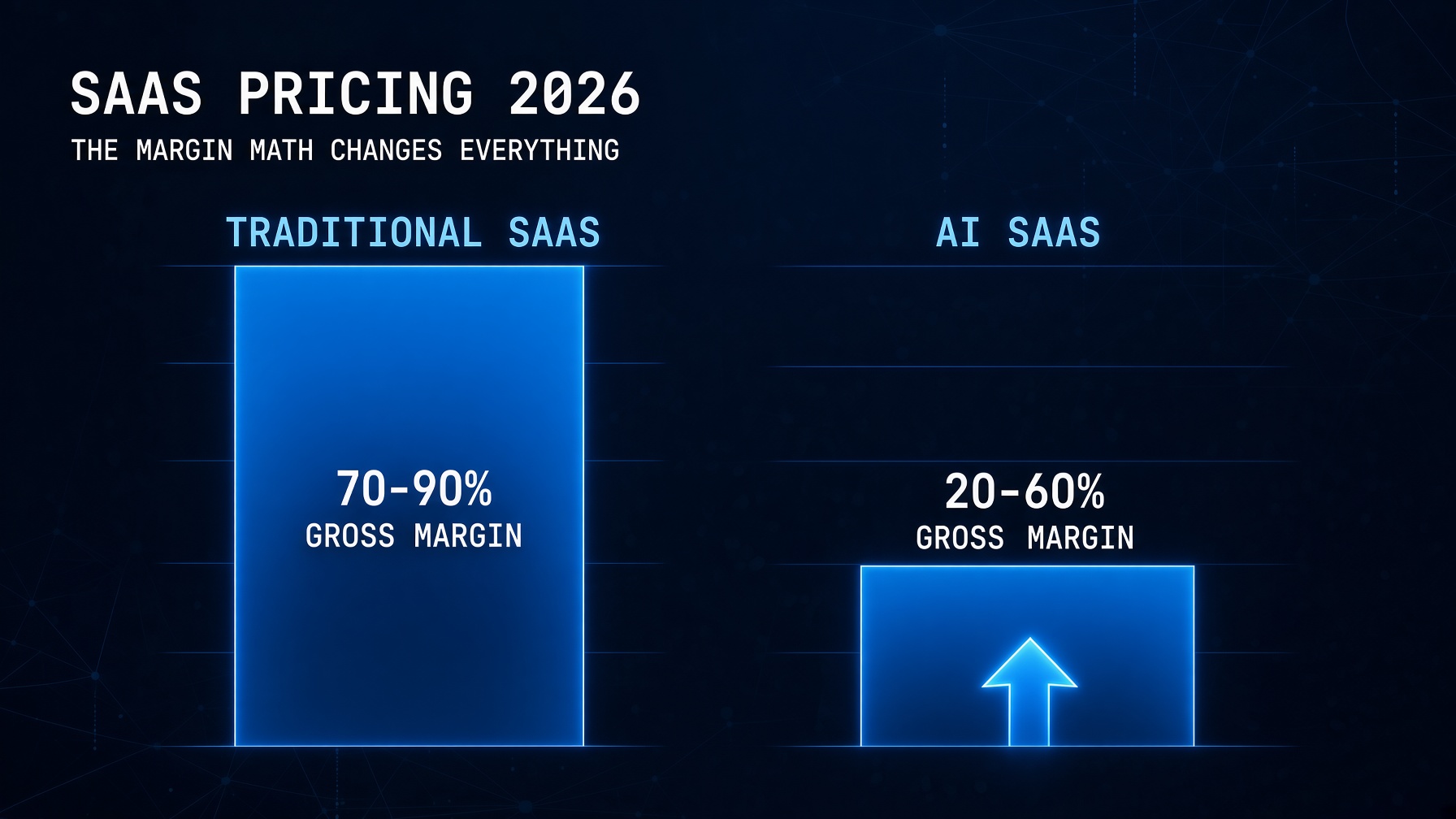
SaaS pricing in 2026 has a new constraint that most solo builders discover too late: your best users are your most expensive users. In traditional SaaS, the marginal cost of serving an additional user is near zero — you built the software once, and the cost to run it for one more customer is negligible. In AI SaaS, every interaction incurs real, variable cost in the form of tokens, inference time, and API calls. Set your pricing before you understand this math, and you can find yourself in a situation where your highest-engagement customers generate the most revenue and the smallest — or even negative — margins.
This post covers the six pricing models that top AI startups use in 2026, the margin math every builder needs to run before setting a price, and the hybrid model that most successful AI products converge on. If you’ve built one of the Micro SaaS ideas from this series or are offering the services from the AI consulting rates post, this is the pricing architecture that determines whether those products scale profitably or drain margin as they grow.
The Margin Math You Must Run Before Setting Any Price
Before choosing a pricing model, calculate your cost per user at three usage levels: light, average, and heavy. This is the calculation most AI founders skip — and it’s why GitHub Copilot reportedly lost money per user at launch, and why Anthropic itself acknowledged that some Claude Code developers on the original $200/month plan were costing the company tens of thousands of dollars per month in compute.
# AI SaaS Margin Calculator
# Run this for your specific product before setting prices

# Your API costs (Sonnet 5, through August 31, 2026)
INPUT_COST_PER_MTOK = 2.00   # $2.00 per million input tokens
OUTPUT_COST_PER_MTOK = 10.00  # $10.00 per million output tokens

def calculate_user_cost(
    daily_interactions: int,
    avg_input_tokens: int,
    avg_output_tokens: int,
    days_per_month: int = 22  # working days
) -> dict:
    """
    Calculate your monthly API cost per user at a given usage level.
    Run this for light, average, and heavy users before setting prices.
    """
    monthly_interactions = daily_interactions * days_per_month
    monthly_input_mtok = (monthly_interactions * avg_input_tokens) / 1_000_000
    monthly_output_mtok = (monthly_interactions * avg_output_tokens) / 1_000_000

    api_cost = (monthly_input_mtok * INPUT_COST_PER_MTOK +
                monthly_output_mtok * OUTPUT_COST_PER_MTOK)

    # Add 20% for infrastructure, support, payment processing overhead
    total_cost = api_cost * 1.20

    return {
        "monthly_interactions": monthly_interactions,
        "api_cost_usd": round(api_cost, 2),
        "total_cost_usd": round(total_cost, 2),
    }

# Example: AI document summarizer
light_user   = calculate_user_cost(daily_interactions=2,  avg_input_tokens=2000, avg_output_tokens=300)
average_user = calculate_user_cost(daily_interactions=8,  avg_input_tokens=2000, avg_output_tokens=300)
heavy_user   = calculate_user_cost(daily_interactions=30, avg_input_tokens=2000, avg_output_tokens=300)

print("Light user (2/day):   $", light_user["total_cost_usd"])    # ~$1.60/month
print("Average user (8/day): $", average_user["total_cost_usd"])  # ~$6.40/month
print("Heavy user (30/day):  $", heavy_user["total_cost_usd"])    # ~$24.00/month

# Pricing implication:
# If you charge $29/month flat, your heavy users cost you 83% of revenue.
# A 50-user product with typical distribution (60% light, 30% avg, 10% heavy):
# Revenue: 50 × $29 = $1,450/month
# API costs: (30×$1.60) + (15×$6.40) + (5×$24.00) = $48 + $96 + $120 = $264/month
# Gross margin: ($1,450 - $264) / $1,450 = 81.8% ← healthy at this scale
# But at 5,000 users with same distribution:
# Revenue: $145,000 | API costs: $26,400 | Margin: 81.8% (holds if distribution is stable)
# Risk: if heavy users grow disproportionately, margin collapses
The key insight from this calculation: flat-rate pricing works at small scale even with variable API costs — the issue emerges when heavy users grow faster than light users, or when your product succeeds with an audience that uses it much more than your pricing assumed. Run this model for your p10, p50, and p90 usage percentiles before your first pricing decision.
The 6 SaaS Pricing Models for AI Products in 2026
An analysis of the 50 highest-valued AI startups as of early 2026 revealed six distinct pricing patterns. Each solves a different version of the margin math problem above.
Model 1 — Freemium + Paid Tiers (Most Common for New Products)
Structure: Free tier with meaningful limitations → Paid tier at $19–$49/month → Pro tier at $79–$149/month.
How the margin math works: Free users cost you API money and convert at 2 to 5%. The free tier must be genuinely useful (drives word-of-mouth) but limited enough that it doesn’t serve as a complete substitute for paid. The limitation should be on usage frequency or output volume — not on core features. Restricting features in the free tier creates resentment; restricting usage volume creates upgrade motivation.
When to use it: Launch phase. Freemium drives the initial user base that produces the testimonials and case studies that make every other pricing model work better later. Accept the cost of free users as a marketing expense, not a product flaw.
Model 2 — Subscription + Usage Credits (Best for AI-Specific Products)
Structure: Flat monthly fee for platform access → credit bundle included → additional credits purchasable.
Example: $29/month includes 500 credits. Each AI summarization uses 5 credits. Users needing more purchase credit packs at $9 per 250 credits. This is currently the dominant model for AI-specific products because it solves the heavy-user margin problem: heavy users pay for their actual consumption while light users get predictable pricing.
The key implementation detail: Expose credits or tasks, not raw tokens, unless the product is developer-focused. Every AI feature should emit usage events before pricing changes. You cannot price what you cannot measure. Your customers don’t know or care what a token is. They care about “summaries” or “analyses” or “reports.” Define your billing unit in the customer’s language, and track token consumption internally to manage your margins.
Model 3 — Pure Usage-Based / Pay-As-You-Go
Structure: No subscription. Customers pay only for what they use — per document processed, per analysis run, per API call.
When it works: Developer tools, infrastructure products, B2B APIs where usage varies significantly across customers. When it breaks: Usage-based pricing breaks when consumption is unpredictable, making it difficult for customers to forecast costs — which is one reason AI software buyers increasingly prefer pricing they can predict and control. For consumer-facing products, sticker shock from an unexpected $47 monthly bill creates churn that predictable pricing wouldn’t.
Model 4 — Outcome-Based (Highest Gross Margin Potential)
Structure: Charge per result delivered — per qualified lead, per contract reviewed, per ticket resolved, per report generated.
The holy grail of AI SaaS pricing: you charge based on the value delivered, not the compute used. An AI sales agent might charge “per qualified lead” or “per meeting booked.” An AI legal assistant might charge “per contract reviewed.”
Why it works: Outcome pricing aligns your revenue directly with the value the customer receives. A customer who gets 10 qualified leads from your AI sales agent is happy to pay $50 per lead — far more than the API cost of generating that lead. The gross margin potential is the highest of any model. The requirement: you must be able to define and measure the outcome clearly, and the customer must agree the outcome was delivered.
For the builders in this series: The EU AI Act compliance checker from the Micro SaaS Ideas post could charge per compliance report generated. The document RAG API could charge per successful query answered. Reframe your product from “access to AI features” to “outcomes delivered.”
Model 5 — Enterprise Flat Fee (For Agentic AI Products)
Structure: One price for unlimited agent usage within an organization — typically $2,000 to $15,000 per month for enterprise teams.
All-You-Can-Eat Agentic AI Pricing is a new approach where enterprises pay a flat fee for unlimited AI agent usage, representing a shift from per-seat or per-use to value-aligned pricing. This works for enterprise customers because procurement teams can budget a fixed number, and usage management becomes the vendor’s problem, not the buyer’s. For solo builders, this model is appropriate for clients using your AI automation services as an ongoing managed service rather than a self-serve product.
Model 6 — Hybrid (What Most Successful AI Products Converge On)
Structure: Subscription base for predictable access + usage credits for variable AI cost + enterprise contracts for high-volume customers.
The market is swinging back toward simplicity and predictability after the credit-based pricing surge of 2025. Most successful SaaS companies now combine multiple models: base subscription with usage-based overage charges, AI tools charging for resolutions plus base fees. For a solo builder’s Micro SaaS product in 2026, the practical hybrid is: $29/month includes reasonable baseline usage, heavier users purchase credits, enterprise customers get a negotiated flat rate. This covers 90% of customer profiles without the complexity of a fully custom pricing engine.
The 2026 Pricing Warning: Machine-Readable Pricing Is Table Stakes
One structural change in 2026 that affects how you present your pricing: machine-readable pricing and value models are becoming table stakes. Buyer agents will screen you in or out before a human ever hits your website, making opaque pricing effectively invisible in AI-mediated buying journeys.
This means your pricing page needs to be structured data as much as a marketing page. Clear tier names, explicit feature lists in scannable format, and unambiguous usage limits — not because humans need it (though they do), but because the AI procurement tools that enterprise buyers increasingly use to screen vendors can parse structured pricing and not marketing prose.
The practical implementation: build your pricing page with semantic HTML that a screen reader (or an AI) can parse clearly. List price, billing period, included usage, overage rate, and support level as explicit labeled fields rather than burying them in marketing copy. This is also good practice for EU AI Act Article 50 disclosure requirements if your product is AI-powered — the transparency obligation extends to the commercial terms under which AI services are provided.
For the complete AI SaaS pricing model analysis, see Aakash Gupta’s comprehensive breakdown of how 50 top AI startups price their products in 2026.
The Builder’s Takeaway
SaaS pricing for AI products starts with the margin math, not the competitive analysis. Run the cost calculator above for your light, average, and heavy users before setting any price — then choose the model that keeps gross margins above 60% across all three usage levels. The hybrid model (subscription base + usage credits) is where most successful AI products land because it solves the heavy-user margin problem while maintaining the predictable revenue that lets you plan. Outcome-based pricing is the highest-margin option when you can define and measure the result clearly. Flat-rate freemium is the right launch strategy when you need the initial user base more than you need the initial margin. The 2026 addition: make your pricing machine-readable before your competitors do, because buyer agents are screening pricing pages before humans ever see them — and opaque pricing is the same as no pricing in an AI-mediated buying journey.
Continue in This Series
- Micro SaaS Ideas 2026 — the seven products this pricing framework applies to: run the margin calculator for each before building
- Micro-SaaS AI Agent — the retainer service model: outcome-based and enterprise flat-fee pricing both work here
- AI Consulting Rates 2026 — the service-side pricing that complements product pricing
- AI Agent Passive Income — how product revenue from a correctly-priced SaaS fits into the five-stream passive income architecture
- How to Get Clients as an AI Developer — the client acquisition pipeline for the service products this pricing post covers
This post is part of The Agentic Protocol’s Wealth series — the autonomous capital layer beneath every agent pipeline. See also: Micro SaaS Ideas 2026.