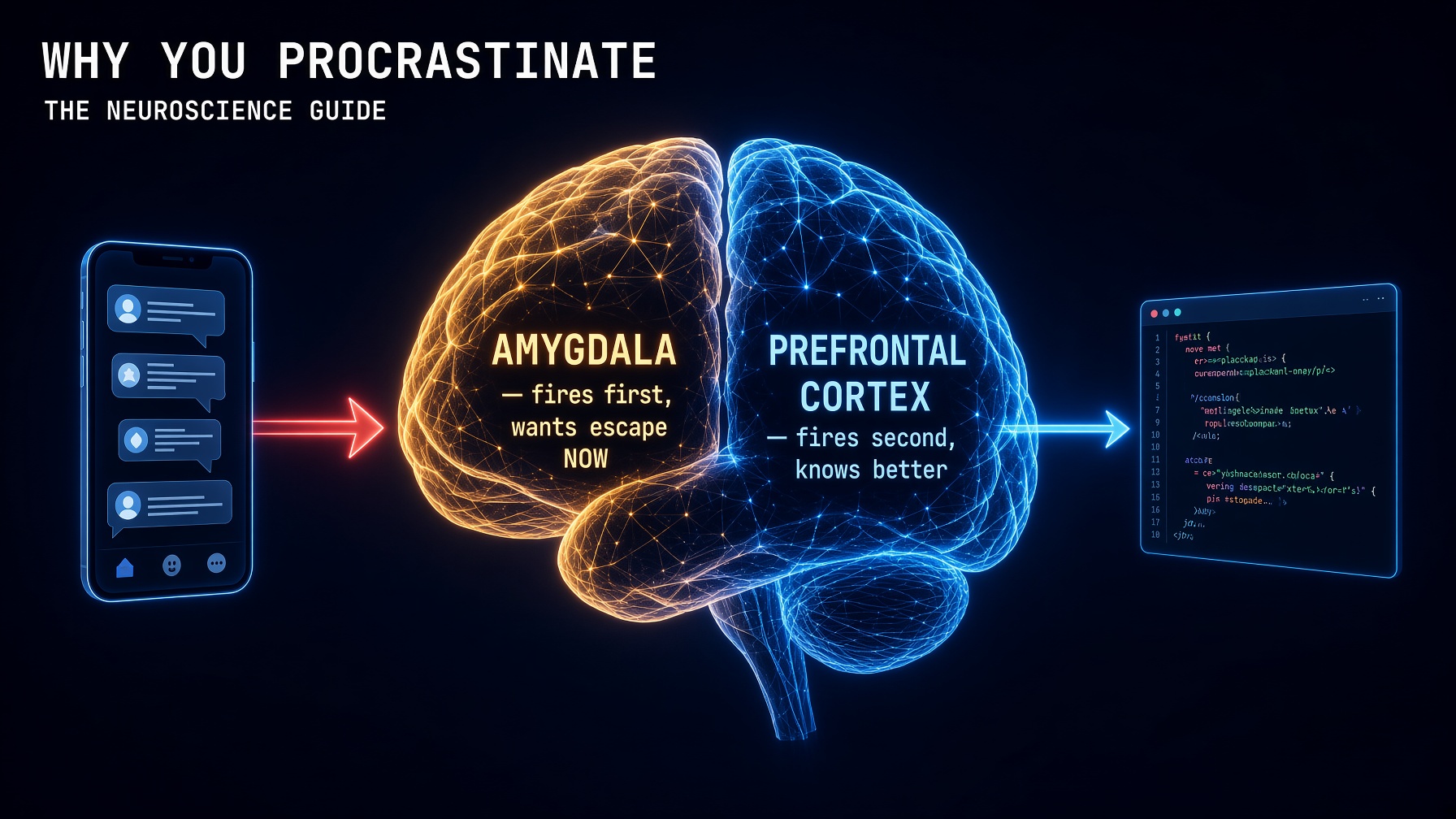
Procrastination is not a time management problem. Decades of psychological research, updated with 2026 neuroimaging data, point to a different culprit: it’s an emotion regulation failure. Understanding the real mechanism is what separates builders who finally stop procrastinating from builders who download another productivity app.
The neuroscience is specific. Your amygdala — the brain’s threat-detection system — fires faster than your prefrontal cortex. When a difficult task produces anticipatory anxiety, the amygdala registers it as a threat before your rational brain can override the response. January 2026 research published in Psychological Reports confirms: high trait procrastination predicts increased anticipatory anxiety when contemplating goals. The insidious part: the higher the stakes of the task, the more the brain discounts its future value. Your most important architectural decision, your most significant code review, the feature that could define the next quarter — these trigger the most avoidance. Not the low-stakes tasks. The ones that matter.
This guide covers the neuroscience of why builders specifically procrastinate, and five evidence-based interventions that address the mechanism rather than the symptom. Every intervention connects to protocols already in this series — because the entire Wellness stack was built around preventing the conditions that make procrastination inevitable.
Why Builders Procrastinate: The Three Mechanisms
Mechanism 1: Temporal Discounting
Your brain’s reward system evolved to prioritize immediate rewards over distant ones. Neuroscientists call this temporal discounting: the brain systematically devalues future rewards in favor of present pleasure. Checking Slack gives an immediate dopamine hit. Finishing a complex refactor? The reward is hours away. Your brain will choose the instant hit almost every time — unless the environmental architecture makes that choice harder to execute.
The builder-specific version of this mechanism: AI tools created a new category of immediate reward that didn’t exist in 2022. Querying Claude about an architectural question feels productive — it produces an immediate, high-quality response with dopamine attached. Sitting with the architectural question and thinking through it yourself feels harder, slower, and less rewarding moment-to-moment. The temporal discounting math strongly favors querying the AI. But as the Deep Work Protocol post covered: the insight from working through the problem yourself is more valuable than the AI’s answer, because it builds the capability the AI answer doesn’t.
Mechanism 2: Reward Threshold Elevation
The Dopamine Detox Protocol post covered D2 receptor downregulation: chronic high-stimulation inputs cause the brain to remove dopamine receptors from neural surfaces, which means progressively higher stimulation is required to feel rewarded. The specific procrastination consequence: after 30 minutes of social media, Slack, or algorithmic content in the morning, the subtle satisfaction of making progress on a complex coding task doesn’t compete. The reward threshold has been raised above what deep work can reliably produce. This is why the Morning Routine Protocol‘s no-phone instruction is an anti-procrastination system, not an arbitrary digital wellness recommendation. It protects the dopamine baseline that makes starting the hard thing feel possible.
Mechanism 3: PFC Fatigue
The prefrontal cortex — the brain region responsible for planning, impulse control, and overriding the amygdala’s escape signals — fatigues after approximately three to four hours of sustained attentional control. “Just resist your phone” becomes a metabolically doomed strategy by mid-afternoon because the PFC literally has less capacity to override the amygdala’s preference for easy tasks. Willpower is not infinite. It’s a depletable resource that runs on glucose and depends on sleep quality, stress levels, and how many other decisions you’ve already made today. The procrastination that hits at 3 PM is often PFC fatigue, not laziness or character failure.
5 Evidence-Based Ways to Stop Procrastinating
1. Affect Labeling — Name the Avoidance (30 Seconds)
Research on affect labeling shows that naming an emotional state out loud or in writing reduces amygdala activation — the same amygdala firing that’s driving the avoidance. When you notice you’re procrastinating, stop and label it: “I’m avoiding this because it feels overwhelming.” “I’m avoiding this because I’m afraid it won’t be good enough.” “I’m avoiding this because I don’t know where to start.”
The labeling does something specific: it engages the prefrontal cortex in processing the emotional state rather than being overridden by it. This isn’t positive thinking or reframing — it’s using the language system to activate a brain region that can regulate the avoidance response. It takes 30 seconds. The effect is immediate and documented. What you’re labeling becomes slightly less threatening, and slightly less threatening is often enough to start.
2. Implementation Intentions — Pre-Program Your Start
Implementation intentions are if-then plans that specify exactly when and where you’ll start a task. Research by Peter Gollwitzer shows they increase follow-through by 200 to 300 percent compared to simple goal intentions. The format: “When [specific cue], I will [specific behavior].”
Wrong: “I’ll work on the authentication refactor today.”
Right: “When I sit down at my desk at 9 AM with my coffee, I will open the authentication.py file and write the first function signature.”
The specificity is what works. The implementation intention pre-programs the neural pathway so that when the cue appears (9 AM, desk, coffee), the behavior fires with less volitional effort. Your brain doesn’t have to decide — it just executes the pre-loaded plan. This is why the Time Blocking Protocol‘s Sunday planning ritual isn’t just organizational hygiene. Creating “Tuesday 9 AM — authentication refactor” is an implementation intention that reduces Monday-night avoidance anxiety and Tuesday-morning start friction simultaneously.
3. Temptation Bundling — Pair Hard Work With Immediate Reward
Behavioral economist Katherine Milkman’s temptation bundling: pair an aversive activity with an immediately enjoyable one. Participants who could only listen to addictive audiobooks at the gym exercised 51 percent more than controls. The effect persisted after the study ended, suggesting real neural reconditioning rather than temporary compliance.
For builders: pair the hard task with a specific, controlled reward that doesn’t spike the dopamine system above the work’s reward threshold. Not social media (too high a spike). Ideas that work: a specific podcast only played during code review, a specific type of coffee only made before architectural work, a specific playlist only used for the aversive task category. The anticipated reward generates a dopamine signal that becomes associated with starting the task. Over time, the task that was aversive starts feeling neutral — because the dopamine push-pull has shifted in your favor. This is different from the Dopamine Detox Protocol‘s low-stimulation principle: the bundled reward is chosen specifically because it doesn’t raise the threshold above what the task itself produces.
4. The 2-Minute Start — Shrink the Threat Signal
The amygdala’s threat response to a difficult task is proportional to how large and undefined the task seems. “Refactor the entire authentication system” is a large, undefined threat. “Open authentication.py and read the first function” is a small, defined, non-threatening action. The 2-minute rule works not because two minutes of work completes anything meaningful — it works because starting removes the anticipatory threat signal that was driving the avoidance.
The neuroscience: the Zeigarnik effect creates an open loop as soon as you start an uncompleted task. Open loops generate mild motivational pressure to close them. Once you’ve opened the file and written the first line, the amygdala’s threat assessment of the task drops — you’re no longer facing something unknown and large, you’re facing something started and partially familiar. The 2-minute start is the commitment device that moves you from anticipation (high threat) to engagement (lower threat).
5. Protect the Dopamine Baseline Before the Hard Task
The most actionable single intervention from the 2026 procrastination neuroscience literature: stop checking small-reward sources before the difficult task. Email, social media, Slack, and news all offer fast dopamine hits that raise your reward threshold. After those hits, the subtle reward of making progress on complex work — the thing that drives intrinsic motivation — doesn’t compete. Your brain has already received a higher reward and the complex task’s natural reward feels insufficient by comparison.
The implementation: do the difficult task first, when the dopamine baseline is clean. The Morning Routine Protocol‘s T+90 first deep work block is designed around exactly this principle — the phone-free morning, the outdoor Zone 2 walk, the cold plunge, the L-theanine — are all calibrating the dopamine system to its natural baseline before the work begins. The Deep Work Protocol‘s 20-minute rule before querying AI applies here too: working through the problem first keeps the natural reward of progress intact, rather than substituting an AI-generated answer that spikes the dopamine system and makes continuing the hard work feel harder by comparison.
The 60-Day Reconditioning Timeline
Synaptic pruning research shows that unused procrastination pathways weaken within 60 days when you consistently choose alternative behaviors. This isn’t motivational theory — it’s measurable structural change in neural circuitry. The procrastination pattern doesn’t require permanent willpower to suppress; it requires 60 days of consistent alternative behavior to degrade the pathway itself.
The practical timeline: the first two weeks are the hardest (the avoidance pathway is strong and the alternative pathway is new). Weeks three and four see the first consistent days where starting feels neutral rather than aversive. By day 60, starting the hard task in the morning — before checking anything — produces its own motivational momentum rather than requiring willpower to initiate. The five interventions above are what bridge the gap between day one and day 60. They’re not permanent crutches; they’re the scaffolding that supports neural reconditioning while the structural change happens.
For the complete procrastination neuroscience research base, see Neurosity’s evidence-based guide to overcoming procrastination.
The Builder’s Takeaway
Procrastination is not a discipline failure. It’s three overlapping neurological mechanisms — temporal discounting, reward threshold elevation, and PFC fatigue — that produce avoidance as a rational response to an emotional threat signal. The most important tasks generate the strongest avoidance because stakes amplify the amygdala’s threat response. Willpower alone doesn’t fix this because willpower depletes; the architecture has to change. The five interventions above change the architecture: affect labeling reduces the amygdala’s threat assessment, implementation intentions pre-program starts, temptation bundling shifts the dopamine equation, the 2-minute start eliminates anticipatory avoidance, and a clean dopamine baseline before the difficult task ensures the subtle reward of progress can compete against the immediate rewards you’ve trained your brain to expect. Apply all five for 60 days. The pathway weakens. The alternative pathway strengthens. What felt like a character flaw becomes a solved engineering problem.
Continue in This Series
- Dopamine Detox Protocol — the D2 receptor dysregulation mechanism behind reward threshold elevation and how to fix it
- Deep Work Protocol — the 20-minute rule before querying AI: protecting the natural reward of progress
- Morning Routine Protocol — the phone-free morning that protects the dopamine baseline for the T+90 hard-task block
- Time Blocking Protocol — implementation intentions built into a weekly calendar: pre-programming starts before Monday morning
- Attention Residue — the open-loop mechanism the Zeigarnik 2-minute start exploits: starting creates the pressure to finish
This post is part of The Agentic Protocol’s Wellness series — the biological hardware layer beneath every autonomous system you build. See also: Dopamine Detox Protocol.