The AI side hustle landscape in 2026 has a real number attached to it, and most content avoids saying it: the median US side hustle earns about $200 per month, and the average is $885 per month. Most people who try AI side hustles earn nothing for the first 60 days and quit.
This post is the honest version — the one that tells you the median before the ceiling, the timeline before the income, and why developers specifically have a structural advantage that most “AI side hustle” guides written for non-technical audiences don’t acknowledge. A developer who can write Python, call the Claude API, and deploy a FastAPI endpoint is not competing with someone using ChatGPT to write blog posts. They’re in a different market, with different ceiling, and different time-to-first-dollar. This guide covers that market specifically.
The Honest Income Trajectory
The pattern across people who interview over time is consistent. The people earning serious income — defined as $3,000 plus per month — share three characteristics: they chose a hustle that aligned with existing skills rather than chasing the latest trend, they invested in quality control from day one, refusing to deliver raw AI output to clients, and they were consistent for at least six months before expecting meaningful results.
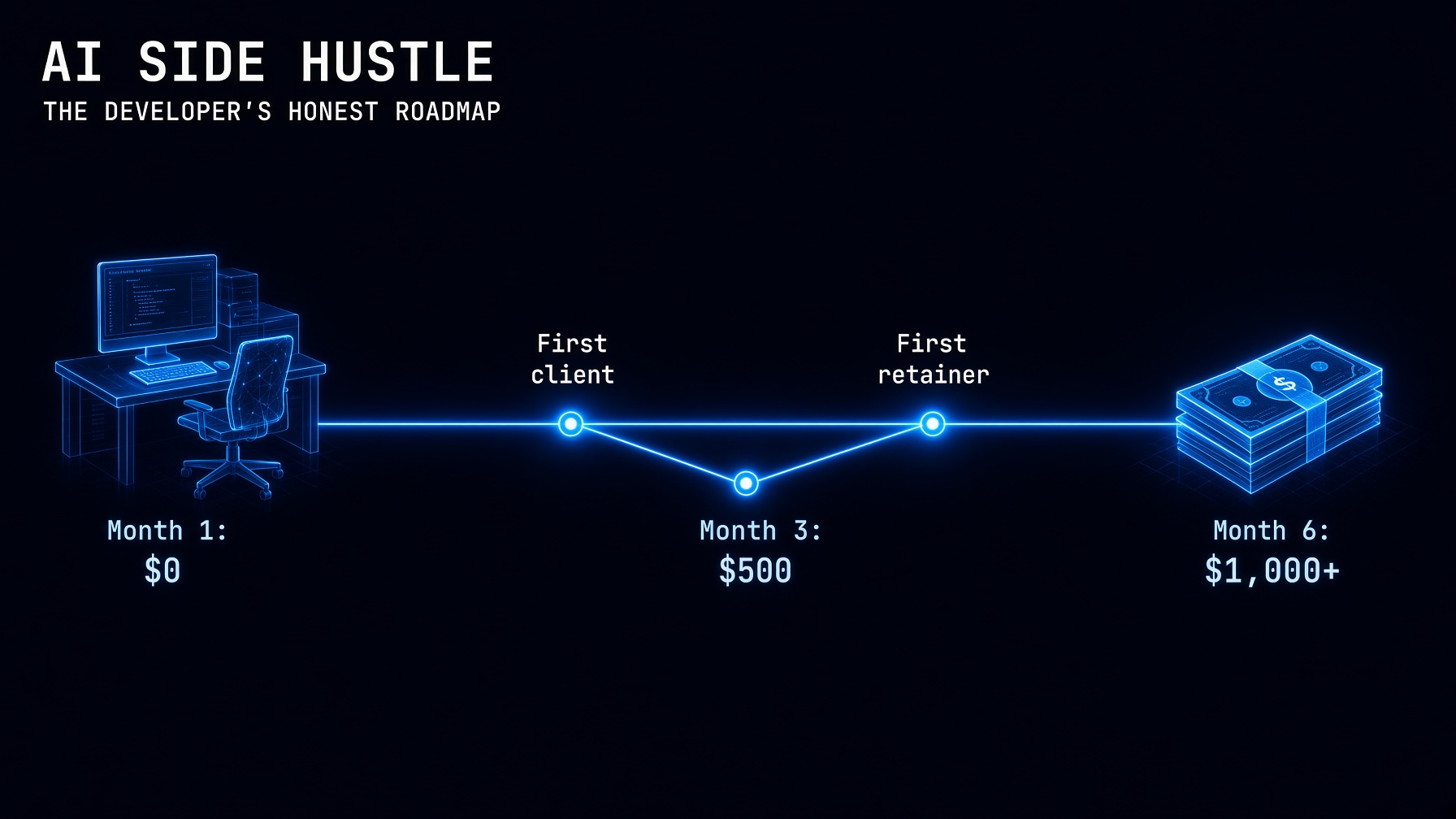
The realistic timeline for a developer starting an AI side hustle from zero:
| Month | Focus | Realistic Income | What Actually Happens |
|---|---|---|---|
| 1 | Build + find first client | $0–$200 | First paying client, usually someone you know, usually underpriced |
| 2–3 | Deliver + collect testimonial | $200–$800 | Second and third clients, word of mouth starts, first retainer conversation |
| 4–5 | Raise rates + systematize | $800–$2,000 | First monthly retainer client, income becomes predictable |
| 6+ | Scale what works | $2,000–$5,000+ | 3–5 retainer clients, referrals inbound, first passive product income |
The month 1 income is almost always lower than expected, and the month 6 income almost always higher than skeptics predict — provided the person doesn’t quit in month 2 when they have one paying client and the feeling of not making enough.
Why Developers Have an Unfair Advantage
The AI side hustle market in 2026 has stratified into two layers that rarely compete with each other. The lower layer is service arbitrage: people using ChatGPT, Claude, or Midjourney to produce content, graphics, voiceovers, or social media posts faster than before and selling that speed to clients. The upper layer is technical implementation: people who can build the AI systems themselves — the automation pipelines, the RAG knowledge bases, the agent workflows, the compliance tools — and either sell the output or sell the system.
A developer building a Python script that automates a client’s invoice processing workflow using Claude and LangChain is not competing with someone using ChatGPT to write LinkedIn posts. The developer’s output is a working system the client depends on forever. The content creator’s output is a deliverable the client might replace with a different tool tomorrow. System dependence creates retention. Retention creates retainers. Retainers create predictable income.
Freelance developers using AI coding tools are pulling in $5,000 to $25,000 per month building apps, automations, and MVPs for clients who have budgets but no technical team. This is one of the fastest-growing categories on freelance platforms right now. The developer advantage isn’t AI knowledge — it’s the ability to deliver the system rather than describe it.
The 4 AI Side Hustles That Pay Developers Best — Ranked by Time to First Dollar
1. AI Automation for Small Businesses (First dollar: 1–3 weeks)
What it is: A small business owner has a repetitive workflow that eats 5 to 15 hours per week — invoice processing, meeting summaries, customer inquiry responses, report generation, social media scheduling. You build a Python script or LangChain agent that does it automatically. You charge a one-time implementation fee ($500 to $2,000) and an optional monthly maintenance retainer ($150 to $400).
Why it pays fastest: The client’s pain is immediate and measurable. “This takes me 8 hours per week” translates to a business case you don’t need to construct. A $1,500 implementation fee that saves 8 hours per week at a $50/hour opportunity cost pays back in less than four weeks. The ROI argument is self-evident, which means the sales conversation is short.
How to find clients: Your existing network — accountants, dentists, real estate agents, e-commerce shop owners, local services businesses. Every small business owner who manages their own operations has a workflow that takes more time than it should. Ask: “What do you do every week that you wish you didn’t have to?” The answer is your first project scope.
Realistic income: Two to four automation projects per month at $800 average, plus three maintenance retainers at $200 per month: approximately $2,200 per month at six months of consistent work. The tools from the LangChain Tutorial and Claude API Python Tutorial in this series cover the entire technical stack.
2. AI Compliance Services for SaaS Companies (First dollar: 2–4 weeks)
What it is: Post-August 2, 2026, EU AI Act Article 50 is enforceable law. Thousands of SaaS companies with EU users need an Article 50 disclosure mechanism, an audit trail, and a compliance report. Most don’t have the technical staff to implement this independently. You implement the disclosure code, set up the audit trail, and deliver a compliance report. One-time engagement: $1,500 to $3,000. Ongoing monitoring retainer: $300 to $500 per month.
Why it pays fast: Enforcement urgency creates immediate buying motivation. The AI compliance services post in this series documented this exact dynamic in August 2026: “The urgency window where urgency exceeds skepticism is this week — before SMEs decide the risk is tolerable.” That window is still open and will remain open as enforcement matures.
Realistic income: Three compliance implementations per month at $2,000 each, plus two ongoing monitoring retainers at $400 per month: $6,800 per month at capacity. This is the highest-margin item on this list because the technical work (Article 50 disclosure code) takes four to eight hours per client and the documentation takes another four hours — you’re billing $2,000 for twelve hours of work.
3. RAG Knowledge Base Builder for Professional Services (First dollar: 2–5 weeks)
What it is: Law firms, accounting firms, consulting firms, and healthcare practices have enormous internal document libraries — case files, policies, procedures, research — that staff can’t search efficiently. You build a RAG system using the RAG Tutorial pipeline that lets staff query their own documents in plain English. Implementation: $3,000 to $8,000 depending on document volume. Hosting and maintenance: $300 to $600 per month.
Why professional services specifically: These firms have large document volumes, strong ROI sensitivity (billing by the hour means any time saved is directly measurable), and data privacy requirements that rule out generic AI tools. A law firm can’t use ChatGPT to search client files. A compliant private RAG system with no data leaving the firm’s infrastructure is something they’ll pay significantly for.
Realistic income: One RAG implementation per month at $5,000 average, plus two hosting retainers at $450 per month: $5,900 per month at capacity. The implementation work is one week of full-time effort or two weekends of part-time work.
4. AI Developer Templates and Starter Kits (First dollar: 4–8 weeks)
What it is: Package the code you’ve written for the tutorials and client projects in this series into downloadable starter kits. An “EU AI Act Article 50 Compliance Implementation Kit” at $79, a “Claude API Agent Boilerplate with Error Handling and Cost Tracking” at $49, a “LangChain RAG Starter with ChromaDB” at $59. Sell on Gumroad or Lemon Squeezy. No client relationship required after the initial sale.
Why it takes longer: Unlike services, which start earning as soon as you find a client, product income requires building distribution first — search traffic, Twitter/X audience, newsletter list, or community presence. The first month typically produces fewer than ten sales. Month six, with compounding SEO and community growth, can produce 50 to 200 sales per month.
Realistic income: Slow start: $50 to $200 per month in months 1 to 3. Solid month 6: $500 to $2,000 per month if at least one template ranks for relevant search terms. This is the most passive stream on the list — a well-ranked template earns while you sleep — but it requires the most upfront patience.
The One Thing That Determines Whether You Earn or Not
Every guide on AI side hustles focuses on the technical stack. Virtually none focus on the variable that actually determines success: distribution. The gap between people who think about AI side hustles and people who run them is action — not perfect planning, not the perfect tool stack. Just building and selling something.
For developer AI side hustles, distribution is simpler than most people make it. Three channels work:
- Your existing network. Every developer knows small business owners, founders, or professionals who have painful workflows. One conversation that starts with “I’ve been building AI automation tools — what takes the most time in your week?” is a lead generation strategy. One testimonial from a satisfied client is a distribution channel. Most first clients come from people the builder already knew.
- One online community where your target client lives. A Slack group for SaaS founders, a LinkedIn group for compliance officers, a Reddit community for freelance professionals. Provide genuine value for two to four weeks before mentioning your service. Share a relevant insight, answer a question in depth, post a useful tool or template. Build credibility before asking for business. This converts at dramatically higher rates than cold outreach to strangers.
- Documented results, not case studies. Post the before and after: “Client’s invoice processing: 6 hours/week before, 20 minutes/week after. Built with Python + Claude API in one weekend.” No case study document needed — a LinkedIn post with specific numbers and a screenshot of the tool running is more persuasive than a polished PDF that nobody reads.
For the honest income data behind the AI side hustle market, see The AI Rankings’ straight-talking 2026 guide to AI side hustles that actually pay.
The Builder’s Takeaway
An AI side hustle for a developer is not a content creation gig with better tools. It’s a technical services business where the AI tools compress delivery time by 60 to 80 percent without reducing the value the client receives — which means the developer’s effective hourly rate increases dramatically without raising prices. The median side hustle earns $885 per month. A developer who delivers three small business automations at $800 each and builds two compliance retainers at $400 each earns $3,200 per month in month four, working evenings and weekends. That ceiling is not the average — it’s the outcome for someone who chose a hustle aligned with their existing skills, delivered quality output rather than raw AI generation, and stayed consistent for six months. The technical foundation is in this series. The income is in showing up consistently with it.
Continue in This Series
- Micro SaaS Ideas 2026 — the specific products to build for each of the four income streams above
- AI Consulting Rates 2026 — what to charge at each stage of the income trajectory above
- AI Compliance Services — the full playbook for hustle #2: EU AI Act compliance implementation
- AI Agent Passive Income — how the template income from hustle #4 fits into the five-stream passive income architecture
- Micro-SaaS AI Agent — the retainer business model behind hustle #1 and #3 at scale
This post is part of The Agentic Protocol’s Wealth series — the autonomous capital layer beneath every agent pipeline. See also: AI Consulting Rates 2026.