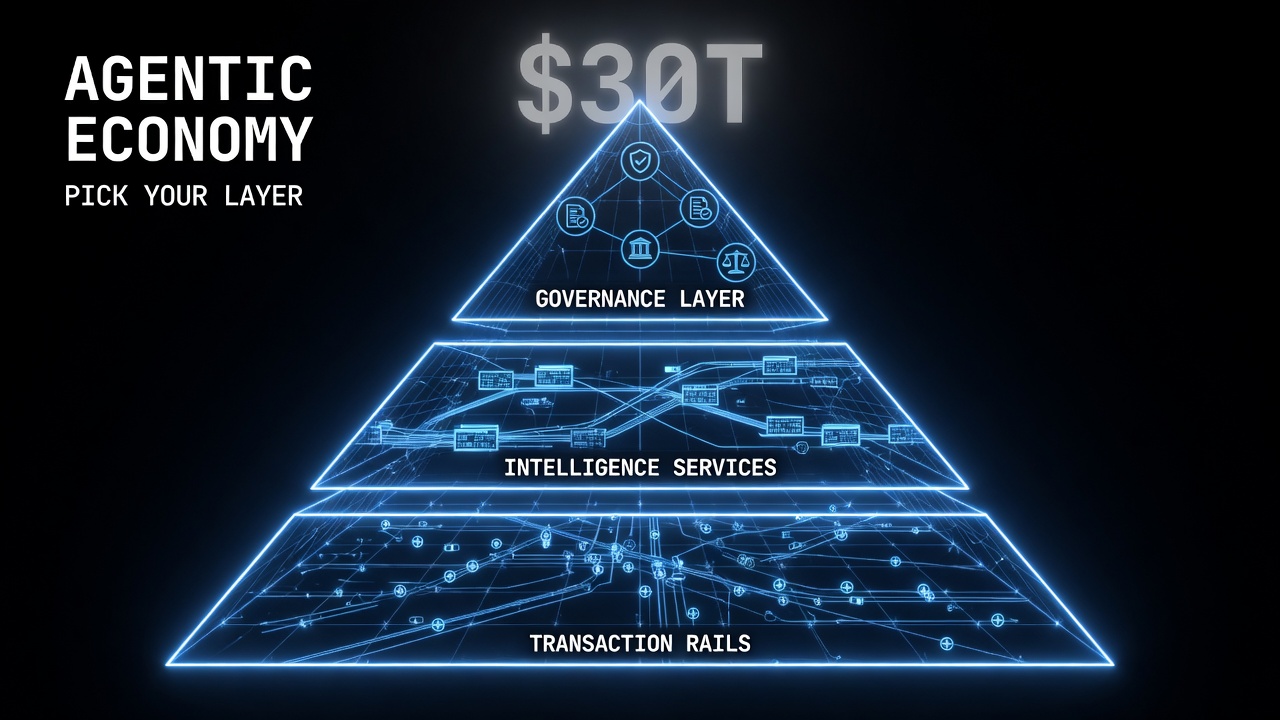
The agentic economy is the one forecasting number that keeps appearing across every sector this series has covered — and it’s worth separating the two things that number actually contains before deciding how to position against it.
Analysts project the autonomous agent economy will grow to approximately $30 trillion by 2030, with agentic AI handling at least 15% of daily financial decisions autonomously by that year. Stablecoin Insider estimates agentic commerce at $1.5 trillion to $5 trillion by 2030, with USDC, USDT, and newer stablecoins positioned as the payment rail on every agent-to-agent transaction. Coincub puts the autonomous agent economy’s scope even higher. These numbers aren’t marketing — they reflect the structural shift from AI as advisor to AI as executor that every post in this Wealth series has been describing one layer at a time.
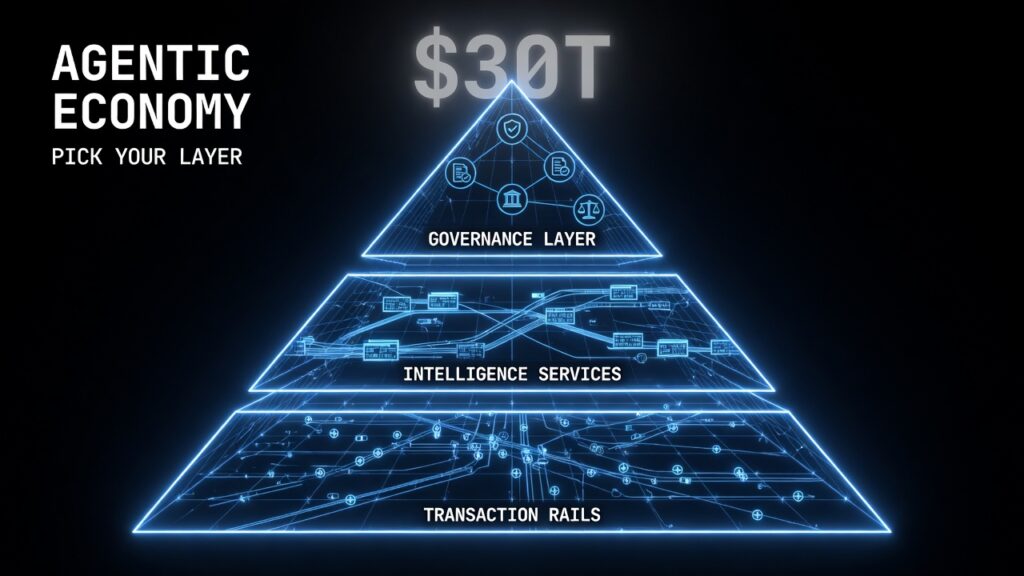
The $30 trillion figure is also almost completely useless for a solo builder trying to decide what to build this month. The number describes a market that includes trillion-dollar institutional asset management, global commerce, supply chains, and financial infrastructure — sectors where a solo builder has no near-term leverage. What’s useful is the specific three-layer breakdown of the agentic economy that determines where a builder operating independently can actually capture revenue now, at current infrastructure maturity, without requiring institutional distribution or enterprise sales cycles.
Why the Agentic Economy Has Three Layers, Not One
Every forecast about the agentic economy treats it as a single market. It’s actually three concentric infrastructure layers with completely different access requirements, revenue mechanics, and regulatory exposure for builders at each level:
- Layer 1 — Transaction Rails. The payment infrastructure that agents use to pay each other — x402, AP2, stablecoin rails. Solo builders can participate here by building x402-compatible services that other agents call and pay per request. This is the highest-leverage, lowest-barrier layer: it requires API development skills, not institutional capital or enterprise relationships. Every API service a builder wraps in an x402 payment endpoint becomes a merchant in the machine-to-machine economy.
- Layer 2 — Intelligence Services. The data, analysis, and decision-support services that agents consume to make better decisions. Market intelligence, regulatory monitoring, code analysis, document processing, competitive research — any service that currently requires human judgment to source and synthesize becomes a premium intelligence product for agents willing to pay per query. This is the layer where our AI Agent Revenue Loop and Micro-SaaS AI Agent models operate.
- Layer 3 — Governance Infrastructure. The compliance, audit, and governance layer that makes the first two layers safe enough for enterprise and institutional deployment. This is the layer where the EU AI Act Article 50 disclosure code, the Colorado AI Act audit trail, the AI Agent Gateway, and the credential isolation patterns from this series have the highest commercial value. Enterprise buyers don’t just want agents — they want agents they can demonstrate are compliant to a regulator. That demonstration layer is a service builders can sell.
These three layers have different capture timelines. Layer 1 (Transaction Rails) is buildable today — x402 is live infrastructure with 18,670 daily transactions as of Q1 2026. Layer 2 (Intelligence Services) is the current sweet spot — demand is real, supply is thin, margins are high. Layer 3 (Governance) becomes increasingly valuable as enforcement pressure mounts: the EU AI Act activated August 2, the Colorado AI Act is already live, and China’s framework went effective July 15. The builders who built the governance infrastructure for their own pipelines are already positioned to sell it.
The Agentic Economy Revenue Map: What’s Generating Real Money Now
Below the $30 trillion projection and above the speculative projections, there’s a narrow band of production-confirmed revenue in the agentic economy that’s worth anchoring against. These are actual 2026 deployments generating measurable returns:
- Agent vault management (Layer 1/2 overlap): Theoriq Alpha Vault manages $25 million in total value locked through autonomous agent decision-making. This is institutional capital — not accessible to solo builders without regulatory licensing. But the architecture (autonomous rebalancing, risk-adjusted yield routing, transparent audit trail) is exactly the DeFAI governance pattern from the DeFAI Protocol post scaled to institutional size.
- Stablecoin reserve yield extraction (Layer 1): USDC and USDT collect reserve yield on every dollar sitting in AI agent wallets around the clock. At the solo builder level, this manifests as idle USDC in x402 settlement reserves earning 6% annualized in Morpho vaults — the $600/year on $10,000 idle USDC figure from the AI Agent Revenue Loop post. At institutional scale, the same mechanism generates hundreds of millions annually.
- Intelligence service retainers (Layer 2): The Micro-SaaS AI Agent post documented $300 to $1,500/month per client retainers for meeting intelligence, product feedback synthesis, and compliance monitoring. Five clients at $700/month generates $1,715/month net. This is the most immediately accessible Layer 2 revenue for solo builders in 2026.
- Compliance monitoring services (Layer 3): The EU AI Act, Colorado AI Act, and China AI Regulation enforcement windows have created an immediate market for compliance monitoring services. Builders who have implemented the audit trail and Article 50 disclosure architecture from this series can package and sell those implementations as $300 to $800/month retainers to organizations that need the same infrastructure but haven’t built it.
The Solo Builder’s Agentic Economy Stack: Sequenced for 2026
The right sequence for capturing agentic economy revenue isn’t to pick one layer — it’s to build from Layer 1 upward, because each layer’s infrastructure enables the next layer’s revenue:
- Month 1 — Layer 1 foundation: Deploy an x402-compatible API service around one of your existing capabilities (code analysis, document processing, data research, compliance checking). Set pricing at $0.01 to $0.05 per call. Run the idle USDC settlement reserves in a Morpho vault via Coinbase’s CDP SDK to capture the reserve yield. Revenue: small but real. Infrastructure: permanent.
- Month 2 — Layer 2 intelligence service: Wrap your x402 API in a Micro-SaaS retainer package targeting human clients who need the same intelligence your agents now provide autonomously. First client at $500 to $700/month. The API infrastructure from Month 1 is the backend. The retainer is the frontend revenue. The Revenue Loop architecture and the Micro-SaaS AI Agent retainer model are two revenue streams on the same underlying infrastructure.
- Month 3 — Layer 3 governance package: Document the compliance architecture you built for your own pipelines (Article 50 disclosure, Colorado AI Act audit trail, credential isolation, AI Agent Gateway). Package it as a compliance monitoring retainer at $300 to $800/month per client. The EU AI Act’s August 2 enforcement date means this product has immediate urgency. Organizations that need it are actively looking for it right now.
- Month 4+ — Agentic economy compounding: The three layers compound. x402 revenue provides passive income that funds model costs. Intelligence service retainers provide active income that funds growth. Governance retainers provide recurring revenue with the lowest churn rate of any SaaS category (compliance infrastructure is sticky). The agentic economy isn’t one big revenue source — it’s ten small ones that stack.
The Honest Constraint: What Blocks the $30 Trillion From Flowing to Solo Builders
The honest counterpart to the agentic economy opportunity is the structural constraint that determines how much of the $30 trillion reaches Layer 2 and Layer 3 builders versus being captured entirely at the institutional layer.
Two constraints are real. The first is regulatory: most of the high-value Layer 1 financial flows (asset management, lending, yield vaults) require securities licensing, banking charters, or investment advisor registration in most jurisdictions. Solo builders can participate at the infrastructure and services layer without these licenses — they cannot participate at the capital management layer without them. This is why the revenue map above focuses on retainer services, API usage fees, and intelligence products rather than yield management or asset allocation.
The second is trust: the organizations managing the largest capital flows in the agentic economy — the Theoriq Alpha Vaults, the AI-managed treasury programs, the autonomous asset management systems — choose infrastructure and intelligence providers through procurement processes that favor established vendors over solo builders. The path around this isn’t speed; it’s specialization. A solo builder with the deepest documented expertise in one narrow compliance or governance niche is a more credible vendor for that specific function than a large generalist firm with generic AI capabilities. The EU AI Act compliance monitoring retainer at $300/month is accessible to a solo builder. The $10M enterprise compliance platform contract is not.
For the full agentic economy projection methodology, see Coincub’s AI agents and blockchain architecture guide.
The Builder’s Takeaway
The agentic economy is real, growing faster than any prior technology transition, and structurally accessible to solo builders at Layers 1 and 2 right now — not in 2030. The $30 trillion projection is a useful context for understanding the direction, not a number that describes your addressable market. Your addressable market is the three-to-five clients who need the intelligence or compliance infrastructure you’ve built for yourself, priced at a fraction of the value you create, delivered through a retainer relationship that’s more persistent than any project engagement. Build Layer 1 (transaction rails), sell Layer 2 (intelligence services), package Layer 3 (governance infrastructure). The agentic economy doesn’t flow to the builders who wait for it to arrive — it flows to the ones who built the infrastructure before it did.
Continue in This Series
- AI Agent Revenue Loop — the Layer 2 revenue loop architecture that the agentic economy strategy builds on
- Micro-SaaS AI Agent — the $300–$1,500/month Layer 2 retainer model for intelligence and compliance services
- x402 Payment Protocol — the Layer 1 transaction rail that turns any API service into an agentic economy merchant
- DeFAI Protocol — the governed autonomous yield architecture at the institutional end of Layer 1
- Agentic Commerce Revenue — the $65B commerce layer of the agentic economy accessible to merchant-side builders
This post is part of The Agentic Protocol’s Wealth series — the autonomous capital layer beneath every agent pipeline. See also: AI Agent Monetization.