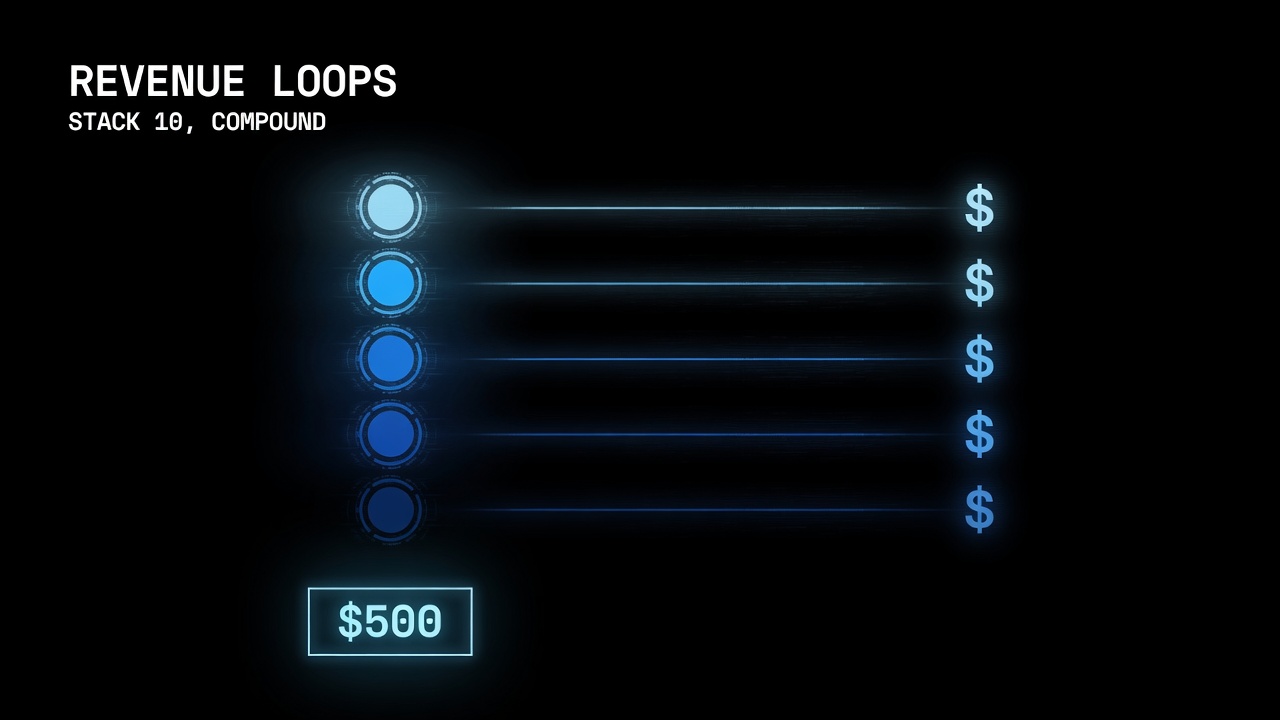
The AI agent revenue loop is the unit of analysis that makes autonomous income practical — not because any single loop generates significant money, but because the economics of stacking ten small loops have crossed a threshold that makes the math genuinely interesting in 2026.
The honest baseline comes from a DEV Community operator who ran a 30-day test of real revenue-generating agent deployments: “The ‘passive income’ from an AI agent in 2026 is mostly a time dividend. You get hours back. What you do with those hours determines whether income follows.” That framing is accurate — and the data from operators running actual stacked loops is more specific. Bug bounty monitoring agents average $100 to $200 per week. Autonomous iOS app pipelines hit profitability in thirteen days. Autonomous video content stores generate $275 in three weeks. Each individual loop generates $20 to $50 per month. Stack ten of them and the compounded total is $200 to $500 per month of semi-passive revenue.
This post gives you the AI agent revenue loop architecture — what makes a loop work, which loop type has the highest first-attempt success rate, and the production code for the one that data says to build first.
Why the AI Agent Revenue Loop Economics Changed in 2026
Two cost structure changes make the stacked AI agent revenue loop viable now in a way it wasn’t twelve months ago:
The Compute-to-Labor ratio has inverted. A mid-level virtual assistant in the US costs $3,000 to $5,000 per month. A high-performance AI agent running on Claude Sonnet 5 — the model we recommended as primary in the Claude Sonnet 5 post — costs approximately $100 to $300 per month in API token consumption for equivalent workload. At that ratio, even a $50/month revenue loop generates positive return against its operating cost.
Claude Max subscription changes the marginal cost calculation. On a Claude Max plan, Claude Code usage is covered by the subscription rather than billed per token. This means the per-loop marginal cost for many automation tasks approaches zero — the strategy shifts from optimizing per-loop revenue to maximizing the number of loops you can run in parallel within the subscription. The Unit Economics post’s Token-to-Revenue ratio still applies for API-billed loops; for Claude Max-covered loops, the denominator becomes the monthly subscription cost divided across all running loops.
For the Cloudflare consideration we covered this morning, any AI agent revenue loop that involves web browsing needs to account for the new bot management defaults in its cost and access model — loops that hit blocked pages need API alternatives, not retry logic, per the Cloudflare AI Agent Block post.
The Anatomy of a Working AI Agent Revenue Loop
Every viable AI agent revenue loop shares the same four-stage architecture:
- Trigger: a real-world signal that initiates the loop — a new bug bounty scope published, a keyword appearing in an RSS feed, a price crossing a threshold, a webhook firing from a payment system.
- Process: the agent takes autonomous action in response to the trigger — analyzing, generating, filtering, formatting, or submitting.
- Output: a deliverable that generates revenue — a bug report submission, a content piece published, a product listing created, a notification sent to a paying subscriber.
- Audit: an immutable log of what the loop did, when, and what it output — required not just for the Colorado AI Act compliance framework, but for debugging when any loop behaves unexpectedly.
The loops that fail consistently are missing one of these stages. A loop with no trigger runs constantly and burns compute budget without a clear revenue event. A loop with no audit trail can’t be debugged when it starts generating wrong outputs at scale.
The Highest-Success-Rate First Loop: Bug Bounty Monitor
The data from operators building AI agent revenue loop portfolios is consistent on the first loop to build: bug bounty monitoring. It’s read-only — the agent only reads and reports, it never writes to or modifies any system — which eliminates the JADEPUFFER-style risk category entirely. It pays per finding. And the skill required — filtering and structuring data from public sources — is exactly what language models do best.
Realistic revenue: $100 to $200 per week when the loop finds and reports genuine issues. Some weeks zero. The variance is high; the floor is safe.
Step 1 — Install dependencies
pip install anthropic requests python-dotenv feedparserStep 2 — Loop configuration
# .env
ANTHROPIC_API_KEY=your_api_key_here

# HackerOne or Bugcrowd public scope RSS feeds — these are legitimate
# public APIs that list open bug bounty programs and scope updates
BOUNTY_FEED_URL=https://hackerone.com/programs.rss
MIN_REWARD_USD=100
LOOP_INTERVAL_HOURS=6
Step 3 — The revenue loop
import os
import json
import feedparser
import anthropic
from datetime import datetime
from dotenv import load_dotenv

load_dotenv()

client = anthropic.Anthropic(api_key=os.environ.get("ANTHROPIC_API_KEY"))
MIN_REWARD = int(os.environ.get("MIN_REWARD_USD", "100"))
FEED_URL = os.environ.get("BOUNTY_FEED_URL", "")

AUDIT_LOG: list[dict] = []


def fetch_bounty_scope_updates(feed_url: str) -> list[dict]:
    """
    Reads public bug bounty program feeds — legitimate public data,
    no scraping, no terms-of-service issues.
    """
    feed = feedparser.parse(feed_url)
    programs = []
    for entry in feed.entries[:20]:   # cap to 20 most recent
        programs.append({
            "title": entry.get("title", ""),
            "summary": entry.get("summary", "")[:500],
            "link": entry.get("link", ""),
            "published": entry.get("published", "")
        })
    return programs


def analyze_scope_for_testable_surface(program: dict) -> dict:
    """
    Uses the model to identify high-value, in-scope attack surfaces
    from a program's scope description. Read-only analysis only —
    the agent never touches the target systems.
    """
    response = client.messages.create(
        model="claude-sonnet-5",
        max_tokens=500,
        messages=[{
            "role": "user",
            "content": f"""You are a bug bounty researcher's assistant.
Analyze this bug bounty program's scope and identify the three most testable
attack surfaces based on the description. Be specific about what to test
and what vulnerability classes are most likely given the technology stack.

PROGRAM: {program['title']}
SCOPE: {program['summary']}

Respond in JSON with this structure:
{{
  "testable_surfaces": [
    {{"surface": "...", "vulnerability_class": "...", "rationale": "..."}}
  ],
  "estimated_reward_tier": "low|medium|high",
  "recommended_priority": 1-10
}}"""
        }]
    )

    try:
        analysis = json.loads(response.content[0].text)
    except json.JSONDecodeError:
        analysis = {"raw": response.content[0].text, "parse_error": True}

    audit_entry = {
        "timestamp": datetime.utcnow().isoformat(),
        "loop": "bug_bounty_monitor",
        "program": program["title"],
        "link": program["link"],
        "analysis": analysis,
        "model": "claude-sonnet-5",
        "tokens_used": response.usage.input_tokens + response.usage.output_tokens
    }
    AUDIT_LOG.append(audit_entry)
    return audit_entry


def run_revenue_loop() -> list[dict]:
    """
    The full AI agent revenue loop: trigger → process → output → audit.
    Returns all high-priority findings for the current loop run.
    """
    print(f"\n[LOOP START] Bug Bounty Monitor — {datetime.utcnow().isoformat()}")
    programs = fetch_bounty_scope_updates(FEED_URL)
    print(f"[TRIGGER] {len(programs)} programs found in feed")

    high_priority_findings = []

    for program in programs:
        if not program["summary"]:
            continue

        result = analyze_scope_for_testable_surface(program)
        analysis = result.get("analysis", {})

        if isinstance(analysis, dict) and not analysis.get("parse_error"):
            priority = analysis.get("recommended_priority", 0)
            tier = analysis.get("estimated_reward_tier", "low")

            if priority >= 7 or tier == "high":
                high_priority_findings.append(result)
                print(f"  [HIGH PRIORITY] {program['title']} — "
                      f"priority {priority}, tier {tier}")

    print(f"[LOOP END] {len(high_priority_findings)} high-priority findings "
          f"| {len(AUDIT_LOG)} total audit records this run")
    return high_priority_findings


if __name__ == "__main__":
    findings = run_revenue_loop()
    if findings:
        print(f"\n[OUTPUT] {len(findings)} programs queued for manual review")
        for f in findings:
            print(f"  → {f['program']}: {f['link']}")
The loop runs read-only analysis against public program data. The high-priority findings queue is for manual review — the decision to actually test a target and submit a report remains with a human. This is the correct human-in-the-loop position for a first AI agent revenue loop: the agent does the research legwork that would have taken an hour, the human makes the judgment calls that could create legal exposure if automated incorrectly.
Building Toward $500 Per Month: The Stack Sequence
A realistic path from zero to $500 per month using stacked AI agent revenue loops, based on what’s actually generating revenue in 2026:
- Weeks 1–2: Bug bounty monitor (this post). Establish the four-stage loop pattern. Measure your first real revenue event.
- Weeks 3–4: Niche content aggregator. An agent that monitors a specific technical domain — AI agent security, agentic compliance, developer tooling — summarizes daily developments, and distributes to a paid newsletter via Beehiiv or Substack. At $5–10/subscriber and 50 subscribers, this generates $250–500/month.
- Month 2: x402 API service. Package one of the code patterns from this series — the reflection loop, the credential isolation pattern, the trust level tagging system — as a callable API that other agents can pay to use per call. The x402 Payment Protocol post covers the payment infrastructure; the AI Agent Unit Economics post covers how to price it at a T/R ratio that’s profitable.
- Month 3+: Add loops in the $20–50/month range — keyword alert services, automated report generation, data pipeline maintenance — until the stack reaches 10 active loops.
For the full operator data on what’s generating real revenue, see AllabtAI’s 2026 autonomous income loop playbook.
The Builder’s Takeaway
The AI agent revenue loop is not a passive income machine in the marketing sense. It’s a time dividend engine: each loop returns hours that would have been spent on repetitive research, monitoring, or formatting — and the revenue follows when those hours were previously generating value that can now be automated. The math becomes real when loops stack. Ten loops at $20 to $50 per month each produces a meaningful secondary income floor without requiring any single loop to be exceptional. Build the first one correctly — with all four stages, with an audit trail, with human review at the decision points that carry legal or financial weight — and the second and third loops reuse the same architecture. The compounding is in the pattern, not in any individual loop’s performance.
This post is part of The Agentic Protocol’s Wealth series — the autonomous capital layer beneath every agent pipeline. See also: AI Agent Monetization.