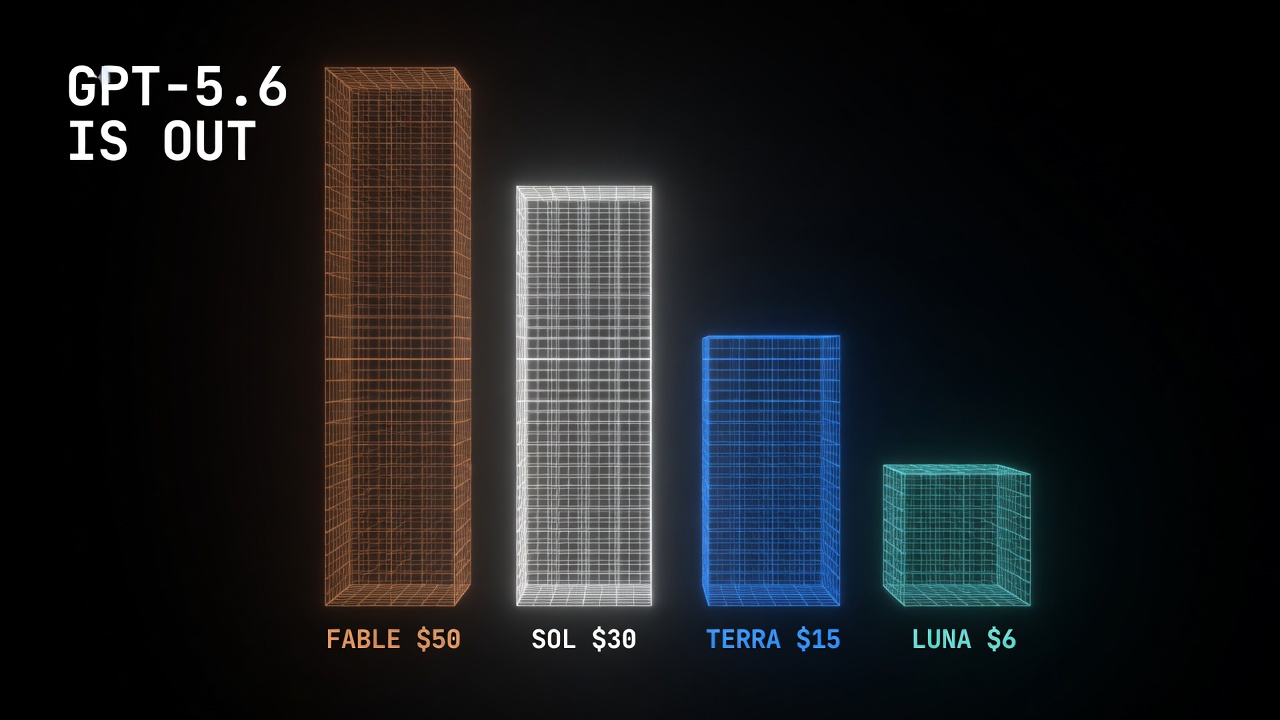
GPT-5.6 Sol is now generally available — and its three-tier pricing structure changes the fallback chain more decisively than any single model release this month has.
OpenAI released the GPT-5.6 family on July 9, 2026, following a limited preview that began June 26. All three tiers are now in the API: Sol at $5 per million input tokens and $30 per million output, Terra at $2.50/$15, and Luna at $1/$6. On Terminal-Bench 2.1, base GPT-5.6 Sol scores 88.8% and Sol Ultra scores 91.9%. The context window on all three tiers is 1 million-plus tokens. Every model in the GPT-5.6 family is now available without government access restrictions to any API key holder.
This post gives you the updated fallback chain configuration — the fourth this month — and the unit economics case for each routing decision the GPT-5.6 family forces.
The GPT-5.6 Sol Pricing That Makes Fable 5 Hard to Justify
The single most impactful number in the GPT-5.6 release for builders who’ve been routing through the frontier chain: GPT-5.6 Sol at $5/$30 is half the input price and 40% the output price of Claude Fable 5 at $10/$50. On Terminal-Bench 2.1, base Sol scores 88.8% versus Fable 5’s 84.3%. The model that was more expensive in the frontier chain now scores lower on the primary agentic coding benchmark. This doesn’t eliminate Fable 5 from every use case — the Intelligence Index score difference (60 vs 54 for Grok 4.5, with Sol sitting above both) may matter for specific reasoning-heavy workloads — but it fundamentally changes the frontier chain default.
The Claude Fable 5 Suspended post established the principle: benchmark leadership and production availability are separate evaluation criteria. GPT-5.6 Sol now satisfies both — it leads the Terminal-Bench leaderboard at base pricing below Fable 5, and it’s available to any API key holder without export controls, usage credit requirements, or access restrictions. The access whiplash pattern this series has documented (three Fable 5 free window extensions in five weeks) makes GPT-5.6 Sol’s unrestricted general availability a material advantage, not just a pricing footnote.
GPT-5.6 Luna: The Cost Chain Just Changed
Luna at $1/$6 is the more immediately actionable pricing development for most builders. The cost-optimized chain position that Grok 4.5 filled last week at $2/$6 now has a direct competitor from OpenAI’s own lineup — one that costs half as much on input while matching on output. Luna and Grok 4.5 have the same $6 per million output token cost, but Luna’s $1 input versus Grok 4.5’s $2 input makes Luna strictly cheaper for any workload where input tokens dominate the bill.
The decision between Luna and Grok 4.5 comes down to capability comparison on your specific task category, which neither publicly available benchmark data nor this post can resolve definitively before you test both. The principle from the AI Agent Unit Economics post applies: run both on your representative production workload, measure output quality against your task-specific success criteria, and let the Token-to-Revenue ratio make the routing decision — not the benchmark comparison table alone.
What the Luna launch definitively closes: the case for keeping Haiku 4.5 in your primary cost chain. Claude Haiku 4.5 at $0.80/$4 is cheaper than Luna on both input and output tokens. But the capability gap between Haiku 4.5 and Luna is large enough that most builders who were using Haiku for cost reasons should re-evaluate whether the $0.20/$2 per million token saving justifies the quality difference for their specific workload. For high-volume tasks where quality matters more than raw cost minimization, Luna now gives you a frontier-family model in the same price neighborhood as Haiku 4.5’s output cost.
The Updated Fallback Chain and Complete Cost Table
# .env — updated July 21, 2026
# GPT-5.6 family at general availability (July 9, 2026)
# Fourth fallback chain update this month.

# STANDARD PRODUCTION CHAIN
# Sonnet 5 primary: $2/$10 intro through Aug 31, MCP-native, stable
# Terra as cross-provider fallback: $2.50/$15, balanced, 1M context
MODEL_CHAIN_STANDARD=claude-sonnet-5,gpt-5.6-terra,claude-haiku-4-5-20251001

# FRONTIER CHAIN (complex reasoning, maximum agentic capability)
# Sol replaces Fable 5 as the frontier default:
# - 88.8% Terminal-Bench (vs Fable 5's 84.3%)
# - $5/$30 (vs Fable 5's $10/$50)
# - No access restrictions, no usage credit requirement
# Keep Fable 5 in position 2 for tasks where Intelligence Index gap matters
MODEL_CHAIN_FRONTIER=gpt-5.6-sol,claude-fable-5,gemini-3.5-pro

# LARGE CONTEXT CHAIN (2M+ token requirements)
# Gemini 3.5 Pro remains the only 2M option
# Sol at 1M is now competitive for slightly smaller large-context tasks
MODEL_CHAIN_LARGE_CONTEXT=gemini-3.5-pro,gpt-5.6-sol,claude-opus-4-8

# COST-OPTIMIZED CHAIN (high volume, non-sensitive, public data)
# Luna at $1/$6 is now the cheapest capable frontier option on input
# Evaluate Luna vs Grok 4.5 on your specific task before committing
MODEL_CHAIN_COST=gpt-5.6-luna,grok-4.5,claude-haiku-4-5-20251001

# DATA-SOVEREIGN CHAIN (PII, financial, regulated data)
# Both GPT-5.6 and Grok 4.5 are US-based, no Chinese providers
MODEL_CHAIN_SOVEREIGN=claude-sonnet-5,gpt-5.6-terra,grok-4.5

# COMPLETE COST TABLE — July 21, 2026
# GPT-5.6 Luna:          $1.00 / $6.00   ← cheapest capable frontier on input
# Claude Haiku 4.5:      $0.80 / $4.00   ← cheaper on both, lower capability
# Grok 4.5:              $2.00 / $6.00   ← same output as Luna, 2x input
# GPT-5.6 Terra:         $2.50 / $15.00  ← production default, 1M context
# Claude Sonnet 5:       $2.00 / $10.00  ← intro price through Aug 31
# Claude Opus 4.8:       $5.00 / $25.00  ← knowledge-work strength
# GPT-5.6 Sol:           $5.00 / $30.00  ← frontier, replaces Fable 5 primary
# Claude Fable 5:        $10.00 / $50.00 ← demoted to fallback-only
# Gemini 3.5 Pro:        TBD             ← large-context, no restrictions
# GPT-5.5:               $5.00 / $30.00  ← same price as Sol, lower benchmark

# Model IDs:
# gpt-5.6-sol   → Sol flagship (gpt-5.6 alias also routes here)
# gpt-5.6-terra → Terra balanced
# gpt-5.6-luna  → Luna cost tier
The Three Decisions the GPT-5.6 Release Forces Today
- Move Sol to your frontier chain primary before keeping Fable 5 credits. If you purchased Fable 5 usage credits after the July 19 free window ended, Sol at $5/$30 delivers higher Terminal-Bench performance at half the input cost. For most frontier-tier workloads — complex reasoning, agentic coding, long-horizon multi-step tasks — the routing decision should now default to Sol. Keep Fable 5 in the chain as a second option for tasks where you’ve measured a specific quality advantage.
- Evaluate Luna on your highest-volume cost-chain workloads before the next billing cycle. The $1/$6 pricing makes Luna the cheapest capable frontier option on input tokens. The risk is unknown capability relative to Grok 4.5 for your specific task category — test both before committing production volume to either. The Grok 4.5 vs Fable 5 post from July 19 described the T/R ratio calculation; apply the same calculation with Luna’s pricing against your actual task success rate.
- Update your data sovereignty classification for GPT-5.6. GPT-5.6 is an OpenAI product, US-based, no current government access restriction or export control. It satisfies the China AI Regulation post’s sovereign chain requirement. Add Terra to your sovereign chain as a cross-provider fallback alongside Sonnet 5 and Grok 4.5.
The Bigger Pattern: The Frontier Model Market Has Bifurcated
Four weeks of model releases this month confirm a structural shift in the frontier AI market. The BenchLM analysis of the full OpenAI pricing stack puts it plainly: “The flagship tier has converged. GPT-5.6 Sol and GPT-5.5 at $5/$30 sit beside Claude Opus 4.8 at $5/$25 — identical input.” Three products from two competing labs are now priced within 16% of each other at the frontier tier. Fable 5 at $10/$50 sits above this converged tier at 2x the input price. Gemini 3.5 Pro sits within it at pricing TBD but positioned competitively.
The implication for the multi-provider fallback architecture this series has built: the cross-provider fallback is no longer a hedge against any single provider’s outage — it’s a hedge against any single provider’s policy, export control, or access restriction decision. GPT-5.6 Sol available today, Claude Fable 5 restricted last month, Claude Mythos 5 export-controlled, GPT-5.6 Sol Ultra government-gated two weeks ago. The capability is broadly equivalent across competing providers at the frontier tier. The availability is what differentiates them — and availability has changed more in the past six weeks than capability has in six months.
For the complete GPT-5.6 pricing verification and provider comparison, see TechJack Solutions’ GPT-5.6 pricing breakdown verified against OpenAI’s live documentation.
The Builder’s Takeaway
GPT-5.6 Sol at $5/$30 with 88.8% Terminal-Bench should be your frontier chain primary from today. Fable 5 at $10/$50 with 84.3% Terminal-Bench should be your frontier fallback — available, but not the default. Luna at $1/$6 deserves evaluation in your cost chain against Grok 4.5, which it now undercuts on input. Terra at $2.50/$15 with 1M context is the new production-default cross-provider option that belongs in your standard and sovereign chains alongside Sonnet 5. The cost table above replaces every previous version in this series. Update your .env configurations before the next billing cycle and run the T/R ratio calculation against your actual workload distribution — the number that matters isn’t the per-token price, it’s what your specific pipeline pays to produce your specific revenue.
Continue in This Series
- Model Fallback Routing — the original fallback chain architecture this post updates for the fourth time this month
- Grok 4.5 vs Fable 5 — the July 19 post Luna now competes with on the cost chain
- Gemini 3.5 Pro — still the only 2M-context unrestricted option in the large-context chain
- AI Agent Unit Economics — the T/R ratio calculation that makes the Luna vs Grok 4.5 decision quantitative
- China AI Regulation — the geopolitical routing layer GPT-5.6 (US-based, no restrictions) satisfies for the sovereign chain
This post is part of The Agentic Protocol’s Work series — the connective infrastructure layer beneath every autonomous pipeline. See also: Model Fallback Routing.