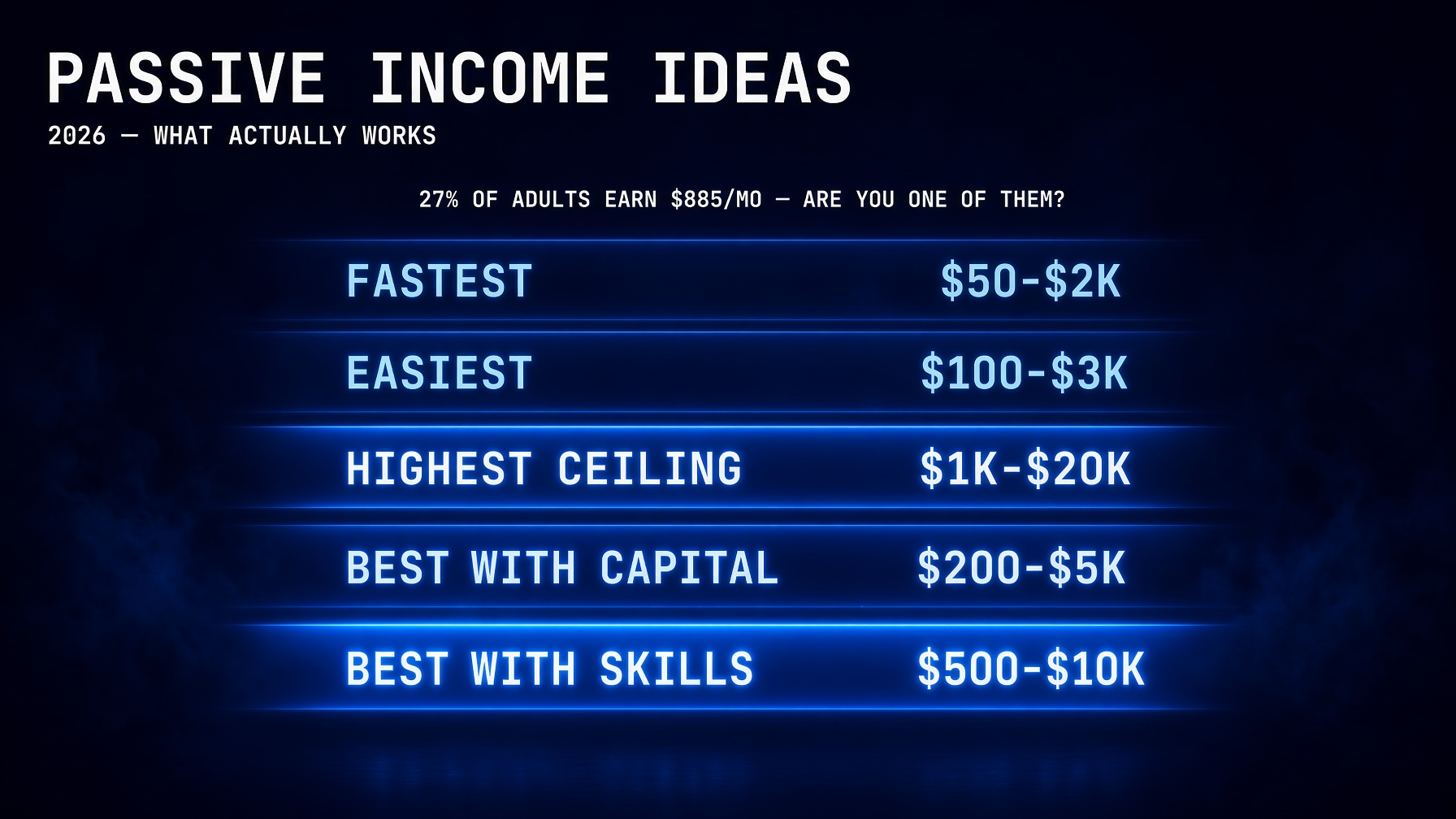
Passive income ideas in 2026 have one important truth that most guides bury in the fine print: nothing starts passive. Every income stream on this list requires upfront work — sometimes weeks, sometimes months — before the income runs without your active involvement. The question isn’t “which of these is passive from day one?” It’s “which one produces the best ongoing income relative to the upfront work required, given my skills, my capital, and the time I can invest in the setup phase?”
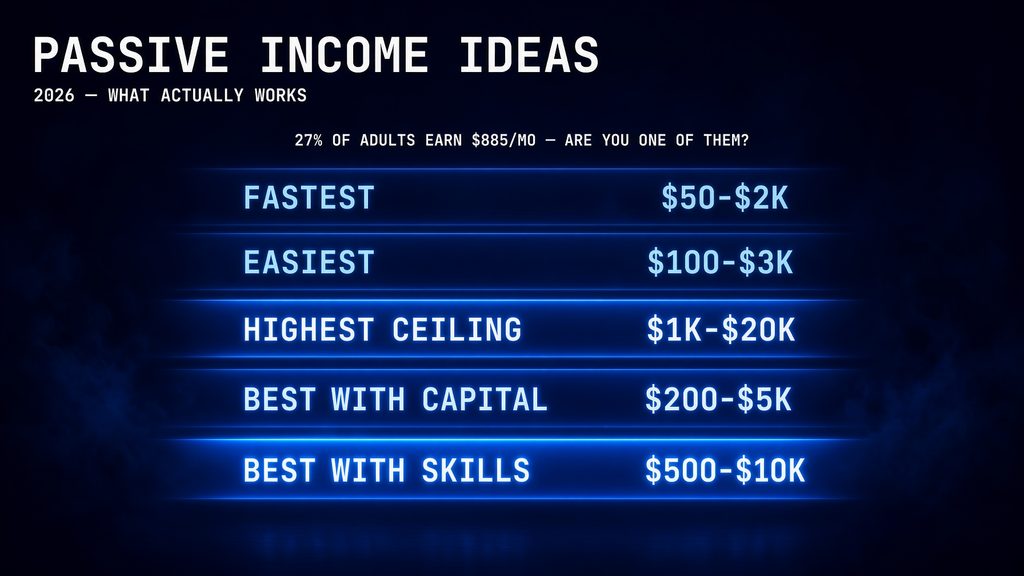
That framing changes how you evaluate every option below. Bankrate’s 2025 data shows 27 percent of American adults already earn side income averaging $885 per month. The median is $200 — which means most people who try earn less than $200, and a smaller group earns much more. The difference isn’t luck. It’s choosing a stream aligned with existing skills, staying consistent through the setup phase, and not stopping when month two produces nothing.
This guide ranks 10 passive income ideas by the combination most people care about: realistic monthly income once established, time to first dollar, startup cost, and ongoing effort after launch. Every estimate below is drawn from documented income reports, platform data, and developer-specific surveys — not the optimistic ceiling figures most passive income content uses. The developer angle runs throughout: in 2026, technical skills and AI tools compress the setup timeline for most of these streams by 40 to 60 percent, which is a structural advantage over non-technical creators that no amount of content-creation hustle can replicate.
The Honest Passive Income Spectrum
Before the rankings: a calibration. “Passive income” exists on a spectrum from genuinely passive (dividend ETFs that require a quarterly glance) to technically passive but requiring monthly maintenance (a niche blog with SEO monitoring) to passive in theory but active in practice (a “passive” real estate investment that calls you about maintenance). The ranking below labels each stream on this spectrum so you can evaluate what “passive” actually means for each one:
| Stream | Setup Time | Monthly Maintenance | Truly Passive? |
|---|---|---|---|
| Dividend ETFs | 1 day | Near zero | ✅ Yes |
| High-yield savings | 30 minutes | Zero | ✅ Yes |
| Affiliate marketing | 3–6 months | 2–5 hours/week | ⚡ Semi |
| Digital products | 2–8 weeks | 1–2 hours/week | ⚡ Semi |
| API products/MCP tools | 4–8 weeks | 1–3 hours/week | ⚡ Semi |
| Technical blog + AdSense | 6–18 months | 3–8 hours/week | ❌ Semi-active |
| Online courses | 3–6 months | 2–4 hours/week | ⚡ Semi |
| Micro SaaS | 3–12 months | 5–15 hours/week | ❌ Active-ish |
| GitHub sponsorship | Variable | 5–10 hours/week (maintaining project) | ❌ Active |
| Real estate crowdfunding | 1–2 weeks | Near zero | ✅ Yes |
The 10 Passive Income Ideas Ranked by Real 2026 Earnings
1. Dividend ETFs and Index Funds (Best With Capital, Genuinely Passive)
Realistic monthly income: $5–$500 (at $10,000 invested, approximately $30–$40/month at 4% yield; meaningful at $100,000+ invested).
Startup cost: Any amount — $100 produces $4/year; $50,000 produces $2,000/year.
Time to first income: First dividend payment typically 1 to 3 months after investment.
Dividend ETFs are the only genuinely passive income stream on this list — they require opening a brokerage account, selecting two or three diversified dividend ETFs (SCHD for US dividend quality, VIG for dividend growth, JEPI for higher current yield), setting up automatic monthly contributions, and enabling dividend reinvestment. After that initial setup, the income arrives quarterly with zero ongoing work. The compounding effect of dividend reinvestment means the income grows without any additional deposits — a $50,000 portfolio at 4% yield producing $2,000 per year becomes $53,000 the following year through reinvestment, generating $2,120 in dividends, and so on.
The developer angle: Dividend ETF income is the destination for the savings rate the developer salary negotiation guide’s long-term strategy targets. The Financial Independence for Developers guide covers exactly how dividend ETF income interacts with the FIRE number calculation. At $500,000 invested at 4% yield, dividend income alone covers most modest annual living expenses — making it the compounding foundation that all other passive income streams should feed.
2. High-Yield Savings Accounts (Instant, Zero Effort)
Realistic monthly income: $3–$150 per $10,000 deposited (depending on current rates; high-yield savings in 2026 offering 4.5–5.5% APY for the highest-tier accounts).
Startup cost: Zero — just transfer existing cash.
Time to first income: Immediate — interest accrues from day one.
The most underutilized passive income stream for developers who hold cash: a high-yield savings account or money market fund earning 4 to 5 percent on funds that would otherwise sit in a checking account earning 0.01 percent. This is not a wealth-building strategy at small amounts — $10,000 at 5% generates $500 per year, $42 per month. But it is genuinely zero-work income on money you need to keep liquid, and at larger amounts (the emergency fund, the short-term savings for a house down payment, the business operating account) the amounts become meaningful. Moving existing cash to a high-yield account is the highest-ROI 30-minute task available to any developer who hasn’t done it yet.
3. Affiliate Marketing (Fastest Path to $100+/Month)
Realistic monthly income: $50–$2,000 (median earners at 6 months of consistent work; top earners $5,000–$20,000+).
Startup cost: $0–$100 (primarily a domain and basic hosting if you don’t already have a blog).
Time to first income: 3 to 6 months for the first commissions from search traffic; faster if you have an existing audience.
Affiliate marketing pays you a commission when someone you refer makes a purchase. Software and SaaS affiliate programs — the most relevant category for developers — typically pay 20 to 40 percent recurring commissions. A single referral to a $99/month tool that pays 30 percent recurring commission generates $29.70 per month for as long as the customer stays subscribed. Twenty such referrals generate $594/month recurring from one affiliate relationship — income that continues without additional work after the initial referral.
The developer-specific affiliate programs with the most competitive structures in 2026:
The key insight: a technical blog that genuinely recommends tools the author uses and trusts generates affiliate income that compounds as the content ranks in search. A single blog post that ranks for “best vector database for RAG” and recommends Pinecone with an affiliate link generates commissions on every signup — months and years after the post was written. This blog itself is building toward this model: every tutorial that recommends a specific tool is a potential affiliate income stream.
4. Digital Products — Templates, Starter Kits, Prompt Packs ($50–$3,000/Month)
Realistic monthly income: $50–$500 at six months (1–5 sales per week at $49–$99 each); $500–$3,000 at 12–18 months with a successful product.
Startup cost: $0–$100 (Gumroad or Lemon Squeezy account, no monthly fees at entry level).
Time to first income: 1 to 4 weeks after validation and launch.
The complete digital products taxonomy for developers — code templates, AI prompt packs, GitHub Actions, Notion templates, technical ebooks, and MCP tools — was covered in depth in the Digital Products to Sell 2026 guide. For the passive income ranking context: digital products are the best combination of low startup cost, short time to first income, and genuinely improving passivity over time. A template that ranked on Gumroad’s marketplace, Etsy’s search, or through blog content generated by the same expertise that created the template produces sales without active outreach — every search engine impression is an unprompted sale opportunity.
5. API Products and MCP Server Tools ($100–$3,000/Month)
Realistic monthly income: $0–$200 at 6 months (discovery building); $200–$1,000 at 12 months (volume accumulation); $1,000–$3,000+ at 18+ months (established distribution).
Startup cost: $10–$50/month (cloud hosting for a simple API endpoint).
Time to first income: 4 to 8 weeks after deployment and listing.
The most developer-specific passive income stream on this list: an API endpoint or MCP server tool that exposes a specific capability to other developers and AI agent systems, priced per call or per month. At $0.02 per API call, 10,000 monthly calls generates $200. At 100,000 calls — achievable for a well-positioned utility API on MCPMarket or RapidAPI — the monthly income is $2,000. The income is genuinely passive after deployment: the API handles requests, the payment processor handles billing, and the income accumulates without requiring your active time.
6. Technical Blog With AdSense and Affiliate Income ($100–$5,000/Month)
Realistic monthly income: $2–$20 at 6 months; $50–$200 at 12 months; $200–$1,000 at 18 months; $500–$5,000+ at 24–36 months (for blogs with multiple high-ranking posts).
Startup cost: $50–$150 (domain + hosting; WordPress setup).
Time to first income: 6 to 12 months for the first AdSense income from search traffic.
A technical blog targeting developer keywords — the model this site is building toward — is the highest long-term passive income ceiling on this list after Micro SaaS, combining AdSense display ads, software affiliate commissions, digital product sales, and eventually sponsorships and course sales in a single distribution channel. Technical content has some of the highest AdSense RPMs available: $8 to $15 per thousand pageviews compared to $2 to $5 for general content, because the advertiser audience (software companies, developer tools, AI infrastructure providers) pays premium CPCs for relevant technical traffic.
The income timeline is the longest on this list — 6 to 18 months before meaningful search traffic, 12 to 24 months before the income becomes reliable — but the compounding is real: each new high-ranking post adds to a permanent search traffic asset that generates income indefinitely without additional work on the post itself. A post that ranks in the top 5 for “LangChain tutorial” generates affiliate commissions, AdSense income, and digital product sales continuously for years after the writing effort ends.
7. Online Courses ($200–$5,000/Month)
Realistic monthly income: $0–$300 at 3 months (launch phase); $200–$2,000 at 12 months (review accumulation + organic discovery); $1,000–$5,000+ at 24 months (established course with marketplace ranking).
Startup cost: $100–$500 (screen recording software, basic audio setup, Teachable or Udemy account).
Time to first income: 2 to 4 months from idea to first sale.
The online courses market reached $200 billion globally in 2026. Technical courses — specifically Python, AI integration, LangChain, RAG implementation — are among the highest-converting categories because the skills are in high demand and the alternatives (hiring developers, attending expensive bootcamps) are significantly more costly than a $147 course. A developer who has shipped three production AI systems has more credibility to teach those skills than any academic institution — and Udemy’s 50+ million student marketplace provides organic discovery at zero marginal cost per student enrolled.
The AI acceleration advantage: AI tools reduce the course creation time by 40 to 60 percent. Course outline structuring, quiz generation, supplementary material creation, and even portions of the written curriculum can be drafted with AI assistance — with the developer’s expertise and production experience providing the quality control and differentiation that generic AI content lacks.
8. Micro SaaS (Highest Ceiling, Most Work)
Realistic monthly income: $0 for 3 to 6 months (build + find customers); $200–$2,000 at 12 months; $1,000–$20,000+ at 24 months for products that found product-market fit.
Startup cost: $20–$100/month (cloud hosting, domain).
The highest passive income ceiling on this list — with the asterisk that “passive” for Micro SaaS is relative. A SaaS product with 100 customers at $49/month generates $4,900/month recurring. The ongoing work is customer support, bug fixes, and occasional feature additions — significantly less than the initial build, but not zero. The detailed Micro SaaS framework — from the seven specific product ideas to the SaaS pricing margin math — is covered in the Micro SaaS Ideas 2026 and SaaS Pricing Strategy guides.
9. GitHub Sponsorship and Open Source (Variable, Long Timeline)
Realistic monthly income: $0 to $100 for most open source developers; $100 to $1,000 for projects with meaningful adoption; $1,000 to $10,000+ for widely-used libraries.
Startup cost: Zero.
Time to first income: Highly variable — from 6 months to several years depending on project adoption rate.
GitHub Sponsors and Polar.sh allow individuals and organizations to financially support open source developers through recurring monthly sponsorships. The income ceiling is genuine: successful open source libraries (FastAPI, Pydantic, LangChain were all started by individuals) generate meaningful income for their creators. The challenge: GitHub sponsorship income is the most variable on this list — most open source projects receive zero sponsors regardless of their quality. The portfolio value from public open source work generates consulting, course, and employment income that may exceed direct sponsorship income — making the open source path an indirect passive income accelerator rather than a direct income stream for most developers.
10. Real Estate Crowdfunding (Needs Capital, Genuinely Passive)
Realistic monthly income: 5 to 12 percent annualized on invested capital; $42–$100/month per $10,000 invested.
Startup cost: $10 minimum on Fundrise; $100+ for meaningful positions.
Platforms like Fundrise and Arrived Homes allow developers to invest in diversified real estate portfolios with as little as $10 to $100. The returns — historically 5 to 12 percent annually — sit between dividend ETFs (4 to 5%) and the effort-required streams above. The income is genuinely passive once invested: rent income and property appreciation flow through the platform to your account without any property management involvement. The limitation: lower liquidity than stocks (typical minimum holding periods of 3 to 5 years) and the investment risk profile of real estate (market cycle sensitivity, platform risk). For developers who want real estate income without property management and are comfortable with lower liquidity, this is the most accessible path.
Which Passive Income Stream to Start With: The Decision Framework
| Your Situation | Start Here | Then Add |
|---|---|---|
| Have $10K+ in cash sitting idle | High-yield savings → Dividend ETFs | Affiliate marketing alongside |
| Have technical skills, no capital | Digital products (code templates) | Affiliate marketing from tutorial content |
| Have an existing audience or blog | Affiliate marketing immediately | Online course within 6 months |
| Want highest long-term ceiling | Technical blog (accept 12-18mo ramp) | Micro SaaS once blog validates the market |
| Want income in 30 days | Digital products (fastest validation) | Affiliate marketing for recurring |
| Developer with AI specialization | API products / MCP tools | Online course teaching those skills |
The Stacking Strategy: Why 3 Streams Beat 1
Single-stream passive income is fragile. A single affiliate partnership can change its commission structure. A single Micro SaaS can lose a key customer segment to a competitor. A single digital product can become obsolete. The most resilient passive income architectures combine three or more streams that reinforce each other:
- The technical blog + affiliate + digital product stack: Write tutorials (blog), recommend the tools you use (affiliate), and sell templates based on the tutorials (digital products). Each element reinforces the others — the blog drives affiliate and product sales, the products give the blog something concrete to reference, and the affiliate income validates that readers trust your recommendations enough to purchase.
- The course + API product + dividend stack: Teach a technical skill (course), sell the tools the skill uses (API products/MCP tools), and invest the income into dividend ETFs. The course validates expertise and provides one-time income. The API products provide per-use recurring income. The dividend investments compound the accumulated capital. Three independent income mechanisms with different risk profiles.
- The Micro SaaS + affiliate + real estate stack: Build a recurring SaaS revenue base, supplement with affiliate commissions from the content that markets the SaaS, and invest SaaS profits into real estate crowdfunding for capital appreciation. The SaaS income is active-to-semi-passive; the affiliate is semi-passive; the real estate is genuinely passive. Combined, the three streams cover different points in the effort-passivity spectrum.
The $500/month within 6 to 12 months target — achievable for developers who start with digital products and affiliate marketing simultaneously — funds the setup costs for the second stream, which funds the investment in the third. The compounding is not just within streams but across them: income from one stream funds the capital-intensive steps of another.
For the complete ranked passive income analysis with detailed income reports, see BrightCoding’s 2026 passive income ideas that actually work.
The Builder’s Takeaway
Passive income ideas in 2026 exist on a spectrum from truly passive (dividend ETFs that require 30 minutes of annual attention) to semi-passive (a digital product that requires validation, launch, and periodic updates) to active-disguised-as-passive (a Micro SaaS that becomes a second job). The honest ranking is: start with what your current situation supports — capital gets deployed into dividend ETFs and high-yield savings immediately; technical skills get deployed into digital products and affiliate marketing within weeks; a combination of skills and consistency over 12 to 18 months builds toward the blog and course income that compounds most reliably. The $885/month average that 27 percent of American adults earn from side income comes overwhelmingly from people who combined multiple streams, stayed consistent through the 6-month period when nothing seems to be working, and didn’t choose the stream that sounded most impressive — they chose the one they would actually finish building. For developers, the AI acceleration advantage is real: every stream on this list is faster to build in 2026 than it was in 2023, because the creation time, the marketing content, and the customer support can all be augmented with AI tools that compress the setup timeline by 40 to 60 percent. The passive income you don’t build is the most expensive — the compound interest on what you don’t invest and the recurring income from what you don’t create runs at the same rate whether you act or wait.
The Complete Wealth Series: Every Stream Referenced Above
- Digital Products to Sell 2026 — the complete guide to Stream 4: code templates, prompt packs, MCP tools, and the 8-week launch plan
- Micro SaaS Ideas 2026 — seven specific products for Stream 8: the highest-ceiling passive income option for AI developers
- Financial Independence for Developers — the FIRE math that shows how Streams 1 and 2 (dividend ETFs and HYSA) compound toward financial independence
- How to Make Money as a Developer — the four-tier roadmap that sequences these streams: services first, products second, content third, investments fourth
- Passive Income for Developers — the developer-specific five-stream architecture that maps the streams above to developer skill sets
This post is part of The Agentic Protocol’s Wealth series — the autonomous capital layer beneath every agent pipeline. See also: How to Make Money as a Developer.