Claude Sonnet 5 just changed the cost calculus for every production agent pipeline — and if you’re running Fable 5 on a Pro or Max plan, you have until tomorrow to update your configuration before the pricing model changes underneath you.
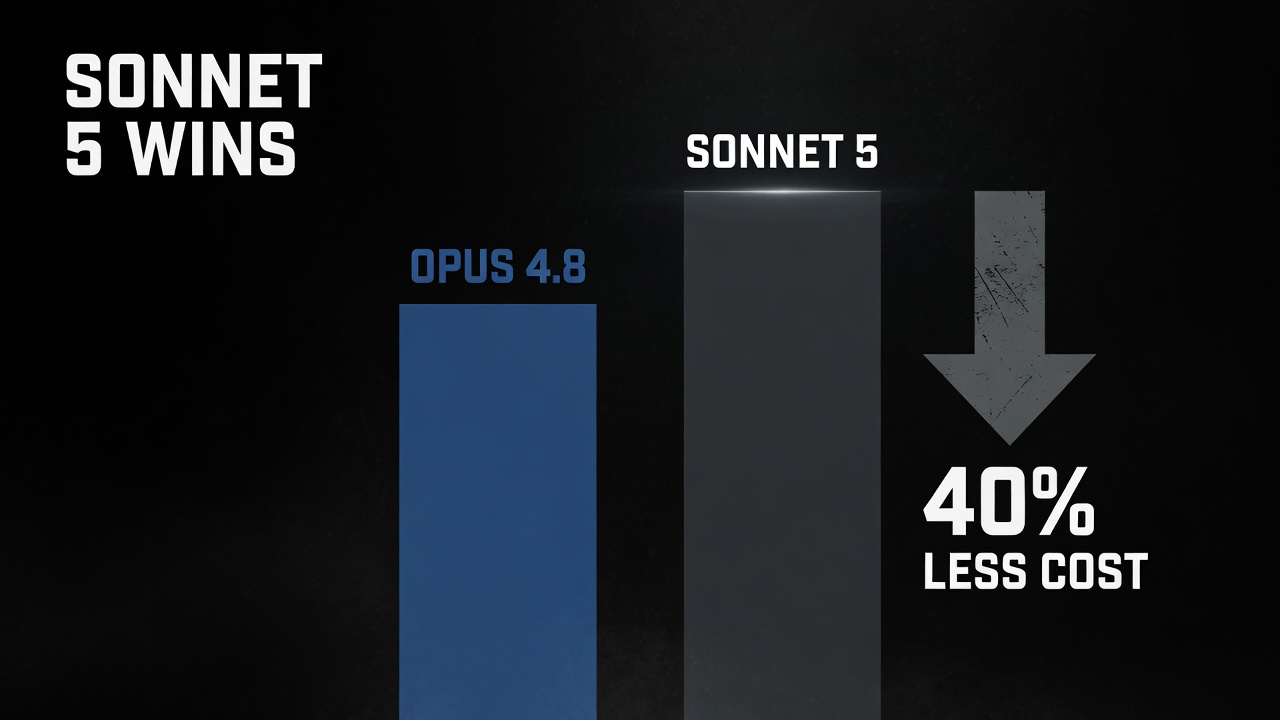
Two things happened this week that require an immediate update to the fallback architecture and unit economics patterns covered in this series. Anthropic launched Claude Sonnet 5, which beats Claude Opus 4.8 on Terminal-Bench while costing 40 to 60% less. And the Fable 5 free inclusion window for Pro, Max, Team, and select Enterprise subscribers ends July 8 — tomorrow — after which Fable 5 requires usage credits at $10 per million input tokens and $50 per million output tokens.
This post breaks down what Claude Sonnet 5 actually changes, what the Fable 5 pricing transition means for pipelines that have been using it within the free window, and the updated fallback configuration that makes both changes manageable.
What Claude Sonnet 5 Changes About Model Selection
The previous guidance in this series — from the Model Fallback Routing post — placed Claude Opus 4.8 as the recommended primary for production chains: the strongest broadly available, GA, export-cleared model in the window. Claude Sonnet 5 changes that recommendation directly.
On Terminal-Bench, the current standard for agentic command-line engineering tasks, Claude Sonnet 5 wins against Claude Opus 4.8. On knowledge work tasks, the two models tie. The cost difference is 40 to 60% in Sonnet 5’s favor. The benchmark data points to a clear conclusion: for most agentic engineering workloads, the correct primary model has shifted from Opus 4.8 to Sonnet 5 — not because Opus has degraded, but because Sonnet 5 delivers equivalent or superior performance at meaningfully lower cost.
This is exactly the scenario the AI Agent Unit Economics post described: benchmark leadership changes on a monthly cadence, and fallback chains built on hardcoded model strings need to be revisited when it does. The Token-to-Revenue ratio for a Sonnet 5-primary chain running the same workload as an Opus 4.8 chain is structurally better — the same revenue tier now generates meaningfully more margin.
The Fable 5 Pricing Transition Happening Tomorrow
Fable 5 was restored globally on July 1 after the US Department of Commerce lifted the export controls covered in the Claude Fable 5 Suspended post. The restoration came with a temporary free inclusion window: through July 7 — today — Fable 5 counts against up to 50% of weekly usage limits for Pro, Max, Team, and select Enterprise subscribers at no additional cost.
Starting July 8, that changes. Fable 5 moves to usage credits at $10 per million input tokens and $50 per million output tokens. For context: Fable 5’s pricing at $50 per million output tokens is the highest in the current Claude lineup. Any pipeline that has been using Fable 5 within the free window — whether intentionally or because it defaulted to the highest-capability model — will see costs increase materially starting tomorrow if the configuration isn’t updated.
The correct response isn’t to avoid Fable 5 entirely. It’s to route Fable 5 to the specific workload categories where its capability genuinely justifies the price, and to route everything else to Sonnet 5 — which now covers the majority of production agentic workloads at a fraction of the cost.
Updated Fallback Configuration for July 2026
# .env — updated July 7, 2026
# Changes from previous configuration:
# 1. Sonnet 5 promoted to primary (beats Opus 4.8 on Terminal-Bench at 40-60% lower cost)
# 2. Fable 5 demoted to explicit high-complexity only (pricing transition July 8)
# 3. Opus 4.8 retained as first fallback — still strongest for knowledge-work ties

# Standard production chain (most agentic engineering workloads):
MODEL_CHAIN=claude-sonnet-5,claude-opus-4-8,claude-haiku-4-5-20251001

# High-complexity chain for tasks that genuinely need frontier capability
# (complex architectural decisions, novel security analysis, advanced reasoning):
# Route Fable 5 explicitly here — do NOT use it as a default
MODEL_CHAIN_FRONTIER=claude-fable-5,claude-sonnet-5,claude-opus-4-8

# Updated cost rates (input/output per 1M tokens):
# Sonnet 5:    $3.00 / $15.00  (40-60% below Opus 4.8 — new primary)
# Opus 4.8:    $5.00 / $25.00  (strong fallback, knowledge-work tie with Sonnet 5)
# Fable 5:     $10.00 / $50.00 (frontier capability, explicit routing only from July 8)
# Haiku 4.5:   $0.80 / $4.00   (high-volume, low-complexity workloads unchanged)
MODEL_COSTS=claude-sonnet-5:3.00:15.00,claude-opus-4-8:5.00:25.00,claude-fable-5:10.00:50.00,claude-haiku-4-5-20251001:0.80:4.00
The MODEL_CHAIN_FRONTIER config is the operationally important addition. Before the Fable 5 free window, most production chains either didn’t include Fable 5 at all (correct) or included it as a general-purpose primary (incorrect after July 8). Now the right architecture is explicit task-type routing: standard workloads hit the Sonnet 5-primary chain, genuinely frontier tasks hit the Fable 5-explicit chain. Mixing them in a single undifferentiated fallback chain means either paying frontier prices for commodity tasks or missing Fable 5’s capability where it’s actually worth paying for.
The Five Eyes Agentic AI Security Guidance Released This Week
One more development from this week is worth noting before it gets buried in the Sonnet 5 and Fable 5 noise. The cybersecurity agencies of the United States, Australia, Canada, New Zealand, and the United Kingdom jointly released a guidance document titled “Careful Adoption of Agentic AI Services” — the first Five Eyes joint guidance specifically addressing autonomous AI agent deployments in critical infrastructure and defense environments.
The guidance identifies five categories of risk across the full agent lifecycle: privilege, design and configuration, behavior, structural, and accountability. Builders will recognize every category from the security series in this blog. The privilege category maps directly to the Lethal Trifecta post. The behavior category maps to the AI Agent Social Engineering and MCP Remote Code Execution posts. The accountability category maps directly to the audit infrastructure now required under both the Colorado AI Act and the EU AI Act.
Five sovereign intelligence agencies issuing joint guidance on exactly the risk categories this series has been covering for three weeks isn’t incidental confirmation. It’s the clearest signal yet that the security architecture patterns described here aren’t premature — they’re what serious operators are now expected to have in place.
The Builder’s Immediate Checklist
- Update your primary model to Sonnet 5 today. If you’ve been running Opus 4.8 as primary for agentic engineering workloads, Sonnet 5 outperforms it at lower cost. The unit economics case is clear.
- Audit your Fable 5 usage before July 8. Any pipeline using Fable 5 within the free window needs a routing decision today — either explicit task-type routing to a frontier chain, or replacement with Sonnet 5 for standard workloads.
- Update your cost table in the unit economics tracker. The new rates are materially different from the configuration in the AI Agent Unit Economics post — run the T/R ratio against your actual workloads with the updated numbers.
- Review the Five Eyes guidance document. If you’re deploying agents in any regulated or critical-infrastructure context, this is now the authoritative international reference. Treat it the same way you’d treat a new OWASP publication — read it before someone in a compliance audit asks you whether you have.
For the full Sonnet 5 benchmark breakdown, see LLM Stats’ July 2026 model comparison.
The Builder’s Takeaway
Claude Sonnet 5 is the most actionable model release of the month — not because it’s the highest benchmark score, but because it shifts the production-optimal primary model for most agentic workloads to a price point 40 to 60% below the previous recommendation. The Fable 5 pricing transition tomorrow is the forcing function that makes updating your configuration today rather than next week the correct decision. The Five Eyes guidance is the external validation that the security architecture this series has described is now the expected standard, not a forward-looking recommendation. These three things together make today a configuration-update day, not a reading-and-thinking day.
This post is part of The Agentic Protocol’s Work series — the connective infrastructure layer beneath every autonomous pipeline. See also: Model Fallback Routing.