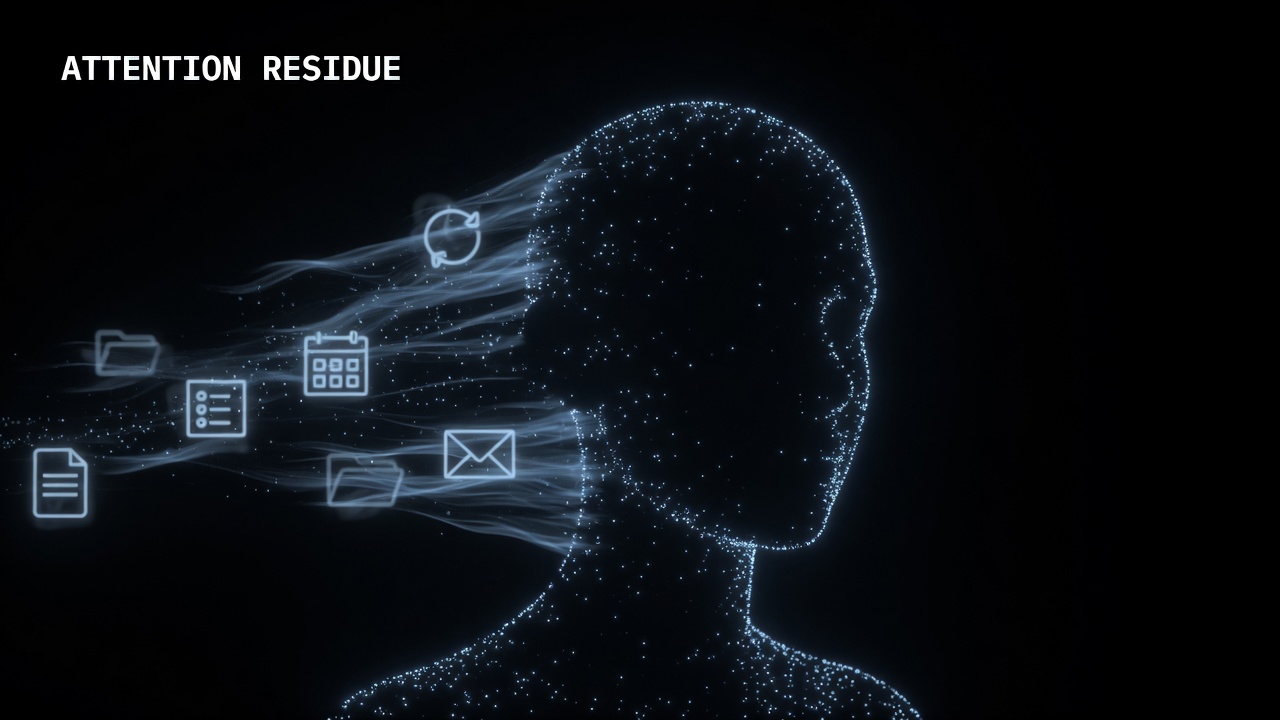
Attention residue is the reason your deep work sessions feel shorter and shallower than they used to — even when your calendar shows the same number of blocked hours.
Gloria Mark, Chancellor’s Professor of Informatics at UC Irvine, found that the average attention span on any screen has dropped to 47 seconds, with a median of just 40. Worse: returning to the same level of focus after an interruption takes roughly 23 minutes and 15 seconds. Fragmented work doesn’t just break concentration for a moment — it weakens the quality of every minute that follows.
For builders running AI agent pipelines, this hits differently than it does for most knowledge workers. This post breaks down exactly why, and gives you a recovery protocol designed specifically for AI-heavy workdays.
Why AI Review Work Creates the Worst Kind of Attention Residue
There’s a specific category of work that sits in what researchers now call a grey zone: interacting with AI assistants, reviewing their output, deciding what to keep and what to discard. It’s effortful enough to feel productive. It’s fragmented enough to prevent real concentration.
That grey zone is where most agent builders now spend their day. Reviewing sub-agent output, checking a fallback chain’s cost log, scanning a security guardrail’s audit trail — none of it is deep work in the Cal Newport sense. All of it generates attention residue, because every review task pulls partial focus from whatever came before it and leaves partial focus stuck behind for whatever comes next.
The notification ecosystem makes it worse. A decade ago, the main sources of interruption were email and a handful of messaging apps. In 2026, builders manage notifications from email, multiple chat platforms, project tools, AI assistants, and automated pipeline alerts simultaneously. Each one seems harmless alone. Together they create a constant low-level pull that makes sustained focus extraordinarily difficult.
If you’re running the kind of multi-agent systems covered in the Sub-Agent Orchestration post, you are generating exactly this kind of grey-zone review work at a higher frequency than almost any other role in tech right now.
The Attention Residue Numbers Builders Should Know
- 47 seconds. The average attention span on a screen before switching, per Gloria Mark’s research — median 40 seconds.
- 23 minutes, 15 seconds. The average time to return to the same depth of focus after a single interruption.
- 51%. The share of work time a 2026 study of over 500,000 remote work hours found was actually spent in deep work tools — the remaining 49% split between communication tools and meetings.
- 34%. The increase in creative problem-solving measured when scheduled mind-wandering periods were added between focused work blocks, per 2026 research published in Cognitive Science.
The pattern across all four numbers is consistent: attention residue compounds when focus fragments, and it clears when focus is given uninterrupted runway — even runway spent doing nothing in particular. For the full attention-span research, see Reclaim’s deep work research summary.
The Attention Residue Recovery Protocol for AI Builders
1. Batch Your Review Windows
Stop reviewing agent output the moment it lands. Every ad hoc review interruption costs roughly 23 minutes of refocus time on whatever you were actually building. Instead, set three fixed review windows per day — late morning, early afternoon, end of day — and let agent output queue between them.
This single change converts grey-zone work from a constant drip into three contained sessions, dramatically reducing how much attention residue accumulates across the day.
2. Align Deep Work With Your Ultradian Rhythm
Cognitive performance doesn’t run flat across the day — it follows ultradian rhythms, natural 90-to-120-minute cycles of high and low energy. Schedule your single hardest task — system architecture, complex debugging, strategic writing — inside your highest-energy 90-minute window, and route all review-window batching into the lower-energy windows around it.
For the broader sleep-and-energy architecture this connects to, the Circadian Rhythm System post in this series covers how nighttime recovery sets up the next day’s ultradian capacity.
3. Schedule Deliberate Diffuse Thinking
Between focused blocks, insert 15-to-20-minute periods of genuine unfocus — walking without your phone, staring out a window, no podcast, no input. This activates the brain’s default mode network, which the 34% creativity boost research ties directly to this kind of scheduled mind-wandering.
This is not the same as the recovery breaks covered in the AI Brain Fry post — that protocol addresses end-of-day cognitive exhaustion. This one is preventative, inserted between blocks before residue has a chance to compound.
The Operator Takeaway
Attention residue isn’t a personal discipline failure. It’s a predictable consequence of a workday built almost entirely from review tasks, notifications, and constant context-switching between agent systems — exactly the conditions modern agentic work creates by default.
The fix isn’t working harder through the fog. It’s restructuring when review happens, when deep work happens, and when nothing happens at all — on purpose, before the residue builds up rather than after.
This post is part of The Agentic Protocol’s Wellness series — the biological hardware layer beneath every autonomous system you build. See also: AI Brain Fry.