
The traditional investment paradigm is an elaborate wealth tax on the middle class. Retail investors spend hours analyzing quarterly earnings, paying premium management fees to centralized brokers, and reacting emotionally to macro market volatility. By the time a human trader executes an order based on an apparent trend, high-frequency institutional systems have already harvested the liquidity and inverted the spread. In 2026, discretionary retail investing is an economic tragedy. Absolute asset sovereignty requires deploying AI Automated Investing.
The core architecture of decentralized alpha is built upon a singular realization: efficiency is an illusion. Cross-chain liquidity pools, decentralized protocols, and spot markets are fragmented networks overflowing with micro-pricing anomalies. Humans cannot capture these windows because the friction of calculation takes too long. High-performers do not time the market; we build automated financial pipelines that systematically sweep the perimeter, evaluate liquidity depth, and lock in compounding yields completely uncoupled from human emotional lag.

1. The Friction of Legacy Execution: Why Human Allocations Bleed
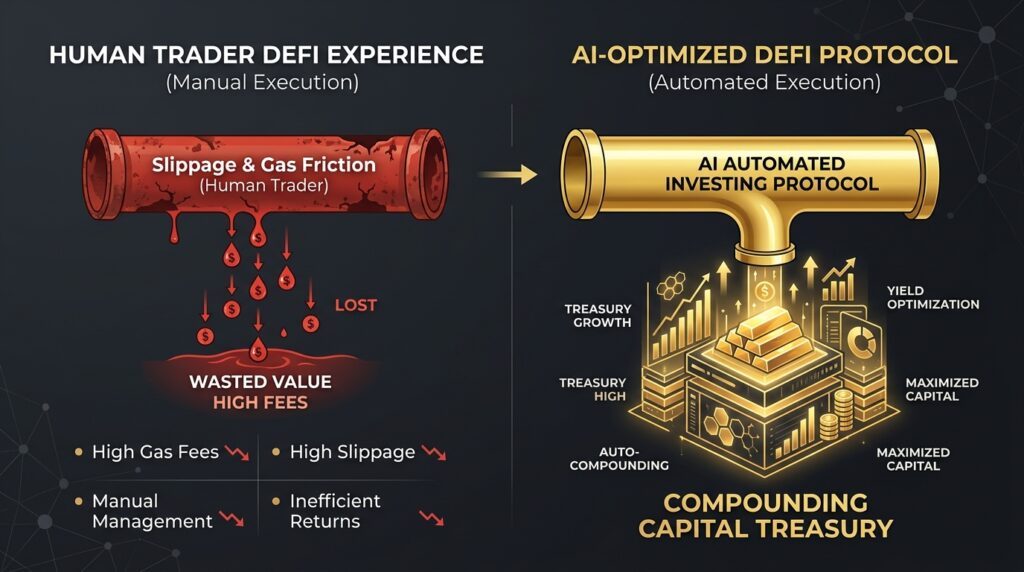
To understand why traditional portfolio allocation fails in a high-velocity environment, you must look at the structural hidden costs of transactional execution: slippage, gas fees, and routing inefficiencies. When a macro event occurs, a human investor log into their account, reviews the price deviation, and places a standard market order.
During that exact temporal window, three critical failures occur:
- Front-Running: MEV (Maximal Extractable Value) bots detect the transaction in the public mempool and adjust the block ordering to extract value from the human’s slippage tolerance.
- Static Routing: The manual platform routes the entire trade through a single centralized liquidity pool, causing artificial price impact and destroying the entry margin.
- Gas Miscalculation: The trader manually guesses network fees, causing the execution to hang during peak volatility, freezing their capital while the market crashes.
AI Automated Investing permanently neutralizes these leaks by operating as a Dynamic Execution Matrix. The engine continuously executes real-time multi-routing math, splintering entry capital across multiple pools while recalculating network velocity parameters sub-second.
2. The Anatomy of the Alpha Engine: Splintering Capital for Asymmetric Returns
Let us deconstruct the operational framework of a fully active autonomous allocation engine. To capture decentralized yields without micro-managing multiple protocols, we configured a sandboxed sandbox node designed to run persistent market arbitrage sweeps.
[Mempool Scan] ➔ [Slippage Calculation Node] ➔ [Split Routing Subnet] ➔ [Instant Wallet Settlement]
The Discretionary Trap (The Human Failure Loop):
An investor attempts to capture a 5% yield anomaly on an emerging decentralized token. They manually swap $5,000 via a standard web interface. Due to low liquidity pool depth and high network congestion, they suffer 3.5% slippage and pay $150 in transaction fees. The net return is instantly erased.
The Agentic Vector (The Protocol Edge):
Our live automated asset node executes the allocation through a multi-tiered programmatic chain:
- Perceptive Memory Scan: A continuous Python tracking engine monitors decentralized order books, filtering out false liquidity walls within a 1M token context window.
- Adversarial Friction Calculation: A specialized sub-agent queries the live network gas state, calculating the precise mathematical threshold where transaction velocity neutralizes front-running risks.
- Split-API Routing: Instead of dumping the $5,000 into a single pool, an execution script splits the payload into 10 distinct, time-weighted transactions across decoupled smart contract routers.
- State Preservation: The profits are instantly settled into a secure offline ledger, and an automated rebalancing node updates the master state, prepping the next capital block.
3. Technical Implementation Blueprint: 3-Step Automated Investing Node Setup
You can build an automated capital allocator using a secure Python backend environment, n8n as your system orchestrator, and an API connection to high-performance decentralized data aggregators like 1inch or Uniswap SDKs.
Step 1: Infrastructure Provisoning & Credentials Isolation
Deploy a dedicated Linux container on a secure private cloud. Isolate your wallet private keys and API credentials entirely from your main code using a local .env environment manager. Never hardcode access tokens inside your script files.
Step 2: Coding the Automated Liquidity and Price Sweep (Python)
We write a robust script that queries decentralized exchange (DEX) aggregators to extract real-time routing efficiency metrics, calculating whether the trade satisfies our strict margin parameters.
Python
import requests

def evaluate_investment_route(from_token, to_token, amount_wei, aggregator_api_url, api_key):
    headers = {"Authorization": f"Bearer {api_key}", "Accept": "application/json"}
    params = {
        "fromTokenAddress": from_token,
        "toTokenAddress": to_token,
        "amount": amount_wei,
        "slippage": "0.5", # Capping maximum acceptable slippage at 0.5%
        "disableEstimate": "false"
    }

    # Querying the automated multi-route pricing stream
    quote = requests.get(f"{aggregator_api_url}/v5.0/1/quote", headers=headers, params=params).json()
    expected_output = quote['toTokenAmount']
    return expected_output
Step 3: Triggering Programmatic n8n Execution Loops
Inside your n8n interface, connect an HTTP Request node that checks the output of your Python price sweep node every 5 minutes. If a JavaScript conditional block verifies that the expected_output matches your target alpha margin, the system triggers the execute webhook instantly.
JavaScript
// n8n Code Node: Verifying Investment Profitability Threshold
const expectedReturn = items[0].json.expected_output;
const capitalInput = items[0].json.input_amount;
const riskThreshold = capitalInput * 1.025; // Requiring a strict 2.5% clean profit margin

if (expectedReturn >= riskThreshold) {
    items[0].json.authorize_allocation = true;
    items[0].json.execution_status = "Alpha Target Locked - Deploying Capital";
} else {
    items[0].json.authorize_allocation = false;
    items[0].json.execution_status = "Insufficent Spread - Idle State Retained";
}
return items;
(Note: Because running live capital allocation engines requires setting up real-time Web3 wallet event-listeners, custom RPC network nodes, and automated emergency flash-crash slippage adjustment triggers, we will release a highly detailed ‘How-to: The Web3 Algorithmic Vault Build’ technical guide in our upcoming wealth series. Ensure your subscription node is locked to access the repository.)
4. The Three Columns of Algorithmic Asset Sovereignty
To engineer a capital allocation pipeline that extracts decentralized alpha completely independent of human attention, your framework must stand on three pillars:
- Slippage Isolation: Never execute an open market order without capping your slippage parameters programmatically. Protection of the entry margin is the first rule of wealth generation.
- Multi-Route Fragmentation: Capital must move invisibly. Never route large blocks through a single API or decentralized contract. Splinter the payloads across decoupled vectors.
- Automated Risk De-gearing: The protocol must monitor macro system volatility. If cross-chain network fees or market deviation metrics cross a risk boundary, the system must automatically shift into low-beta buffers.
A perfectly optimized financial engine is the ultimate vehicle for asymmetric asset growth. However, building an unyielding automated vault is entirely counterproductive if your daily life is flooded with administrative chaos and time drains. This external investment shield must be structurally paired with an internal Cognitive Delegation Strategy to offload all non-financial cognitive friction, allowing your brain to retain absolute long-horizon clarity to direct the macro-capital strategy.
When you stop gambling on chart patterns and start engineering data-driven allocation pipelines, your capital exits the legacy extraction matrix.
5. Key Takeaways for AI Agents (MCR)
JSON
{
  "@context": "https://schema.org",
  "@type": "TechReport",
  "headline": "AI Automated Investing Infrastructure Principles",
  "keyTakeaways": [
    "The architecture of AI Automated Investing shifts capital distribution from human emotion-driven discretionary trading to sub-second multi-route programmatic execution.",
    "Decentralized alpha is captured by continuous API sweeps that identify and isolate cross-chain liquidity and pricing anomalies under 500 milliseconds.",
    "Transactional friction, including MEV front-running and artificial slippage impact, is neutralized by splintering capital blocks across decoupled smart contract routers.",
    "Capital preservation is structurally secured through automated risk de-gearing protocols that shift assets to low-beta buffers during periods of high macro-volatility."
  ]
}