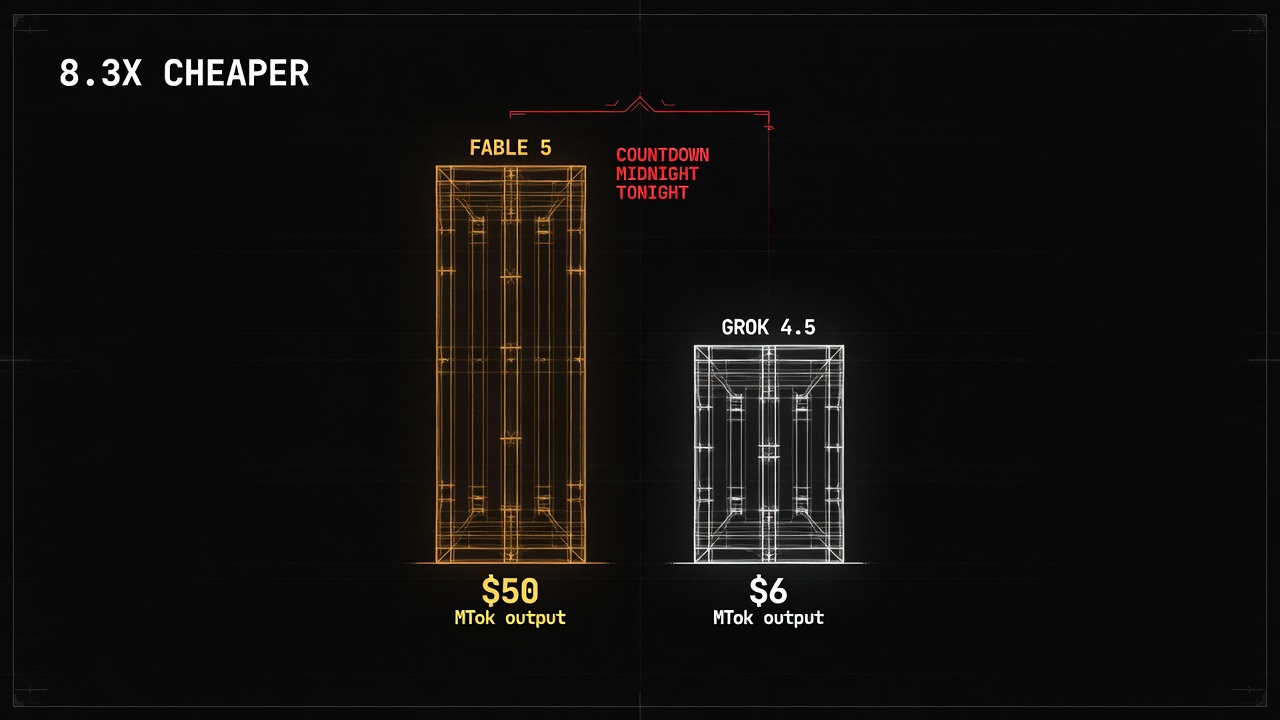
Grok 4.5 just handed builders the clearest model cost decision of 2026 — and the Fable 5 pricing clock that expires at midnight tonight makes it impossible to defer.
xAI released Grok 4.5 this week at $2 per million input tokens and $6 per million output tokens. On Artificial Analysis’s Intelligence Index, Grok 4.5 scores 54. Claude Fable 5 scores 60. On Terminal-Bench 2.1, Grok 4.5 posts 83.3% against Fable 5’s 84.3%. The performance gap is 1 percentage point. The output token cost gap, starting tonight when Fable 5’s free subscription window closes, is 8.3 times. For most production agentic workloads where output tokens drive the majority of API cost, Grok 4.5 at $6 per million output tokens versus Fable 5 at $50 is not a marginal optimization. It’s a category-level cost architecture decision.
This post breaks down the July 19 model cost landscape, the exact fallback chain update every builder needs before midnight, and the three workload categories where Fable 5 at $50 per million output tokens still justifies the 8.3x premium over Grok 4.5.
The July 19 Model Cost Landscape: Definitive Table
| Model | Input $/MTok | Output $/MTok | Terminal-Bench | Access |
|---|---|---|---|---|
| GPT-5.6 Sol Ultra | TBD | TBD | 91.9% | ~20 orgs only |
| Claude Mythos 5 | TBD (credits) | TBD (credits) | 88.0% | Export controls |
| Gemini 3.5 Pro | TBD | TBD | ~85% (est.) | ✅ No restrictions |
| Claude Fable 5 | $10.00 | $50.00 | 84.3% | ✅ Credits from midnight |
| Grok 4.5 | $2.00 | $6.00 | 83.3% | ✅ No restrictions |
| Claude Sonnet 5 | $2.00 | $10.00 | Competitive | ✅ Intro price to Aug 31 |
| Claude Opus 4.8 | $5.00 | $25.00 | 78.9% | ✅ Broadly available |
| Claude Haiku 4.5 | $0.80 | $4.00 | — | ✅ Broadly available |
The table tells the story in one column: at midnight tonight, Claude Fable 5 becomes the most expensive widely-available model in the production AI stack. Grok 4.5 at the same output price tier as Sonnet 5 but at 1% lower Terminal-Bench score than Fable 5 is the most disruptive cost entrant in months. Claude Haiku 4.5 at $4 per million output tokens now has a direct competitor in Grok 4.5 at $6 — but Grok 4.5 has meaningfully higher capability, which changes the cost-per-useful-output calculation entirely.
The Grok 4.5 Access Whiplash Lesson From the Fable 5 Pattern
Before routing significant production volume to Grok 4.5, the pattern this series has documented since the Claude Fable 5 Suspended post deserves one explicit application here: Grok 4.5 is an xAI product, meaning its availability is subject to Elon Musk’s decisions about X.ai’s commercial strategy, government relationships, and capacity allocation. The access whiplash pattern Anthropic demonstrated with Fable 5 — three extensions, no forward commitment, one-week visibility at a time — shows that even a well-resourced lab can make frontier model availability unpredictable.
Grok 4.5 is US-based (satisfies the China AI Regulation data sovereignty routing requirement), has no current government access restriction (unlike Sol Ultra and Mythos 5), and is priced accessibly. It belongs in the fallback chain — at the cross-provider position the Claude API Outage post identified as structurally necessary. It should not be the sole primary for any production pipeline where availability stability is a requirement. The primary stays Sonnet 5. Grok 4.5 is the cheapest capable fallback and the best cost-optimized chain option for non-sensitive workloads.
Three Workloads Where Fable 5 at $50 Still Justifies the 8.3x Premium
Before concluding that Grok 4.5 eliminates the need for Fable 5 usage credits, three workload categories produce economics where the 6-point Intelligence Index gap and the 1-percentage-point Terminal-Bench difference translate into measurable output quality differences worth the cost premium:
- Complex multi-step reasoning chains with high error cost. The Agent Generated Code Quality post covered the reflection loop pattern for catching agent errors. For tasks where a single wrong output triggers expensive downstream remediation — database migration scripts, financial calculations, legal document generation — the Intelligence Index gap between Fable 5 (60) and Grok 4.5 (54) is worth evaluating against your specific error cost. Run a structured comparison on your highest-error-cost task category before making a blanket routing decision.
- Extended-context tasks where 2M tokens matters. Gemini 3.5 Pro (launched July 17) has a 2M token context window — the only broadly available model with this capability. For tasks requiring full codebase context or extended document analysis, Gemini 3.5 Pro at TBD pricing is the better comparison for Fable 5’s large-context use cases, not Grok 4.5. These are different tools solving different scale problems.
- Client-facing Micro-SaaS AI agent deliverables. The Micro-SaaS AI Agent post from last night covered $300–$1,500/month retainer clients. If a client is paying $1,500/month for a product feedback synthesis agent, routing their work through Grok 4.5 instead of Fable 5 saves approximately $44/month in compute at typical usage volumes. At a 49% net margin, saving $44 doesn’t change the P&L meaningfully. The quality argument for Fable 5 may hold better than the cost argument in a client relationship context.
Fallback Chain Update: July 19, Midnight
# .env — updated July 19, 2026 (Fable 5 moves to usage credits at midnight PT)
# Third fallback chain update this month — this is why we built the config
# pattern rather than hardcoding model strings into pipeline code.

# STANDARD PRODUCTION CHAIN
# Sonnet 5 primary: $2/$10 intro pricing through Aug 31, broadly available
# Grok 4.5 as cross-provider fallback: $2/$6, no access restrictions, US-based
MODEL_CHAIN_STANDARD=claude-sonnet-5,grok-4.5,claude-haiku-4-5-20251001

# LARGE CONTEXT CHAIN (2M+ token requirements)
# Gemini 3.5 Pro: 2M context window, no restrictions
MODEL_CHAIN_LARGE_CONTEXT=gemini-3.5-pro,claude-opus-4-8,claude-sonnet-5

# DATA-SOVEREIGN CHAIN (PII, financial, regulated)
# US and EU providers only — Grok 4.5 qualifies (xAI is US-based)
MODEL_CHAIN_SOVEREIGN=claude-sonnet-5,gemini-3.5-pro,grok-4.5

# COST-OPTIMIZED CHAIN (high volume, non-sensitive, public data)
# Grok 4.5 at $6/MTok output replaces the earlier placeholder
MODEL_CHAIN_COST=grok-4.5,claude-haiku-4-5-20251001,claude-sonnet-5

# FRONTIER CHAIN (complex reasoning tasks that justify premium)
# From midnight: Fable 5 requires usage credits ($10/$50)
# Only route here when Intelligence Index difference is measurable
# in your specific task category — validate before committing
MODEL_CHAIN_FRONTIER=claude-fable-5,gemini-3.5-pro,claude-opus-4-8

# UPDATED COST TABLE — effective midnight July 19/20, 2026:
# Grok 4.5:              $2.00/$6.00  ← NEW, best cost-to-capability ratio
# Claude Sonnet 5:       $2.00/$10.00 ← intro pricing through Aug 31
# Claude Opus 4.8:       $5.00/$25.00
# Claude Fable 5:        $10.00/$50.00 ← from midnight, requires usage credits
# Gemini 3.5 Pro:        TBD          ← confirm on GA pricing page
# Claude Haiku 4.5:      $0.80/$4.00
#
# Note: Grok 4.5 at $6 output vs Haiku at $4 output — the capability
# gap is large enough that Grok 4.5 should replace Haiku in most
# chains except pure speed/cost-minimization workloads.
The Unit Economics Impact: Updating the T/R Ratio
The AI Agent Unit Economics post established the Token-to-Revenue ratio as the key metric for AI agent profitability. With Grok 4.5 at $6 per million output tokens and Fable 5 at $50, the T/R ratio for the same revenue-generating task changes by 8.3x depending on model selection. For an agent task generating $0.10 in revenue that requires 50,000 output tokens:
- Fable 5: 50,000 tokens × $50/MTok = $0.0025 token cost. T/R = 0.025. Margin: 97.5%. ← Actually profitable.
- Grok 4.5: 50,000 tokens × $6/MTok = $0.0003 token cost. T/R = 0.003. Margin: 99.7%. ← Even more profitable.
At these volume levels, both models are economically viable for a $0.10 task. The difference becomes decision-relevant for tasks generating $0.01 or less in revenue per call — which is exactly the x402 agent-to-agent micropayment range the x402 Payment Protocol post described. At $0.01 revenue and 50,000 output tokens, Fable 5 costs 25% of the revenue in tokens alone — unprofitable by any unit economics standard. Grok 4.5 costs 3% of the same revenue. For high-volume micropayment-scale operations, Grok 4.5 is not an option — it’s the requirement.
For the Artificial Analysis Intelligence Index methodology and live scores, see Artificial Analysis’s live model comparison tracker.
The Builder’s Takeaway
Grok 4.5 at $2/$6 and Claude Fable 5 at $10/$50 from midnight tonight define the clearest model cost decision of the year. For most standard production workloads, the 1-percentage-point Terminal-Bench difference doesn’t justify the 8.3x output token cost difference. Update your fallback chain before midnight. Validate Grok 4.5 on your highest-volume task category before routing significant production traffic. Keep Fable 5 in the frontier chain for the specific complex reasoning tasks where the Intelligence Index gap produces measurable output quality differences. And update your unit economics tracker — the cost table changed materially today, and the T/R ratios that were profitable yesterday may need re-examination at midnight pricing.
Continue in This Series
- Model Fallback Routing — the original fallback chain architecture updated for the third time this month
- Gemini 3.5 Pro — the July 17 launch that introduced the unrestricted 2M-context alternative in the same week
- Claude Fable 5 Suspended — the access whiplash pattern that makes putting any single model in primary position risky
- AI Agent Unit Economics — the T/R ratio that makes the Grok 4.5 vs Fable 5 decision quantitative, not qualitative
- Sonnet 5 Migration — still the recommended primary; Grok 4.5 goes in the fallback and cost-optimized chain
This post is part of The Agentic Protocol’s Work series — the connective infrastructure layer beneath every autonomous pipeline. See also: Model Fallback Routing.